Binocular Tools & Calculators
Make sense of the numbers behind the view.
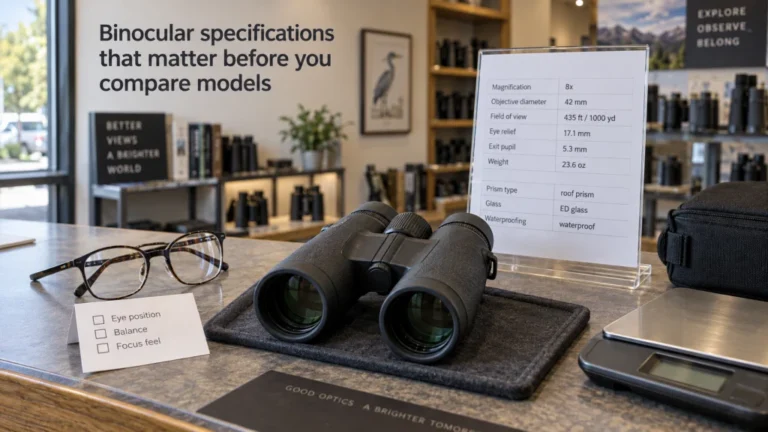
A field-of-view number is useful only when you know what it describes. These five calculators help you translate published binocular specifications into comparable measurements, without guessing at optical quality or searching a product database.
Clear inputs and outputs
Formulas explained
Illustrative results from angular geometry; published specifications are often rounded.
Find your starting point
Choose the calculation you actually need.
Some tools convert the numbers printed on a binocular’s specification sheet. Others use magnification, lens diameter, or a viewing distance to answer a different question.
Angle, width, and the visible scene
Field of view
3 calculators
Binocular FOV Converter
Degrees, ft at 1,000 yd, or m at 1,000 m.
The same real field of view in all three standard specification formats.
Convert field of view
Binocular Field Width Calculator
Real field of view and your target distance.
An estimated scene width at the distance you choose.
Calculate field width
Binocular Apparent FOV Calculator
Magnification and real angular field of view.
An apparent field angle using the stated calculation method.
Calculate apparent FOV
Magnification and objective diameter
Configuration & light-related indexes
2 calculators
Binocular Exit Pupil Calculator
Magnification and objective diameter in millimeters.
The exit pupil diameter, in millimeters.
Calculate exit pupil
Binocular Relative Brightness Calculator
Magnification and objective diameter for two setups.
Two traditional relative brightness indexes and their ratio.
Compare the indexes
Before you calculate
Start with the exact spec on the label.
The most common mistake is asking the right question with the wrong input. Check whether a field-of-view figure is an angle in degrees or a width quoted at a specific reference distance.
- For a field-of-view calculation: find the real FOV, such as 7.5° or 393 ft at 1,000 yd.
- For exit pupil or a brightness index: use magnification and objective diameter, such as 8×42.
- For width at a location: add the actual distance from the binoculars to the scene.
Need the meaning before the math?
Understand binocular specifications first.
Our main specifications guide explains the printed numbers, viewing trade-offs, and the questions a calculator alone cannot answer.