Binocular accessories are useful only when they solve a real problem with carrying, protection, replacement, support, or phone alignment. The best choice may be a harness, case, replacement cap, eyecup, tripod adapter, phone adapter, or no additional purchase at all. Compatibility matters more than feature count because attachment points, eyepiece dimensions, body clearance, and supplied accessories vary by model. Start with the constraint you can name, then verify the fit before paying for a more elaborate solution.
Route the accessory by the problem it solves
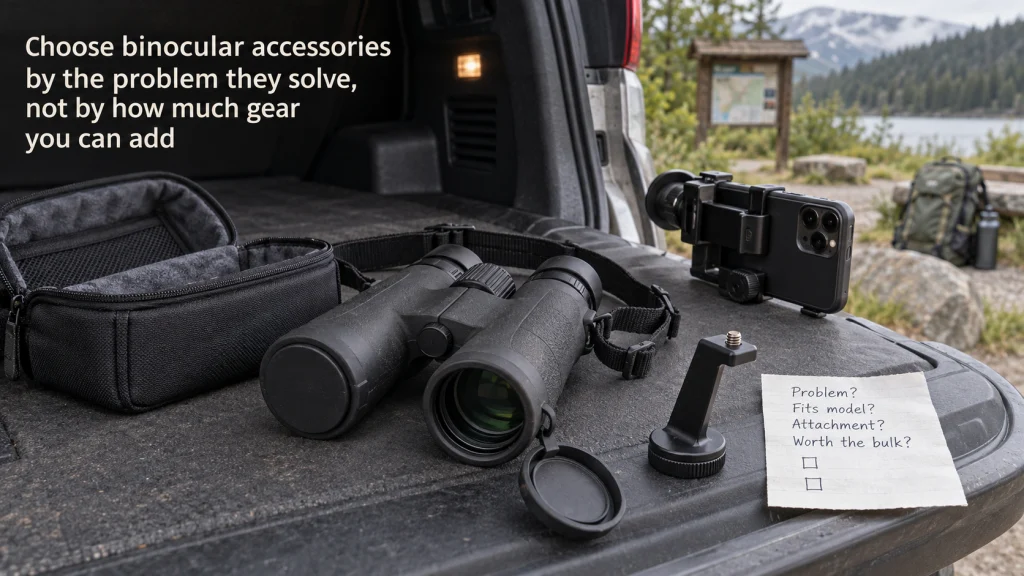
The best binocular accessories are the ones that remove a specific obstacle between the binocular and the way you actually use it. Start with the binocular in front of you and sort the problem into four jobs: carry, protection, support, or phone capture. If the stock strap is comfortable, the included caps stay attached, and handheld viewing is already steady enough, there may be nothing to fix. That is a better starting point than treating every accessory category as an automatic upgrade.
This problem-first approach also prevents one accessory from being asked to solve the wrong job. A padded case can protect the binocular in storage, but it does not redistribute weight while you are walking. A tripod adapter can stabilize a compatible binocular, but it does not make a bulky setup easier to carry. Once the job is clear, the accessory family becomes much easier to judge on fit, access, and actual usefulness.
| Constraint | Accessory family to check | What to verify first |
|---|---|---|
| Neck load, bouncing, or slow access | Binocular harness options | Attachment points, strap routing, body fit, and how quickly the binocular can be raised |
| Storage or transport protection | Binocular case selection | Internal dimensions, closure, padding, and whether attached accessories still fit |
| Lost or damaged objective or eyepiece protection | Replacement binocular lens caps | Exact barrel or eyepiece fit, attachment style, and interference with normal use |
| Damaged, missing, or unsuitable eye interface | Replacement binocular eyecups | Exact model compatibility, installed height, and eyeglass use |
| Handheld shake or long stationary viewing | Binocular tripod adapter choices | Binocular mounting interface, bridge clearance, and support connection |
| Phone camera cannot stay centered over the eyepiece | Binocular phone adapter fit | Eyepiece diameter, phone clamp range, camera position, and case clearance |
The table is a routing tool, not a shopping list. One owner may need only a replacement cap, while another may need a carry solution and nothing else. The useful comparison is between the problem you have now and the change the accessory can make, not between how many features two accessories advertise. If you cannot describe that change in one sentence, the purchase deserves another look.
Carry load and access
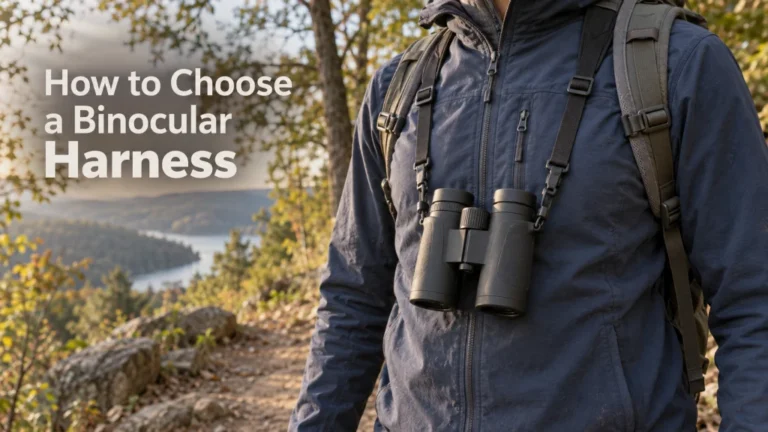
A carry accessory earns its place when the supplied strap creates a real comfort, bounce, or access problem. A harness can spread load differently and keep the binocular closer to the body, but it also adds straps, adjustment points, and another layer to put on. Before changing the carry system, check how the binocular attaches and whether you need fast one-handed access or simply better weight distribution. The detailed binocular harness guide is the next step when carrying is the actual constraint.
Protection and replacement
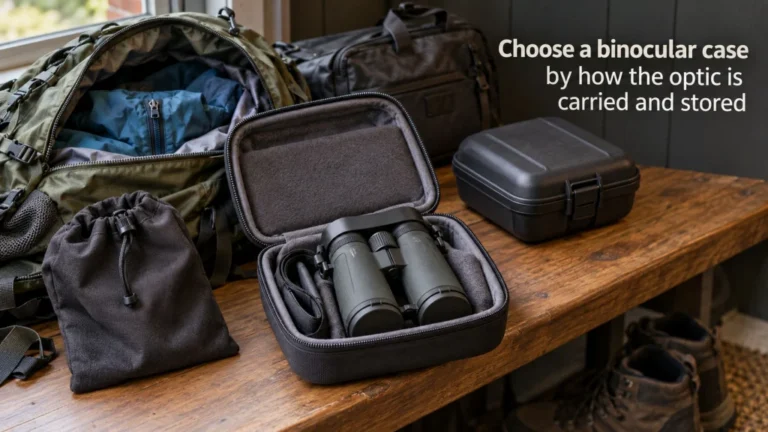
Protection problems are not all the same, so a case, cap, and eyecup should not be treated as interchangeable add-ons. A case protects the whole binocular during storage or transport, while lens caps protect exposed optical surfaces and eyecups affect the physical interface at the eyes. Use the binocular case guide for storage fit, the binocular lens caps guide for lost or damaged covers, and the binocular eyecups guide when the eye interface itself needs attention. Replacement parts should be checked against the exact model because small dimensional differences can determine whether a part seats correctly.
Stability and support
Support becomes relevant when handheld movement is interfering with the viewing job or when the binocular will stay aimed for longer periods. The first question is not which adapter looks strongest, but whether the binocular has a supported mounting interface and enough physical clearance for the adapter body. The support side also has to match the tripod head or quick release system you intend to use. When stability is the real problem, the binocular tripod adapter guide explains the compatibility checks that matter before buying.
Phone capture and alignment
Phone capture adds a second fit problem because the adapter must work with both the eyepiece and the phone. Eyepiece diameter, phone width, camera position, case thickness, and the adapter adjustment range can all matter even when the package uses broad compatibility language. A secure clamp is not enough if the phone camera cannot be centered over the optical exit path. The binocular phone adapter guide is the right route when repeatable camera alignment is the problem you are trying to solve.

The GlassPak carries full-size binoculars close to the body and uses tethers to help prevent accidental drops. Mesh side pockets and a rear zippered pocket provide separate storage for small items. Vortex lists specific compatible binocular families, so confirm the exact model before using the harness as the carry solution.
Check on AmazonIf you click this link and buy, we earn a commission at no additional cost to you.
Check whether the binocular already includes an adequate solution
Before buying anything, lay out what came with the binocular and judge each included item against the problem you are trying to solve. Many binocular packages already include some combination of a neck strap, objective covers, an eyepiece cover, a storage case, or a cleaning cloth. Included does not automatically mean ideal, but it does mean the replacement should beat a known baseline rather than an imagined absence. If the stock part works without creating friction, keeping it is a valid decision.
This check is especially important with protection and carry gear because duplicate accessories can add bulk without improving use. A larger case may provide more room yet become inconvenient enough that the binocular is left unprotected between outings. A more complex strap system may distribute weight differently but slow access for someone who mainly uses the binocular for short sessions. The useful question is whether the current solution fails in a repeatable way, not whether an aftermarket category exists.
Inspect the supplied accessory for the exact function you need: attachment security, closure, padding, retention, reach, or fit around the binocular body. Then make one controlled comparison against the limitation you have identified. That keeps accessory spending tied to a measurable ownership problem instead of turning the binocular into a platform for accumulating gear. It also makes later compatibility checks much easier because you know exactly what must improve.

This hard EVA case has a water-resistant exterior, carry handle, and shoulder strap for binocular transport. Amazon lists it for most compact and mid-size binoculars, but that broad fit claim should not replace a measurement check. Compare the binocular as stored, including attached caps or straps, with the case space before replacing an included case.
Check on AmazonIf you click this link and buy, we earn a commission at no additional cost to you.
Compatibility comes before premium materials or feature count
An accessory can be beautifully made and still be wrong for the binocular. Compatibility is a chain that starts at the binocular, passes through the accessory interface, and sometimes continues to another device such as a tripod head or phone. A failure at any point makes material quality largely irrelevant. This is why dimensions, attachment method, and model-specific documentation should be checked before weight, finish, padding thickness, or extra adjustment features.
Broad words such as universal, standard, and fits most can be useful clues, but they are not substitutes for a fit check. A standard thread can still sit behind a bridge that leaves too little clearance for a particular adapter body. A phone clamp can accept the phone width while failing to align the active camera with the eyepiece. Treat published dimensions and exact model compatibility as evidence, then use feature count only after the connection itself is credible.
Physical fit
Physical fit means checking the space the accessory actually occupies, not just the nominal size printed in a listing. Cases need usable internal dimensions, lens caps need the correct seating diameter or retention design, and phone adapters need enough clamp range around the eyepiece and the phone. Bulky cases, thick armor, unusual bridge shapes, or a large phone case can change whether a nominally compatible accessory works in practice. Measure the relevant contact point and compare it with the published range before treating the accessory as a match.
Attachment interface
The interface is the point where compatibility becomes mechanical rather than descriptive. A strap may use loops, clips, or rings, while a tripod adapter may depend on a threaded receiver, a model-specific stud, or a clamping geometry with enough clearance. Phone adapters usually add another interface around the eyepiece plus an adjustable phone platform. Verify every connection in the chain so that one compatible end does not hide a mismatch at the other.
Documented protection or load claim
Protection and support claims need the same discipline as fit claims. A case should be judged by its construction, closure, padding, and stated compatibility, not by a vague impression that a thicker looking shell must be safer. A mounting accessory should be checked for the connection it is designed to support rather than assumed suitable because it is metal. If a manufacturer does not document the relevant fit or interface, narrow the claim and do not treat appearance as proof.
- Confirm the exact binocular model or measure the required contact point.
- Check the accessory attachment method and any required thread, loop, stud, clamp, or clearance.
- For cases, compare usable internal space with the binocular as you actually store it.
- For phone adapters, check both eyepiece fit and phone camera alignment range.
- For support adapters, verify the binocular connection and the tripod or head connection separately.
- Prefer documented compatibility over a generic universal claim when the two conflict.
This checklist is intentionally simple because a compatibility failure usually appears before premium features matter. Once the accessory is known to fit, then comfort, speed, construction, adjustment range, weight, and price become useful comparison points. Reversing that order is how buyers end up with a more expensive accessory that never becomes part of the actual setup. Fit first gives every later comparison a stable foundation.

This adapter is designed to hold a smartphone over an optical eyepiece for image and video capture. Amazon lists it for telescopes, binoculars, and spotting scopes. Check eyepiece fit, phone position, and camera alignment before treating it as compatible with a specific setup.
Check on AmazonIf you click this link and buy, we earn a commission at no additional cost to you.
Keep cleaning, setup and owner technique separate from accessory selection
Some frustrations that look like accessory problems are really setup or maintenance problems. Poor eye placement will not be fixed by buying a case, and an incorrectly set diopter will not improve because the carry system changed. Dirt on an optical surface should be handled with the cleaning method allowed by the binocular manufacturer, not used as a reason to buy unrelated add-ons. Keeping these decisions separate prevents a shopping solution from replacing a use or care solution.
The same boundary matters when an accessory touches a serviceable part such as an eyecup or removable cover. A documented owner-replaceable part can be a reasonable purchase, but internal looseness, severe double image, water ingress, or damaged optical components belongs outside normal accessory selection. Do not use an accessory as a workaround for internal damage. When the problem is setup, cleaning, or owner-level use, follow the appropriate use guidance and the exact model manual instead.
This distinction also protects the role of simple technique. A steadier stance, correct interpupillary distance, properly adjusted eyecups, and a deliberate focus sequence may solve a viewing problem without adding anything to the binocular. Accessories should enter the decision only after the underlying setup is sound. That keeps the purchase tied to a remaining constraint rather than masking an adjustment that still needs to be corrected.

The retractable brush removes loose dust from optical surfaces before closer cleaning. Its cleaning tip is designed for smudges without requiring liquid. Celestron lists the LensPen for binoculars as well as other optical lenses, making it a focused maintenance tool rather than a workaround for setup or internal damage.
Check on AmazonIf you click this link and buy, we earn a commission at no additional cost to you.
Keep activity-specific binocular recommendations separate from accessory selection
An accessory decision starts with the binocular you have and the constraint around using it, while an activity decision starts with what you need to observe. Those are different questions even when they meet in the same outing. A harness can change carry behavior, but it cannot turn an unsuitable optical configuration into the right binocular for a different viewing distance, light level, or target movement. Keeping those questions separate makes both decisions more precise.
For example, a support adapter may help when magnification and viewing duration make handheld movement distracting, but it does not answer whether that magnification was a sensible choice for the activity in the first place. A compact case can improve transport, but it does not prove the binocular itself has the field of view or eye relief you need. Solve the optical and use case decision on its own terms, then choose an accessory only for the remaining carry, protection, support, replacement, or phone capture problem. This prevents accessories from becoming compensation for a binocular that is poorly matched to the job.
The separation also helps control cost because you can tell whether you need different gear or simply a better way to use the gear already chosen. If the binocular itself is correct and the only friction is carrying it for a long period, then a carry solution is a focused purchase. If the binocular is fundamentally wrong for the viewing task, accessory spending may only delay the real decision. That boundary is more useful than a generic list of accessories attached to every activity label.

This pan-tilt tripod is made for spotting scopes, binoculars, and cameras and provides a stable viewing platform. The design is described as lightweight and portable for everyday outdoor use. Pair it only with a binocular and adapter interface that are documented to work together.
Check on AmazonIf you click this link and buy, we earn a commission at no additional cost to you.
Reject an accessory that does not remove a defined binocular constraint
The easiest way to avoid unnecessary gear is to require a before-and-after statement. Before buying, describe the current problem in plain language, then state what the accessory should change. If the statement is vague, such as making the setup more professional or more complete, the benefit has not been defined well enough. A useful accessory should change access, protection, replacement fit, stability, or phone alignment in a way you can recognize.
This test also makes trade-offs visible before checkout. A more protective case may take more space, a harness may require more adjustment, a tripod setup adds bulk, and a phone adapter adds setup steps around the eyepiece. Those costs can be completely reasonable when they solve a real problem, but they are still costs. The right decision is not the accessory with the most features, but the smallest compatible solution that removes the limitation you actually have.
Use a short ownership test before adding another item to the setup. Ask whether the problem happens often enough to matter, whether the included solution already works, whether the accessory is documented to fit, and whether the new complexity is acceptable. If the answers are weak, skip the purchase for now and keep using the binocular. The option to buy later is usually better than carrying an accessory that never earns a place in the routine.

This two-pack uses soft neoprene straps with snap fasteners and is listed for binoculars as well as cameras. The design provides a simple replacement path when a supplied neck strap is the specific carry problem. Confirm that the binocular attachment points accept this connector style before changing the stock strap.
Check on AmazonIf you click this link and buy, we earn a commission at no additional cost to you.
Final Thoughts: solve the clearest constraint with the smallest compatible accessory
A good accessory decision begins with one specific friction point, not a checklist of gear that every binocular supposedly needs. Identify whether the issue is carry, protection, replacement, support, or phone capture, then check whether the supplied solution is already adequate. If a purchase is still justified, verify physical fit and the complete attachment chain before comparing materials or extra features. That order keeps the decision practical and reduces the chance of paying for compatibility problems.
The simplest answer is often the strongest one. A replacement part may be enough, the stock strap may already work, or a support adapter may solve the only limitation that remains. Choose the smallest change that addresses the problem without creating more bulk or setup than you want to manage. If no clear constraint remains after that check, the binocular does not need another accessory just because one is available.

This adapter connects compatible binoculars to a tripod through a standard 1/4-20 thread. Its metal construction supports a stable hands-free setup for longer viewing sessions. Verify that the binocular has the required tripod interface and enough bridge clearance before attaching it.
Check on AmazonIf you click this link and buy, we earn a commission at no additional cost to you.
Frequently asked questions
🎒 Do I need a binocular harness if I already have a neck strap?
Not automatically. Keep the neck strap if it is comfortable and gives you the access you need, and consider a harness only when load, bounce, or carry comfort is a recurring problem.
🧳 How do I know whether a binocular case will fit?
Compare the binocular’s stored dimensions with the case’s usable internal space, including any attached caps or straps you plan to leave on. Do not rely on a generic size label when exact dimensions are available.
👁️ Can I replace binocular eyecups with a universal pair?
Only when the replacement is explicitly compatible with the model and attachment design. Eyecup height, thread or retaining method, and eyeglass use can all affect whether a replacement works correctly.
📷 Will any phone adapter work with any binocular?
No. Check the eyepiece diameter, phone clamp range, active camera position, and whether a thick phone case changes the fit or alignment.
🔩 How can I tell whether my binocular accepts a tripod adapter?
Check the exact model documentation for a tripod mounting interface and the type of adapter it supports. Also verify that the adapter body has enough clearance around the binocular bridge and that its other end matches your support system.
🛡️ Are more protective accessories always better?
No. More protection can add bulk, slower access, and more items to manage, so choose the level that matches the way the binocular is stored and carried.
References and Sources
- Nikon binocular accessories: Shows that harnesses, straps, tripod adapters, cases, and maintenance items are distinct accessory categories rather than one universal upgrade path.
- ZEISS binocular manual: Documents included caps, carrying strap, carrying case, and model supported tripod attachment information.
- Nikon tripod adapter compatibility: Demonstrates that a tripod adapter can be made for specific binocular series even when the tripod side uses a standard thread.
- Celestron smartphone adapter compatibility: Shows why eyepiece dimensions and exact compatibility checks matter for phone capture accessories.
- ZEISS replacement eyecup compatibility: Shows that replacement eyecups can be limited to named binocular models rather than treated as universal parts.