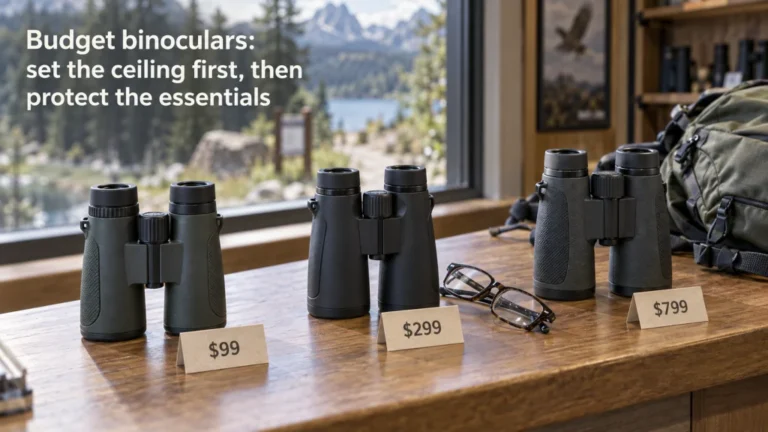
A useful binocular buying guide should reduce a purchase to a sequence of decisions, not bury the buyer under specifications. Start with the viewing job, reject anything that fails physical fit or basic configuration needs, compare only the specifications that affect that job, then add budget, seller, condition, return, and warranty risk. The result should be a short list with clear pass, reject, and unknown statuses rather than a pile of attractive options. If a candidate cannot clear one important requirement, a stronger headline specification somewhere else does not rescue it.
Knowing the specifications is not the same as having a buying process
A binocular buying guide becomes useful when three plausible choices are sitting in front of you and all three look reasonable on paper. One may offer more magnification, another may be lighter, and a third may have a broader warranty or easier return path. Comparing every specification at once makes that decision harder because the buyer has not yet decided which differences can actually disqualify a candidate. I would start by defining the viewing job and the rejection gates before looking for small advantages.
That order matters because binocular specifications interact with one another. Higher magnification can make fine detail look larger, but it commonly brings a narrower field of view and makes hand movement more visible, while a larger objective can improve light gathering at the cost of more size and weight. Eye relief can be decisive for someone who wears glasses even when two models share the same basic 8×42 or 10×42 format. The right question is therefore not which binocular has the most impressive list of features, but which candidate clears the requirements of the actual viewing situation.

This is the 8x42 Diamondback HD configuration. Vortex lists HD optics plus waterproof, fogproof, shockproof, and tripod-adaptable construction for this variant. The package includes a GlassPak harness for carrying and securing the binocular.
Check on AmazonIf you click this link and buy, we earn a commission at no additional cost to you.
Define the buying problem before comparing models
Begin with what you expect to observe, how far away it usually is, how much it moves, and what the light is normally like. Then add how long you tend to hold binoculars, whether you wear glasses, how much weight you will carry, and whether compact storage matters. These constraints should exist before price comparisons because they determine which configurations are worth pricing in the first place. A buyer who skips this step can spend more money and still end up with a pair that is tiring, awkward, or poorly matched to the job.
Write the constraints down as simple requirements instead of turning them into a wish list. A requirement might be a full usable view with your glasses on, a field wide enough to acquire moving subjects quickly, or a weight you are willing to carry for the whole outing. Another might be close focus that suits nearby viewing rather than distant observation. Once these conditions are visible, the shortlist starts shrinking for reasons that can be explained and checked.
Write down distance, light, movement, duration, and carry constraints
Distance determines how much reach is useful, but it does not decide magnification by itself. Movement makes field of view and steadiness more important, while low light increases the value of an appropriate objective and exit pupil without making a larger binocular automatically better. Long viewing sessions raise the importance of weight, balance, eyecup comfort, and focus access. Carrying a binocular for miles also changes the acceptable size even if a heavier option looks better on a specification sheet.
Let the dominant viewing job control the next handoff
If one use clearly dominates, let that use control the next comparison instead of forcing one pair to be equally optimized for everything. A person following moving wildlife in mixed cover may care more about field width and quick acquisition than someone studying distant stationary scenery. If the activity itself is still unclear, compare the viewing conditions first and then use the site’s guidance on binoculars by viewing use to narrow that part of the decision. The point is to resolve the use case before debating small specification differences.

This compact 8.5x21 Papilio II is built for both close and distant viewing. Pentax states that its close-focus system can observe subjects from about 50 cm. That near-focus ability is relevant when the viewing job includes insects, museum details, or other nearby subjects.
Check on AmazonIf you click this link and buy, we earn a commission at no additional cost to you.
Build product and fit rejection gates
A rejection gate is a requirement a candidate must pass before deeper comparison. Architecture, magnification and objective pairing, eye relief, field of view, close focus, physical fit, and environmental protection can all become gates when the viewing job makes them important. This stops one attractive feature from hiding a basic mismatch. It also keeps missing information visible instead of treating an unverified claim as a pass.
Use the exact model page for any specification that can vary by version or size. Two 10×42 binoculars can still differ meaningfully in field of view, eye relief, weight, focus behavior, and close focus. If a required specification is missing, mark it unknown and verify the exact variant. A familiar brand name or polished product photo is not evidence.
Choose the product architecture before comparing models
Decide whether the physical design suits the way the binocular will be carried and used before comparing small optical differences. Roof prism, Porro prism, compact, stabilized, digital, zoom, and other designs solve different problems and create different tradeoffs. The types of binoculars guide separates those architectures before you build a same-type shortlist. Once the architecture is settled, model comparison becomes cleaner.
Treat magnification and objective size as a configuration pair
Do not shop magnification and objective diameter as independent upgrades. Moving from 8×42 to 10×42 changes magnification while keeping the objective diameter the same, so steadiness, field width, and exit pupil also change. A larger objective can improve light gathering at the same magnification, but it usually adds bulk and weight. Choose the configuration that serves distance, light, movement, and carrying constraints together.
Use field of view, eye relief, and close focus only when the job makes them important
Field of view matters more when subjects move or must be found quickly. Eye relief becomes a fit issue when glasses hold your eyes farther from the eyepieces, so pair the published number with a real fit check when possible. Close focus matters for nearby subjects but may be irrelevant for distant scenery. Use the binocular specifications guide for deeper specification detail instead of turning this buying process into an optics textbook.
Make physical fit a rejection gate rather than a post-purchase surprise
A binocular can meet every numerical requirement and still fit badly. Check hinge range, eyecup position, focus-wheel reach, and whether the body feels controllable in your hands. With glasses, verify the full usable view rather than assuming a published eye relief figure guarantees fit for every face and frame. If you cannot test in person, a workable return path becomes more important.
Separate optical quality from headline specification labels
Numbers such as 8×42, field of view, and eye relief describe important parts of the system, but they do not prove overall image quality. Coatings, glass choice, baffling, prism execution, alignment, and quality control can matter even when two specification sheets look similar. Marketing labels can also be used differently across brands. Treat the specification sheet as a filter, then use model-specific evidence for claims the sheet cannot establish.
Verify waterproofing and environmental claims on the exact product
Terms such as weather resistant, waterproof, and fogproof are not interchangeable promises. Some manufacturers publish specific sealing claims, while others use broader language, so verify the exact model before marking environmental protection as a pass. Internal fog prevention and resistance to external rain are also different issues. If wet weather matters, an unclear claim belongs in the unknown column.

This Nature DX pairs 8x magnification with 42 mm objective lenses and a 7.4-degree field of view. The listing specifies phase-coated BaK-4 prisms and fully multi-coated optics. Its waterproof construction and rubber armor suit the fit and environmental checks in this section.
Check on AmazonIf you click this link and buy, we earn a commission at no additional cost to you.
Add price and transaction constraints after the product gates
Price should enter after the required configuration and fit conditions are clear. Otherwise, the budget can be spent optimizing a feature that does not solve the viewing problem. A ceiling is useful because it stops endless comparison, but it should be tied to defined requirements. The goal is the least expensive path that clears the important gates with acceptable uncertainty.
The transaction deserves its own audit. Seller identity, exact condition, included accessories, return terms, warranty eligibility, and listing accuracy can matter as much as a small optical advantage. A stronger specification sheet can still become the weaker purchase if condition or return terms are unclear. Keep product quality and transaction quality separate so one does not hide problems in the other.
Set the budget ceiling after the required configuration is known
Once the job and rejection gates are clear, decide how much you are willing to spend to satisfy them. If several candidates already pass, paying more should buy a benefit you can name. If every affordable option fails a non-negotiable requirement, waiting and saving can be better than buying a known compromise. Use the budget binoculars guide to separate necessary features from optional upgrades.
Give first-time buyers a simpler mistake-avoidance path
A first purchase has an extra problem: the buyer may not yet know which tradeoffs will matter most. That makes simple controls, predictable fit, manageable weight, and an easy return path more valuable than chasing every premium feature. A first pair should reveal preferences without being chosen only from internet consensus. The first binoculars guide handles that narrower decision without pretending one configuration fits every beginner.
Choose a purchase channel that preserves the evidence and return path you still need
The best place to buy depends on what remains uncertain. If physical fit is unresolved, an in-person trial or strong return process can matter more than a small price difference. If the exact variant, included accessories, or seller status is unclear, resolve those facts before payment. The where to buy binoculars guide focuses on price, verification, seller confidence, and return flexibility.
Treat used binoculars as a separate condition and seller-risk decision
Used binoculars can lower the entry price, but they add condition questions. Focus movement, hinge tension, eyecup operation, alignment symptoms, internal haze, included parts, seller disclosure, and return rights can all matter. A low price is not a pass if an important condition issue cannot be verified. Use the used binoculars guide when condition uncertainty becomes central to the decision.
Replace an existing pair only for a documented limitation
Existing owners should begin with the problem their present binoculars fail to solve. That might be inadequate eye relief, too much weight, insufficient field width, poor close focus, or a missing environmental feature. If the old pair already clears the viewing job, a replacement may add cost without changing the result that matters. Use the upgrade binoculars guide when the real question is whether replacement is justified.
Verify warranty coverage, owner eligibility, and exclusions
A broad warranty headline does not establish what happens if a particular binocular needs service. Check who is covered, whether proof of purchase is required, whether coverage follows a second owner, what damage is excluded, and what the service process requires. Terms can differ by brand, product line, market, and purchase channel. Use the binocular warranty guide when warranty risk can change the seller or condition you choose.

The Triumph HD uses a 10x42 configuration with Vortex HD optics. The listing identifies it as tripod adaptable, waterproof, fogproof, and shockproof. An included GlassPak harness adds a practical package item to verify when comparing transaction details.
Check on AmazonIf you click this link and buy, we earn a commission at no additional cost to you.
Build the final comparison sheet
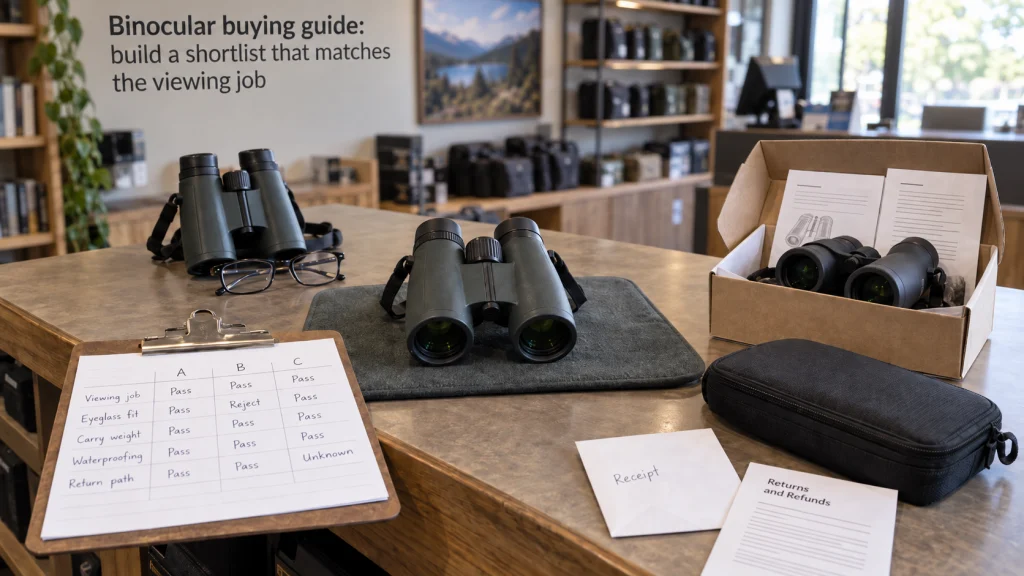
Once the candidates have passed the early gates, reduce the remaining comparison to a compact sheet. Put each requirement in a row and give every candidate a pass, reject, or unknown status supported by a specific fact. Add only the specifications that matter to the defined viewing job, such as field of view, eye relief, close focus, weight, waterproofing, or tripod compatibility. This format keeps an attractive but irrelevant specification from dominating the decision.
The sheet should also separate product facts from transaction facts. A candidate might pass on configuration and fit but remain unknown on return terms or warranty eligibility, while another might have a safer transaction but fail a physical requirement. That distinction helps you decide what to verify next instead of repeatedly rereading the same product pages. It also gives the shortlist a finish line because every unresolved item has a visible reason to exist.
| Decision item | Candidate A | Candidate B | What the status means |
|---|---|---|---|
| Viewing-job configuration | Pass | Pass | Both match the required distance, light, and movement conditions. |
| Eyeglass fit | Pass | Reject | Candidate B does not provide a full usable view for the buyer. |
| Carry weight | Pass | Pass | Both remain acceptable for the expected carrying duration. |
| Waterproofing claim | Pass | Unknown | The exact claim for Candidate B has not been verified. |
| Return path | Pass | Pass | Both offer a workable way to resolve remaining fit uncertainty. |
In this example, Candidate B could have higher magnification, a larger objective, or a lower price and still be rejected because it fails the buyer’s eyeglass fit gate. That is the point of the sheet: a non-negotiable failure has more decision weight than a headline advantage that does not solve the viewing job. The table is not a scoring contest where enough minor positives can cancel a major negative. It is an audit of whether each option remains eligible.
Use pass, reject, and unknown columns
Pass means the requirement has been verified and is acceptable for the buyer’s conditions. Reject means the candidate fails a requirement that the buyer already decided is non-negotiable. Unknown means there is not enough evidence yet, which is different from a failure and different from a pass. Keeping those three states separate prevents optimism from filling gaps in a listing or specification page.
Reject a candidate when one non-negotiable fails
A shortlist works only if the rejection gates are real. If a binocular cannot provide the usable view needed with glasses, exceeds the carrying limit, or lacks a required environmental claim, a better number elsewhere does not fix that mismatch. This is where many comparisons go wrong because the buyer mentally averages strengths and weaknesses. A true gate is binary: clear it or leave the shortlist.
Keep unknown facts unknown until they are verified
Do not infer a missing specification from a nearby model, a similar-looking body, or a retailer’s category label. Check the exact manufacturer page, manual, authorized seller listing, or another source that clearly identifies the same variant. If the fact still cannot be confirmed, leave it unknown and decide whether that uncertainty matters enough to stop the purchase. An honest unknown is more useful than a confident guess because it tells you exactly what still needs work.

This BX-2 Alpine HD is the 8x42mm model 181176. The listing identifies fully multi-coated optics along with fog-proof and lightweight construction. It provides distinct optical and physical facts that can be recorded separately on the comparison sheet.
Check on AmazonIf you click this link and buy, we earn a commission at no additional cost to you.
Use one final buying sequence from viewing job to shortlist
Define the viewing job, test physical fit, choose the architecture, compare the specifications that matter, set the budget, audit the seller and condition, verify warranty details, then build the shortlist. Each step should remove choices or expose a fact that still needs verification. If a step only adds models, the process has drifted back into browsing. The sequence should tell you what to ignore as clearly as what to compare.
Use specialist pages when one part of the sequence becomes the real decision. Specifications, architecture, activity, budget, first-pair uncertainty, seller choice, used condition, upgrade justification, and warranty each have their own deeper path. The map below keeps those handoffs separate instead of repeating them here. After resolving one, return to the shortlist and update the affected status.
Run the pre-purchase decision tree before payment
Use this tree only after the viewing job is defined. Each branch either keeps the candidate alive, sends you to one unresolved check, or removes it from the shortlist. Do not compensate for a failed gate with a better specification elsewhere. A candidate reaches payment only when every non-negotiable is a pass and every important unknown has been resolved.
| Decision point | If yes | If no |
|---|---|---|
| Does the configuration match the viewing job? | Check physical fit. | Reject the candidate. |
| Does the binocular clear every non-negotiable fit gate? | Check the required specifications. | Reject the candidate. |
| Are the important specifications verified on the exact model? | Check price and transaction risk. | Keep the fact unknown and verify it. |
| Are seller, condition, return, and warranty terms acceptable? | Keep the candidate on the final shortlist. | Resolve the uncertainty or reject it. |
| Does the candidate still clear the budget ceiling? | It is eligible for purchase. | Wait, save, or choose another passing candidate. |
The tree is deliberately unforgiving about non-negotiables. A lower price cannot repair poor fit, and a stronger feature list cannot repair an unacceptable seller or condition risk. Unknowns are not automatic failures, but they must stay visible until verified. If no candidate survives, no purchase is a valid end point.
| Question that is blocking the purchase | Use this next |
|---|---|
| I do not understand what the specification numbers prove. | Understand binocular specifications |
| I do not know which physical or electronic design fits the job. | Compare types of binoculars |
| My viewing activity should control the configuration. | Choose binoculars by viewing use |
| I need to set a realistic spending ceiling. | Work through a binocular budget |
| This is my first serious pair and I want to avoid basic mistakes. | Choose first binoculars |
| I need to decide where the safest purchase path is. | Compare places to buy binoculars |
| I am considering a used pair. | Evaluate used binoculars |
| I already own binoculars and may not need to replace them. | Decide whether to upgrade binoculars |
| Warranty terms could change the seller or condition I choose. | Check binocular warranty terms |
If every affordable option fails a required gate, wait rather than buy a known mismatch. If two candidates both pass, choose between them using the difference that matters most to the viewing job instead of inventing a universal winner. If one important fact remains unknown, resolve that fact before adding another model to the comparison.

This TrailSeeker is the 8x42 BaK-4 prism variant. Celestron lists phase and dielectric prism coatings, fully broadband multi-coated optics, a lightweight magnesium body, and twist-up eyecups. Its 6.5-foot close focus adds a concrete specification to verify during the final buying sequence.
Check on AmazonIf you click this link and buy, we earn a commission at no additional cost to you.
Final thoughts: let the audit decide which binocular stays on the shortlist
A disciplined buying process makes binocular shopping smaller. Start with the scene you need to view, turn its constraints into rejection gates, and compare only candidates that survive. Add price and transaction risk after the product already makes sense. This keeps marketing features and small specification advantages from taking control.
You should know why each candidate remains, what would disqualify it, which facts are unknown, and what must be verified before payment. If you cannot explain them, keep auditing rather than browsing. A good purchase is the one that clears the right requirements with the least important uncertainty left unresolved.

This Nature DX ED uses an 8x42 configuration with extra-low-dispersion objective glass. The listing specifies a 7.5-degree field of view, twist-up eyecups, and tripod adaptability. Its waterproof, nitrogen-purged construction gives the final audit a concrete environmental claim to verify against the exact model.
Check on AmazonIf you click this link and buy, we earn a commission at no additional cost to you.
FAQs
Most buying questions get easier once the viewing job and rejection gates are written down. The same specification can matter greatly in one situation and little in another. Use these answers as decision shortcuts, not universal rules. Exact fit and model-specific claims still need verification.
A shortlist should also stay small. Adding options without resolving eye relief, field of view, weight, seller risk, or budget increases uncertainty. Work through the condition that changes the outcome first. Then return to the comparison sheet and update its status.
🔭 Is 8x or 10x better for general use?
Neither is universally better. 8x often gives a steadier view and wider field, while 10x gives more image scale, so distance, subject movement, hand stability, and the exact model’s field of view should control the choice.
👓 How should I choose binoculars if I wear glasses?
Treat usable eye relief and eyecup adjustment as fit requirements. Verify that you can see the full field with your glasses on rather than relying on one published number to guarantee fit for every frame and face.
🌲 Does a higher magnification always show more useful detail?
No. Higher magnification can enlarge detail, but it can also make hand movement more visible and reduce field width, so useful detail depends on steadiness, viewing distance, subject movement, and the exact optical design.
🎒 How much should binocular weight matter?
Weight matters in relation to viewing duration and carrying time. A heavier pair may be acceptable for short stationary viewing but become a rejection point if you will carry and hold it for long periods.
💵 Should I set my budget before choosing specifications?
Set a rough financial boundary, but define the required viewing job and configuration before optimizing within it. If the budget cannot buy a candidate that clears the important gates, waiting can be better than purchasing a known mismatch.
📦 Is buying online a problem if I cannot try the binocular first?
Not necessarily, but unresolved fit makes the return process more important. Confirm the exact model, seller, condition, included items, and return terms so you have a practical way to correct a fit mismatch.
References and sources
The technical claims here rely on sources covering magnification, objective size, field of view, eye relief, close focus, and environmental protection. They support the decision gates rather than a universal recommendation. Exact specifications can still differ by model. Verify the specific binocular before purchase.
Nikon supports the core specification relationships used in the guide. B&H adds practical selection context across the same factors. Crutchfield adds fit and weatherproofing context. None of these sources is used to declare one model best for everyone.
- Nikon choose by specifications: Supports magnification, objective diameter, field of view, eye relief, close focus, and waterproof construction.
- B&H binocular buying guide: Supports practical tradeoffs involving magnification, field of view, eye relief, close focus, and weather protection.
- Crutchfield binoculars buying guide: Supports fit, eye relief, weatherproofing, and the value of trying different binoculars when possible.