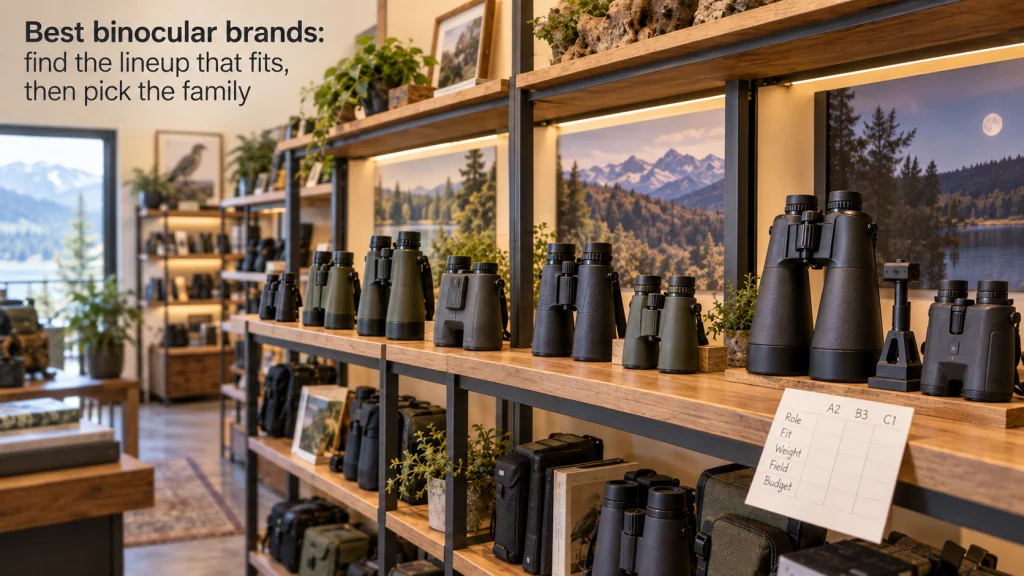
The best binocular brands are not useful as a single prestige ranking because the real purchase decision happens inside each brand’s active families. A strong shortlist starts with the viewing job, physical fit, carrying limits, and budget, then compares families that serve the same role. Broad brands can span entry, midrange, premium, compact, and specialist designs, while narrower brands may concentrate on one or two roles. The goal is to reduce the market to a few brands, then move into the family comparison that can actually finish the decision.
A trusted logo still leaves the harder choice
Searching for the best binocular brands sounds like a shortcut, but the logo is usually the easy part. A buyer may already trust Nikon, Vortex, ZEISS, Leica, or another established name and still face several families that differ in weight, field of view, eye relief, compactness, low-light emphasis, and price position. Those differences can matter more than the brand name once the binoculars are actually at your eyes. I would treat the brand as a filter, not as the verdict.
The useful question is not, “Which brand wins?” It is, “Which brand has a family that matches this viewing situation without paying for the wrong advantage?” A traveler who values small size is solving a different problem from someone who watches moving wildlife for long sessions or wants stabilization. Once that is clear, brand reputation becomes supporting evidence rather than the starting assumption. That keeps the shortlist practical and stops a familiar logo from hiding a poor fit.

This 8x42 Diamondback HD uses fully multi-coated optics and has 17 mm eye relief. Vortex lists a 393-foot field of view at 1,000 yards and tripod adaptability. Its waterproof, fogproof, shockproof body and included GlassPak make it a concrete family example for comparing optical and carry trade-offs.
Check on AmazonIf you click this link and buy, we earn a commission at no additional cost to you.
Brand comes after the viewing requirement, not before it
Start by describing the observation before opening a brand catalog. Distance, light, movement, viewing duration, eyeglasses, hand fit, weight tolerance, and how the binoculars will be carried all change what a useful family looks like. An 8x configuration with a wide field can be easier for moving subjects, while a compact body can make more sense when the binoculars spend most of the day in a small bag. A larger objective or higher magnification may help one constraint while making stability, bulk, or carry comfort worse.
This is also why the same brand can be a good fit for one buyer and an unnecessary detour for another. If physical fit or long eye relief is the main constraint, a famous flagship does not solve the problem unless the exact configuration supports that fit. If portability is the real issue, a smaller family may be the better stopping point even when a larger family sits higher in the catalog. The brand earns a place on the shortlist only after its families line up with the work the binoculars need to do.
- Define the target distance and whether the subject is moving or mostly stationary.
- Decide how much weight and bulk are acceptable for the full viewing session.
- Check eyeglass use, eye relief, grip, and focus access before treating optics as the only fit question.
- Separate a real need for stabilization, compactness, or large objectives from a general desire for more features.
That short list of constraints is more useful than starting with a logo. It also gives you a fair basis for comparing two brands later, because both candidates will be solving the same viewing problem.

This full-size 10x42 PROSTAFF P3 is waterproof, fogproof, and rubber armored. Nikon positions the configuration with a wide field of view and long eye relief for outdoor observation. Its 10x magnification gives the section a specific model for weighing reach against stability, fit, and carry requirements.
Check on AmazonIf you click this link and buy, we earn a commission at no additional cost to you.
Separate reputation from family depth and U.S. product status
A brand can have a long reputation and still have a lineup that changes around the exact family you are considering. Manufacturer catalogs may show active families, support pages may remain online for older products, and retailers can continue listing stock after a maker has moved on. That means a search result alone is not enough to call a family active. I would verify the maker’s current U.S. category page, then use support material only to confirm specifications or ownership details.
This matters most when a buyer sees an older family beside a replacement line and assumes both represent the same purchase path. They may not. A replacement can change field of view, weight, eyecup design, included accessories, or the range of available configurations even when the family names look related. Treat status as a separate fact from reputation, because the support path and upgrade path depend on what the manufacturer is actually carrying forward.
| Status | How to read it | What to verify next |
|---|---|---|
| Active | The family appears in the manufacturer’s current product or shop structure. | Compare the exact configuration, fit details, warranty, and availability. |
| Transition | Old and replacement families appear side by side, or current retail stock does not line up cleanly with the maker’s lineup. | Confirm which family the manufacturer is carrying forward before choosing an upgrade path. |
| Watch only | The name appears mainly in support, archived, discontinued, or inconsistent retail material. | Do not assume normal availability or a long future support path from the old page alone. |
The labels are not quality grades. They are buying-status labels that keep an old family name from being mistaken for a current recommendation.

This Nature DX uses an 8x42 configuration with phase-coated BaK-4 prisms and fully multi-coated optics. Celestron lists the model as waterproof and designed for birding and outdoor viewing. The exact active configuration makes it useful when separating current product status from the reputation of the broader brand.
Check on AmazonIf you click this link and buy, we earn a commission at no additional cost to you.
Value brands can contain premium branches, and premium brands can contain compact branches
Brand identity is often broader than the stereotype attached to it. Vortex, Nikon, Celestron, Bushnell, Athlon, and Leupold each cover more than one price or product role, so a single budget or premium label hides useful differences. The same is true at the upper end: Swarovski, ZEISS, and Leica divide their ranges into families with different portability, field of view, handling, and cost trade-offs.
A lower-priced family from a broad brand may be intentionally simple, while the same manufacturer also offers a much more ambitious optical or specialist branch. A premium maker can likewise offer a compact route that prioritizes carrying ease instead of maximum low-light performance. Compare the role and trade-offs of the family rather than assuming the badge tells you how every line is positioned.

This 10x42 Triumph HD uses Vortex HD optics and fully multi-coated lenses. The model is tripod adaptable and built with waterproof, fogproof, and shockproof construction. It provides an accessible Vortex family example for showing how one broad brand can span multiple price and performance positions.
Check on AmazonIf you click this link and buy, we earn a commission at no additional cost to you.
Build the shortlist by product role before comparing brands
A family map becomes useful when every line is assigned a job. Entry families should cover basic viewing needs without unnecessary complexity. Midrange families should show what improves in fit, optical design, construction, or configuration breadth, while premium families need to justify the extra cost with an advantage the buyer will use. Compact and image-stabilized families belong in separate roles because their trade-offs differ from a standard full-size roof-prism ladder.
This role-first view also prevents a common buying mistake: treating every higher-priced line as the next logical upgrade. A heavier premium family can be a worse choice for travel than a lighter midrange family, and image stabilization can solve hand shake without making every other specification better. If the problem is already solved at a lower tier, moving upward should require a specific reason. The role matrix below is a routing tool, not a scorecard.
| Role | What should change for the buyer | Brand examples to inspect |
|---|---|---|
| Entry and value | Simple access to common configurations with manageable cost and straightforward ownership. | Nikon, Bushnell, Celestron, Athlon, Leupold, Pentax |
| Midrange | Better fit choices, optical refinement, materials, or a broader configuration ladder without flagship pricing. | Vortex, Nikon, Athlon, Kowa, Maven, Hawke, GPO |
| Premium | A clear reason to pay more for optical, ergonomic, weight, field, or construction advantages that match the use case. | Swarovski, ZEISS, Leica, Vortex, Nikon, Maven |
| Compact | Lower carry burden with an accepted trade-off in objective size, handling, or low-light capability. | Leica, ZEISS, Swarovski, Nikon, Pentax, Maven |
| Image stabilized | Reduced visible shake where stabilization matters more than following a conventional roof-prism upgrade ladder. | Canon, Fujinon, Nikon |
| Specialist | Purpose-driven designs such as large objectives, Porro formats, marine-oriented construction, or other nonstandard roles. | Fujinon, Celestron, Pentax, Kowa |
Use the row that matches the real problem and ignore rows that do not. That immediately makes the next comparison smaller and more defensible.

This 7x50 Cometron uses a Porro-prism design and multi-coated optics for wide-field astronomy viewing. Celestron lists it as comfortable for handheld use and tripod adaptable. The large-objective specialist configuration shows why product role should be assigned before comparing unrelated binocular families.
Check on AmazonIf you click this link and buy, we earn a commission at no additional cost to you.
Compare brands only after matching equivalent product roles
A fair binocular brands comparison needs matched roles before it needs opinions. Put compact against compact, midrange full-size against midrange full-size, and stabilized against stabilized. If one family is built around low carry weight while another is built around maximum objective size, declaring one brand better from that comparison mostly proves that the products were mismatched. The closer the viewing job, configuration, and price position are, the more useful the differences become.
Once the roles match, compare the details that can change ownership: field of view, eye relief, weight, focus behavior, close focus, weather sealing, included accessories, warranty terms, and exact availability. Manufacturer claims can document specifications and product position, but they do not automatically prove that one view is subjectively better. Independent testing is useful when the exact family and method are clear, and physical fit still needs a real check when possible. This is where a brand comparison becomes a purchase comparison rather than a logo contest.
A midrange family should not be judged against a flagship
A flagship can win on expensive materials, optical correction, or finish and still tell you very little about whether another brand’s midrange family is the better match for a normal budget. The reverse is also true: a lower-cost line should not be praised as a brand winner simply because it delivers more features per dollar than a much higher tier. Match the role first, then ask what the extra cost changes in the viewing situation. If the answer is vague, the comparison is not ready to guide a purchase.
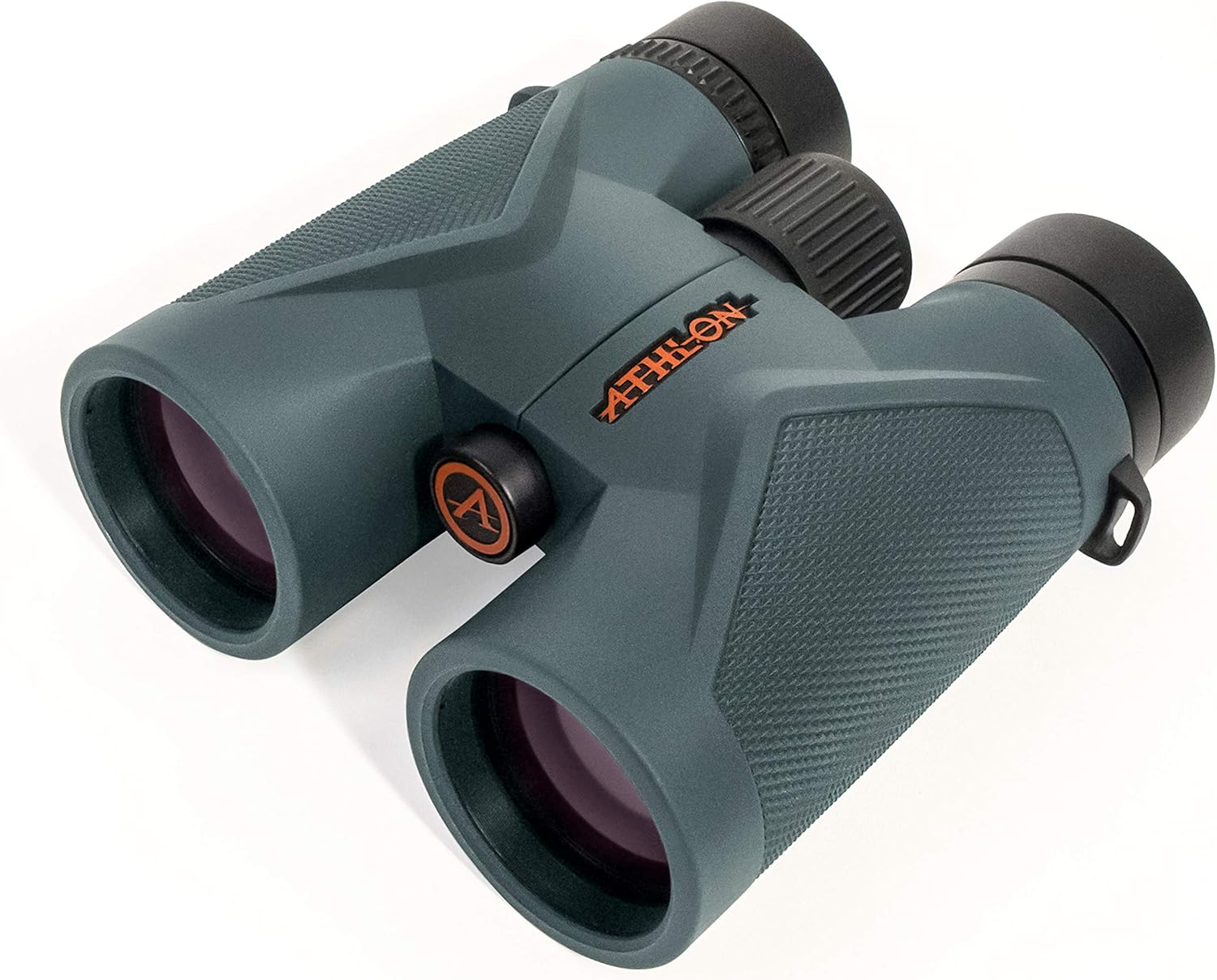
This 8x42 Midas UHD uses ED glass, dielectric prism coatings, and fully multi-coated optics. Athlon lists 17.2 mm eye relief and an 8.1-degree field of view for this roof-prism configuration. Those exact specifications make it useful for a matched midrange comparison rather than a brand-wide ranking.
Check on AmazonIf you click this link and buy, we earn a commission at no additional cost to you.
Broad U.S. lineups make the first cut easier
Several brands are useful early in the process because their active U.S. ranges cover multiple roles. Vortex spans mainstream roof-prism families through higher-end branches and specialist high-magnification options. Nikon stretches from accessible ACULON and PROSTAFF families into MONARCH lines, compact choices, and stabilized designs. Celestron covers common nature-viewing families while also maintaining strong large-objective and astronomy-oriented branches, so its family structure changes more sharply by use.
Bushnell combines accessible general-use families with R-series, water-oriented, and other purpose-specific branches. Athlon steps through Neos, Talos, Argos, Midas, and Cronus families, which creates a visible value-to-premium ladder without requiring a jump to a different brand. Leupold uses its BX structure to separate price and feature levels, with compact and specialized branches alongside standard full-size choices. The point is not that these brands are automatically better, but that a broad ladder gives a buyer more chances to solve the problem without changing ecosystems.
| Brand | Useful family structure to inspect | Why it belongs on an early shortlist |
|---|---|---|
| Vortex | Crossfire, Diamondback, Viper, Razor, plus specialist branches | Wide spread of price and performance roles inside one catalog. |
| Nikon | ACULON, PROSTAFF, MONARCH, compact and stabilized branches | Multiple entry points plus clear steps into more refined families. |
| Celestron | Nature DX, TrailSeeker, SkyMaster and other use-specific families | Strong separation between general nature viewing and larger specialist formats. |
| Bushnell | PowerView, H2O, R-series, Engage and related branches | Broad access to value, weather-oriented, and upgraded general-use roles. |
| Athlon | Neos, Talos, Argos, Midas and Cronus | Visible ladder from accessible full-size choices into higher-spec families. |
| Leupold | BX families with compact, full-size, and specialist branches | Clear family numbering helps separate role and price position before exact-model comparison. |
Do not assume every family is available in every configuration. The brand page narrows the search, but the exact size, magnification, eye relief, and stock status still need verification before purchase.

This 10x42 Crossfire HD uses Vortex HD optics in a waterproof and fogproof outdoor body. The model is tripod adaptable and protected by rubber armor. It represents one mainstream step inside the wider Vortex lineup, making the family ladder concrete before moving to exact-model comparisons.
Check on AmazonIf you click this link and buy, we earn a commission at no additional cost to you.

This Leica Trinovid HD uses an 8x42 roof-prism configuration in a premium full-size format. Leica lists 17 mm eye relief, 42 mm objectives, and nitrogen-filled construction for the Trinovid HD family. It gives the premium section a specific family example where optical ambition, size, fit, and carry still require a separate decision.
Check on AmazonIf you click this link and buy, we earn a commission at no additional cost to you.
Specialist and alternative brands deserve their own route
Broad top-brand lists often compress Kowa, Maven, Hawke, Canon, Pentax, Fujinon, and GPO into a single “other brands” paragraph, which hides why a buyer might deliberately start there. Kowa’s range visibly separates premium nature-viewing families from more accessible and compact branches. Maven uses B and C families to separate premium and midrange positions, while Hawke builds clear Frontier, Endurance, Nature-Trek, and Vantage steps. GPO similarly separates its Passion families and other specialist routes rather than presenting one universal binocular.
Canon and Fujinon matter for a different reason: stabilization is a product role, not simply another price tier. Pentax remains relevant where Porro, compact, close-focus, and traditional family structures change the buying question. These brands should not be treated as backup options after the famous names fail. They belong in the first shortlist whenever their specialist strength directly matches the viewing constraint.

This compact Papilio II uses 8.5x magnification with 21 mm objective lenses. Pentax gives the model a close-focus system that can observe subjects from about 50 cm. Its unusual close-viewing role shows why a specialist or alternative brand can belong on the first shortlist when the viewing constraint matches.
Check on AmazonIf you click this link and buy, we earn a commission at no additional cost to you.
Keep brand choice separate from use, architecture, buying process, and optical theory
A brand page should not have to answer every binocular question. If the unresolved issue is whether 8x or 10x suits moving subjects, that is a configuration decision. If the issue is roof versus Porro, image stabilization, compact construction, or high magnification, that is a product-type decision. If the reader is still working out budget, return policy, warranty, or how to verify a listing, those belong to the buying process rather than to a brand reputation score.
Keeping those decisions separate makes the brand shortlist cleaner. It also prevents a family from getting credit or blame for a trade-off that comes from its configuration rather than its manufacturer. Two brands can both make excellent 10×42 binoculars and still differ meaningfully in field of view, eye relief, weight, focus behavior, and close focus. Compare the characteristic that is causing the decision, then return to brand only when the family structure or support path changes the answer.

This SkyMaster uses a 15x70 configuration with multi-coated optics and BaK-4 prisms. Celestron includes a tripod adapter for supported viewing with the large-aperture design. The model makes high magnification and objective size a product-architecture decision instead of a simple brand comparison.
Check on AmazonIf you click this link and buy, we earn a commission at no additional cost to you.
Cross-brand comparisons belong where matched families create a real purchase decision
A useful cross-brand comparison begins after the shortlist is narrow. The two families should serve roughly the same job, occupy a similar product role, and be available in comparable configurations. That is when field of view, eye relief, carry weight, focus design, included accessories, warranty, and family depth can reveal a meaningful difference. Before that point, a head-to-head often compares different answers to different questions.
A result should stay tied to the matched family and use case. A brand can be stronger in one compact comparison and less compelling in a full-size or stabilized decision, and lineup changes can alter that result. Choose the matched family that solves the actual constraint with the fewest unwanted trade-offs rather than carrying one comparison across the whole brand.

This TrailSeeker is the 8x42 BaK-4 prism variant with phase and dielectric prism coatings. Celestron lists fully broadband multi-coated optics, a lightweight magnesium body, and a 6.5-foot close focus. Those exact specifications give a matched-family comparison concrete field, handling, and close-focus variables.
Check on AmazonIf you click this link and buy, we earn a commission at no additional cost to you.
Continue with the brand family that matches your shortlist
Once the market is down to a few names, move into the brand-specific family map rather than opening random product listings. Each route below is intended to show how that manufacturer’s active families divide by role, where the meaningful steps occur, and which configurations deserve closer comparison. Use only the brands that survived the viewing and fit requirements from the earlier sections. There is no benefit in researching all of them if three already match the job.
If two brands still overlap after that pass, use the comparison route to put equivalent families side by side. That is the point where a head-to-head can be precise without becoming a prestige contest. The table is deliberately broad because the exact winner should come from the matched family decision, not from this page. A smaller, defensible shortlist is the intended result.
| Brand route | What to use it for |
|---|---|
| Vortex binocular family guide | Map Vortex families by role before comparing exact configurations. |
| Nikon binocular family guide | Separate Nikon entry, PROSTAFF, MONARCH, compact, and stabilized routes. |
| Celestron binocular family guide | Separate general nature-viewing families from large-objective and specialist branches. |
| Bushnell binocular family guide | Compare Bushnell value, weather-oriented, and upgraded general-use families. |
| Athlon binocular family guide | Follow the Athlon ladder from accessible full-size families into higher-spec lines. |
| Leupold binocular family guide | Understand the BX family steps and specialist branches. |
| Swarovski binocular family guide | Choose among premium family roles instead of treating the brand as one product tier. |
| ZEISS binocular family guide | Separate full-size, lighter premium, compact, and other ZEISS routes. |
| Leica binocular family guide | Compare Leica full-size and compact family roles with fit and carry in mind. |
| Kowa binocular family guide | Map Kowa premium, midrange, compact, and specialist nature-viewing families. |
| Maven binocular family guide | Separate Maven B and C family roles before comparing configurations. |
| Hawke binocular family guide | Follow Hawke family steps from accessible lines into higher tiers. |
| Canon binocular family guide | Focus on image stabilization, portability, and exact configuration trade-offs. |
| Pentax binocular family guide | Compare compact, Porro, close-focus, and conventional family roles. |
| Fujinon binocular family guide | Separate stabilized, large-format, and specialist viewing families. |
| GPO binocular family guide | Map GPO Passion families and related specialist choices by role. |
| Matched binocular brand comparisons | Use head-to-head comparisons only after equivalent families have been identified. |
The next step is to open only the routes that match your remaining candidates. That keeps the decision focused on family fit instead of restarting the entire market search.

This 10x25 Trailblazer II is an ultra-compact Nikon travel binocular. Nikon lists waterproof and fogproof construction, multilayer-coated optics, and a rubber-armored body. The compact family gives readers a specific Nikon route to inspect after the broad brand shortlist has already been narrowed.
Check on AmazonIf you click this link and buy, we earn a commission at no additional cost to you.
Final Thoughts: choose the family before the logo
The strongest shortlist is usually smaller than the first search results make it look. Start with the viewing requirement, remove brands that do not offer the right family role, then compare equivalent families on fit, field of view, eye relief, weight, focus behavior, support, and exact configuration. A familiar name can be reassuring, but it cannot decide which family fits your eyes, hands, carrying routine, or viewing conditions. Those checks still belong to the exact configuration you may buy.
Once a family meets those constraints, ask whether moving higher in the same lineup solves a specific remaining problem. If the next step mainly adds cost, bulk, or features you will rarely use, the current family may already be the right stopping point. If two brands remain equally plausible, move to a matched-family comparison instead of restarting with broad reputation claims. That leaves you with a purchase decision built on fit and use rather than prestige.

This Nature DX ED uses an 8x42 configuration with extra-low-dispersion objective glass. Celestron lists a 7.5-degree field of view, twist-up eyecups, and tripod adaptability. Its waterproof nitrogen-purged construction gives the final shortlist a specific family configuration to judge on fit, viewing role, and practical trade-offs.
Check on AmazonIf you click this link and buy, we earn a commission at no additional cost to you.
FAQ
🔭 Is there one best binocular brand for everyone?
No. The better brand depends on which active family matches your distance, light, movement, physical fit, carry needs, and budget. Compare equivalent family roles before deciding that one manufacturer is stronger for your use.
👓 Should eyeglass wearers choose a brand or an eye relief number first?
Start with the exact configuration and its usable eye relief rather than the logo. Eyecup design and your face shape also affect whether the full field is comfortable, so a brand reputation cannot guarantee fit.
🎒 Is a premium brand always better for travel?
No. Travel can make size, weight, case bulk, and quick handling more important than maximum optical ambition. A lighter compact or midrange family can be the better choice when it solves the carry problem cleanly.
🌲 How should I compare two brands with very different lineups?
Do not compare the brands as whole catalogs. Find the two families that serve the same viewing role, then compare their exact configurations, fit, field of view, eye relief, weight, focus behavior, support, and availability.
🧭 Does a wider product lineup mean a better brand?
No. A broad lineup gives you more internal routes, but it does not prove better optical performance or value. A narrower brand can be the stronger choice when its specialist family matches your constraint more directly.
✋ When should I stop moving up a brand’s product ladder?
Stop when the current family already solves the viewing and fit problems that matter to you. Move higher only when the next family provides a specific improvement you can identify and will actually use.
References and Sources
- Vortex binocular catalog: verifies the active breadth of Vortex binocular families and specialist branches.
- Nikon USA binocular catalog: verifies Nikon’s active ACULON, PROSTAFF, MONARCH, compact, and stabilized routes.
- Celestron sport optics catalog: verifies current general-use and large-objective binocular families.
- Bushnell binocular catalog: verifies current Bushnell collections including PowerView, H2O, R-series, and other active families.
- Athlon binocular families: supports the active Athlon family ladder alongside the manufacturer’s related Neos, Talos, Argos, and Midas pages.
- Leupold binocular catalog: verifies the active BX family structure and specialist branches.
- ZEISS nature observation binoculars: verifies current full-size, lighter premium, compact, and related family roles.
- Leica sport optics: verifies Leica full-size and compact binocular categories.
- Kowa binocular catalog: verifies GENESIS, BD, SV, compact, and specialist family positions.
- Maven binocular catalog: verifies the B Series and C Series structure and their different market positions.
- Hawke binocular catalog: verifies Frontier, Endurance, Nature-Trek, and Vantage family routes.
- Canon image stabilized binocular support: verifies Canon’s image-stabilized binocular architecture and ownership details.
- Fujinon binocular support: verifies stabilized, Hyper-Clarity, FMT, Mariner, and other specialist series.
- Pentax binocular catalog: verifies compact, Papilio, Jupiter, and broader Pentax family groupings.
- GPO USA binocular catalog: verifies Passion family structure and other current nature-viewing branches.