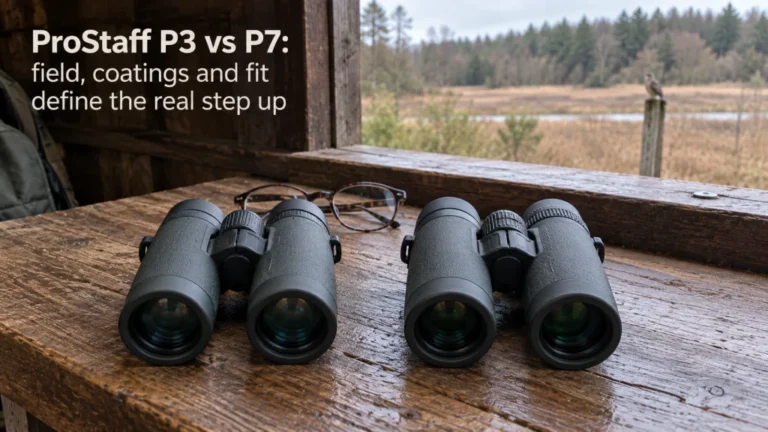
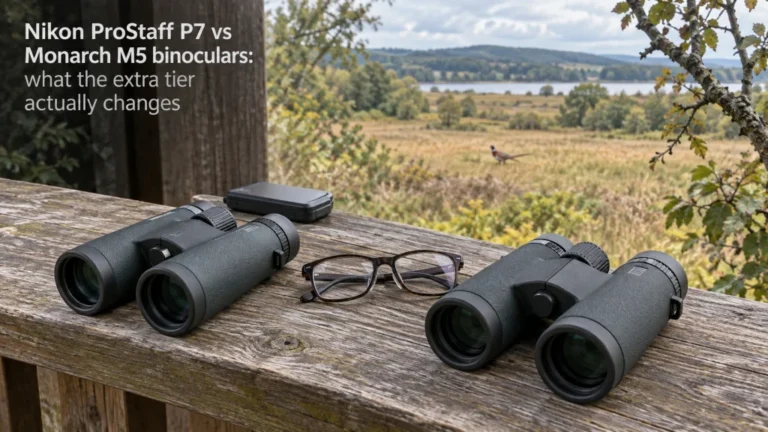
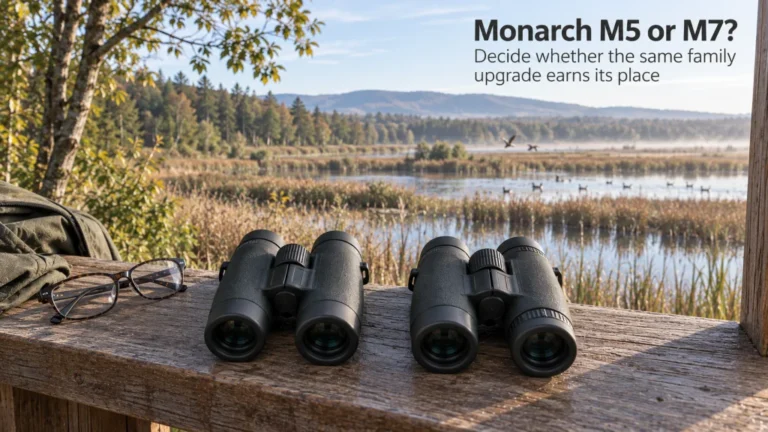
Nikon binoculars make more sense when the lineup is read by requirement rather than by price. ProStaff P3 and P7 cover the mainstream roof-prism starting range, Monarch M5 introduces a different optical priority with ED glass, Monarch M7 expands the viewing window in key configurations, and Monarch HG belongs behind a stricter premium threshold. The Porro side needs a separate check because Aculon, legacy Action Extreme pages, and the newer Action family do not form the same kind of progression. The useful stopping point is the first family that solves the actual viewing, fit, carry, and weather needs without paying for a change the buyer cannot name.
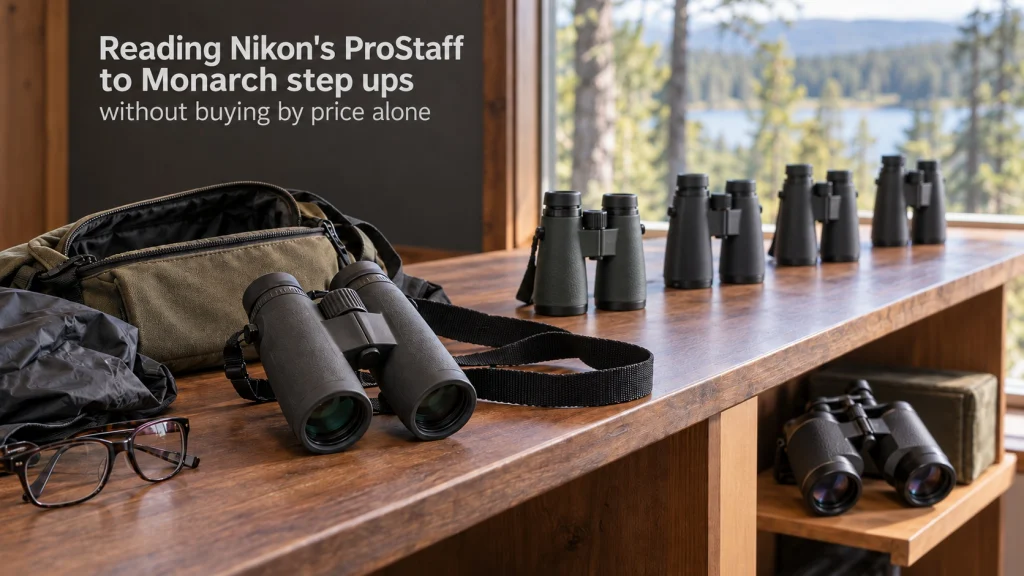
Start with the Nikon family that solves the broadest mainstream job
A buyer can move through Nikon binoculars from ProStaff P3 to P7, then into Monarch M5, M7, and HG and assume each higher price simply means a better version of the same thing. That is the wrong reading. A useful family map starts by asking whether the buyer needs a light waterproof roof-prism binocular with comfortable eye relief, a wider viewing window, ED glass, a more premium body, or a different Porro-style handling and viewing experience. For the broader brand context, the binocular brand guide is the better place to compare Nikon with other manufacturers rather than forcing every Nikon family into one internal ranking.
ProStaff P3 is the cleanest place to establish that baseline because it already covers compact and full-size roof-prism configurations with waterproofing, fogproofing, adjustable eyecups, and long eye relief in the family. Moving upward should therefore require a named constraint, not just a larger budget. If the buyer is already satisfied with the carrying weight, field of view, eye position, weather protection, and basic controls, there may be no reason to leave that family. The rest of the lineup only becomes relevant when one of those requirements survives the first comparison.
| Family area | What changes the decision | Reason to stop instead of moving up |
|---|---|---|
| ProStaff P3 | Mainstream roof-prism fit, carry, weather protection, and straightforward configurations | The basic viewing and ownership requirements are already met |
| ProStaff P7 | Additional prism coatings, locking diopter control, and lens-surface protection | Those additions do not solve a problem the buyer actually has |
| Monarch M5 | ED glass and a different optical package | A wider viewing window matters more than the M5 feature set |
| Monarch M7 | ED glass plus a notably wider field in major configurations | The extra viewing window is not worth the added cost or fit trade-off |
| Monarch HG | Premium materials, optical claims, focus distance, and fit details | The buyer cannot identify a remaining limitation that requires the premium step |
| Porro families | Body architecture, eye relief, weather protection, and current family status | A roof-prism format better matches carry and handling needs |
The table is not a quality ranking. It is a filter for deciding which change is large enough to matter to the person using the binoculars. Once the requirement is named, the adjacent comparison becomes much easier to read. If the requirement is still vague, the buyer should stay at the baseline family and define the problem before moving higher.

This is Nikon's PROSTAFF P3 8x42 full-size configuration. Amazon identifies it as waterproof, fogproof, and rubber-armored. The listing also calls out a wide field of view and long eye relief.
Check on AmazonIf you click this link and buy, we earn a commission at no additional cost to you.
Treat size and magnification variants as configurations unless they create a new decision
Nikon often offers several magnification and objective-size combinations inside one family, and those variants should not automatically be treated as higher or lower product tiers. An 8×30 and an 8×42 can differ in carry burden, exit pupil, body size, and field behavior while still sharing the same family-level feature package. The same applies when a family includes 10x or 12x options. Magnification changes the viewing problem, but it does not by itself move the buyer into a more advanced family.
This distinction matters because the current ProStaff P7 and Monarch M5 ranges extend into larger objective configurations while keeping their family identity. A buyer who needs a larger objective or different magnification may be solving a light, reach, or support problem rather than shopping for a more expensive tier. That decision should be separated from questions about ED glass, prism coatings, body materials, or control design. Otherwise, a configuration change gets mistaken for an upgrade and the comparison becomes needlessly expensive.
| Usually stable enough to compare directly | Should be treated as a market check |
|---|---|
| Magnification and objective diameter | Retail price |
| Field of view and eye relief | Sale discount |
| Weight and dimensions | Dealer inventory |
| ED glass, prism coatings, weather sealing, and control features | Bundle contents and temporary promotions |
That separation keeps the family map useful even when retail conditions change. Price can decide whether an otherwise sensible step is affordable, but it should not be used as proof that one family solves a different viewing requirement. A temporary discount can make a higher family cheaper without changing its fit or optical role. The buyer should therefore compare stable specifications first and treat price as the final market filter.

This is Nikon's PROSTAFF P3 10x42 full-size configuration. Amazon identifies it as waterproof, fogproof, and rubber-armored. The listing also calls out a wide field of view and long eye relief.
Check on AmazonIf you click this link and buy, we earn a commission at no additional cost to you.
The ProStaff P3 to ProStaff P7 step only matters when it changes the buyer’s decision
The ProStaff P3 and P7 families are a good example of why adjacent price steps need to be read carefully. In comparable 8×42 configurations, Nikon lists the same field of view, close-focus distance, exit pupil, and eye relief, so the basic viewing geometry does not suddenly change just because the badge changes. P7 adds documented features such as phase-correction and dielectric prism coatings, a locking diopter, and an oil and water-repellent lens coating. Those are real differences, but they should be connected to a need rather than treated as automatic reasons to spend more.
If the buyer values a locking diopter because the setting is easily disturbed, wants the additional exterior lens coating for easier cleaning, or specifically wants the P7 optical coating package, the move can be rational. If the practical requirements are simply a waterproof 8×42 roof-prism binocular with long eye relief and manageable weight, P3 may already clear the bar. The narrower decision belongs in the ProStaff P3 and P7 comparison, where the question is whether the added P7 features alter actual use. The family map should not declare P7 the winner before that requirement exists.

This is Nikon's PROSTAFF P7 10x42 full-size configuration. Amazon lists waterproof and fogproof construction with rubber armor. It also specifies an oil and water-repellent coating and a locking diopter.
Check on AmazonIf you click this link and buy, we earn a commission at no additional cost to you.
Route ProStaff P7 versus Monarch M5 by the trade-off that survives research
The move from ProStaff P7 to Monarch M5 is not a simple continuation of the same ladder because the optical priorities diverge. Nikon documents ED glass in Monarch M5, along with dielectric and phase-correction coatings, so the M5 family introduces a feature intended to control chromatic aberration rather than merely adding another convenience feature. At the same time, a same-magnification M5 does not automatically offer a wider field than P7. That means the buyer has to decide whether ED glass and the M5 package address a real limitation or whether the P7 viewing window and controls already fit better.
This is where a buyer should resist using price as a shortcut for image quality. Manufacturer specifications can establish glass type, field of view, eye relief, weight, close focus, and coatings, but they do not prove that every viewer will prefer one image. The ProStaff P7 versus Monarch M5 comparison should therefore be opened only when ED glass, field width, fit, or the optical package is the unresolved constraint. If none of those differences matters in the buyer’s actual use, moving into Monarch M5 is not automatically progress.
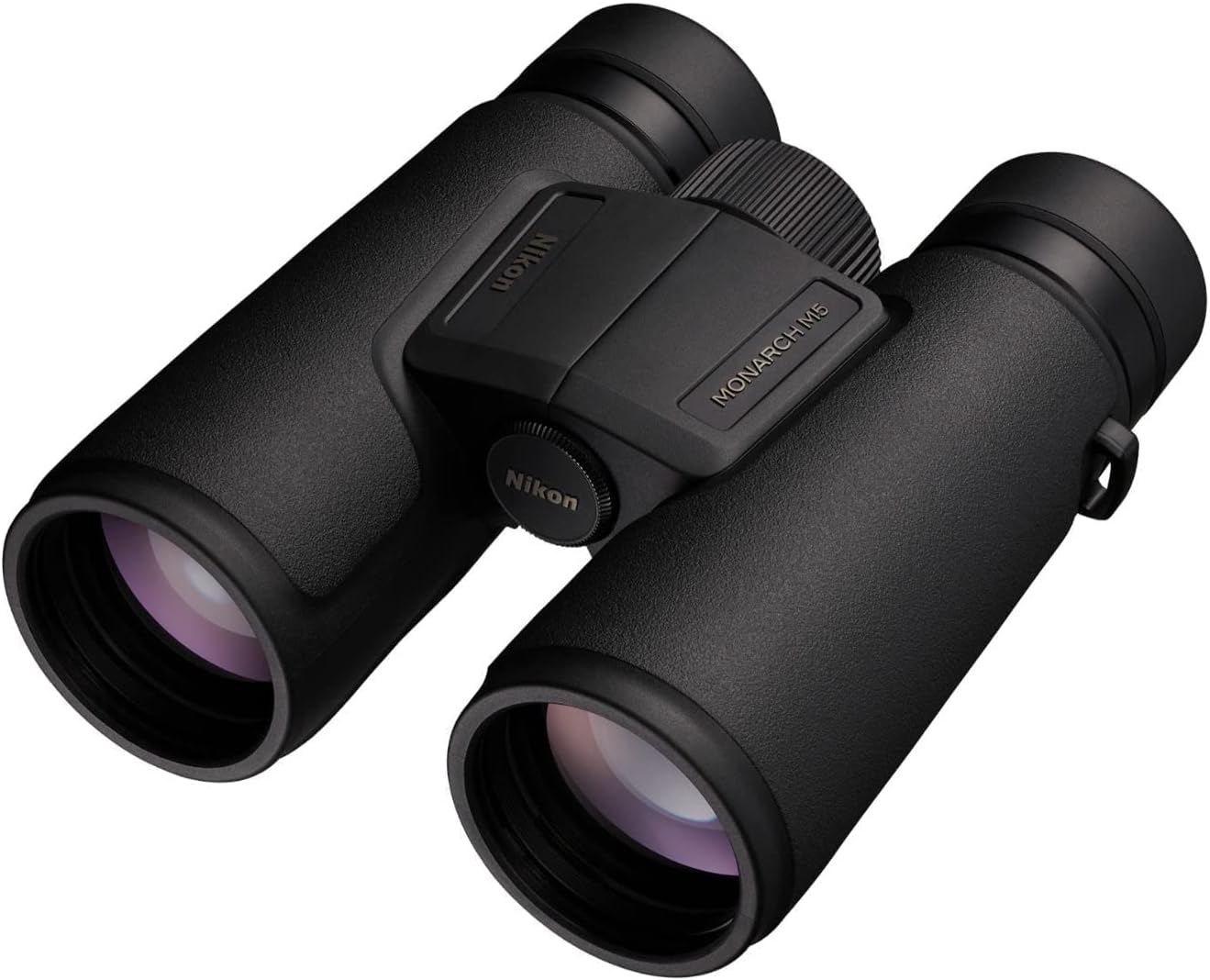
This is the Nikon Monarch M5 10x42 configuration. Amazon lists waterproof and fogproof construction with ED glass optics. The listing also specifies a dielectric prism coating for this model.
Check on AmazonIf you click this link and buy, we earn a commission at no additional cost to you.
Monarch M5 versus Monarch M7 comes down to viewing window, fit, coatings, and price
Monarch M5 and M7 are closer relatives than P7 and M5 because both families document ED glass, dielectric prism coating, phase correction, waterproofing, and fogproofing. The larger separation is the viewing window in major configurations. Nikon lists a substantially wider field of view for M7 than for the corresponding M5 in both 8×42 and 10×42, while the M5 keeps slightly longer eye relief and somewhat lower weight in those same examples. That creates a real trade-off instead of a simple better-or-worse ranking.
A buyer who frequently has trouble acquiring moving subjects, following action through vegetation, or maintaining context around the target may care a great deal about the M7 field width. A buyer who wears glasses, prefers a little more eye relief, or wants to reduce carry weight may not value the wider view enough to justify the change. The Monarch M5 and M7 comparison is the right next step when those differences remain unresolved. If the M5 already provides the required image control and fit, the presence of M7 above it in the catalog is not a reason to keep climbing.

This is the Nikon Monarch M7 8x42 configuration. Amazon lists a lightweight waterproof and fogproof body with ED glass and multilayer coatings. The listing also highlights a wide view, smooth focus, and long eye relief.
Check on AmazonIf you click this link and buy, we earn a commission at no additional cost to you.
When the shortlist reaches Aculon and Action Extreme, test the buyer’s next constraint
The Porro side of Nikon’s catalog needs to be handled separately because it does not mirror the ProStaff to Monarch roof-prism path. Aculon A211 pages remain visible in Nikon’s U.S. catalog, the newer Action family is also surfaced, and legacy Action Extreme pages remain online. That mixed catalog makes family status part of the buying decision before any optical comparison begins. It is safer to verify the exact U.S. listing and specifications than to assume a familiar badge still occupies the same role. Price should come after that status check, not before it.
The practical constraints in this branch are also different. Aculon A211 and Action Extreme examples can differ meaningfully in eye relief, weather protection, weight, and body design even when magnification and objective size look similar, while the newer Action family changes the current context again. The Aculon and Action Extreme comparison is useful when the buyer is specifically choosing between those two older families, but it should not be mistaken for a complete map of Nikon’s current Porro offerings. A buyer who prioritizes compact carry may also discover that this entire branch solves the wrong problem and should return to a roof-prism shortlist.
Current lineup check: Nikon’s U.S. catalog can show families from different product generations at the same time. Verify the exact family page and exact configuration before treating availability, weather protection, or eye relief as settled. An older product page can remain useful for specifications without proving that the family still fills the same current role. Use the live catalog to establish status, then use the exact product page for the details that affect the choice.

This is the Nikon ACULON A211 10-22x50 zoom configuration. Amazon identifies it as a Porro-prism binocular with multilayer coating. The listing also specifies turn-and-slide eyecups and tripod adaptability.
Check on AmazonIf you click this link and buy, we earn a commission at no additional cost to you.
Use independent evidence when a Nikon family step depends on visible optical performance
Specifications are strong evidence for what a binocular is built with, but they are weaker evidence for how large an optical improvement a particular viewer will actually see. ED glass, dielectric coatings, phase correction, field width, and claimed transmission all describe meaningful design choices, yet they do not replace a controlled comparison of glare, color fringing, edge behavior, contrast, focus feel, or low-light performance. This matters most near the premium end, where the buyer may already have adequate weather protection, eye relief, and basic optical features. The remaining question can become whether subtle image or handling gains are visible enough to justify the next step.
Monarch HG illustrates that boundary. Nikon documents premium materials, a magnesium alloy body, a high transmission claim, wide field of view in the 8×42 configuration, and a close-focus advantage, but a spec sheet alone cannot prove that every user will perceive a proportionate improvement over M7. One direct side-by-side comparison of the 8×42 versions reported only small overall optical differences, with the clearest distinction in distortion and subtler differences in coatings and contrast; the observer also found field size, edge softness, depth of field, and chromatic aberration difficult to distinguish. That is one observer report rather than a laboratory measurement, so it should narrow the question instead of settling it for every buyer. The Monarch M7 versus Monarch HG comparison should therefore test whether those remaining differences solve a visible problem for the individual viewer. If the buyer cannot identify the limitation that HG is supposed to remove, the premium boundary has not been crossed yet.

This is the Nikon Monarch HG 10x42 model 16028. Amazon lists a wide field of view with bright multicoated lenses in a lightweight body. The listing also identifies it as waterproof and fogproof.
Check on AmazonIf you click this link and buy, we earn a commission at no additional cost to you.
Separate Nikon family choice from generic specifications, activities, buying process, and technology
A family map works only if it stays focused on family-level decisions. Questions such as whether 8x or 10x is better, how much eye relief a glasses wearer needs, what objective diameter fits low-light use, or how much weight is tolerable belong to the underlying viewing requirement. They may eliminate a configuration, but they do not by themselves establish that ProStaff, Monarch, Action, or Aculon is the correct family. The family decision comes after those constraints are defined well enough to compare the relevant Nikon options.
The same separation applies to brand choice. Someone who has not decided that Nikon is the right fit should compare the company’s approach with alternatives in the binocular brand comparisons rather than treating this page as proof that Nikon is best for everyone. Once Nikon is the working shortlist, use family changes to answer a specific problem and stop when the next step no longer changes the outcome. That keeps the decision narrow enough to be useful and prevents generic feature shopping from taking over the purchase.
- Stay with the current family when fit, field of view, carry, weather protection, and controls already solve the job.
- Move to the next family only when a documented feature addresses a remaining constraint.
- Change configuration before changing family when magnification, objective size, or carry format is the real issue.
- Use a child comparison when two adjacent families remain plausible after the broader filter.
- Stop the upgrade path when the remaining benefits depend on optical preferences that have not been verified.
This sequence also keeps the decision reversible. If a supposedly higher family creates worse eye position, more weight, or a viewing window that does not suit the user, returning to the lower family is not a downgrade in practical terms. The family name matters less than whether the binocular remains comfortable and useful in the intended viewing conditions. A lower family that fits the job cleanly is simply a better match.

This is the Nikon Monarch M7 8x30 binocular. The listed configuration uses 8x magnification. Its objective size is 30 mm.
Check on AmazonIf you click this link and buy, we earn a commission at no additional cost to you.
Reject nonadjacent jumps when the skipped family already solves the requirement
The easiest way to overspend in a brand lineup is to compare a starting family with a much more expensive family before testing the intermediate step. A buyer considering ProStaff P3 and Monarch M5, for example, may discover that the P7 feature package solves the actual concern without requiring the ED-glass move into M5. That narrower path is covered in the ProStaff P3 versus Monarch M5 comparison, but the point of the broader map is to question the jump before accepting it. Price distance is not evidence that the skipped family is irrelevant.
The same logic applies at the top of Monarch. If M7 already solves the viewing-window problem and fits the user’s eyes and hands, HG needs a new justification rather than inherited momentum from the previous upgrade. A useful lineup decision therefore ends with a rejection as often as it ends with a purchase path. The buyer should be able to say not only which family remains, but also why the family above and below it fail to solve the same requirement more cleanly.

This is Nikon's PROSTAFF P7 8x30 compact configuration. Amazon lists it as waterproof and fogproof with rubber armor. The listing also specifies an oil and water-repellent coating and a locking diopter.
Check on AmazonIf you click this link and buy, we earn a commission at no additional cost to you.
Final Thoughts: Stop at the first family that solves the requirement
Nikon’s lineup becomes easier to navigate when each step has to earn its place. Start with the viewing and fit requirement, separate configuration changes from family changes, and use documented differences such as ED glass, field of view, eye relief, coatings, weather protection, weight, and control design to decide whether moving up actually changes the result. Treat the Porro branch as its own decision, especially where older and newer family names overlap in the U.S. catalog. That keeps a family label from substituting for a real viewing requirement.
The practical stopping point is the first family that solves the job without creating a new fit, carry, or cost problem. If the next step only adds a feature the buyer cannot connect to actual use, there is no reason to keep climbing. If a remaining limitation is specific, move to the narrow comparison that tests that one difference. A good Nikon shortlist ends when both the chosen family and the rejected alternatives can be explained in plain terms.

This is Nikon's PROSTAFF P3 8x30 compact configuration. Amazon lists it as waterproof and fogproof with rubber armor. The listing also calls out a wide field of view and long eye relief.
Check on AmazonIf you click this link and buy, we earn a commission at no additional cost to you.
Compare the Nikon family steps that remain after the first filter
Once the broad family map leaves two realistic options, use the narrower comparison that matches that exact step. Each page below isolates one family boundary instead of restarting the whole buying process. That keeps field of view, eye relief, coatings, ED glass, fit, weight, and price tied to the decision that actually remains. It also prevents a higher family from winning simply because it sits farther up Nikon’s catalog.
| Comparison | What it helps decide |
|---|---|
| Nikon ProStaff P3 versus P7 | Whether the P7 coatings, control features, and lens protection change the decision. |
| Nikon ProStaff P7 versus Monarch M5 | Whether ED glass and the M5 optical package matter more than P7’s strengths. |
| Nikon Monarch M5 versus M7 | Whether the wider M7 viewing window justifies its fit, weight, and price trade-offs. |
| Nikon Monarch M7 versus Monarch HG | Whether the premium HG differences solve a limitation that remains after M7. |
| Nikon Aculon versus Action Extreme | How eye relief, weather protection, weight, and Porro-family status affect the older branch. |
| Nikon ProStaff P3 versus Monarch M5 | Whether a nonadjacent jump is justified or an intermediate family should be considered first. |
If the comparison still cannot identify a requirement that changes, there is no need to keep moving upward. Return to the lower family and check the exact configuration that best matches magnification, objective size, eye relief, and carry needs. If the unresolved issue is broader than Nikon, step back to a cross-brand comparison instead of forcing a Nikon-only answer. The narrower route should simplify the shortlist, not manufacture another upgrade.
This is Nikon's PROSTAFF P7 10x30 compact configuration. Amazon lists it as waterproof and fogproof with rubber armor. The listing also specifies an oil and water-repellent coating and a locking diopter.
Check on AmazonIf you click this link and buy, we earn a commission at no additional cost to you.
FAQs
🔭 Is Monarch always better than ProStaff?
No. Monarch families add different optical features and, in some cases, different viewing geometry, but ProStaff can still be the better fit when its field of view, eye relief, weight, and controls already solve the job.
👓 Which Nikon family should glasses wearers start with?
Start with the exact configuration’s eye relief and eyecup design rather than the family name alone. Eye relief can change by magnification and model, so verify the specification and confirm that the full field remains comfortable with glasses.
🌲 Does Monarch M5 replace ProStaff P7?
No. M5 adds ED glass and its own optical package, while P7 can offer a different balance of field width, controls, weight, and price. Treat them as overlapping choices that solve different constraints, not as a mandatory replacement sequence.
🧭 Is Monarch M7 mainly a wider-field version of M5?
Field of view is one of the clearest family-level differences in major configurations, but it is not the only one. Compare eye relief, weight, fit, price, and exact configuration before deciding that the wider view is worth the move.
🌧️ Are Aculon and Action Extreme the same kind of choice?
No. Exact examples differ in weather protection, eye relief, weight, and construction, and Nikon’s newer Action family changes the current catalog context. Verify the exact model page rather than treating the names as a simple price ladder.
💰 Should I choose the most expensive Nikon family I can afford?
No. Set the viewing, fit, carry, and weather requirements first, then stop at the first family that satisfies them. A higher family only makes sense when a documented difference solves a remaining problem.
References and Sources
- Nikon U.S. binocular catalog: Confirms the Nikon families and configurations currently surfaced in the U.S. catalog.
- Nikon ProStaff P3 and P7 information: Supports the ProStaff family configurations, field of view, eye relief, weather protection, and P7 feature differences.
- Nikon Monarch M5 family: Supports M5 ED glass, prism coatings, weather protection, and family positioning.
- Nikon Monarch M7 family: Supports M7 ED glass, prism coatings, wide-field positioning, and family-level feature claims.
- Nikon Monarch HG 8×42 specifications: Supports the premium-family material, field of view, fit, focus, and transmission details discussed above.
- BirdForum direct M7 and HG comparison discussion: Provides an attributed side-by-side observer report that helps define which visible differences may remain after the specification comparison.
- Nikon Action family: Supports the current Action family features and helps distinguish it from older Aculon and Action Extreme listings.