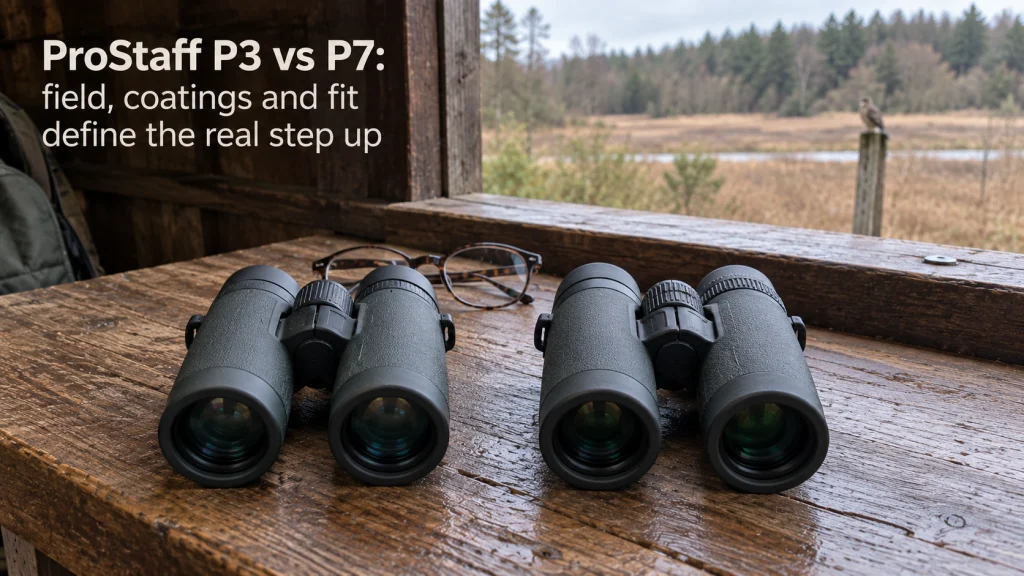
ProStaff P3 and ProStaff P7 overlap far more than their model numbers suggest. In the current 10×42 specifications, Nikon lists the same magnification, objective size, field of view, eye relief, close focus, and body dimensions for both, so the P7 upgrade case cannot honestly be built on a wider view or easier eyeglass fit. The meaningful differences are the P7 coating package, its oil and water repellent exterior lens coating, and its locking diopter, while the P3 keeps the lower tier simpler and slightly lighter. Choose between them by asking whether those differences matter enough at the price gap you actually see, not by assuming seven must be better than three.
Start with what ProStaff P3 and ProStaff P7 already share
The first useful fact in a ProStaff P3 versus P7 decision is how much does not change. In the 10×42 configuration, both are roof prism binoculars with 10x magnification, 42 mm objectives, a 367 foot field of view at 1,000 yards, 15.7 mm of eye relief, and a 9.8 foot close focus distance. Nikon also lists the same 5.9 by 5.1 inch body dimensions and waterproof, fogproof construction for both. That means the P7 does not earn its higher position by changing the basic viewing geometry on the spec sheet.
This is why it helps to settle the broader lineup question before treating the family number as an upgrade score. Our guide to Nikon binoculars shows where the ProStaff families sit within Nikon’s current range, while our binocular brand comparison framework is the better starting point if Nikon itself is not yet fixed. Once the brand and ProStaff family choice are settled, this page can stay narrow and ask what the extra P7 features actually change. The comparison becomes much cleaner when the shared specifications are treated as the baseline instead of being repeated as selling points for both sides.

This 10x42 roof-prism binocular uses multilayer-coated optics and a silver-alloy reflective prism coating. Nikon lists waterproof and fogproof construction with 15.7 mm eye relief and a 367-foot field of view at 1,000 yards. The rubber-armored body uses the same 5.9 by 5.1 inch dimensions discussed in the matched P3 versus P7 comparison.
Check on AmazonIf you click this link and buy, we earn a commission at no additional cost to you.
Compare ProStaff P3 and ProStaff P7 in the closest current configuration
The matched 10×42 pair removes configuration differences from the argument. Nikon lists the same real angular field of 7 degrees, apparent angular field of 62.9 degrees, 4.2 mm exit pupil, 17.6 relative brightness, and interpupillary adjustment range for both. Those values confirm that the basic viewing format is not the upgrade. The comparison can therefore focus on weight, coatings, lens treatment, controls, and price.
Nikon lists P3 10×42 at 20.6 ounces and P7 at 21.2 ounces, with the same body dimensions. The 0.6 ounce gap is too small to prove one will feel better in every hand. It does show that P7 is not the lighter or smaller option on paper. If P3 already fits physically, the premium must earn itself elsewhere.
| 10×42 specification | ProStaff P3 | ProStaff P7 | Decision meaning |
|---|---|---|---|
| Field of view at 1,000 yd | 367 ft | 367 ft | No published field advantage for P7. |
| Eye relief | 15.7 mm | 15.7 mm | No nominal eyeglass fit advantage for P7. |
| Close focus | 9.8 ft | 9.8 ft | Neither one wins on published close focus. |
| Body size | 5.9 x 5.1 in. | 5.9 x 5.1 in. | The higher tier does not buy a smaller body. |
| Weight | 20.6 oz | 21.2 oz | P3 is slightly lighter on the current product pages. |
| Prism coating approach | Silver alloy reflective coating | Dielectric high reflective multilayer plus phase correction | This is one of the clearest documented upgrade differences. |
| Exterior lens coating | No equivalent oil and water repellent feature listed | Oil and water repellent coating | P7 adds better resistance to oil and water and can make exposed glass easier to clean. |
| Locking diopter | No locking feature listed | Yes | P7 can better preserve a set diopter position against accidental movement. |

This 10x42 model uses dielectric high-reflective multilayer and phase-correction prism coatings. It adds oil- and water-repellent exterior lens coatings plus a locking diopter while retaining the 367-foot field of view and 15.7 mm eye relief of the matched P3. Nikon lists it as waterproof and fogproof with a 21.2-ounce body.
Check on AmazonIf you click this link and buy, we earn a commission at no additional cost to you.
The specification where ProStaff P3 can still be the better fit
The cleanest physical advantage for P3 in this matched pair is its lower published weight. Nikon lists P3 10×42 at 20.6 ounces and P7 at 21.2 ounces, a difference of 0.6 ounce. That gap is modest and does not prove P3 will feel dramatically better in every hand. It simply means P3 preserves the same body dimensions while carrying slightly less weight.
P3 can also be the cleaner choice when the additional P7 controls and coatings do not solve a problem you actually have. If you rarely disturb the diopter after setting it, a locking ring may add little practical value, and mostly dry use can reduce the value of the exterior lens treatment. The same logic applies to the optical coating upgrade when you have not identified a viewing condition that exposes a limitation you care about. A lower price matters most when none of the P7 additions solves a specific problem.

This compact 8x30 PROSTAFF P3 weighs 16.8 ounces and measures 4.9 inches long. Its listed field of view is 456 feet at 1,000 yards, and the adjustable eyecups provide 19.6 mm of eye relief. The Amazon listing identifies it as waterproof, fogproof, and rubber armored for compact field use.
Check on AmazonIf you click this link and buy, we earn a commission at no additional cost to you.
The documented change that gives ProStaff P7 its strongest upgrade case
Nikon’s clearest P7 changes are in the prism system and controls. P3 uses multilayer coated lens elements and a highly reflective silver alloy coating on the roof prism mirror surfaces. P7 adds a dielectric high reflective multilayer prism coating plus a phase correction coating, then adds an oil and water repellent coating to the objective and eyepiece lenses. It also adds a locking diopter adjustment ring.
That package gives P7 a legitimate upgrade case without changing the basic 10×42 geometry. The prism coatings are optical design changes, while the exterior lens treatment and locking diopter affect maintenance and control. They can matter in wet, dusty, or frequently handled use, but they do not quantify a visible improvement for every observer. Treat them as documented differences whose value depends on your conditions, not as automatic proof that every aspect of the view improves.
Field of view does not separate the 10×42 pair
Field of view is often an easy place to justify an upgrade because a wider view can help with subject acquisition and tracking. Here, that shortcut does not work because both 10×42 models are listed at 367 feet at 1,000 yards. A buyer choosing P7 for a wider 10×42 view would therefore be paying for a benefit the published specification does not show. If field width is the main constraint, this exact P3 versus P7 comparison does not resolve it.
Eye relief and eyeglass fit remain a real-world fit check
Both 10×42 models list 15.7 mm of eye relief, so P7 has no nominal advantage here. Usable eyeglass fit can still differ because frame position, eyecup shape, lens recess, and facial geometry affect the effective viewing distance. That makes fit something to verify rather than an upgrade to assume. If P3 already gives you a stable full field with your normal glasses, the P7 specification does not promise more room.

This compact 8x30 PROSTAFF P7 carries the P7 feature set into a smaller configuration. The Amazon listing identifies waterproof and fogproof construction, an oil- and water-repellent lens coating, and a locking diopter. The selected Amazon variant is the PROSTAFF P7 8x30 rather than the full-size 10x42 model discussed in the article.
Check on AmazonIf you click this link and buy, we earn a commission at no additional cost to you.
Keep test-dependent image claims out of the spec sheet verdict
The coating difference is real, but a coating list cannot quantify how much the view changes for a particular observer. Nikon documents dielectric high reflective multilayer coating and phase correction on P7, while P3 uses a different reflective approach. The spec sheet cannot establish the size of any visible advantage in backlight, shade, fine detail, or glare. Claims that P7 looks sharper, brighter, or cleaner therefore need matched observation under conditions that can reveal those differences.
This distinction keeps feature names from becoming performance scores. Published dimensions, weight, field, eye relief, close focus, coatings, and controls can be checked directly as stable facts. Perceived sharpness, flare control, color rendering, focus feel, and viewing comfort still depend on the observer and test conditions. If image quality is your only reason to pay more, compare the exact models in the light and subject detail that matter to you.

The Nikon 7072 Lens Pen uses a soft retractable brush to sweep away dust and dirt. Its natural chamois cleaning tip uses a non-liquid compound to remove fingerprints, dust, and grit from optical surfaces. Nikon describes it as suitable for maintaining binoculars, telescopes, spotting scopes, and camera optics.
Check on AmazonIf you click this link and buy, we earn a commission at no additional cost to you.
Convert close focus into a buy or skip threshold
Close focus is useful here because it creates a simple threshold instead of an upgrade story. Nikon lists both 10×42 models at 9.8 feet, so P7 does not move the published near focus point closer. Decide whether that distance works for the nearby subjects you actually observe. If it does not, reject both for this requirement instead of assigning P7 a benefit it does not have.
Set the farthest close focus distance you can tolerate before comparing coatings or controls. Remove any model that fails that limit. If both P3 and P7 pass, close focus becomes neutral and should leave the final tie break. If both fail, neither price nor family number can fix the mismatch.

The Nikon MONARCH M7 10x42 has an 8.2-foot close focus distance, compared with 9.8 feet for the matched PROSTAFF pair in the article. It uses ED glass with phase-corrected dielectric-coated prisms. Nikon also lists waterproof and fogproof construction with oil- and water-repellent lens coatings.
Check on AmazonIf you click this link and buy, we earn a commission at no additional cost to you.
Use price as a variable, not proof of quality
The value of P7 depends heavily on the price gap because the upgrade is concentrated in coatings and controls rather than a different 10×42 format. A small premium can make the coating package, exterior lens treatment, and locking diopter easier to justify when those features map directly to how you use and maintain binoculars. A large premium needs a stronger reason because the extra spend is still buying refinement rather than a new basic configuration. Price changes the value judgment without changing the underlying product facts.
Do not preserve a temporary sale or retailer gap as if it were a permanent product fact. Check the delivered price for the exact P3 and P7 configuration you are considering, then ask what each extra dollar is buying in documented differences. If the P7 premium is mostly paying for features you would not notice or use, P3 remains a rational stop. If the price gap is modest and the P7 coating system, easier cleaning, or locked diopter directly addresses your use, the upgrade case becomes much stronger.

This PROSTAFF P3 uses 8x magnification with 42 mm objectives in a full-size roof-prism format. The Amazon listing identifies waterproof and fogproof construction, rubber armor, a wide field of view, and long eye relief. It is the 8x42 variant of the same PROSTAFF P3 family discussed in the article.
Check on AmazonIf you click this link and buy, we earn a commission at no additional cost to you.
Do not confuse the ProStaff P7 coating upgrade with an ED glass step
P7 occupies a higher ProStaff tier, but that does not make it an ED glass binocular by implication. Nikon explicitly identifies extra low dispersion glass as a feature of the Monarch M5 line, while the P7 materials emphasize dielectric and phase correction prism coatings plus the exterior lens treatment and locking diopter. Those are meaningful differences, but they solve a different part of the optical system than ED glass. Treating P7 as a disguised Monarch step would blur the boundary that matters most in this comparison.
If ED glass is a requirement, do not infer it from the P7 name or price. The separate comparison of ProStaff P7 and Monarch M5 is the right place to evaluate that higher tier boundary. This page has a narrower job: decide whether P7’s documented coating and control changes justify more money than P3. Keeping that boundary clear prevents a feature upgrade from being mistaken for a different glass category.

The Nikon MONARCH M5 8x42 uses ED glass optics with a dielectric prism coating. Its Amazon listing identifies waterproof and fogproof construction in an 8x42 roof-prism format. The ED glass specification makes this model a direct reference point for the optical boundary discussed between PROSTAFF P7 and the MONARCH line.
Check on AmazonIf you click this link and buy, we earn a commission at no additional cost to you.
End with a reason to choose each side and a reason to reject both
Choose ProStaff P3 when the matched configuration already fits your use and the lower price matters more than the P7 extras. Choose ProStaff P7 when the current premium is acceptable and you specifically value the dielectric and phase correction coating system, the oil and water repellent exterior lens treatment, or the locking diopter. Neither choice needs to be defended by lineup order because the useful differences are concrete. The better value is the one that solves your actual requirement with the fewest paid features that do not matter to you.
Reject both when your requirement sits outside what this pair changes. That can mean needing different field geometry, more usable eye relief, closer focus, another weight class, or ED glass. Skipping both is not a failure to choose between P3 and P7. It is the correct result when the specification you need is not part of this upgrade.
| Decision | Choose it when | Do not choose it for |
|---|---|---|
| Choose ProStaff P3 | The shared field, fit, close focus, and body size already work, and saving money matters more than the P7 extras. | An assumed field, eye relief, or close focus advantage that does not appear in the matched 10×42 specifications. |
| Choose ProStaff P7 | You value the dielectric and phase correction coating package, exterior oil and water repellent lens treatment, or locking diopter enough to pay the current premium. | The assumption that a higher family number means every published specification improves. |
| Skip both | Your real requirement is different field geometry, more usable eye relief, closer focus, a different weight class, or ED glass. | Trying to force one of two closely matched models to solve a requirement neither one changes. |
This PROSTAFF P7 variant combines 10x magnification with 30 mm objectives. Amazon lists a 346-foot field of view at 1,000 yards for the compact 10x30 configuration. It retains the P7 family features that include upgraded prism coatings, an oil- and water-repellent lens treatment, and a locking diopter.
Check on AmazonIf you click this link and buy, we earn a commission at no additional cost to you.
Final Thoughts: let the coating package earn the step up
ProStaff P7 earns attention because Nikon changes the prism coating system and adds useful ownership features, not because the model number creates a blanket upgrade. P3 remains the stronger stopping point when the matched configuration already works and the P7 additions do not solve a named problem. P7 becomes defensible when its coating system, exterior lens treatment, or locking diopter matters enough to justify the price gap you see. The decision therefore rests on whether the documented extras change your use, not on which badge sits higher.
The most important boundary is what P7 does not become. It does not turn the ProStaff comparison into an ED glass decision, and a higher number does not substitute for checking the exact specification you need. Compare the current prices only after field, fit, close focus, carry, and optical requirements are clear. Then choose P3, choose P7, or leave both behind based on the requirement that actually changes your viewing.

The Nikon MONARCH M7 8x42 uses ED glass and dielectric multilayer prism coatings. Its Amazon listing identifies waterproof and fogproof construction in an 8x42 outdoor binocular. This higher-tier configuration provides a relevant next comparison when the PROSTAFF P3 versus P7 pair does not meet the optical requirement being prioritized.
Check on AmazonIf you click this link and buy, we earn a commission at no additional cost to you.
Frequently asked questions
The most common P3 versus P7 questions come from treating the higher family number as a complete upgrade. This comparison does not support that shortcut. The practical differences are concentrated in coating design, controls, exterior lens treatment, weight, and current price. The answers below keep those categories separate so a feature name is not mistaken for a guaranteed visible performance gain.
Fit still deserves a personal check even when published figures match. Eye relief is nominal, carrying comfort is individual, and coating benefits depend on viewing conditions. Use specifications to rule models in or out, then reserve hands-on comparison for claims the numbers cannot settle. If neither model changes the requirement, neither should win by default.
🔭 Does ProStaff P7 have a wider field of view than ProStaff P3 in 10×42?
No. Nikon lists both 10×42 models at 367 feet at 1,000 yards, so field width is not a published reason to pay more for P7 in this matched configuration.
👓 Is ProStaff P7 better for eyeglass wearers?
Not by nominal eye relief in the 10×42 pair. Both are listed at 15.7 mm, so usable eyeglass fit still depends on eyecup geometry, frame position, lens recess, and your face.
✨ What does ProStaff P7 add over ProStaff P3?
The clearest documented additions are the dielectric high reflective multilayer prism coating, phase correction coating, oil and water repellent coating on the exposed lenses, and a locking diopter adjustment ring. Those are real design and ownership differences even though several core 10×42 specifications remain tied.
📏 Does ProStaff P7 focus closer than ProStaff P3?
No, not in the matched 10×42 specifications. Nikon lists both at 9.8 feet, so a need for closer focus is a reason to look beyond this pair rather than a reason to choose P7.
🔬 Does ProStaff P7 use ED glass?
Nikon does not list ED glass as a ProStaff P7 feature. Nikon does identify ED glass in the Monarch M5 line, so the P7 step should be understood as a coating and feature upgrade rather than an ED glass step.
💵 When is ProStaff P3 the better value?
P3 is the stronger value when its field, eye relief, close focus, size, weather protection, and handling already meet your needs and the P7 coating and control additions are not worth the current premium to you. Compare the exact current prices after deciding which differences you would actually use.
References and Sources
This comparison relies primarily on Nikon’s current product pages for the matched 10×42 specifications and listed features. Those pages support the field of view, eye relief, close focus, dimensions, weight, waterproof and fogproof status, and the P7 feature differences used in the decision. The Nikon ProStaff launch material adds the clearest direct description of the silver alloy prism coating on P3 and the dielectric plus phase correction system on P7. No visible performance claim is treated as settled when the cited material provides only a feature description.
The Monarch M5 source is included only to establish the ED glass boundary discussed in the article. It is not used to turn this page into a broader lineup ranking or a recommendation for a different model. Retail price snapshots are intentionally excluded because the buying rule is to compare the current exact prices at the time of purchase. This keeps the stable product facts separate from a variable that can change without altering the binocular itself.
- Nikon ProStaff P3 10×42 product page: verifies current 10×42 field of view, eye relief, close focus, dimensions, weight, prism type, and waterproof and fogproof status.
- Nikon ProStaff P7 10×42 product page: verifies the matched 10×42 specifications plus phase coating, dielectric coating, locking diopter, and exterior lens coating features.
- Nikon ProStaff P3 and P7 launch specifications: documents the matched family specifications and distinguishes P3’s silver alloy reflective prism coating from P7’s dielectric high reflective multilayer and phase correction coatings.
- Nikon Monarch M5 family page: verifies that Nikon explicitly identifies ED glass as a Monarch M5 feature, supporting the boundary between the P7 coating upgrade and an ED glass step.