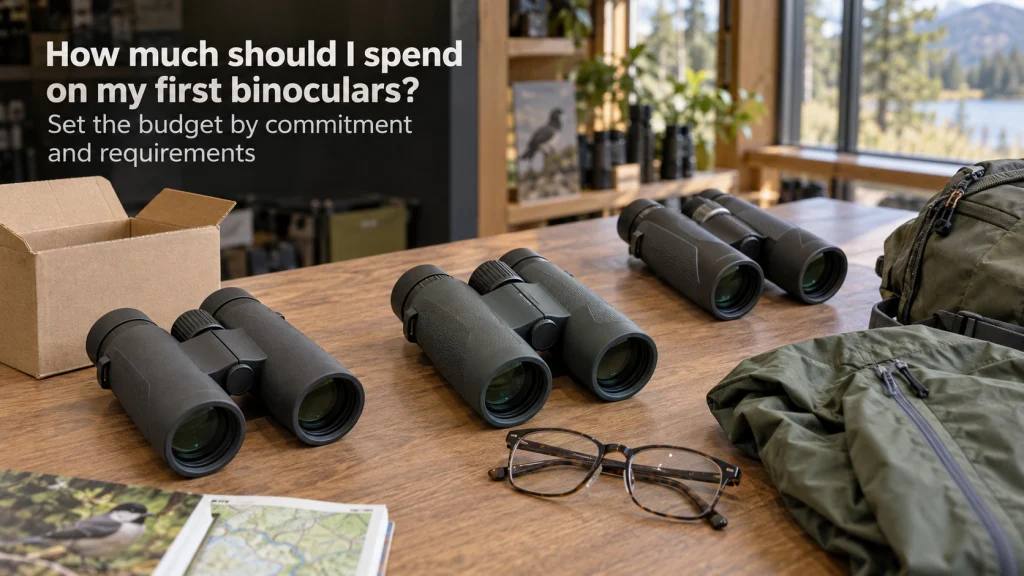
Your first binocular budget should follow the job the binoculars need to do, how often you expect to use them, and how certain you are about fit. A low-risk trial purchase can justify a lower ceiling, while a pair meant for frequent outdoor use may justify more spending on weather protection, handling, eye relief, and support. Current retail choices exist across several price levels, so beginner status alone is not a reason to choose either the cheapest option or a premium one. The useful question is whether the next level of spending solves a requirement you can name.
Two beginners can rationally spend very different amounts
If your question is “How much should I spend on my first binoculars?”, beginner status alone cannot set the number. Someone buying a pair for one vacation, one sporting event, or occasional backyard viewing has a different risk profile from someone who already expects to use binoculars every week for years. The first buyer may value a low trial cost and an easy return more than refined optics. The second may care more about long-term comfort, weather resistance, warranty coverage, and avoiding an early replacement.
That is why I would start with the role of the first pair, not with a universal dollar target. The broader first binocular decision process helps define what the first pair needs to accomplish, while the binocular buying guide covers the wider buying factors that sit beyond budget alone. Once the use case is clear, price becomes a filter rather than a guess. That change in order prevents a common beginner mistake: choosing a price first and then trying to force every other requirement to fit inside it.

This 8x42 roof-prism binocular uses an ED lens and fully multi-coated optics for outdoor viewing. Its listed 17.2 mm eye relief gives beginners a concrete fit specification to compare, especially when eyeglasses matter. The waterproof body and 8.12-degree field of view make it a practical candidate for testing how real requirements shape a first-binocular budget.
Check on AmazonIf you click this link and buy, we earn a commission at no additional cost to you.
Define commitment before assigning a number
Commitment is not a promise that you will stay with a hobby forever. It is simply your best estimate of how often the binoculars will come out of the case and how costly a poor fit would be. A pair used twice a year can tolerate compromises that become annoying during weekly use. Frequent use makes comfort, focus behavior, weight, weather protection, and support more important because small frustrations repeat.
The goal is to separate requirements from preferences before a price band starts influencing the decision. A lighter body may be a requirement for hiking, while a premium finish is probably a preference. Long enough eye relief can be non-negotiable for an eyeglass wearer, while a slightly more elaborate accessory package may add little value. The more clearly those categories are separated, the easier it becomes to decide whether spending more is solving a real problem.
Decide whether this is a trial purchase or a long-term first system
A trial purchase is mainly buying access to the activity at controlled cost. If you are unsure whether birding, stadium viewing, travel observation, or casual nature watching will become regular, it is reasonable to keep the ceiling lower and preserve room for a later upgrade. A long-term first pair has a different job because it is expected to remain comfortable and dependable after the novelty wears off. In that case, paying more can make sense when the extra cost clearly buys better fit, weather protection, handling, or support that you expect to use repeatedly.
Define the likely use before setting the number
Viewing conditions can move the budget more than beginner status does. Bright daytime sightseeing is forgiving, while frequent dawn, dusk, wet weather, long carry periods, or fast-moving subjects can make field of view, weight, grip, eye relief, and sealing more important. The same is true if the binoculars must fit a small bag or stay comfortable during long sessions. Set the use case first, then ask what current options meet it without paying for features that will rarely matter.
List fit and weather requirements that cannot be traded away for price
Price cannot rescue a binocular that does not fit your face, hands, or eyeglasses. Check interpupillary adjustment, usable eye relief, eyecup positions, focus access, weight, and grip rather than assuming a common configuration such as 8×42 will fit everyone. If rain, humidity, or rapid temperature changes are realistic parts of the use case, verify the exact model’s environmental protection instead of relying on vague outdoor language. A cheaper pair that meets those requirements is a better first purchase than a more expensive one that does not.
Use current market evidence instead of an evergreen universal dollar floor
Beginner guides and owner discussions often quote very different budgets because they are answering different use cases. One activity-specific guide may describe a few hundred dollars as a useful range, while another first-time buyer may be trying to stay near a much lower ceiling for casual use. Current retail listings also show that functional binoculars exist below several commonly repeated thresholds. That evidence supports a flexible method, not a rule that every beginner should spend the same amount.

This 8x42 roof-prism binocular is waterproof and nitrogen filled for outdoor use. Its 20.2 mm eye relief is a useful specification for comparing comfort when eyeglasses are part of the fit requirement. A listed 377-foot field of view gives beginners another concrete viewing metric to weigh against long-term use.
Check on AmazonIf you click this link and buy, we earn a commission at no additional cost to you.
Compare what different spending levels actually change
A price band is useful only when it is connected to requirements. Moving up in price can widen the number of candidates with better coatings, weather protection, more comfortable eye relief, smoother mechanics, stronger warranty terms, or lower weight, but those benefits are model specific. It does not follow that every more expensive binocular improves every part of the viewing experience. Fit, field of view, focus behavior, and physical balance can still make the less expensive option the better match.
For a first purchase, I would treat common ceilings such as under $100, under $200, and around $500 as search boundaries rather than quality grades. Start at the lowest level where multiple candidates satisfy the non-negotiables, then move upward only when a requirement remains unsolved. This keeps the budget tied to an observable improvement. It also makes it easier to stop spending when the next tier adds refinement without changing the job the binoculars can do for you.
Under $100 can work as a trial ceiling when a credible fit exists
The sub-$100 market is not automatically useless. Current retail listings include binoculars at this level with ordinary full-size configurations and basic outdoor features, so a careful buyer can sometimes find a workable trial pair. The trade-off is that choice may be narrower once you add demanding fit, eye relief, weather, weight, or optical requirements. If a candidate fits well, has a return path, and meets the actual use case, a lower ceiling can be rational for someone testing whether binocular use will become regular.
Under $200 usually creates a broader choice set
Moving toward $200 often expands the number of models that combine mainstream configurations with more complete outdoor feature sets. That extra choice matters because the first pair is still partly a fit experiment, and more candidates make it easier to reject a poor eyecup position, uncomfortable bridge shape, excessive weight, or unsuitable field of view without abandoning the budget. The point is not that $200 is a magic threshold. It is that a wider choice set can make requirement matching easier.
A first-time buyer does not need to use a $500 ceiling just because the money is available
A larger budget can buy refinements, but the first purchase does not need to consume the entire ceiling. If a lower-priced pair already fits, handles well, covers the viewing conditions, and provides the support you want, spending the remaining amount may not improve the first-pair job in a meaningful way. The unused budget also preserves flexibility if later experience reveals a preference you could not predict at the start. Paying more is easiest to justify after you can identify exactly what the additional money changes.
Pay more only when the refinement solves the first-pair job
Useful refinements can include lower weight, more generous eye relief, a wider field, better environmental protection, more precise focus feel, improved coatings, or stronger support. None of those deserves a premium in isolation. A wider field matters more for someone following moving subjects than for someone mainly studying stationary scenery, and lower weight matters more during long carry periods than from a fixed viewing spot. Spend on the refinement that removes a real limitation, not on the longest feature list.
Return policy has extra value when fit is still unknown
A first-time buyer often has not yet learned which eyecup position, eye relief, bridge width, focus resistance, or weight feels comfortable over a full session. That uncertainty makes the seller’s return conditions part of the practical value of the purchase. Read the policy before ordering, keep packaging until fit is confirmed, and test normal viewing positions promptly. A slightly higher purchase price can be reasonable if it buys a safer way to discover that the binoculars do not fit.

This 10x42 binocular combines HD optics with waterproof, fogproof, and shockproof construction. Amazon lists 17 mm eye relief and a tripod mount, while the package includes a GlassPak harness. Those verified features make it useful for comparing what a broader feature set actually changes instead of treating a spending tier as a quality grade.
Check on AmazonIf you click this link and buy, we earn a commission at no additional cost to you.
Choose a spend that matches the first-pair role
Once the requirements and market level are clear, the final budget should be easy to explain in one sentence. For example, a buyer might choose a lower ceiling because the pair is for occasional travel and the hobby is uncertain, or choose a higher ceiling because the binoculars will be carried weekly in wet conditions while wearing glasses. That sentence is more useful than saying the budget is simply what feels affordable. It creates a reason that can be checked against real specifications and policies.
A simple worksheet helps keep that reasoning visible while shopping. Write down what must be true, what would be nice, and what would trigger waiting instead of buying. Then compare candidates only inside the lowest spending level that can satisfy the must-have column. If every option in that level fails the same non-negotiable, the next step is either to raise the ceiling, change the requirement, buy used with appropriate caution, or wait.
| Decision point | Trial first pair | Long-term first pair |
|---|---|---|
| Expected use | Occasional or uncertain | Frequent and predictable |
| Budget priority | Control downside if the activity does not stick | Reduce repeated fit and ownership frustrations |
| Fit tolerance | Acceptable only if basic comfort is confirmed | Stricter because discomfort will repeat often |
| Weather and build | Match the actual trip or occasional use | Match the regular environment and carry pattern |
| Return and support | High value because preferences are still unknown | High value, with warranty more important over time |
| Reason to spend more | A required feature or fit problem remains unsolved | A repeat-use limitation is removed |
The table is not a scoring system and it does not assign a universal price to either column. Its purpose is to reveal why two new buyers can stop at different levels without either one making a bad decision. If you cannot identify what the extra spending changes in the row that matters to you, there is no strong reason to move up. If a non-negotiable remains unmet, the higher level may be justified.
Warranty matters more for a long-term first pair
Warranty value rises with expected ownership time, but the terms need to be checked rather than assumed from brand reputation. Look at what the exact coverage includes, whether proof of purchase is required, how accidental damage is treated, and what costs remain with the owner. A one-trip trial tool may not justify paying much more solely for a stronger warranty. A pair expected to stay in regular service for years gives that support more time to matter.
Waiting can be rational when every current candidate fails a non-negotiable
Do not lower a genuine fit or use requirement merely to complete the purchase today. If every candidate inside the current ceiling has too little usable eye relief, too much weight, the wrong environmental protection, or an unsuitable carry size, waiting can be the cleaner decision. That does not mean a higher price is automatically better. It means the current price ceiling is not producing a credible match for the job you defined.
Buying used can stretch the budget when condition risk is acceptable
Used binoculars can provide access to a higher original price tier, but the discount comes with condition uncertainty. Check for obvious external damage, smooth hinge and focus movement, clean viewing, intact eyecups, and signs of moisture or severe internal misalignment before accepting the purchase. Confirm what return protection or warranty, if any, still applies. If you cannot inspect condition confidently or return a bad example, the lower price may not compensate for the risk on a first pair.
Do not overspend just to reach a prestige tier
A binocular is a viewing tool, not a test of whether a beginner is serious enough. If a higher tier requires stretching beyond the budget you deliberately set, step back and ask which requirement is actually being purchased. Waiting is reasonable when the feature matters, and choosing a lower tier is reasonable when it does not. Prestige by itself is not a viewing requirement.
- Start with likely use frequency and viewing conditions.
- Mark eye relief, weight, grip, weather protection, and carry size as required or preferred.
- Search the lowest current price level that offers more than one credible match.
- Check return terms before treating the purchase as low risk.
- Record why a candidate was rejected before raising the ceiling.
This sequence prevents the price ladder from becoming the decision itself. It also separates purchase timing from seriousness: waiting, buying used, or choosing a lower tier can all be rational outcomes. Keeping a short reason for each rejected candidate makes later comparisons more consistent. The purchase then stays grounded in fit and use rather than status.

This 8x42 roof-prism binocular has 17 mm eye relief, fully multi-coated optics, and a waterproof body. Its listed 393-foot field of view gives a concrete viewing specification to compare with the role of a first pair. The GlassPak harness stores and protects the binoculars while keeping them accessible for regular outdoor use.
Check on AmazonIf you click this link and buy, we earn a commission at no additional cost to you.
Final Thoughts: Set the first-pair budget around role and commitment
The best first-binocular budget is the lowest level that gives you a credible fit for the job you actually plan to do. A trial buyer can reasonably keep the ceiling lower when the use is occasional and the activity is uncertain. A frequent user can reasonably spend more when the extra cost solves repeat problems involving comfort, weather, weight, viewing conditions, or support. Neither buyer needs a universal beginner minimum.
Before paying, verify the exact fit, eye relief, weight, environmental protection, return terms, and warranty that matter to your use case. If a cheaper candidate meets those needs, there is no rule requiring you to move up. If every candidate fails a non-negotiable, wait or raise the ceiling for that specific reason. The budget should be the result of the decision, not the starting point.

This 10x42 binocular uses an HD optical system and is built for waterproof, fogproof, and shockproof outdoor use. The adjustable eyecups and center focus support basic fit and viewing setup, while tripod adaptability adds another use option. The included GlassPak harness provides a practical carry solution for checking whether the final feature set matches the role and commitment level defined in the article.
Check on AmazonIf you click this link and buy, we earn a commission at no additional cost to you.
FAQs
💵 Is $100 enough for first binoculars?
It can be enough for a trial purchase if a current option fits your face, eyeglasses, carry needs, and viewing conditions. Treat $100 as a ceiling to test, not as proof that every binocular below it is adequate.
🔭 How much should beginners spend on binoculars?
There is no single beginner amount. Set the spend from expected use frequency, fit requirements, weather exposure, return risk, and whether the pair is a short trial or a long-term tool.
👓 Should I spend more if I wear glasses?
Only if more spending is needed to get usable eye relief and eyecups that let you see the full field comfortably. Check the exact model because the same price or configuration does not guarantee the same eyeglass fit.
🌧️ Is waterproofing worth paying extra for on a first pair?
It is worth prioritizing when the binoculars will regularly face rain, humidity, or outdoor temperature changes. Verify the exact environmental protection rather than assuming every outdoor model provides the same sealing.
🧾 Does a return policy matter if the specifications look right?
Yes, especially for a first pair because specifications cannot fully predict face fit, eyecup comfort, grip, focus feel, or balance. A usable return window reduces the cost of discovering that the binoculars do not fit you.
♻️ Are used binoculars a good way to save money?
They can be, provided you can evaluate condition and have acceptable protection if the pair has hidden problems. For a first purchase, avoid a used deal that leaves you unable to return a binocular with damage, moisture, or alignment issues.
References and Sources
- Birdr beginner binocular guide: provides an activity-specific example of a beginner spending range rather than a universal rule.
- First-time buyer discussion: shows how a new buyer can combine a modest target budget with long-term durability and comfort goals.
- B&H sub-$100 retail listing: confirms that current U.S. retail inventory can include a full-size outdoor configuration below the $100 ceiling.
- B&H binocular listings: supports the point that broader current U.S. retail choice exists around the under-$200 level and above.