Two binoculars can look equally suitable on a spec sheet and still produce different buying decisions once you hold them to your face. A useful pre-purchase test checks personal fit, access to the full field, control reach, handling and obvious sample problems without pretending to measure laboratory optical quality. The same basic workflow works in a store or during an eligible return period after delivery. The goal is not to prove which binocular is universally better, but to reject a candidate when fit, controls or sample condition leave important uncertainty.
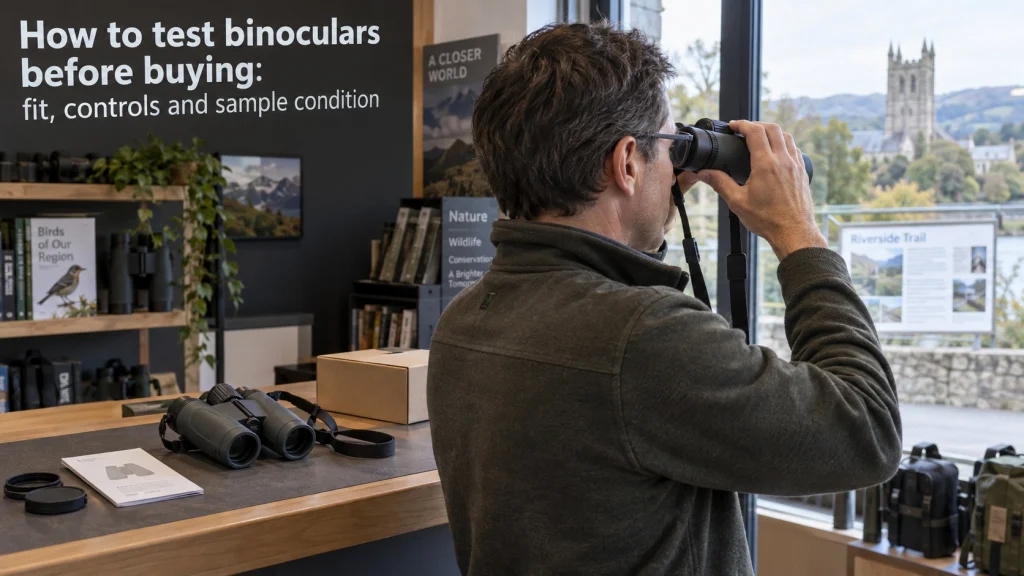
Two good spec sheets can still produce different decisions in your hands
Specifications can narrow a shortlist, but they cannot tell you whether a particular body fits your face, whether your index finger reaches the focus wheel naturally or whether you can hold the full field without constantly correcting eye position. That is where knowing how to test binoculars before buying becomes useful. The first binoculars decision guide helps narrow the type of binocular that makes sense before this stage, while the broader binocular buying guide explains the specifications that shape the shortlist. Once two candidates have survived that work, the test in your hands becomes a different kind of filter. It asks whether the published promise and the actual sample are easy to use together.
A store check should be simple enough that you can repeat it on both candidates under the same conditions. Use the same glasses, the same basic hold, the same detailed target and the same lighting whenever possible, then pay attention to differences that affect normal ownership rather than trying to invent a miniature optics laboratory. A remote buyer can follow the same sequence after delivery while staying within the seller’s current return terms and preserving the item as required by that policy. If you are still making broad configuration choices rather than evaluating a specific candidate, the article on beginner binocular choices belongs earlier in the decision.

These 8x42 binoculars use adjustable twist-up eyecups, making them suitable for repeated eyeglass and eye-position checks. The listing identifies waterproof and fogproof construction and includes the GlassPak harness. Compare fit, focus reach, and full-field access with the same hold and lighting used for the other finalist.
Check on AmazonIf you click this link and buy, we earn a commission at no additional cost to you.
Check physical fit and full-field access before judging image quality
Start with fit because a poor eye position can make an otherwise capable binocular look worse than it is. Set the eyecups for the way you actually view, adjust the hinge until both barrels resolve into one comfortable circular field, and bring the binocular to your eyes the same way several times. You are looking for a repeatable viewing position, not a single lucky moment when everything happens to line up. If you must hunt for the image every time, that is already useful buying information.
Keep personal fit separate from sample condition as you test. A narrow or awkward fit may be wrong for you even when the binocular is functioning normally, while gritty controls, loose parts or visible contamination may indicate a problem with that particular sample. That distinction prevents you from blaming your face for a mechanical issue or rejecting an entire design because one unit appears questionable. It also makes a return or exchange decision easier to explain.
Decide what this test can and cannot prove
This workflow is an acceptance test, not a scientific measurement of transmission, resolution, collimation, durability or long-term mechanical life. A sharp central view under store lighting does not prove that every optical parameter is excellent, and a short handling check does not predict years of service. What the test can do is reveal whether you can use the binocular comfortably, whether its controls behave normally enough for purchase and whether the sample shows an obvious reason to reject it. Treat any conclusion beyond that boundary as uncertain unless it is supported by documented testing.
Match eyecups and interpupillary distance before judging the view
Set the eyecups to suit your actual viewing condition before you judge brightness or sharpness. If you wear glasses while observing, test with those glasses on and begin with the eyecups in the position recommended by the manufacturer for eyeglass use. Adjust the hinge until the left and right views combine into one circular field without forcing your eyes inward or outward. If the image only works at an uncomfortable hinge position or the eyecup setting never lets you settle naturally behind both eyepieces, record that as a fit problem rather than trying to talk yourself around it.
Check whether the full field is easy to hold
Once the eyecups and hinge are set, look at a detailed target and notice whether the field stays open without dark crescents appearing around the edges. Move your head a small amount, then return to your normal viewing position and see whether the complete view comes back easily. The point is not to demand that the image remain perfect through careless eye placement, but to learn how forgiving the binocular is for your face and viewing habits. A full field that requires constant micro-adjustment can become more annoying than a specification sheet suggests.
Reach and turn the focus wheel without changing your grip
Bring the binocular up normally and check whether your focusing finger lands on the focus wheel without shifting the rest of your hand. Turn the wheel through the range you would use on nearby and more distant objects, paying attention to smoothness, resistance and any obvious slack or sticking. The best feel is not a universal amount of resistance because hand size and preference differ, but the control should be predictable enough that you can make small corrections without disturbing the view. Repeat the motion on the second candidate using the same grip before deciding which control layout is easier for you.
| What you notice | Likely category | What to do next |
|---|---|---|
| You cannot reach a stable full field with your normal eyeglasses or eye position | Personal fit | Try another eyecup setting if the manual allows it, then reject the fit if the problem remains |
| The focus wheel placement forces an awkward grip every time | Personal fit or control layout | Compare another candidate using the same hold |
| A control feels gritty, catches, has abnormal play or will not hold its setting | Possible sample condition | Compare another unit or use the seller’s return or exchange path |
| You see obvious internal contamination, damage or a visibly loose component | Sample condition | Reject or return the sample without opening it |
The useful question is not whether every difference is technically defective. The useful question is whether the difference belongs to your anatomy and handling, to the design itself or to the condition of the specific sample. That classification keeps the next step practical. It also stops a quick fit check from turning into amateur diagnosis of internal optics.
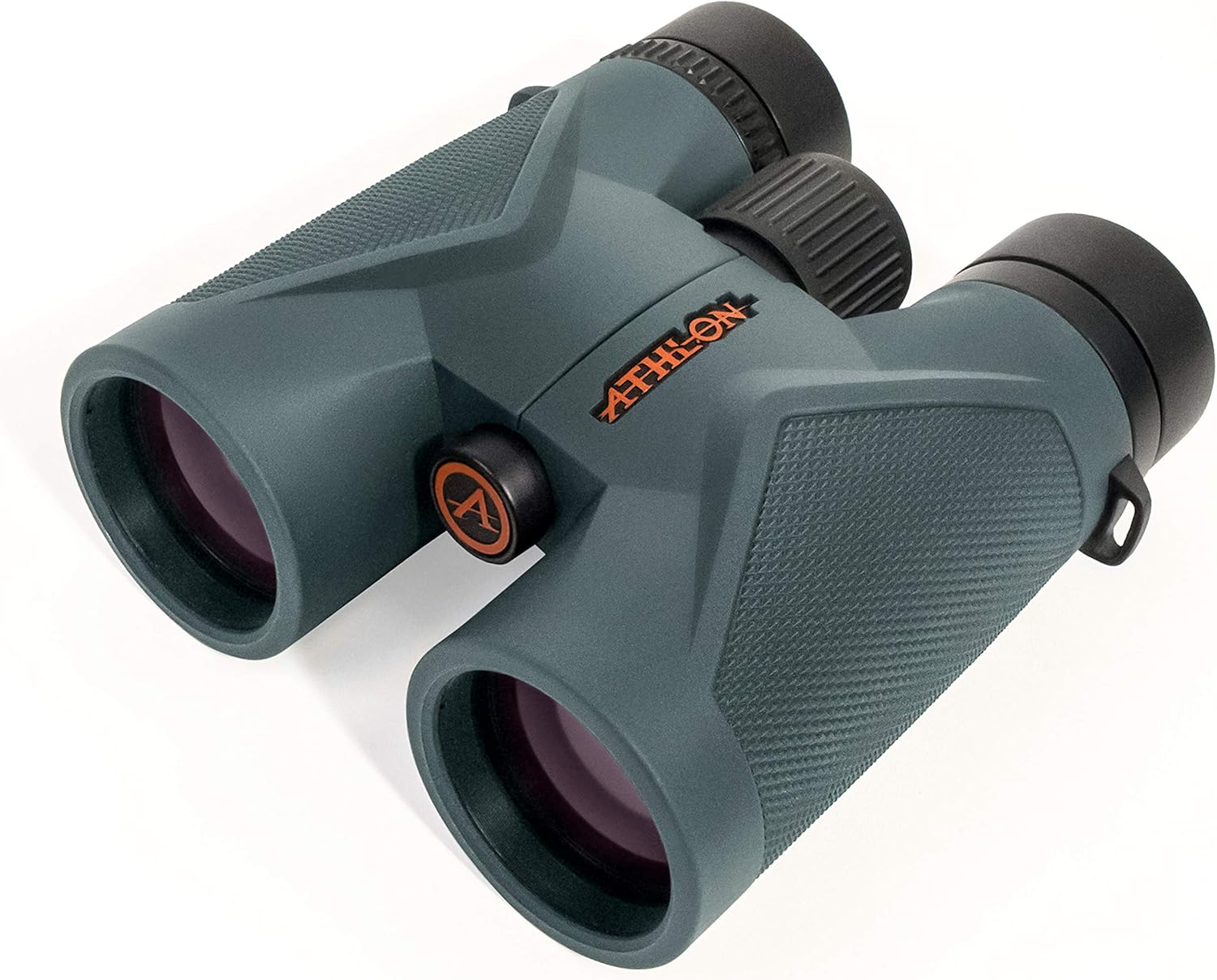
The Midas UHD is an 8x42 roof-prism binocular with 17.2 mm eye relief and an 8.1-degree field of view on the Amazon listing. Its 5.25 mm exit pupil and waterproof construction fit the full-size 8x42 format. Use your normal glasses and eyecup position to see whether the published field is comfortable and repeatable for your face.
Check on AmazonIf you click this link and buy, we earn a commission at no additional cost to you.
Evaluate the controls, handling and condition of the actual sample
After fit is stable, test the parts you will touch during ordinary use. Keep the sequence consistent so one binocular does not get a careful evaluation while the other gets a casual glance. The focus wheel, diopter, hinge and eyecups should all be judged as controls, not as marketing features. What matters is whether they let you establish and maintain a usable view without fighting the mechanism.
This is also the point to inspect the particular sample rather than the model name. A well-reviewed design can still arrive with a damaged eyecup, contaminated optical surface, loose component or control that does not feel right, and a store demonstrator may have been handled heavily. You do not need to identify the internal cause to make a purchase decision. If a sample gives you a clear reason for concern, compare another unit or use the seller’s allowed return path instead of opening the binocular.
Verify that the diopter works through its normal control range
The diopter is there to balance focus between your eyes, but this article does not need to become a full setup tutorial to verify that the control behaves normally. Follow the exact manufacturer’s instructions for the model, make a modest adjustment, and confirm that the control moves predictably and can reach a usable setting for you. If the model uses a locking or integrated diopter, check that the mechanism engages and releases as described rather than forcing it. Do not use excessive pressure or continue turning beyond the intended control range in an attempt to fix a problem.
Compare grip, balance and control access with the same hold
Hold each candidate in the same viewing posture and notice where the weight seems to sit relative to your hands. A binocular can be heavier on paper yet feel easier to control if the shape, bridge and balance work well for your grip, while a lighter one can feel awkward if your fingers have nowhere comfortable to rest. Raise each pair to your eyes several times and check whether your fingers naturally find the focus wheel without covering useful surfaces or pressing against strap lugs. This is a personal handling test, so the correct result is the one that remains comfortable and repeatable for you.
Use one detailed target to compare center sharpness and side-to-side consistency
Choose a detailed stationary object that both binoculars can view from the same place, such as printed lettering, textured material or fine structural detail. Focus carefully at the center, then move your attention across the field and look for any obvious imbalance in clarity or brightness from one side to the other. Some edge softness can be part of an optical design, so the goal is not to declare every change toward the edge a defect. You are checking for an obvious inconsistency that makes one sample look wrong compared with itself or with another unit under the same conditions.
Look for obvious damage or contamination without opening anything
Inspect accessible exterior surfaces under normal light and operate only the owner controls described by the manufacturer. You are looking for obvious reasons to reject a sample, not trying to diagnose the internal optical train. A short store-demo card can keep the check focused:
- Confirm eyecups move through their intended positions and stay where set.
- Confirm the hinge moves smoothly enough to set your eye spacing and then holds that position.
- Check the focus and diopter controls for predictable movement without obvious grinding, catching or abnormal looseness.
- Look through both barrels for obvious contamination, damage or a strong side-to-side mismatch that persists after normal adjustment.
- Inspect the body, objective areas and eyepieces for visible impact damage, cracks or loose external parts.
If the sample fails one of these checks, ask to compare another unit of the same model when that option exists. A second sample can help separate a design trait from a problem unique to the first unit, but you still do not need to identify the technical cause. Do not remove covers, open housings, adjust internal screws or attempt collimation. Any concern that requires internal access belongs with the seller, manufacturer or qualified service provider.

The Terra ED 8x42 listing highlights a large, easy-to-grip focus wheel designed for quick focusing. It is a waterproof 8x42 binocular with coated glass, giving this section a concrete sample for checking control feel and exterior condition. Work the normal controls gently and reject any individual unit that shows abnormal play, grinding, or damage.
Check on AmazonIf you click this link and buy, we earn a commission at no additional cost to you.
Use the same test to protect the purchase decision in a store or at home
The test becomes more useful when every candidate faces the same simple task. Keep the target, light, eyeglasses, basic hold and approximate viewing distance as similar as practical, then change one binocular at a time. This reduces the chance that a brighter corner of the store, a different target or a rushed second trial decides the result for you. It also makes small handling differences easier to notice because you are not changing several conditions at once.
The same discipline works after an online order arrives, but the return policy becomes part of the test procedure. Read the seller’s current terms before using the product beyond what the policy allows, keep required packaging and documentation intact, and complete your acceptance checks while return or exchange options remain open. Do not assume that one retailer’s policy applies to another retailer or marketplace seller. A remote test is useful precisely because it gives you a planned decision point instead of letting uncertainty linger until returning the item becomes difficult.
Compare candidates under the same simple target and light
Use a target with enough fine detail to make focusing easy and place both candidates in the same general viewing position. If daylight is available for both, compare both in daylight; if you are limited to indoor lighting, keep both in that same indoor condition and avoid turning the result into a claim about outdoor low-light performance. Make a short note about fit, focus feel, full-field access, balance and any obvious image inconsistency before switching models. This is a better comparison than relying on memory after several unrelated trials.
Test with the glasses you actually wear for observation
If you normally observe through binoculars while wearing glasses, those glasses belong in the test. Eye relief numbers can narrow a shortlist, but the eyecup design, your frame shape and the distance between the lens of the glasses and your eye all affect whether you can see the field comfortably. Set the eyecups according to the manufacturer’s instructions and check whether you can reach a full view without pressing the binocular hard against your frames. If you normally remove your glasses for viewing, test that normal routine instead of creating an artificial condition just for the store.
Treat the seller’s return terms as the remote version of the store test
Remote-buyer version: Before ordinary use, confirm the exact seller’s current return or exchange conditions, keep required packaging and accessories together, then run the same fit, control and sample checks you would perform at a counter. Record any problem clearly enough that you can decide whether it is a personal fit issue, a design preference or a questionable sample. If a return is needed, use the seller’s documented process rather than continuing to experiment with a unit you already plan to reject. Return eligibility is a transaction term, so verify it from the seller instead of assuming a general binocular rule.
This approach matters because a delivery box can create a false sense that the decision is already finished. It is not finished until the binocular fits, the normal controls behave as expected and the particular sample passes a basic owner-level inspection. The acceptance test should happen before you add unnecessary wear or make changes that could complicate a return. That keeps the purchase decision reversible while the evidence is still clear.
Stop at persistent double image or malfunction instead of attempting repair
If normal eyecup, hinge, focus and diopter adjustment do not produce a usable view, do not move into internal adjustment. Persistent double image, a control that will not operate normally, obvious internal damage or a loose optical component is enough reason to stop and use the seller, manufacturer or qualified service route. A buyer-level acceptance test cannot prove the internal cause, and it does not need to. The safe decision is to preserve the binocular and use the available return, exchange or service path rather than trying to repair an unfamiliar sample.
If your shortlist itself still feels unstable, review the common first binocular buying mistakes before blaming the test. A mismatch in magnification, field of view, eye relief, weight or use case can survive a quick store comparison if the original shortlist was built around the wrong priorities. The acceptance workflow is strongest after the basic buying decision is already sensible. It should confirm or reject a candidate, not rescue a poorly defined use case.

The Nature DX 8x42 uses phase-coated BaK-4 prisms, fully multi-coated optics, and 42 mm objective lenses according to the Amazon listing. Its rubber-armored waterproof body makes it a straightforward full-size candidate for the same repeated acceptance test. If ordered online, check fit, controls, and sample condition while following the seller's current return requirements.
Check on AmazonIf you click this link and buy, we earn a commission at no additional cost to you.
Final Thoughts: use the test to reject uncertainty the spec sheet cannot resolve
A good pre-purchase test is deliberately modest. It verifies whether the binocular fits your eyes and hands, whether the main controls are reachable and predictable, whether you can access the field comfortably and whether the actual sample shows an obvious reason for concern. Those observations can change a buying decision even when two candidates look equally convincing on paper. They do not need to become claims about laboratory optical performance to be useful.
Run the same sequence on every finalist and keep personal fit separate from sample condition. With an online purchase, make the return or exchange terms part of the workflow before ordinary use begins, and stop rather than opening the binocular when a problem appears internal. The best outcome may be choosing one candidate, asking for another sample or returning both and reconsidering the shortlist. Each of those outcomes is better than keeping a binocular whose uncertainty was visible before the purchase became difficult to reverse.

The Carson 3D ED TD-842ED is an 8x42 roof-prism binocular with 19.5 mm eye relief and ED glass. Amazon lists it as waterproof and fog proof, with a compact design. Use it as another real candidate for the article's final keep-or-return check, separating personal fit from any problem specific to the sample.
Check on AmazonIf you click this link and buy, we earn a commission at no additional cost to you.
Frequently asked questions
🔭 What should I check first when testing binoculars in a store?
Start with eyecup position, interpupillary distance and whether you can see one comfortable full field. Judge sharpness only after your eye position is stable, because poor fit can make the view look worse than it is.
👓 Should I test binoculars while wearing my glasses?
Yes, if glasses are part of the way you normally observe. Use your actual glasses, follow the manufacturer’s eyecup guidance and check whether the full field is accessible without pressing the binocular hard into the frames.
🎯 Can a store test prove that binoculars have excellent optical quality?
No. A store test can reveal fit, control feel, obvious sample problems and useful image differences under the conditions available, but it is not a laboratory measurement of resolution, transmission, collimation or durability.
⚙️ What should a focus wheel feel like before I buy?
There is no universal preferred resistance, but the wheel should feel predictable for your hand and allow small corrections without obvious sticking, grinding or abnormal slack. Compare candidates with the same grip rather than judging one in isolation.
📦 How do I test binoculars bought online without losing the return option?
Read the exact seller’s current return conditions first, preserve whatever packaging and documentation the policy requires, and perform the basic fit, control and sample checks before adding unnecessary wear. If a problem appears, use the seller’s documented return or exchange process rather than opening or repairing the binocular.
🛠️ Should I try to fix persistent double image before returning a new pair?
No. After normal owner adjustments are correct, persistent double image or obvious malfunction should be routed to the seller, manufacturer or qualified service provider instead of internal adjustment or DIY collimation.
References and Sources
- REI binocular buying guidance: Supports in-store comparison of focusing ease, hand comfort, sharpness, brightness and side-to-side consistency.
- Birdwatching.com binocular testing guidance: Supports checking eyecups, interpupillary distance, focus-wheel behavior, fit, balance and image consistency.
- Nikon binocular adjustment guidance: Supports manufacturer-level handling of eyecups, full-field access and diopter focusing.
- REI returns and exchanges information: Illustrates why return eligibility and procedure are retailer-specific transaction terms that should be checked before a remote acceptance test.