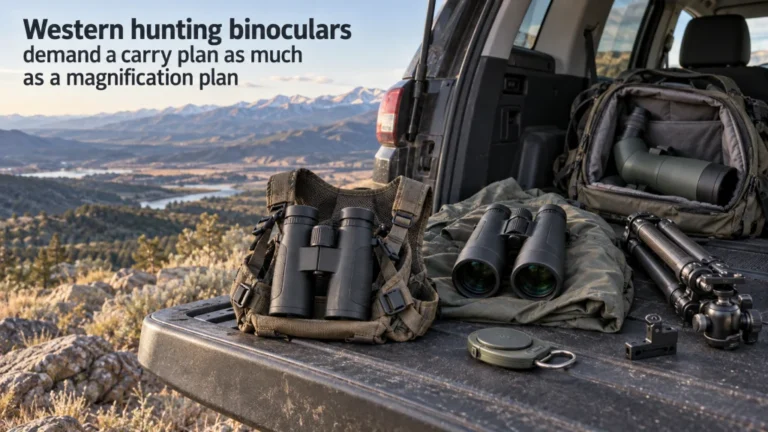
An 8×42 versus 10×42 hunting choice is not a contest between a weak option and a strong one. With the same 42 mm objective, 10x gives more image scale, while 8x often gives a wider viewing window and a larger geometric exit pupil. A current ZEISS comparison within one product family shows why exact specifications matter: its 8×42 and 10×42 versions have the same listed weight and eye relief, yet their field of view differs meaningfully. Choose the configuration that repeatedly solves your real viewing constraint, then verify the exact model rather than trusting a terrain slogan.
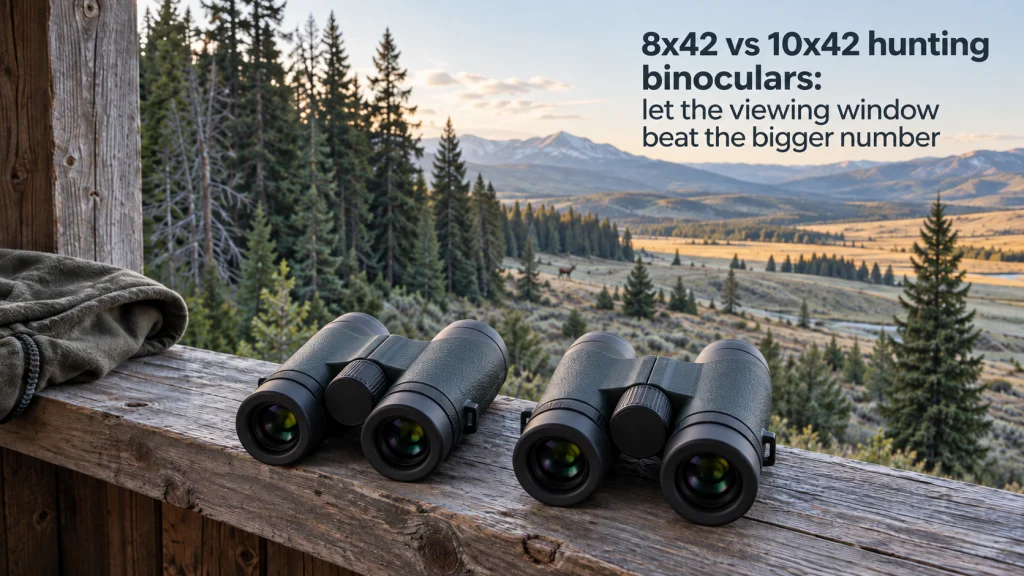
The same 42 mm objective can produce two very different hunting views
Put the same distant animal into two different scenes and the choice between 8×42 and 10×42 hunting binoculars becomes easier to understand. In dense timber, branches and short openings can make the width of the visible scene more useful than another step of magnification. Across a broad open basin, the subject may stay small enough that the extra image scale of 10x becomes useful for sustained observation. Neither scene proves a universal winner because the repeated viewing problem is what changes.
If you are still defining the overall use case, start with choosing hunting binoculars around terrain and viewing workflow before treating magnification as the first decision. It also helps to keep the broader binocular buying priorities that determine fit and usability in view, especially field of view, eye relief, weight, handling, and weather protection. The useful comparison begins only after objective size is held constant and the actual viewing constraint is clear. From there, 8x and 10x become different tools rather than a ranking from basic to better.

This 8x42 roof-prism binocular uses fully multi-coated optics and a waterproof, nitrogen-purged housing. Its 8x magnification and 42 mm objective match the format discussed in this section. Twist-up eyecups and a rubber-armored body support outdoor viewing and handling.
Check on AmazonIf you click this link and buy, we earn a commission at no additional cost to you.
Hold objective size and product family constant before comparing 8x and 10x
Comparing an 8×42 from one brand with a 10×42 from another can hide the effect you are trying to isolate. Field of view, eye relief, focus behavior, housing shape, coatings, weight, and eyecup design can all change at the same time. A comparison within one product family is cleaner because more of those variables stay controlled. That does not make every pair identical, but it gives magnification a fairer test.
The current ZEISS Conquest HDX 8×42 and 10×42 make a useful controlled example rather than a product recommendation. ZEISS lists both at 25.2 ounces, both with 16.5 mm exit pupil distance, and both with the same 42 mm objective diameter. The 8×42 is listed at 384 feet of field of view at 1,000 yards, while the 10×42 is listed at 345 feet. That is exactly why a buyer should compare the configuration inside one product family before turning a generic rule into a purchase decision.
| ZEISS Conquest HDX specification | 8×42 | 10×42 |
|---|---|---|
| Magnification | 8x | 10x |
| Objective diameter | 42 mm | 42 mm |
| Field of view at 1,000 yd | 384 ft | 345 ft |
| Exit pupil distance | 16.5 mm | 16.5 mm |
| Listed weight | 25.2 oz | 25.2 oz |
The important point is not that one ZEISS configuration settles the entire category. It shows that equal objective size does not force a weight penalty when magnification rises, while field of view can still change meaningfully. Another brand may pair the same magnifications with different eye relief or a small weight difference. Verify the exact two models you are actually considering.
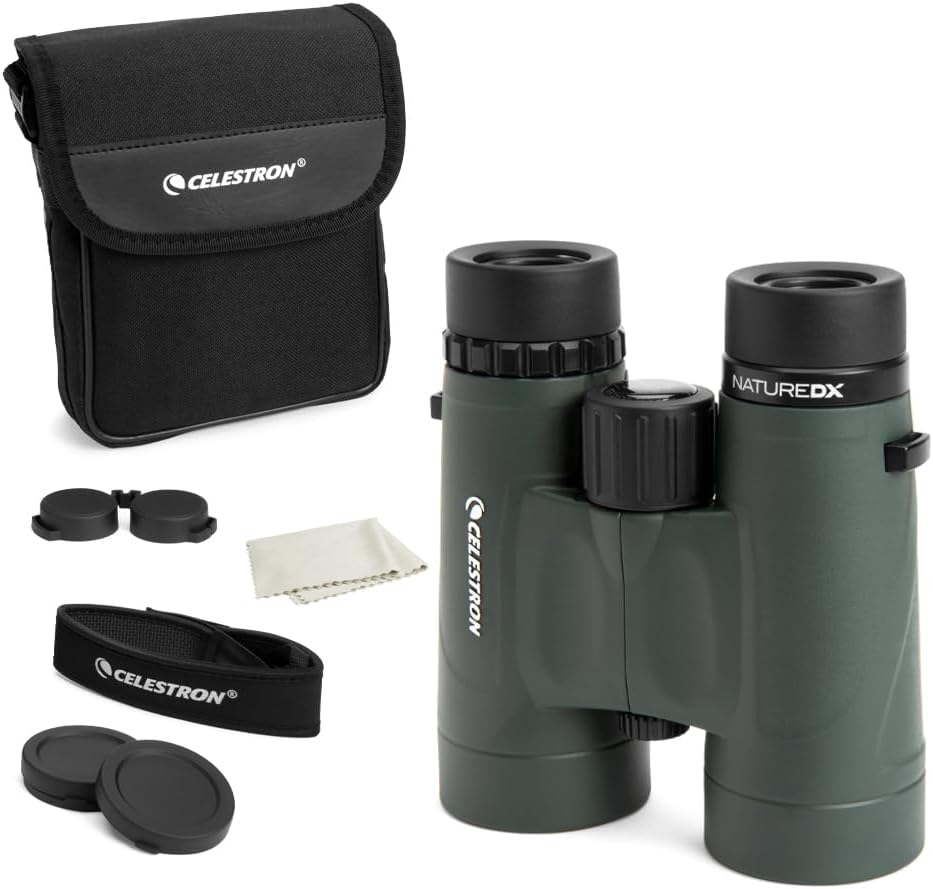
This 10x42 binocular combines 10x magnification with a 42 mm objective in the same Nature DX family as the 8x42 version. Its phase-coated roof prism, nitrogen-purged housing, and twist-up eyecups are listed for this model. It provides a same-family counterpart for comparing magnification while holding objective size constant.
Check on AmazonIf you click this link and buy, we earn a commission at no additional cost to you.
10x gives more image scale, not an automatic observation advantage
The clean benefit of 10x is simple: the subject occupies more of the view than it does at 8x. That can help when the observation repeatedly happens across broad open ground and the subject remains small in the 8x view. The extra scale is useful only if you can keep the subject in the field, settle the image well enough to use the detail, and remain comfortable for the length of the viewing session. Magnification is therefore a gain with conditions, not a free upgrade.
The difference also needs to be kept in proportion. Moving from 8x to 10x is a 25 percent increase in magnification, not a transformation into a different class of optic. If the problem is poor fit, a narrow field, short eye relief with glasses, awkward balance, or weak optical quality, the extra 2x magnification will not repair it. For a broader explanation of how magnification should be matched to hunting use, see how to choose hunting binocular magnification by viewing need.

This 10x42 model uses Vortex HD optics and is tripod adaptable. The listing identifies it as waterproof, fogproof, and shockproof, with a GlassPak harness included. Its 10x42 format directly illustrates the additional image scale discussed in this section.
Check on AmazonIf you click this link and buy, we earn a commission at no additional cost to you.
Test 8×42 and 10×42 against the conditions that actually limit your view
A useful comparison starts with the moments when your current view fails, not with a map region or a favorite number. Think about whether you repeatedly lose subjects in cover, struggle to keep enough landscape visible while scanning, or wish distant subjects occupied more of the image. Also note how long you normally observe at one time and whether you can brace against a tree, pack, rail, or other stable support. Those constraints decide whether width or scale deserves more weight.
Do not reduce the decision to one specification either. A wide field that is uncomfortable with your glasses can still be a poor fit, and more magnification that exposes too much hand movement can erase some of the expected benefit. The best choice is the one that removes the recurring problem without creating a larger one. The following three checks make that trade easier to see without pretending that every 8×42 or 10×42 behaves identically.
8x usually preserves more field in comparable designs, but verify the exact model
Lower magnification often comes with a wider field of view when the two binoculars come from the same family. A wider field can make it easier to acquire a subject that appears between branches, recover it after it passes behind cover, or scan without moving the binocular as much. That is a viewing advantage, not a guarantee that every 8×42 beats every 10×42 on field width. Read the exact feet at 1,000 yards or meters at 1,000 meters before buying.
The current ZEISS pair gives a controlled field of view example
ZEISS lists 384 feet at 1,000 yards for the Conquest HDX 8×42 and 345 feet for the 10×42. That 39-foot difference is visible on paper without changing objective size, listed weight, or listed eye relief. In dense or broken cover, that wider viewing window may matter more often than the additional image scale of 10x. In open terrain, the balance can reverse because the subject may remain comfortably inside the narrower field.
Exit pupil math shows one geometric difference without deciding the whole low-light question
Geometric exit pupil is objective diameter divided by magnification, so 42 divided by 8 equals 5.25 mm and 42 divided by 10 equals 4.2 mm. ZEISS rounds its 8×42 listing to 5.3 mm and lists the 10×42 at 4.2 mm, which is consistent with that arithmetic. The larger 8×42 exit pupil can make eye placement more forgiving and changes the light bundle leaving the eyepiece. It does not by itself prove that every 8×42 will outperform every 10×42 in every dim scene.
This 8x42 Diamondback HD gives the article a second real-world format to test against viewing conditions. The listing identifies HD optics, waterproof and fogproof construction, and tripod adaptability. Its 8x42 configuration is appropriate for comparing acquisition, steadiness, and field use against a 10x42 alternative.
Check on AmazonIf you click this link and buy, we earn a commission at no additional cost to you.
Exit pupil geometry is not a complete low-light performance ranking
The 5.25 mm versus 4.2 mm calculation is useful because it is transparent and exact for the two nominal configurations. It tells you the diameter of the light beam leaving the eyepiece, not how much useful detail a complete binocular will deliver under every light condition. Transmission, coatings, optical design, stray light control, focus, fit, and the observer all affect what the final view looks like. A larger geometric exit pupil should therefore be treated as one input rather than a brightness verdict.
This matters because low-light claims are easy to overstate in hunting comparisons. A buyer who often observes in dim cover should treat that geometry as one factor alongside fit and optical performance rather than assuming the 8x label settles the question. The dedicated guide to choosing hunting binoculars for low-light conditions covers that broader decision without turning exit pupil into the whole answer. For this comparison, the safe conclusion is narrower: 8×42 has the larger geometric exit pupil when objective diameter stays at 42 mm.

This 8x42 model is waterproof, fogproof, and rubber armored. Nikon lists a wide field of view and long eye relief for this USA model. Its 42 mm objective and 8x magnification produce the 5.25 mm geometric exit pupil used in the article calculation.
Check on AmazonIf you click this link and buy, we earn a commission at no additional cost to you.
Higher power shows more hand movement, but terrain does not create one handheld cutoff
Magnification enlarges subject detail, and it also enlarges the apparent movement caused by your hands and body. That makes 10x more sensitive to imperfect support than 8x for the same user and viewing posture. The effect can become more noticeable during longer observation, while standing unsupported, or when the binocular balance does not suit your grip. It still does not justify the shortcut that 10x always needs a tripod.
Some users hold 10x comfortably for the way they observe, while others get a more useful view from 8x because the image settles faster. The right test is practical: raise both configurations, acquire the same distant subject, hold for a realistic interval, and see which view lets you extract more usable detail rather than more nominal magnification. Bracing can change the result, so include the support you normally have available. Do not turn another person’s steadiness into your personal cutoff.

This metal binocular adapter connects compatible roof or Porro binoculars to a tripod through a standard 1/4-20 mounting interface. It adds a stable support option when hand movement becomes limiting. The elongated thumbscrew allows tool-free attachment to a binocular with the required threaded socket.
Check on AmazonIf you click this link and buy, we earn a commission at no additional cost to you.
Equal objective size does not guarantee equal eye relief, focus behavior, or weather design
The number 42 tells you the objective diameter, not the whole physical or optical design. Two 8×42 and 10×42 versions may share a chassis closely, or they may differ in weight, eye relief, focus travel, eyecup geometry, and balance. Eyeglass wearers should verify the listed eye relief and then confirm that the full field remains usable with their own glasses if possible. A configuration that looks better in a generic chart can still lose on fit.
Weather protection and handling deserve the same exact-model check. Do not infer sealing, lens coatings, focus feel, or operating range from magnification alone, and do not assume that two brands define those features in the same way. The ZEISS example happens to hold several variables constant, which makes it useful for isolating the 8x versus 10x decision. Your final shortlist should be checked against its own manufacturer specifications rather than copied from the controlled example.

This 8x42 Outland X uses BaK-4 prisms and multi-coated optics in a waterproof, rubber-armored body. Twist-up eyecups provide a model-specific fit feature rather than something magnification alone can predict. Its outdoor construction makes it a concrete example for checking exact-model weather and handling details.
Check on AmazonIf you click this link and buy, we earn a commission at no additional cost to you.
Choose toward 8x when wider acquisition through cover is the repeated constraint
Eight power makes the strongest case when the repeated problem is finding and keeping a subject inside a cluttered or changing scene. Dense timber, brush edges, short openings, and moving subjects can all make field width more valuable than another step of image scale. The same 42 mm format also changes the light bundle at the eyepiece, but that alone should not be used as a blanket low-light ranking. The 8x case becomes strongest when several of these conditions are true.
- You often acquire subjects through branches, brush, or narrow openings.
- You value seeing more surrounding context while scanning.
- You notice enough movement at 10x that the extra scale is hard to use.
- You want the larger geometric exit pupil while keeping a 42 mm objective.
None of those conditions makes 8x universally better. If your normal subject stays far away in open country and the 8x view regularly feels too small, the wider field may be solving the wrong problem. The decision should follow the limitation that appears most often, not the advantage that sounds best in isolation. That is also why trying both powers on the same distant subject is more informative than memorizing a regional rule.

This 8x42 TrailSeeker uses phase and dielectric prism coatings plus fully broadband multi-coated optics. Its lightweight magnesium body and twist-up eyecups are listed for this exact model. The 8x42 format fits the section where wider acquisition and surrounding context are the repeated priority.
Check on AmazonIf you click this link and buy, we earn a commission at no additional cost to you.
Choose toward 10x when additional image scale across open views is repeatedly useful
Ten power makes the stronger case when the subject is commonly distant, the view is open enough that a somewhat narrower field does not slow acquisition, and the extra scale remains usable in your hands. In that situation, 10x can put more of the subject into the image without moving to a larger objective or a heavier configuration by definition. The ZEISS example is useful here because its 10×42 keeps the same listed 25.2 ounce weight as the 8×42. The trade is therefore about the view, not an assumed weight penalty.
The key question is whether that extra scale is useful often enough to matter. If the extra 2x matters only occasionally but the narrower field affects almost every look, 10x may be the wrong compromise even in open country. If distant viewing dominates instead, 10x can be the more efficient choice without claiming that it is a higher tier. Verify steadiness, field of view, and fit together before deciding.

This 10x42 PROSTAFF P3 is waterproof, fogproof, and rubber armored. Nikon lists long eye relief and a wide field of view for this USA model. Its 10x magnification and 42 mm objective directly match the open-view branch discussed in this section.
Check on AmazonIf you click this link and buy, we earn a commission at no additional cost to you.
Western hunting can add support, carry, and higher power branches beyond this simple pair
Open western terrain can make the 10×42 side of this comparison attractive because distant observation happens more often and the subject may stay small in a wide landscape. That still does not turn 10×42 into a mandatory western configuration. Long observation sessions, support availability, pack weight, spotting scope use, wind exposure, and how much ground you cover can all change the best setup. Some of those decisions extend beyond the narrow 8×42 versus 10×42 question.
If your actual use includes long glassing sessions, tripod support, or a need to compare 10×42 with larger or higher power formats, the western hunting binocular decision guide is the better next step. Keep this comparison focused on one controlled fork: wider 8x viewing versus more 10x image scale with the same 42 mm objective. Once the use case moves into 12x, 50 mm objectives, or dedicated support, you are solving a different problem. Do not force that wider decision into a two-configuration answer.

This adjustable shock-cord harness is built to carry binoculars during hunting, birding, and hiking. The compact strap system is designed to reduce neck strain and stay tangle-free in storage. It fits this western-hunting branch because carry comfort matters during long days on foot.
Check on AmazonIf you click this link and buy, we earn a commission at no additional cost to you.
Whitetail hunting can shift the weight of field width, carry, and dim light priorities
Whitetail use can include dense timber, field edges, stands, blinds, and mixed distances, so it is another poor place for a universal 8x or 10x rule. A hunter who spends most viewing time inside broken cover may value fast acquisition and surrounding context more than extra image scale. Another hunter watching broad agricultural fields may place more weight on 10x because distant subjects remain in open view longer. The optics math stays the same even when the priority changes.
The dedicated guide to matching binoculars to whitetail viewing conditions handles those broader priorities without changing the core comparison here. Do not assume that a whitetail label proves one magnification is correct. Check the distances, cover, duration, light, and support that dominate your own observation. Then use those conditions to decide how much the wider 8x field or larger 10x image should matter.

This hard EVA binocular case has a water-resistant exterior, carry handle, and shoulder strap. Its listed 7 x 7 x 2.5-inch interior is intended for medium binoculars including 8x42 models. The D-rings support hands-free shoulder or crossbody carry between viewing stops.
Check on AmazonIf you click this link and buy, we earn a commission at no additional cost to you.
Use a hunting comparison card that keeps the tradeoffs in one place
Once you have handled both powers, write down the conditions that actually changed your view. This prevents one impressive specification from taking over the decision and makes it easier to compare the binoculars you are actually considering instead of two abstract formats. A useful card should include terrain, typical distance, subject movement, field of view, light, weight, eye relief, support, and price. The goal is not to score every row equally, but to identify which rows repeatedly decide the viewing outcome.
For example, a buyer may discover that both powers are equally comfortable in weight and eye relief, just as they are in the ZEISS pair, while field width and image scale remain the meaningful split. Another buyer may compare a different family and find that eye relief or balance changes enough to dominate the choice. That is why a real product comparison can overturn a generic chart. Use the table below as a decision record, not as a universal ranking.
| Decision factor | Lean toward 8×42 when | Lean toward 10×42 when |
|---|---|---|
| Terrain | Cover repeatedly limits acquisition | Open views dominate |
| Typical distance | Subjects are usually close to moderate | Subjects are commonly distant |
| Movement | Following movement is a frequent problem | Subjects remain in open view long enough to settle |
| Field of view | Wider exact-model FOV solves a recurring issue | Narrower FOV remains comfortable |
| Exit pupil | You value the 5.25 mm geometric exit pupil | The 4.2 mm exit pupil is acceptable for your use |
| Weight | Verify both products because weight may be equal or different even within one family | |
| Eye relief | Verify exact specifications and glasses fit rather than assuming magnification decides it | |
| Support | You rely mostly on unsupported handheld viewing | You can brace or otherwise stabilize the view when useful |
| Price | Compare exact configurations because price differences are model specific | |
Do not add up the rows like a quiz score. Mark the two or three constraints that actually cost you useful viewing time, then choose the configuration that improves those constraints with the smallest penalty elsewhere. If the two powers are still tied, exact-model fit should break the tie before magnification prestige does. A binocular that sits correctly at your eyes and stays comfortable in your hands is more useful than a theoretically superior format that does not.

This weatherproof top-spiral notebook measures 3 by 5 inches and uses a universal page pattern. The black-cover listing is a three-pack under model 735-3X. Its pocket format gives the comparison-card workflow a durable place to record field of view, fit, support, and other deciding factors.
Check on AmazonIf you click this link and buy, we earn a commission at no additional cost to you.
Final Thoughts: choose the repeated viewing advantage, not the larger magnification number
The 8×42 versus 10×42 decision becomes manageable once objective size is held constant and the trade is described honestly. Eight power usually gives more field in comparable designs, while 10x gives more image scale. The current ZEISS example also shows that weight and eye relief do not have to change when magnification changes. That keeps the decision centered on what the view actually needs.
Choose toward 8x when wider acquisition, easier tracking through cover, or lower sensitivity to hand movement solves the problem most often. Choose toward 10x when distant subjects usually need more image scale and the narrower field remains easy to use. Then verify field of view, eye relief, weight, fit, focus behavior, and weather protection on the binocular you plan to buy. A larger number is useful only when it improves the observation you actually make.
This 10x42 Outland X combines BaK-4 prisms and multi-coated optics in a waterproof, rubber-armored body. The 10x magnification and 42 mm objective match one side of the article comparison. Twist-up eyecups provide a model-specific fitting feature to check alongside field of view and handling.
Check on AmazonIf you click this link and buy, we earn a commission at no additional cost to you.
FAQs
The common questions around 8×42 and 10×42 usually come down to field width, steadiness, low-light expectations, and terrain. Those are useful questions, but the answer changes with viewing distance, support, eyeglass fit, and the product being considered. Treat the answers below as routing rules rather than fixed laws. Exact manufacturer specifications should make the final call when two models differ.
It is also worth separating optical geometry from complete performance. The underlying geometry can be calculated exactly, but image quality, comfort, and low-light usefulness depend on more than that one number. Magnification changes what the user sees, yet it does not decide weight, eye relief, or weather protection by itself. That distinction prevents a simple comparison from turning into a misleading universal recommendation.
🔭 Is 8×42 or 10×42 better for hunting?
Neither is universally better. Choose 8×42 when wider acquisition and easier handheld control matter more in normal use, and choose 10×42 when distant viewing benefits more often from additional image scale.
🌲 Is 8×42 better in thick woods?
It can be, especially when the exact 8×42 has a wider field of view and subjects appear through short openings or cover. Verify the actual field of view because the size of that advantage varies by model.
🏔️ Is 10×42 always better in open country?
No. Open terrain gives 10x more opportunity to use its additional image scale, but steadiness, observation duration, support, field of view, and fit can still make 8x the better choice for a particular user.
✋ Is 10×42 too shaky for handheld use?
Not automatically. Higher magnification shows more hand movement, so compare 8x and 10x on the same distant subject for a realistic viewing interval and use your normal bracing method.
🌅 Does a 5.25 mm exit pupil make every 8×42 brighter than every 10×42?
No. The calculation shows geometric exit pupil, while complete low-light performance also depends on transmission, optical design, coatings, stray light control, fit, and the observer.
👓 Which is better for eyeglass wearers, 8×42 or 10×42?
Check exact eye relief and usable field with your glasses rather than choosing by magnification. Some pairs within one product family have identical eye relief, while other product lines do not.
References and Sources
This comparison uses an official specification set from one product family to keep the 8x versus 10x trade controlled. The ZEISS data support the field of view, exit pupil, eye relief, weight, and objective diameter figures used in the article. Those specifications are evidence for the example, not a claim that every brand follows the same pattern. Any binocular under consideration should be checked against its current manufacturer data.
The official shop listing was also checked to confirm that both 42 mm configurations are current entries in the same Conquest HDX family. No retailer opinion is used to decide which magnification is universally better because the article does not make that claim. The recommendation logic instead stays conditional on viewing distance, field width, steadiness, fit, and support. Only the sources that directly support those factual points are included below.
- ZEISS Conquest HDX technical data: verifies the 8×42 and 10×42 field of view, exit pupil, eye relief, weight, objective diameter, and related specifications within the same product family.
- ZEISS Sports Optics Conquest HDX listing: confirms both 8×42 and 10×42 configurations are listed in the same current product family.