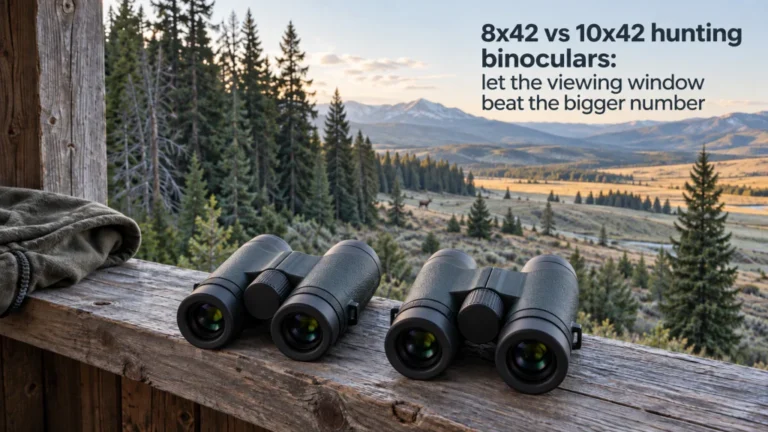
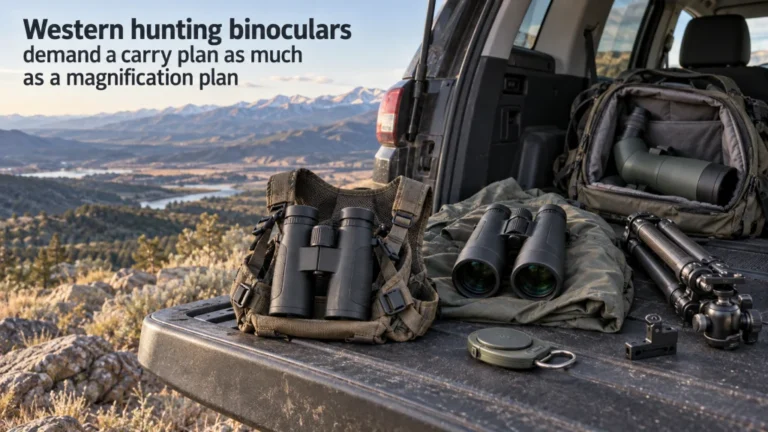
Hunting binoculars make more sense when terrain and viewing workflow come before magnification. Dense cover can reward easier subject acquisition and a wider field, while open country can increase the value of image scale, sustained viewing, and support. Objective size matters, but it cannot prove low-light performance by itself because transmission, optical design, exit pupil, and fit still matter. Start with how you observe, then verify field of view, weight, eye relief, weather protection, and carry burden.
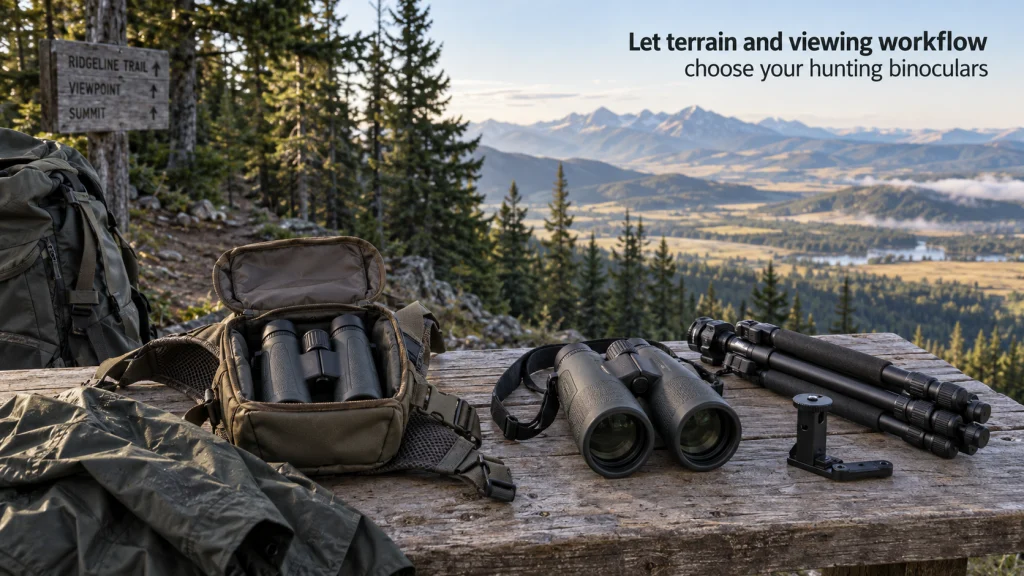
Start with terrain openness and the viewing distance you face regularly
Put two observation scenes side by side, with no weapon in either one. One viewer looks through dense timber where the visible corridor is short and broken, while another scans a broad landscape for long periods. The same binocular buying framework still applies, but the priorities change because the viewing problem changes. Hunting binoculars should therefore be chosen around the environment you repeatedly observe, not around a universal power.
Do not start by asking whether 8x or 10x is more popular. Ask how often you need quick acquisition, how much scene you want visible, how long you stay behind the binocular, and how much weight you will carry. Those constraints show whether extra image scale is useful or simply trades away field, steadiness, and portability. If magnification itself is unresolved, the best magnification for hunting binoculars guide takes that question further.
| Viewing pattern | What becomes more important | What deserves extra scrutiny |
|---|---|---|
| Short, broken sightlines | Fast acquisition, wider field, manageable size | Field of view, focus behavior, eye relief |
| Mixed terrain | Balanced power, carry comfort, versatility | 8×42 versus 10×42, weight, sealing |
| Broad open country | Image scale, stability, sustained viewing | Support burden, field width, larger formats |
| Frequent dim-light viewing | Verified optical performance and fit | Exit pupil, transmission evidence, eyecup fit |
Use the matrix as a sorting tool, not a rulebook. Open terrain does not automatically require high power, and dense cover does not force everyone into 8x. Your mix of distance, motion, duration, and carry burden determines which compromise is acceptable. Once that pattern is clear, specifications become easier to interpret.

The 8x42 configuration keeps a 42 mm objective with moderate 8x magnification. Amazon lists HD optics plus waterproof, fogproof, shockproof construction and tripod adaptability. The package includes the GlassPak carry system for field transport.
Check on AmazonIf you click this link and buy, we earn a commission at no additional cost to you.
Dense cover can increase the value of field of view and manageable magnification
When sightlines are short and interrupted, finding the subject inside the binocular can matter more than making it appear as large as possible. A wider field keeps more scene around the subject and can make reacquisition less fussy when the view is repeatedly broken. Lower magnification can also be easier to hold steady for many users, although balance, grip, and viewing posture still matter. Compare magnification together with field of view and handling rather than treating power as a verdict.
An 8×32 can make sense when low carry burden dominates, while an 8×42 keeps 8x image scale with a larger objective and a 5.25 mm geometric exit pupil. A 10×42 raises image scale but reduces geometric exit pupil to 4.2 mm, and many model families also narrow the field at 10x. Those numbers do not prove image quality because transmission, glass, coatings, and fit remain separate questions. For a closer, more interrupted viewing environment, the whitetail hunting binoculars guide handles that narrower balance.
- Check field of view for the exact configuration.
- Verify eye relief and eyecup range if you wear glasses.
- Treat weight as a carry decision, not just a specification.
- Check whether the focus control suits your hands and viewing pace.
These checks matter when the subject is not already centered. More magnification is not an improvement if acquisition becomes slower or the view becomes harder to hold. A wider field is not automatically better if fit or optical performance suffers. Choose the compromise that matches the scene you face repeatedly.

The 8x32 format reduces objective size while retaining moderate 8x magnification. Amazon lists HD optics plus waterproof, fogproof, shockproof construction and tripod adaptability. The included GlassPak gives the binocular a dedicated carry option.
Check on AmazonIf you click this link and buy, we earn a commission at no additional cost to you.
Open country can increase the value of image scale and sustained observation
Broad landscapes change the problem because viewing sessions can last longer and distant subjects occupy less of the scene. More magnification can make detail appear larger, but it also magnifies hand movement and often narrows the field. That trade works only when the added scale helps more than the lost field and greater stability demand hurt. Longer sessions also make balance, eyecup comfort, focus feel, and support compatibility more important.
This is where 50 mm objectives and 12x configurations can enter the shortlist, but they are not automatic upgrades. Larger bodies can require more harness space, add weight, and make support more attractive during prolonged observation. Independent testing of large-frame binoculars treats handling, low-light performance, and support as separate characteristics, which is the right way to read the format. If long sessions and support are central, the western hunting binoculars guide is the more focused next step.
| Configuration | What it can add | What it can cost |
|---|---|---|
| 8×32 | Low bulk and often generous field | Smaller objective than 42 mm designs |
| 8×42 | Balanced field and 5.25 mm geometric exit pupil | More bulk than compact 32 mm designs |
| 10×42 | More image scale in a common body size | Often narrower field and greater shake sensitivity |
| 10×50 or 12×50 | Larger objective and more open-country scale options | More size, weight, harness space, and support burden |
This strip is deliberately not a ranking. A well-fitted 8×42 can be more useful than a poorly balanced 12×50 even when the latter offers more image scale. Ask what the extra power or objective diameter changes in your repeated viewing sessions. That keeps the shortlist focused on function instead of escalating numbers.
The 10x42 configuration adds 10x image scale without moving to a 50 mm objective. Amazon lists HD optics, tripod adaptability, waterproof, fogproof, and shockproof construction. The included GlassPak provides a dedicated carry setup for longer field sessions.
Check on AmazonIf you click this link and buy, we earn a commission at no additional cost to you.
Compare 8×42 and 10×42 as a general-purpose fork, not a bigger-number upgrade
For many buyers, 8×42 and 10×42 form the most useful first comparison because objective diameter stays fixed while image scale, exit pupil, and often field width change. ZEISS Conquest HDX specifications give a clean example: both versions are listed at 25.2 ounces, while the 8×42 is specified at 384 feet of field at 1,000 yards and the 10×42 at 345 feet. Their listed exit pupils are 5.3 mm and 4.2 mm respectively. The example separates magnification trade-offs from weight, but it does not prove that every 8×42 is wider than every 10×42.
Choose between them by asking whether more image scale earns its keep enough to accept the narrower view and greater sensitivity to movement that can come with 10x. If acquisition, a broader scene, or steadier handheld viewing matters more, 8x can be the more forgiving starting point. If the landscape is more open and the extra scale is genuinely useful, 10x may be the better compromise without moving to a 50 mm body. The 8×42 versus 10×42 hunting comparison takes that fork further.

The 10x42 format is a direct fit for the common 8x42 versus 10x42 decision. Amazon lists HD optics, tripod adaptability, waterproof, fogproof, and shockproof construction. The package includes a GlassPak harness for carrying the binocular.
Check on AmazonIf you click this link and buy, we earn a commission at no additional cost to you.
Western hunting becomes a separate system decision when carry and support are central
Open terrain can turn the binocular from a short-burst tool into equipment carried constantly and used for longer viewing sessions. Practitioner guidance on western chest carry emphasizes that an optic has to work as a carried object as well as an optical instrument. Harness fit, balance, access, weather exposure, and the space required by a larger chassis therefore become ownership issues. A slightly larger body on a specification page can still change how the whole carry system feels.
Support is another fork that should be decided by workflow rather than fashion. A stable mount can make higher magnification more usable, but it adds an adapter, hardware, setup, bulk, and another compatibility check. If support is occasional, a well-balanced handheld configuration may be cleaner; if support is routine, verify the exact interface before buying. Rangefinding electronics are a separate binocular-type decision and do not prove better optical performance.

This camo chest pack combines a binocular compartment with MOLLE storage. Amazon lists a magnetic silent closure, waterproof construction, and two detachable pouches. It is sold as a binocular harness for hunting, hiking, and birdwatching.
Check on AmazonIf you click this link and buy, we earn a commission at no additional cost to you.
Whitetail hunting can prioritize a different mix of field, light, and handling
A closer or more interrupted environment can make compactness and field width more valuable than they are in a broad landscape. That does not mean every whitetail viewer needs a compact binocular, and it does not make 10x automatically excessive. Give more weight to how quickly you can raise the binocular, settle the view, focus, and keep enough surrounding scene for context. Eye relief and eyecup fit also matter because a wide published field is less useful when glasses prevent you from seeing it.
Independent whitetail-oriented testing includes pocket-size 8×25, compact 8×32, 10×42, and 10×50 designs, which shows why the activity itself does not dictate one format. That range is stronger evidence for a conditional decision than for a single best-power answer. Compare the viewing environment first, then decide how much size and objective area you will carry for the light conditions you face. A smaller binocular can win on portability, while a larger one needs a meaningful optical or fit advantage to justify its burden.

The Vanquish uses an 8x26 reverse Porro configuration in a compact body. Vortex lists a 352-foot field of view at 1,000 yards and a weight of 12.7 ounces. Its compact format matches a section that gives field width and carry burden more weight.
Check on AmazonIf you click this link and buy, we earn a commission at no additional cost to you.
Judge low-light performance with optical evidence, not objective size alone
A larger objective can increase geometric exit pupil when magnification stays fixed, but that is only one part of low-light behavior. A 10×42 produces a 4.2 mm geometric exit pupil, while a 10×50 produces 5.0 mm, yet transmission, coatings, glass, baffling, eyepiece design, and fit still affect the delivered view. The viewer’s pupil also limits how much of the available exit pupil can be used under a given condition. Objective diameter is therefore evidence, not a complete brightness score.
Independent testing becomes useful when the method is explicit. Outdoor Life describes resolution-target and twilight procedures with binoculars stabilized for its low-light comparisons, which is stronger evidence than a vague brightness label. A test result still belongs to the exact binocular tested and should not be generalized across every model with the same objective size. The low-light hunting binoculars guide focuses on weighing those evidence types.

The 10x50 configuration produces a 5.0 mm geometric exit pupil from its 50 mm objectives and 10x magnification. Amazon lists HD optics, waterproof, fogproof, shockproof construction, and tripod adaptability. The included GlassPak harness adds a dedicated carry option.
Check on AmazonIf you click this link and buy, we earn a commission at no additional cost to you.
Larger objectives can add exit pupil while also increasing ownership burden
At a fixed magnification, moving from 42 mm to 50 mm increases geometric exit pupil, which is a legitimate reason to compare the larger format. The mistake is assuming that the optical gain arrives without consequences. Larger binoculars can be longer, wider, heavier, and harder to fit into a chest pouch, while some high-power models also make support more attractive. Those costs matter every time the binocular is carried, not just when specifications are compared.
The comparison changes again when magnification changes. A 10×50 gives a 5.0 mm geometric exit pupil, while a 12×50 drops to about 4.2 mm even though both use 50 mm objectives. Ask what the full magnification-objective combination does to exit pupil, image scale, field, body size, and stability. The focused comparisons of 10×42 versus 10×50 for hunting and 10×42 versus 12×50 for hunting handle those two larger-format forks.

The 12x50 configuration pairs a 50 mm objective with higher 12x image scale. Amazon lists HD optics, tripod adaptability, waterproof, fogproof, and shockproof construction. The included GlassPak gives the larger-format binocular a dedicated carry system.
Check on AmazonIf you click this link and buy, we earn a commission at no additional cost to you.
Use a hunting shortlist sequence that keeps the viewing problem in control
A good shortlist should get narrower as evidence improves, not wider as more product pages appear. Write down terrain openness, normal observation distance, subject movement, typical light, viewing duration, and carry tolerance before comparing brands. Keep only configurations that solve those conditions without creating a larger problem in field width, weight, stability, or fit. The exact model choice comes after that sequence.
This order also prevents specialized features from hijacking a basic optical decision. High power, rangefinding electronics, tripod hardware, and budget-first shopping can each become separate buying questions. Keep them separate until the basic observing requirement is clear. Then verify field of view, eye relief, weight, sealing, accessories, and warranty on the few models that remain.
Terrain, distance, and movement
Classify the normal view as enclosed, mixed, or broadly open, then note the longest distance that occurs regularly rather than an extreme edge case. Add whether subjects commonly move through the field or stay easy to hold in view. Those answers determine how much weight to give field width, acquisition, and image scale. When conditions vary often, favor balance rather than optimizing for one rare scenario.
Field of view, magnification, and light
Compare field of view on the exact models because two binoculars with the same basic configuration can differ. Calculate exit pupil as objective diameter divided by magnification, but treat it as geometry rather than a brightness verdict. Look for transmission data or independent low-light testing only when the source clearly matches the model. Extra magnification is useful only when its added scale remains usable in your light and stability conditions.
Carry, support, and weather
Check weight together with dimensions and the carry system you expect to use. If support is part of the plan, verify the exact tripod interface or adapter instead of trusting a generic compatibility claim. For wet or dusty use, look for explicit sealing, waterproofing, nitrogen filling, or manufacturer care information. Every accessory also adds cost, bulk, and setup burden.
Fit and budget
Eye relief, eyecup range, interpupillary distance, focus placement, and grip can make similar specifications feel very different. Glasses wearers should check whether eye relief and eyecup design let them see the field comfortably. Set the budget after the configuration is clear so price does not push you toward unnecessary power, electronics, or bulk. Paying more is easiest to justify when it improves verified optical performance, fit, durability, warranty, or a feature you will use often.
| If the main question becomes… | Treat it as a separate decision |
|---|---|
| Very high magnification | Compare high-power binocular architecture and stability requirements. |
| Rangefinding electronics | Compare electronic binocular types separately from basic optical selection. |
| Tripod hardware | Verify adapter compatibility and support setup as an accessory decision. |
| Strict price ceiling | Set the configuration first, then compare options within the budget. |
- Define recurring terrain and viewing distance.
- Choose magnification while keeping field and stability acceptable.
- Choose objective size with light needs and carry burden together.
- Verify field, eye relief, weight, sealing, and physical fit.
- Decide whether support or electronics belong in the system.
- Compare price after the shortlist is technically coherent.
If the checklist leaves several very different configurations, the viewing problem is still too broad. Return to the condition that occurs most often and make it the main optimization target. Accept a compromise for secondary situations instead of forcing one binocular to dominate every scene. A coherent shortlist is more useful than a long list with no shared logic.

The CC-09 uses a super-clamp design to add a support interface to binoculars. Amazon lists an Arca-Swiss adapter and compatibility with 1/4-inch and 3/8-inch tripod connections. Its clamp-based format directly supports a workflow that includes stabilized observation.
Check on AmazonIf you click this link and buy, we earn a commission at no additional cost to you.
Final Thoughts: Let terrain and viewing workflow make the first cut
The most defensible hunting binocular shortlist starts with viewing conditions and only then moves to magnification, objective size, and features. Dense cover can raise the value of field width and acquisition, while open country can justify more image scale and support. Low-light priority should push you toward better evidence, not toward the assumption that the largest objective must win. Carry burden, eye relief, weather protection, and fit remain part of the same decision.
Once terrain, distance, motion, light, and viewing duration are clear, compare exact configurations rather than category labels. Verify field of view, exit pupil, weight, eye relief, dimensions, sealing, and support compatibility on the models that survive the first cut. Skip features that do not improve your repeated observation workflow. The right choice is the one whose trade-offs match how you actually observe.

This adjustable harness strap is designed to carry binoculars on the body instead of from a conventional neck strap. Amazon lists it as one size fits most and adjustable. Its simple harness format addresses carry burden without adding a rigid chest pack.
Check on AmazonIf you click this link and buy, we earn a commission at no additional cost to you.
Explore the hunting binocular decisions that need a narrower comparison
The broad decision becomes easier when each unresolved trade-off is handled separately. Use the links below when your shortlist reaches a specific fork such as 8x versus 10x, western carry, low-light evidence, or a larger objective. Each page stays at binocular-selection depth instead of drifting into hunting technique. That lets you move from viewing workflow to one precise comparison.
You do not need to read every topic before choosing. Follow only the branch that matches the uncertainty still blocking your shortlist. If terrain and workflow remain unclear, stay with this page until the configuration class is stable. Once it is, a narrow comparison is more useful than another general product list.
| Topic | What you’ll find |
|---|---|
| 8×42 versus 10×42 binoculars for hunting | Field, image scale, stability, and general-purpose fit. |
| Western hunting binoculars | Long observation, chest carry, open terrain, and support burden. |
| Whitetail hunting binoculars | Field, compactness, handling, and dim-light priorities. |
| Low-light hunting binoculars | Exit pupil, transmission evidence, fit, and low-light testing. |
| 10×42 versus 10×50 binoculars for hunting | Larger objective, exit pupil, size, and carry burden. |
| 10×42 versus 12×50 binoculars for hunting | Extra magnification, stability, support need, and portability. |
| Best magnification for hunting binoculars | Terrain, distance, movement, field width, and support willingness. |
Keep every branch subordinate to the same rule: configuration follows the viewing problem. A specialized comparison can sharpen one choice, but it should not erase your constraints around field, weight, light, carry, and fit. When two options remain close, prefer the one whose compromises you can explain from your regular observation workflow. That is a stronger basis for buying than a generic ranking.

The Viper HD uses an 8x42 roof-prism configuration for a full-size general-purpose format. Amazon lists HD optics, XR lens coatings, tripod adaptability, and a locking diopter. The package includes a GlassPak harness as a dedicated carry system.
Check on AmazonIf you click this link and buy, we earn a commission at no additional cost to you.
FAQs
Most hunting-binocular questions sound simple because they begin with one number. The useful answer is usually conditional because terrain, field width, light, viewing duration, fit, and support willingness change the trade-off. Use the answers below as shortlist checks rather than universal rules. Verify exact model specifications before purchase.
🔭 Is 8x or 10x better for hunting binoculars?
8x can be more forgiving when field width, acquisition, and steadiness matter most. 10x can add useful image scale in more open viewing. Compare exact field of view, weight, eye relief, and fit. Neither power is universally better.
🌲 Are 8×42 binoculars a good choice for dense woods?
They can fit well when a wider field and manageable handheld view matter. Check eye relief, focus behavior, and the exact field of view. A label such as 8×42 does not guarantee good fit. The exact model still matters.
🏔️ Do I need 10x binoculars for open country?
No. Open terrain can make 10x image scale useful, but 8x can still win on field width or steadiness. Decide from the distances you face regularly and how long you observe. Terrain alone does not choose the power.
🌅 Are 10×50 binoculars always better than 10×42 in low light?
No. A 10×50 has a larger geometric exit pupil, but transmission, glass, coatings, design, and fit still matter. Look for exact model evidence when low light is a priority. Objective diameter alone is not a verdict.
🎒 How much should binocular weight matter for hunting?
Weight matters more as carrying time increases. Check dimensions and harness fit along with ounces. A heavier model should provide a useful optical, fit, or handling benefit. Otherwise the extra burden is difficult to justify.
👓 What should glasses wearers check before buying?
Check eye relief, eyecup adjustment, and whether you can see the field comfortably with glasses in place. A wide published field is less useful if your eye sits too far from the eyepiece. Fit varies by exact model. Try the binocular when possible.
If these answers still leave very different configurations on the shortlist, return to terrain and workflow first. Remove formats that do not fit the repeated viewing problem before comparing brands or prices. Once the configuration class is stable, exact model details become easier to judge. That sequence also reduces the chance of paying for power, size, or electronics you do not need.
References and Sources
Manufacturer specifications support exact field of view, exit pupil, weight, eye relief, and weather-related claims. Independent testing is used for test methodology and configuration context, not as a substitute for checking the exact binocular under consideration. Practitioner material is used for carry and prolonged-observation concerns in open terrain. None of these sources turns one configuration into a universal rule.
Specifications can change by model, generation, and market, so verify the exact product page or manual before buying. Test results belong to the samples and methods described by the publication. The sources below are included because they support claims used in the article. They are not a general reading list.
- ZEISS Conquest HDX manual: verifies the 8×42 and 10×42 field, exit pupil, weight, eye relief, and weather-related specifications used above.
- ZEISS Victory SFL specifications: supports the discussion of 50 mm configurations and exact model verification.
- Outdoor Life hunting binocular test: supports the description of low-light and resolution testing methods and configuration differences.
- Outdoor Life whitetail binocular test: supports the range of compact, mid-size, and larger formats used in hunting-specific testing.
- Epic Outdoors chest-carry binocular guide: supports current practitioner emphasis on carry comfort and prolonged observation in western use.
Where sources differ in emphasis, keep the claim narrow and return to terrain, viewing duration, field needs, and carry tolerance. Manufacturer material establishes specifications, while independent testing shows how a tested sample performed under a stated method. Practitioner preferences can identify recurring workflow concerns without creating a universal magnification rule. That evidence boundary is intentional.