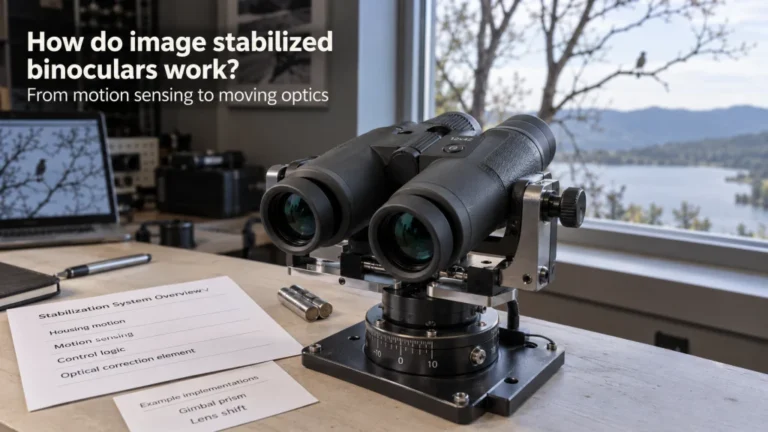
Image stabilized binoculars can make handheld motion less limiting, but the label does not tell you how a specific model will behave. Current designs differ in stabilization architecture, correction range, magnification, power, sealing, eye relief, weight, and support options. The useful question is whether a particular system removes enough motion from your viewing problem to justify its cost and power dependence. A sound shortlist starts with motion and optical fit, then checks the stabilization system, environment, battery behavior, and simpler alternatives.
Current stabilized binoculars share a capability label, not one design
Image stabilized binoculars now cover very different designs. Nikon’s STABILIZED 12×25 S uses an optical lens shift method, KITE’s APC 42 family uses a prism gimbal system, Fujifilm’s TS-L 2040 uses an electronic gyro with a gimbal prism structure, and SIG’s ZULU6 HDX 16×42 uses gyroscopic OIS. Magnification and objective size also vary sharply across those examples. The common label therefore describes a capability, not a finished buying verdict.
The broader guide to binocular types and their trade-offs provides the right frame because stabilization sits on top of ordinary optical choices. Field of view, eye relief, weight, hand fit, and objective size still matter. Power and stabilization hardware simply add more constraints to check. Start by defining what motion is making the view less usable before comparing mechanisms or prices.

Fujifilm pairs 12x magnification with a 28 mm objective in this compact image-stabilized binocular. The stabilization system is designed to reduce visible handheld motion while preserving a two-eye viewing format. Its smaller objective and 12x power make it a useful example of why stabilized binoculars still need to be judged as complete optical designs.
Check on AmazonIf you click this link and buy, we earn a commission at no additional cost to you.
Start with the motion problem the binocular has to correct
Handheld movement becomes more visible as magnification rises because small angular shifts occupy more of the scene. That does not mean every higher-power binocular needs electronics. Viewing duration, body support, wind, platform vibration, and how quickly you must acquire a subject can change how disruptive motion feels. Describe the problem in practical terms before treating stabilization as the answer.
Ask whether the limitation appears during nearly every handheld look or only during long observation. A railing, monopod, tripod, or seated position may remove enough movement without adding a powered system. Stabilization becomes more relevant when mobility matters and the same motion repeatedly hides useful detail. Match the correction system to a recurring problem rather than buying electronics because the specification sounds advanced.

The TrailSeeker tripod provides physical support for binoculars, spotting scopes, and cameras. Its quick-release plate and smooth pan-and-tilt head are built for faster setup and controlled tracking. Adjustable legs let the support adapt to uneven viewing positions when a fixed platform is preferable to handheld stabilization.
Check on AmazonIf you click this link and buy, we earn a commission at no additional cost to you.
Stabilization can make existing detail easier to use without improving the glass itself
Stabilization can reduce scene movement and make fine detail easier to hold long enough to inspect. It does not increase objective diameter, widen field of view, add eye relief, or correct optical aberrations. A weak optical system does not become premium simply because the image moves less. Judge the underlying optics by the same standards you would apply to a conventional binocular.
This matters when marketing language blends optical quality and stabilization into one promise. Two models can differ in coatings, field, chromatic aberration control, focus behavior, or usable eye relief even when both stabilize the view. A glasses wearer may reject a stable model that does not provide enough eye relief. Stability can help you use what the optical system already delivers, but it cannot repair a poor fit.

ZEISS pre-moistened wipes are made for cleaning optical surfaces and come in a 200-count pack. Each disposable wipe uses a pre-moistened formula intended to remove everyday smudges and debris without a separate bottle. Clean optics help preserve the detail the binocular can already deliver without changing the underlying optical design.
Check on AmazonIf you click this link and buy, we earn a commission at no additional cost to you.
Current systems do not all stabilize the same moving optical element
The mechanism matters because manufacturers stabilize different parts of the optical path. Nikon identifies its compact STABILIZED series as optical lens shift, Fujifilm describes a gyro-controlled gimbal prism structure, and KITE publishes a prism gimbal system. SIG describes its OIS as gyroscopically stabilized and adds selectable or adaptive modes in different families. Those descriptions show why one generic explanation cannot cover every current design.
You do not need to become an optical engineer to use this distinction. The deeper guide to how image stabilized binoculars work separates the main mechanism families. For buying purposes, architecture is useful when it explains correction range, mode behavior, power needs, or body design. If documentation does not connect a mechanism claim to a practical specification, leave the supposed advantage unclaimed.

Canon combines 10x magnification and a 30 mm objective with built-in image stabilization in the 10x30 IS II. The stabilization system operates inside the binocular rather than relying on external support. That makes it a concrete example for comparing how different internal architectures manage handheld movement.
Check on AmazonIf you click this link and buy, we earn a commission at no additional cost to you.
A current system comparison shows why the label is incomplete
Current manufacturer specifications show how broad the category has become. The examples below are not recommendations or a ranking. They simply compare architecture, power, correction reporting, and operating details. Exact specifications should still be rechecked before purchase because variants within one family can differ.
| Example | Stabilization detail | Power and environment |
|---|---|---|
| Nikon STABILIZED 12×25 S | Optical lens shift | Two AA batteries, up to 12 hours, non-waterproof |
| KITE APC Stabilized 12×42 | KDGS-1 gimbal, 2 degree correction | AA power, up to 120 hours including spare batteries, IPX7 |
| Fujifilm TS-L 2040 | Electronic gyro and gimbal prism, plus or minus 3 degrees | Two AAA batteries, up to 30 hours, IPX7 |
| SIG ZULU6 HDX 16×42 | Gyroscopic OIS with Scan and Target modes | One AA battery, 30 hours, IPX7, tripod capable |
The table also shows why one number cannot summarize the choice. A compact model may lack waterproofing, while another may emphasize correction range or tripod compatibility. Battery format and runtime vary as well. Compare the whole operating package instead of assuming that all stabilized binoculars behave alike.

SIG SAUER combines 16x magnification and 42 mm objectives with optical image stabilization in the ZULU6 HDX. The Amazon listing identifies the 16x42 configuration as waterproof and fog-proof. Its high magnification and stabilized roof-prism format make it a useful current reference point for the broader stabilized-binocular category.
Check on AmazonIf you click this link and buy, we earn a commission at no additional cost to you.
Correction angle is a fit or rejection metric, not a complete stabilization score
Published correction angle describes the angular movement a system is designed to compensate for within its stated range. Fujifilm publishes plus or minus 3 degrees for current TS-L models, while KITE publishes 2 degrees for the APC Stabilized 42 family. Canon’s discontinued 10×42 L IS WP documented plus or minus 0.8 degrees, and its discontinued 12×32 IS documented plus or minus 1 degree. Those figures come from different architectures and should not be ranked as if every other variable were equal.
A larger number therefore does not prove better overall stabilization. It can help reject a system when expected movement clearly exceeds the published range, but it does not describe panning, response behavior, optical fit, or image quality. The guide to interpreting image stabilization correction angle explains that limit in more detail. Use the number as one boundary beside magnification, field, weight, and the movement you expect.
SIG SAUER combines 12x magnification and 42 mm objectives with optical image stabilization in this ZULU6 HDX model. The Amazon listing identifies the selected SOZ6WP12 variant as waterproof and fog-proof. Its 12x configuration gives a distinct stabilized reference for judging correction behavior alongside magnification and handling.
Check on AmazonIf you click this link and buy, we earn a commission at no additional cost to you.
Before paying for stabilization, compare the conventional binocular you would otherwise buy
The useful price comparison is between the stabilized option and the conventional binocular that would otherwise meet your needs. A simpler 8×42 or 10×42 may offer wider field, lower cost, less power dependence, or easier ownership. If you already hold the needed magnification steadily enough, correction hardware may solve no meaningful problem. Stabilization should earn its premium by changing the usable view.
A stabilized design becomes more relevant when you repeatedly need more handheld image scale or longer inspection without setting up support. The article on when image stabilized binoculars are worth the premium handles that comparison directly. Keep the value judgment conditional on the viewing limitation. A conventional binocular remains the better choice when it already does the job with less cost and complexity.

The PROSTAFF P3 8x42 is a conventional full-size binocular with 8x magnification and 42 mm objectives. Nikon lists it as waterproof and fogproof with a rubber-armored body. Its wide-field 8x format provides a practical baseline for deciding whether electronic stabilization is solving a problem that a simpler binocular leaves unresolved.
Check on AmazonIf you click this link and buy, we earn a commission at no additional cost to you.
Electronic stabilization and physical support solve different workflows
A tripod removes motion by physically supporting the instrument, while internal stabilization works as you continue to hold it. That difference changes setup time, mobility, carrying burden, and how quickly you can move to another subject. Some stabilized binoculars are still tripod capable, so the approaches are not automatically rivals. Physical support can also remain useful when you want a fixed view for a long period.
The practical comparison is covered in image stabilized binoculars versus a tripod. If support is part of your plan, verify the exact mounting interface instead of assuming a generic adapter fits. The separate binocular tripod adapter guide explains that compatibility issue. Choose between stabilization and support by workflow, not by treating one as universally more advanced.

Celestron’s binocular tripod adapter links compatible binoculars to a standard 1/4-20 tripod connection. It attaches at the binocular’s center hinge on supported Porro- and roof-prism designs. The adapter makes mounting compatibility an explicit part of comparing handheld stabilization with physical support.
Check on AmazonIf you click this link and buy, we earn a commission at no additional cost to you.
A spotting scope remains a different optical architecture even when stabilization removes a tripod
High magnification can make stabilized binoculars look like a spotting-scope substitute, but the formats remain different. Binoculars keep two optical channels, while a spotting scope uses a different eyepiece arrangement, support expectation, and magnification range. Stabilization may reduce handheld motion without adding variable power or scope-style mounting options. Start with how you need to observe rather than with the largest magnification number.
The comparison of image stabilized binoculars and spotting scopes handles that architectural choice directly. A binocular can favor quick two-eye viewing and mobility, while a scope can favor supported inspection at higher powers. There is no universal crossover point because distance, field, setup tolerance, and carrying burden vary. Stabilization changes the motion constraint, not the entire optical format.

The Ultima 80 uses an 80 mm objective and a 20-60x zoom eyepiece in an angled spotting-scope format. Its fully multi-coated optics and rotating tripod mount are designed around supported, high-magnification observation. That architecture gives a clear contrast with two-eye stabilized binocular viewing.
Check on AmazonIf you click this link and buy, we earn a commission at no additional cost to you.
12x and 16x remain different optical choices after shake is controlled
Stabilization does not erase the ordinary effects of increasing magnification. A 16x view can make a distant subject appear larger than a 12x view, but field of view, exit pupil, eye relief, and target acquisition may also change. Current families often offer several stabilized magnifications in similar bodies. The right power still depends on whether extra image scale helps more than the accompanying trade-offs hurt.
The comparison of 12x versus 16x image stabilized binoculars focuses on that decision. A common beginner mistake is treating stabilization as permission to choose the highest available magnification. That skips field width, acquisition speed, exit pupil, and viewing comfort. Stabilize the magnification you actually need rather than letting stabilization choose the magnification for you.

Nikon combines 12x magnification and 25 mm objectives with its STABILIZED optical image stabilization system. The 12x25 S weighs 13.9 ounces without batteries and provides a 236-foot field of view at 1,000 yards. Its compact 12x format shows that stabilization does not remove the normal magnification, field, and eye-relief trade-offs.
Check on AmazonIf you click this link and buy, we earn a commission at no additional cost to you.
Battery type, runtime conditions, and no-power behavior are purchase rejection checks
Power is part of the buying decision because stabilization depends on it. Nikon publishes up to 12 hours for its compact series, Fujifilm up to 30 hours for TS-L models, SIG 30 hours for the ZULU6 HDX 16×42, and KITE much longer autonomy for APC 42 systems. Battery formats also differ. These are manufacturer figures, not guarantees under every temperature, battery chemistry, or usage pattern.
Before purchase, check what happens when power is depleted and how easily batteries can be replaced. The guide to battery life in image stabilized binoculars covers those ownership questions. Carrying spares may be trivial for one user and an unwanted dependency for another. Reject a system early if its power routine conflicts with normal use.

Panasonic eneloop cells are pre-charged rechargeable AA Ni-MH batteries supplied here in an eight-pack. The AA format makes spare-cell storage and rotation a visible part of powered-optics ownership. Rechargeable cells also make battery chemistry and charging routine separate checks from the binocular’s optical performance.
Check on AmazonIf you click this link and buy, we earn a commission at no additional cost to you.
Waterproofing, low light, eye relief, and optical quality still need their own evidence
Stabilization specifications do not prove weather protection. Nikon identifies its compact STABILIZED 10×25 S and 12×25 S as non-waterproof, while current KITE APC 42, Fujifilm TS-L, and SIG ZULU6 HDX examples publish IPX7 protection. That contrast shows why sealing should never be inferred from price or electronics. Verify the exact model using the same logic described in the waterproof binocular feature guide.
Low-light performance also remains an optical question involving objective size, magnification, exit pupil, transmission, and coatings. Stabilization may steady the view, but it does not create light that never entered the objective. The guide to choosing binoculars for low light covers that separate decision. Eye relief deserves the same model-specific check, especially for people who wear glasses.

Bushnell’s H2O 8x42 is built as a waterproof and fogproof conventional binocular for outdoor use. Its 8x magnification and 42 mm objectives keep weather protection and optical format separate from stabilization. That makes it useful for comparing sealing, low-light geometry, and handling without treating electronics as proof of environmental readiness.
Check on AmazonIf you click this link and buy, we earn a commission at no additional cost to you.
Stabilization value changes with the viewing environment and platform motion
A person standing on firm ground with supported elbows presents a different motion problem from someone viewing from a vibrating seat, moving platform, or exposed position in gusty wind. The same correction system can therefore be valuable in one setting and unnecessary in another. Published range and operating modes are most useful when tied to the movement you actually expect. Do not turn subjective claims that one system is always calmer into a buying rule.
Keep the evaluation at the level the evidence supports. Compare correction information, operating limits, sealing, and power behavior with the real environment. Do not use a binocular buying guide to diagnose tremor, eye strain, motion sickness, or any other medical concern. The category makes sense when it solves a repeatable viewing-motion problem that can be described without medical claims.

The Vortex GlassPak is a binocular harness with adjustable straps and dedicated storage around the chest. It keeps binoculars supported close to the body while leaving them accessible for repeated viewing. That carrying arrangement is relevant when wind, walking, platform movement, and quick subject acquisition shape how a binocular is actually used.
Check on AmazonIf you click this link and buy, we earn a commission at no additional cost to you.
Brand hierarchy and malfunction diagnosis are separate from choosing stabilization
A brand name can point you toward manuals, warranty terms, accessories, and support, but it does not decide whether a specific system fits your needs. Current families differ in magnification, correction method, power, and body format. Compare the exact configuration instead of ranking the logo on the housing. A strong choice is the one whose documented behavior matches the viewing problem and physical fit.
Troubleshooting is a separate task from selection. If a stabilized binocular develops internal damage, water ingress, severe double image, a broken hinge, or a fault reserved for service personnel, stop at owner-level checks. Do not open the optical body or attempt internal alignment from generic instructions. Use the manufacturer’s support process or qualified service for problems beyond the manual.

The Pelican 1200 is a compact hard case supplied with foam for fitting equipment inside. Its rigid case format adds external protection without requiring the optical body to be opened or modified. For stabilized binocular ownership, a fitted case addresses transport and storage while leaving internal service work to the manufacturer or qualified repair channel.
Check on AmazonIf you click this link and buy, we earn a commission at no additional cost to you.
Use a stabilization shortlist sequence instead of ranking models first
A good shortlist rejects poor fits before minor features enter the comparison. Start with the motion you need to control, then choose magnification and field for the viewing job. Next verify the stabilization system, optical fit, environment, and power routine. Compare price only after those requirements are satisfied.
- Define the recurring motion problem.
- Choose magnification and field for the viewing job.
- Check eye relief, weight, focus behavior, and hand fit.
- Verify correction range or modes when published.
- Confirm sealing, battery type, and runtime conditions.
- Compare a conventional binocular, tripod, or spotting scope.
This order keeps one impressive specification from hiding a basic mismatch. It also makes a skipped upgrade easier to justify when a conventional binocular or simple support already solves the problem. If two stabilized options survive the checklist, compare their remaining differences rather than restarting with brand reputation. The shortlist should become smaller because your constraints are clear.

The PROSTAFF P3 10x42 is a conventional full-size binocular with 10x magnification and 42 mm objectives. Nikon lists the model as waterproof and fogproof with a rubber-armored body. It provides a practical conventional benchmark for a shortlist that checks magnification, optical fit, environment, and handling before adding powered stabilization.
Check on AmazonIf you click this link and buy, we earn a commission at no additional cost to you.
Separate motion, optical fit, environment, and price before making the final cut
The last comparison should make each rejection reason visible. A model can pass the stabilization test and still fail on eye relief, field, weight, sealing, or battery routine. Keeping those checks separate prevents one attractive feature from covering an unrelated problem. The final choice should survive every constraint that matters in normal use.
| Check | Reject when |
|---|---|
| Motion and magnification | A lower magnification or simple support already solves the problem |
| Optical and physical fit | Eye relief, field, focus, weight, or hand fit is wrong |
| Environment and power | Documented limits or battery routine conflict with normal use |
| Alternative and price | The premium does not change the usable view enough to matter |
Price belongs at the end because it matters only after the system passes practical checks. A cheap option that fails fit or weather requirements is not a bargain, and an expensive option that solves no real problem is not an upgrade. I would pay more for stabilization only when the same motion limitation appears often enough to change the usable product. That keeps the purchase tied to a real viewing constraint.

The Nature DX 8x42 combines 8x magnification and 42 mm objectives in a waterproof conventional binocular. Its polycarbonate body is designed to keep the full-size format relatively light. As a shortlist benchmark, it keeps magnification, weather protection, physical fit, and optical format visible as separate buying constraints.
Check on AmazonIf you click this link and buy, we earn a commission at no additional cost to you.
Final Thoughts: pay for stabilization only when stability changes the usable product
Image stabilization is valuable when motion is the constraint stopping an otherwise suitable binocular from doing the job. It is not a substitute for field, eye relief, optical quality, waterproofing, physical fit, or sensible magnification. Current systems also differ in correction range, power, modes, and body format. The exact implementation matters more than the capability label.
Build the shortlist from the viewing problem outward. Verify optical fit, then mechanism, correction information, power, weather limits, and the support alternative. Skip the premium when a conventional binocular already gives you a usable view. Pay for stabilization when it repeatedly improves handheld use without creating a larger problem elsewhere.

The Fujinon Techno-Stabi TS-X 14x40 combines 14x magnification and 40 mm objectives with image stabilization. Its high-power binocular format is designed to reduce handheld motion without converting the instrument into a spotting scope. It illustrates the article’s central test: stabilization matters when it changes the usable handheld view without replacing the other optical and handling checks.
Check on AmazonIf you click this link and buy, we earn a commission at no additional cost to you.
Explore the next image stabilization decisions
Each remaining question deserves its own test. Mechanism, value, support, spotting-scope alternatives, correction range, magnification, and battery behavior are related but not interchangeable. Use the topic that matches the unresolved part of your shortlist. Do not read every topic as another reason to buy more technology.
| Topic | What it resolves |
|---|---|
| How image stabilized binoculars work | Mechanism families and moving optical elements |
| Whether image stabilized binoculars are worth it | Premium versus conventional value |
| Image stabilized binoculars versus a tripod | Mobility versus fixed support |
| Image stabilized binoculars versus a spotting scope | Different optical architectures |
| How to read correction angle | What the number can and cannot tell you |
| Choosing 12x or 16x stabilized binoculars | Magnification trade-offs after stabilization |
| Battery life and power behavior | Runtime, battery type, and ownership routine |
Start with the constraint that is still unclear. If mechanism is settled but power is not, go directly to battery behavior. If magnification is the real question, solve that before comparing correction systems. The goal is a shorter, better-supported shortlist rather than a longer feature checklist.

The TrailSeeker 65 is an angled spotting scope with a 65 mm objective and 16-48x zoom range. Celestron specifies fully multi-coated XLT optics, dual focus, and a rotating tripod mount on this model. It gives readers a concrete supported-scope reference when the unresolved decision is binocular mobility versus higher-magnification scope viewing.
Check on AmazonIf you click this link and buy, we earn a commission at no additional cost to you.
FAQs
These questions cover common points that can change the purchase after the basic concept is clear. Exact behavior still varies by mechanism and model. Manufacturer documentation should settle power, sealing, correction range, and support compatibility. Do not assume one stabilized binocular proves how the whole category behaves.
🔭 Are image stabilized binoculars always better than conventional binoculars?
No. They help most when handheld motion is a recurring limitation, while a conventional binocular may already be stable enough, lighter, simpler, or less expensive.
🔋 Can stabilized binoculars still be used when the battery dies?
It depends on the exact design. Check the manual for what remains usable without power and whether carrying spare batteries fits your routine.
📐 Does a larger correction angle mean better stabilization?
Not by itself. It describes one operating boundary, not panning behavior, optical fit, response, or overall image quality.
🧭 Is 16x automatically better than 12x once stabilization is added?
No. Stabilization reduces motion but does not erase differences in field, exit pupil, eye relief, acquisition speed, or viewing comfort.
🪜 Do stabilized binoculars make a tripod unnecessary?
Not always. A tripod can still suit long fixed views, and some stabilized binoculars are themselves tripod capable.
🌧️ Are all image stabilizing binoculars waterproof?
No. Current examples range from non-waterproof bodies to models with published IPX7 protection, so check the exact specification.
The pattern is simple: stabilization answers only one part of the purchase. Magnification, eye relief, waterproofing, support, and power remain separate checks. Use current model documentation whenever an answer depends on exact hardware. That prevents a useful technology from being asked to solve problems it was never designed to solve.
References and Sources
This article uses manufacturer documentation for mechanism, correction range, battery system, sealing, and current model status. Marketing language about perfect stability or tripod-like performance is not treated as independent proof. The sources establish architecture and operating boundaries rather than product rankings. Exact specifications should still be rechecked before purchase.
- Nikon STABILIZED 12×25 S: current optical and body specifications.
- Nikon STABILIZED series technical release: mechanism, power, runtime guidance, and non-waterproof structure.
- KITE APC Stabilized 42: correction angle, gimbal type, sealing, and power details.
- Fujifilm TECHNO-STABI specifications: current TS-L optical, sealing, weight, and battery details.
- Fujifilm TS-L technical release: correction range and continuous-use guidance.
- SIG ZULU6 HDX 16×42: OIS modes, power, runtime, sealing, and tripod capability.
- Canon 10×42 L IS WP: discontinued U.S. model documenting Vari-Angle Prism and correction angle.
- Canon 12×32 IS: discontinued U.S. model documenting Lens Shift and correction angle.
The Canon pages are legacy technical evidence, not current U.S. buying recommendations. Nikon, KITE, Fujifilm, and SIG provide current examples of different stabilization approaches. These sources support the rule that the capability label never replaces exact model verification. When a specification is absent, leave it unknown rather than infer it from another model.