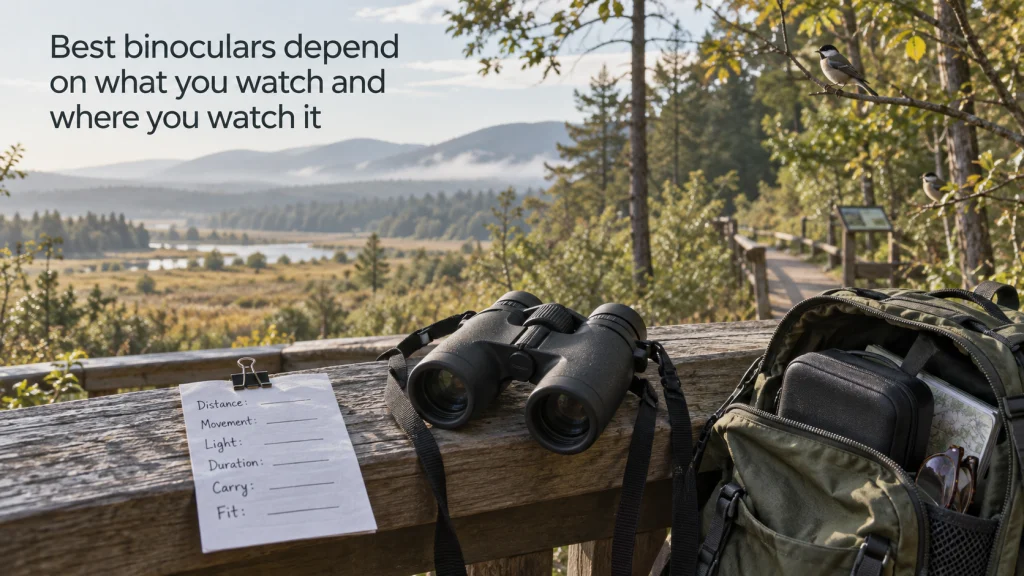
The best binocular choice starts with the viewing situation, not a universal ranking. Distance, movement, light, viewing duration, carry limits, and physical fit can change which trade-offs matter most. A setup that suits a moving bird may be a poor match for a dim sky, a stadium seat, or a child learning to focus. Define the viewing job first, then compare specifications within that smaller set.
Start with what you watch and how the subject behaves
The best binoculars cannot be chosen sensibly until the viewing job is clear. Picture a bird in branches, an animal across open terrain, a dim night sky, a carry-on trip, distant wildlife, a concert seat, a stadium seat, and a child learning to focus. Those situations ask the optics to solve different problems even when the binoculars look similar. No single specification can optimize all eight, so start with the subject and viewing conditions.
This prevents the common mistake of treating magnification as the whole decision. A useful shortlist comes from distance, movement, light, viewing time, packed size, fit, eyeglass use, and support needs. I would accept a modest paper specification before choosing a larger number that makes the real viewing job harder. Once the job is defined, specifications become filters instead of trophies.
| Viewing situation | First priorities to compare | Trade-off to watch |
|---|---|---|
| Bird watching | Fast acquisition, field of view, close focus, fit | More reach can narrow the view or make steadiness harder |
| Hunting observation | Terrain, viewing distance, duration, weather, stability | More power or aperture can add weight and support needs |
| Stargazing | Light gathering, magnification, stability, support | Larger optics can become too heavy for comfortable handheld use |
| Travel | Packed size, weight, durability, useful field of view | Smaller size can give up low-light capability or handling comfort |
| Wildlife watching | Distance, movement, light, weather, viewing time | Long-distance reach can conflict with field of view and portability |
| Concerts | Seat distance, field of view, compactness, venue rules | Too much power can make a moving stage harder to follow |
| Sports | Seat distance, subject movement, field of view, carry size | Narrow views can slow reacquisition when play moves quickly |
| Kids | Physical fit, weight, focus access, easy acquisition | Adult-sized controls can make a good optical specification frustrating to use |
The table is a starting filter, not a set of fixed prescriptions. Two people at the same event can need different eye relief, eyecup positions, grip dimensions, or carrying weight. The next step is to separate the six conditions that most often change the shortlist. That keeps an activity label from becoming a shortcut for a poor fit.

This 8x42 model uses Vortex HD optics and is tripod adaptable. Its body is waterproof, fogproof, and shockproof. A GlassPak binocular harness is included with the binoculars.
Check on AmazonIf you click this link and buy, we earn a commission at no additional cost to you.
Distance changes useful magnification, but more power is not automatically better
Distance matters because a farther subject can make additional magnification useful, but that does not make the highest available power the correct choice. As magnification rises, small hand movements become more visible, and a narrower view can make it harder to locate or reacquire a subject. The practical question is whether the added image scale reveals useful detail at the distances you actually face. If the subject is often closer, moving, or viewed without support, extra power can create more difficulty than benefit.
Think in ranges rather than one imagined maximum distance. A person who alternates between nearby woodland and open overlooks needs a different compromise from someone who spends most viewing time on distant, relatively stationary subjects. Support also changes the answer because a configuration that feels demanding when handheld may be reasonable when mounted or braced. Before comparing models, write down the distance you encounter most often, the longest distance that truly matters, and whether you are willing to carry support.

This full-size 10x42 model is waterproof, fogproof, and rubber armored. Nikon specifies a wide field of view and long eye relief for the PROSTAFF P3. Its 10x magnification provides a concrete configuration for comparing added reach with handheld steadiness.
Check on AmazonIf you click this link and buy, we earn a commission at no additional cost to you.
Subject movement changes the value of field of view and acquisition speed
A moving subject changes the problem from seeing detail to finding, following, and reacquiring that subject quickly. A wider field of view can give more room for a bird crossing branches, an athlete moving across the field, or an animal changing direction before you settle the view. That is why field of view deserves to sit beside magnification in a shortlist rather than appear as a minor line on the spec sheet. A high-power view that is difficult to acquire can be less useful than a lower-power view that keeps the subject in sight.
Focus behavior matters for the same reason, especially when subject distance changes quickly. The useful comparison is not merely which model has a larger field number, but whether the combination of field, focus access, hand position, and magnification suits the movement you expect. If most targets are stationary, you can tolerate a different balance than someone following quick movement. Treat acquisition as a real task you need the binoculars to perform, not an abstract optical preference.

This 8x42 model uses phase-coated BaK-4 prisms and fully multi-coated optics. It has 42 mm objective lenses and durable rubber armor. Its waterproof construction is intended for outdoor bird watching and nature viewing.
Check on AmazonIf you click this link and buy, we earn a commission at no additional cost to you.
Available light changes the value of objective size and optical efficiency
Bright daylight is forgiving, so a compact objective can be entirely reasonable when weight and packed size matter more. Dimmer conditions make objective size, exit pupil, transmission, coatings, and the overall optical design more relevant, but objective diameter alone does not prove how bright or clear two different binoculars will look. Larger objectives can gather more light, yet they usually add bulk and weight that must still fit the viewing job. The useful question is how much low-light performance you need often enough to justify carrying the larger instrument.
This is also where activity labels can mislead. Wildlife viewing at midday, wildlife viewing near dawn, and looking at a dark sky are all low-light discussions at different levels, with different magnification and support demands. I would not buy a large objective merely because occasional dim use is possible if most viewing happens in strong daylight while walking. Compare the light conditions you actually face, then decide how much size and weight you are willing to exchange for better low-light potential.

This 7x50 Porro-prism binocular is designed for wide-field astronomy viewing. It uses multi-coated optics and is comfortable for handheld use. The binocular is tripod adaptable and includes a carrying case.
Check on AmazonIf you click this link and buy, we earn a commission at no additional cost to you.
Viewing duration changes how much weight, balance, and fit matter
A binocular that feels fine for a brief look can become inconvenient when it is raised repeatedly or held for longer observations. Weight is part of that equation, but balance, grip shape, focus-wheel reach, eyecup position, and strap choice can change how manageable the same listed weight feels. This is why a short spec comparison cannot fully settle comfort. When possible, judge how the binocular sits in your hands and against your face with the eyecups set the way you will actually use them.
Longer viewing also makes small fit problems harder to ignore. Eyeglass wearers need enough usable eye relief to see the field comfortably, while every user needs an interpupillary setting and eyecup position that produce one clean circular view. The aim is not to find a universal weight threshold because hand size, strength, balance, and viewing posture differ. Instead, let session length determine how aggressively you should prioritize manageable weight and physical fit before paying for additional optical capability.

This binocular harness uses adjustable shoulder straps and a one-hand forward-folding lid. Its TORAY three-layer fabric is paired with spacer air mesh, side pockets, and a zippered pocket. Three stackable foam shims are included to adjust binocular height inside the harness.
Check on AmazonIf you click this link and buy, we earn a commission at no additional cost to you.
Carry constraints can make compactness part of the activity decision
Packed size matters when binoculars compete with clothing, cameras, water, or other gear, and it matters even more when they must be carried for hours. Compact binoculars can reduce that burden, but compact is not automatically the best travel or everyday answer. Smaller objectives and tighter controls may change low-light usefulness, grip comfort, and ease of focusing. The right size is the smallest package that still performs the viewing job comfortably, not the smallest binocular that fits in a pocket.
Carry method also belongs in the decision. A case, neck strap, harness, jacket pocket, or daypack changes how noticeable the same binocular becomes between viewing moments. If the binoculars are annoying to carry, they may stay packed when the subject appears, which defeats the benefit of impressive specifications. Before buying, decide where the binoculars will physically live during the activity and whether their weight and shape make that plan realistic.

This binocular harness uses fully adjustable straps and a full-coverage lid. It provides two mesh side pockets and a zippered back pocket for extra storage. The package includes the harness strap, binocular case, and two binocular tether straps.
Check on AmazonIf you click this link and buy, we earn a commission at no additional cost to you.
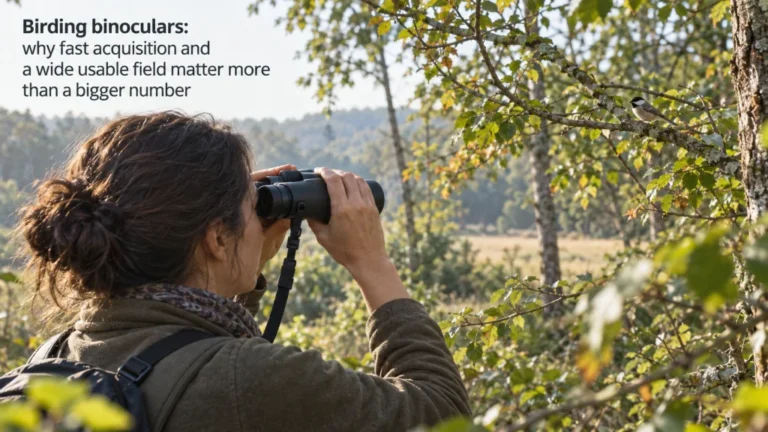
Bird watching rewards fast acquisition, field of view, close focus, and fit
Bird watching can shift from a distant perched subject to a small bird moving through nearby branches in seconds. That makes a usable field of view, responsive focusing, close-focus ability, and comfortable eye placement especially valuable. More magnification can help with distant detail, but it should not be treated as a free upgrade if it narrows the view or makes the image harder to hold steady. The configuration should support finding the bird first and studying detail second.
Physical fit deserves equal weight because birding often involves repeated raising, focusing, and following. Eyeglass use, hand size, focus-wheel reach, and the feel of the eyecups can separate two otherwise similar specifications. For a deeper activity-specific decision, use the birding binoculars guide for fast-moving and close-range viewing before comparing brands. That keeps birding requirements specific without turning one popular configuration into a rule for everyone.
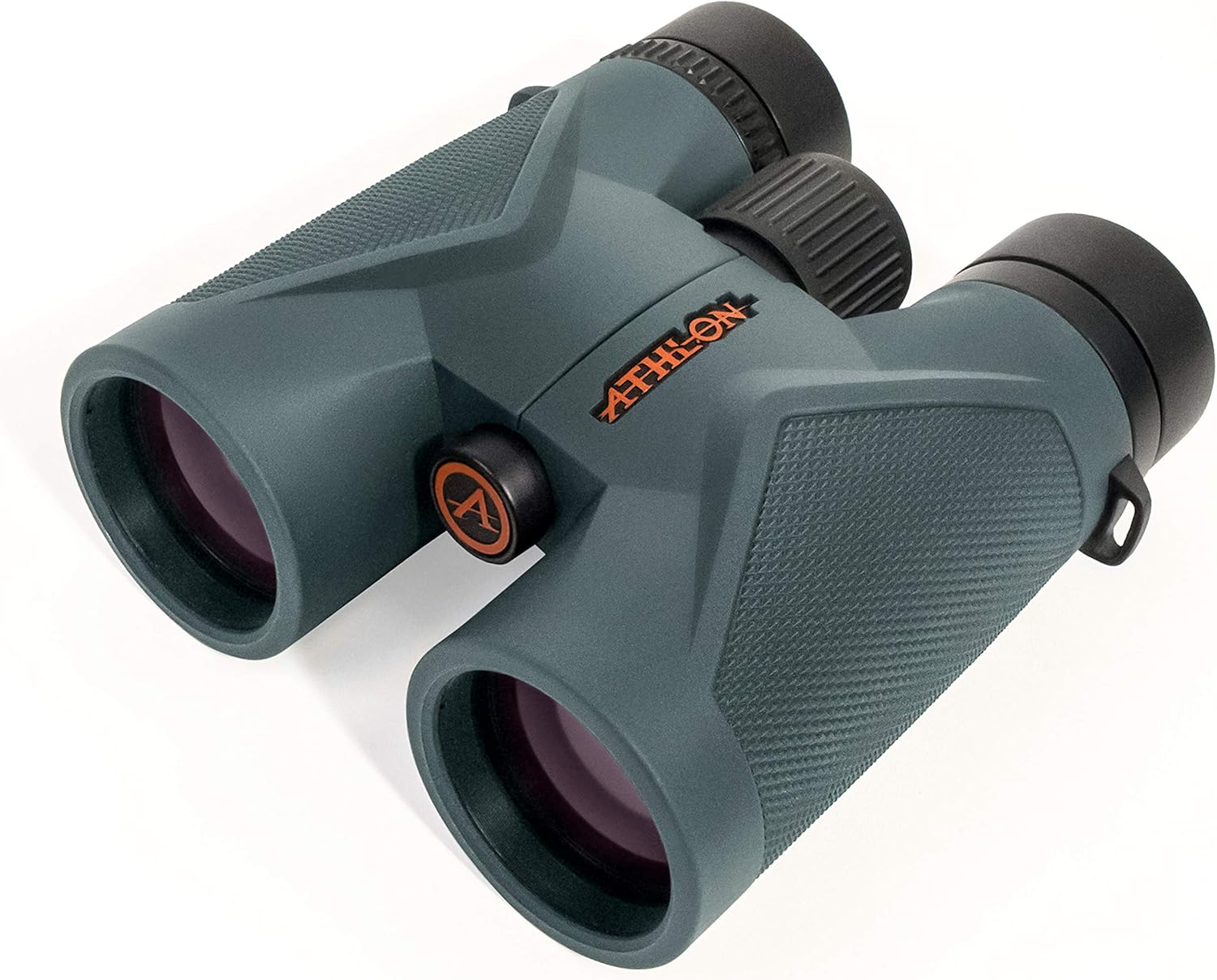
This 8x42 binocular uses ED glass and is waterproof and fogproof. Athlon lists eye relief as part of this Midas UHD configuration. The model is intended for birdwatching and other outdoor viewing.
Check on AmazonIf you click this link and buy, we earn a commission at no additional cost to you.
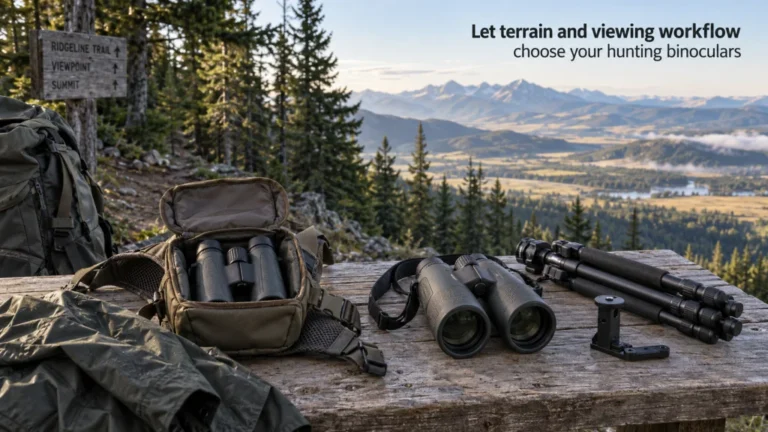
Hunting observation requirements vary with terrain and viewing workflow
For ordinary observation during hunting, terrain changes the binocular task before any specification is chosen. Wooded areas can create shorter, changing sightlines, while open terrain can place more value on studying distant, relatively stationary subjects for longer periods. Weather exposure, carry weight, and the time spent observing also affect the balance between magnification, objective size, field of view, and support. There is no responsible rule that hunting automatically requires high magnification.
The binocular decision should remain about seeing and identifying the environment and wildlife, not aiming, ballistics, or weapon use. A higher-power or larger configuration may be useful in some open viewing situations, but the added weight and steadiness demand still have to fit the person and the terrain. The hunting binoculars guide for terrain and observation conditions goes deeper into those viewing trade-offs. Use it after defining the terrain and typical viewing distance, not as a shortcut to the largest available numbers.

This 10x42 binocular uses Vortex HD optics for outdoor observation. Its rugged rubber-armored body is waterproof and fogproof. The configuration is tripod adaptable when additional support is useful for longer-distance viewing.
Check on AmazonIf you click this link and buy, we earn a commission at no additional cost to you.
Stargazing changes the aperture and support decision
Night-sky viewing makes light gathering and stability more prominent than they are in many daytime uses. Larger objectives can be attractive in dim conditions, and additional magnification can reveal smaller apparent detail, but both can push a binocular toward more weight and a greater need for support. Once the instrument becomes uncomfortable or difficult to steady, the paper advantage may not translate into a better view. The support decision therefore belongs near the start of an astronomy shortlist, not at the end.
A person who wants casual handheld looks at bright objects has a different requirement from someone planning longer sessions with a tripod. That difference can change acceptable size, magnification, and carrying burden before price is considered. The astronomy binoculars guide for night-sky viewing and support choices narrows those trade-offs without assuming that the largest objective is always the answer. Decide first whether handheld convenience or supported viewing is the priority.

This 15x70 binocular is designed for stargazing and deep-sky viewing. It uses multi-coated optics and BaK-4 prisms. A tripod adapter is included, making the large-aperture configuration directly relevant to supported astronomy sessions.
Check on AmazonIf you click this link and buy, we earn a commission at no additional cost to you.
Travel makes packed size and carry burden central
Travel binoculars have to earn their place in limited luggage and remain easy enough to carry once you arrive. That often raises the value of a compact or mid-size design, but compactness should be treated as a constraint rather than an automatic winner. A very small binocular can be easier to pack while also presenting tighter controls, a smaller grip, or less low-light headroom. The best travel choice is the one you will actually carry without giving up the viewing performance you need.
Think through the entire trip rather than the moment of observation. Ask whether the binoculars will ride in a personal item, daypack, jacket pocket, or case, and whether they will share space with other gear. The travel binoculars guide for packed size and carrying trade-offs helps turn those constraints into a practical shortlist. Portability is valuable only when the binocular still fits your eyes, hands, light conditions, and expected viewing distance.

This 10x25 Nikon is an ultra-compact travel binocular. The Trailblazer II is waterproof and fogproof with multilayer-coated optics and a rubber-armored body. Its fold-up design measures 4.5 by 3.9 by 1.7 inches and weighs 10.9 ounces.
Check on AmazonIf you click this link and buy, we earn a commission at no additional cost to you.
Wildlife watching changes with subject distance, movement, and light
Wildlife can be close or distant, still or moving, brightly lit or partly hidden in dim cover. That range makes wildlife watching a poor candidate for one automatic magnification rule. More reach may help across open ground, while field of view and easy acquisition become more valuable when an animal moves quickly or appears close. Low-light use can also raise the value of a larger objective, provided the added weight remains acceptable.
The most useful shortcut is to identify which wildlife scenario dominates your actual use in practice. If most viewing happens while walking, carry burden and fast handheld use deserve more weight than they would from a fixed overlook. The wildlife binoculars guide for distance, movement, and changing light takes that activity one level deeper. Use it to narrow the configuration before letting brand preference or feature lists take over.

This 10x42 binocular uses Vortex HD optics and is tripod adaptable. Its body is waterproof, fogproof, and shockproof. A GlassPak harness is included for carrying the binoculars during outdoor viewing.
Check on AmazonIf you click this link and buy, we earn a commission at no additional cost to you.
Concerts and sports create venue-distance and portability constraints
Concerts and sports both involve fixed seating or standing areas, but the subject behavior can be very different. A moving performer or fast play rewards a field wide enough to follow action, while a distant static moment may tolerate more magnification. Compact size can matter because you may carry the binoculars through crowded spaces, and venue rules can limit what equipment is allowed. Check the venue policy before treating any size or case as automatically acceptable.
Do not use one event category as a stand-in for the actual seat and viewing distance. The concert binoculars guide for stage distance and compact viewing focuses on performance venues, while the sports binoculars guide for following action from the stands focuses on faster movement and field coverage. Those are related problems, not identical ones. Start with where you will sit, how quickly the subject moves, and how much equipment you are willing to carry.

This compact 10x25 binocular is listed for adults and kids. Hontry markets the model for concerts, sports, travel, and bird watching. Its 10x25 configuration keeps the format compact for event and travel use.
Check on AmazonIf you click this link and buy, we earn a commission at no additional cost to you.
Kids need binoculars that physically fit before adult specifications are copied downward
For a child, a good optical specification is not useful if the binocular cannot be held, aligned, focused, or carried comfortably. Smaller hands may need a narrower grip and easy-to-reach focus control, while overall weight can determine whether the binocular stays steady enough to use without frustration. A wide, easy-to-acquire view can also make it simpler to find the subject when learning. These are product-fit questions, not assumptions about child vision or development.
Age labels on packaging are not enough because children of the same age can differ in hand size, face shape, and comfort with the controls. The better check is whether the hinge reaches the needed eye spacing, the eyecups sit comfortably, and the focus wheel can be operated without losing the view. The kids binoculars guide for fit, weight, and simple operation keeps that decision focused on real use. Choose the binocular that can be handled successfully before worrying about copying an adult configuration.

This compact 12x25 binocular is listed for adults and kids. The model uses an easy-focus design and a large eyepiece. Its compact format is intended for travel, sightseeing, and bird watching.
Check on AmazonIf you click this link and buy, we earn a commission at no additional cost to you.
Build a use-first shortlist before comparing brands
A useful shortlist begins as a description of the viewing job, not a product list. Write down what you watch, the meaningful distance range, subject movement, typical light, viewing time, and carry distance. Then add fit requirements such as eyeglasses, hand size, grip comfort, and willingness to use support. This removes bad matches before brand pages and feature lists complicate the decision.
Once those constraints are clear, compare specifications in the order they affect the job. Magnification, objective size, field of view, eye relief, close focus, weight, and architecture should answer a real need. Budget comes after essential constraints because spending more cannot rescue the wrong configuration. The goal is a small set of acceptable trade-offs, not a universal winner.
Subject, distance, and movement
Start with the subject because its size and behavior determine what has to happen quickly. Record the common distance, not just the farthest subject you can imagine seeing, and note whether the subject tends to stay still or move unpredictably. Moving subjects increase the practical value of field of view, acquisition speed, and manageable magnification. Stationary distant subjects can justify a different compromise, especially when support is available.
Light, duration, and carry
Next, separate viewing conditions from carrying conditions. Note whether you commonly use binoculars in full daylight, shaded environments, or dimmer periods, then estimate how long you hold or repeatedly raise them. Record how the binoculars will be carried and how much space they can realistically occupy. This step prevents a low-light advantage from quietly becoming an all-day weight penalty you did not intend to accept.
Fit, architecture, and budget
Finally, check whether the binocular physically works for your eyes and hands before comparing premium features. Eyeglass use, eye relief, eyecup behavior, interpupillary adjustment, focus-wheel reach, grip shape, and overall balance can matter more than a small paper advantage. Only after those fit questions are settled should you decide whether a compact format, conventional design, stabilized system, or another architecture solves a real problem. Set the budget against the shortlist that remains rather than letting price define the configuration.
| Worksheet item | Write down | What it changes |
|---|---|---|
| Distance | Common range and meaningful maximum | Useful magnification and support tolerance |
| Movement | Still, predictable, or fast and erratic | Field of view and acquisition priority |
| Light | Bright, mixed, or frequently dim | Objective size and low-light trade-offs |
| Duration | Brief looks or repeated long sessions | Weight, balance, and comfort priority |
| Carry | Pocket, case, daypack, strap, or harness | Packed size and practical portability |
| Fit | Eyeglasses, hand size, eye spacing, control reach | Usable eye relief, eyecups, hinge, and handling |
Use the worksheet before visiting a store or opening comparison tabs. It turns vague preferences into conditions you can verify. Remove a candidate that fails a non-negotiable fit or carry requirement even if another specification looks better. A short honest shortlist beats a long list of impressive mismatches.
| Your next question | Where the answer belongs |
|---|---|
| What does a specification mean, and how should I compare it? | Binocular specification and basics guidance |
| Should I choose a compact, Porro, roof-prism, stabilized, or specialized design? | Binocular type and architecture guidance |
| How should I set a budget, compare warranties, or approach the purchase process? | Binocular buying guidance |
This division keeps the activity decision from turning into an encyclopedia of every binocular topic. Decide what the viewing job demands, then move to the technical or purchasing question that remains. Each question can then be answered at the right depth. The activity sets the constraints, while later comparisons identify the exact model that meets them.

This 8x42 roof-prism binocular uses ED Prime glass, dielectric prism coatings, and phase-corrected optics. Bushnell specifies a 426-foot field of view at 1,000 yards and 17 mm of eye relief. The magnesium body is waterproof, fogproof, and tripod adaptable.
Check on AmazonIf you click this link and buy, we earn a commission at no additional cost to you.
Final Thoughts: choose the trade-offs that fit the viewing job
There is no single binocular configuration that is best for a moving bird, a distant animal, a night sky, a crowded trip, a concert seat, a stadium, and a child learning to focus. The useful decision is to identify the subject, distance, movement, light, duration, carry burden, and physical fit before comparing brands or premium features. That process may lead to a smaller, lighter, simpler option, or it may justify more aperture, magnification, or support when the viewing job truly benefits. Choose the trade-offs you will use, and verify fit and exact specifications on the model you are actually considering.
If two options still look equally good, return to the constraint that will be hardest to tolerate in real use. A binocular that is too heavy to carry, too narrow to follow the subject, awkward with your glasses, or too demanding to steady is not rescued by an impressive spec elsewhere. The best shortlist is the one that removes those mismatches early. From there, exact-model comparison becomes much simpler and much less vulnerable to marketing labels.
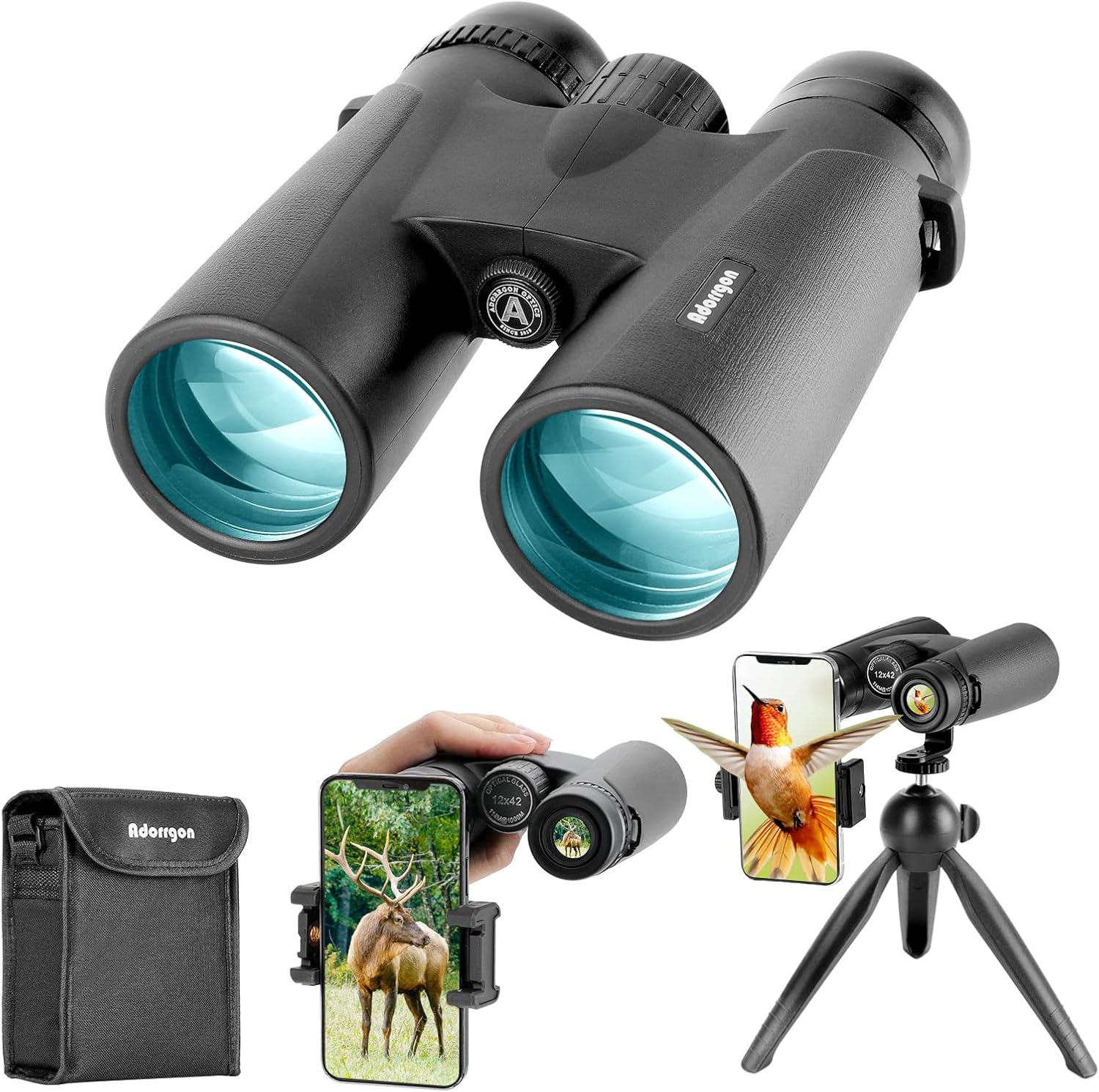
This 12x42 binocular uses BAK4 prisms and FMC optics. The model is waterproof and lists a 367-foot wide view with 18.5 mm eyepieces. A phone adapter and tripod are included with this configuration.
Check on AmazonIf you click this link and buy, we earn a commission at no additional cost to you.
FAQs
🔭 Is 8x or 10x better for general use?
Neither is universally better. Favor the option that best matches your usual distance, subject movement, exact-model field of view, and ability to hold the image steadily.
🌲 What binocular size works best for bird watching?
Start with field of view, close focus, eye relief, comfortable weight, and easy acquisition rather than a fixed size rule. Check the exact model because habitat, distance, eyeglass use, and handling can change the best fit.
🌙 Do stargazing binoculars need a tripod?
Not every astronomy binocular needs a tripod, but support becomes more valuable as magnification, size, weight, and viewing duration rise. If you plan to mount the binoculars, verify the exact model has the required interface.
🎒 Are compact binoculars always better for travel?
No. Choose the smallest binocular that still fits your eyes and hands and meets the trip’s light and distance needs, because very small designs can change grip, control access, and low-light usefulness.
👓 How should eyeglasses change the buying decision?
Check usable eye relief, eyecup adjustment, and whether you can see the full field comfortably with your glasses on. Exact eyepiece design and face position can change the result, so hands-on checking is valuable when possible.
🧒 Should kids use the same binocular specifications as adults?
Not automatically. Check weight, grip size, eye spacing, focus-wheel reach, and whether the child can find and hold a subject in view before copying an adult configuration.
References and Sources
- Nikon binocular numbers guide: Supports objective size, light gathering, weight, and exit pupil.
- Cornell Lab field of view guidance: Supports field of view for finding and following moving birds.
- Cornell Lab close focus guidance: Supports close focus for nearby bird watching.
- Celestron binocular support guidance: Supports tripod use as magnification, weight, and viewing duration rise.
- Audubon guide for growing birders: Supports manageable size, weight, field of view, and operation for children.