Birding binoculars work best when they help you acquire a bird quickly, bring it into focus without fuss, and keep it visible as it moves. Magnification matters, but field of view, close focus, focus control, eye relief, weight, and fit can change the experience just as much. The right configuration depends on where you watch, how far away birds usually are, how much they move, what the light is like, and whether you wear glasses. Start with that viewing workflow, then reject options that create avoidable friction.
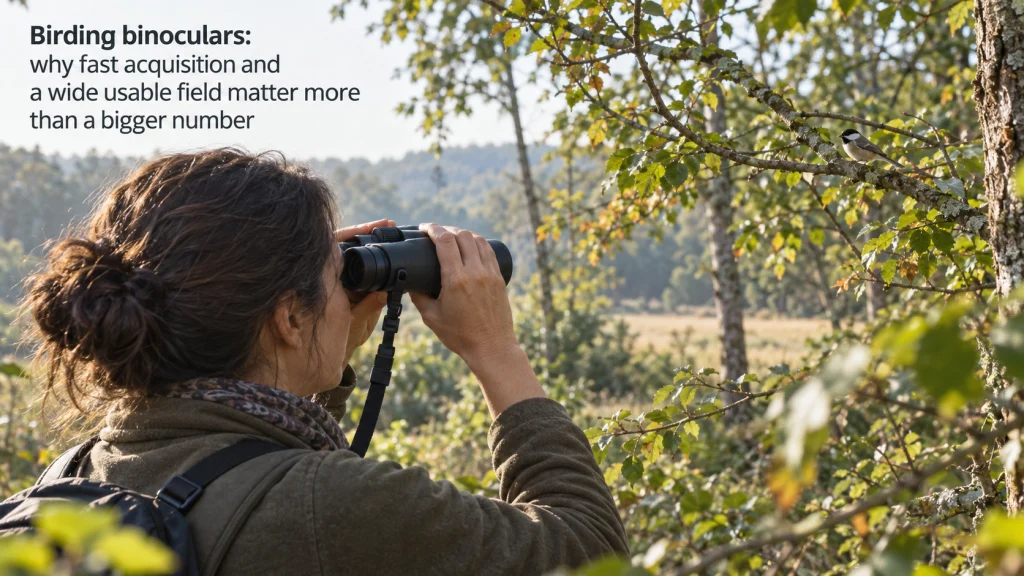
Choose around the moment a bird appears
Birding binoculars should make the first moments of a sighting easier, not turn them into a fight with the optics. A bird lands, changes direction, drops behind a branch, or moves from a nearby perch to a more distant tree, and the binocular has to keep up with that sequence. A wide usable field helps you get the bird into view, a predictable focus control helps you sharpen the image quickly, and a comfortable fit helps you repeat the motion without constantly resetting your grip. Magnification only becomes useful after those basic actions are working.
That is why I would not begin with a brand name or the largest number printed on the body. I would begin with the birding situation, then compare the specifications that affect acquisition, refocusing, eyewear fit, carrying, and changing light. If you are still deciding whether birding is your main use or just one of several uses, the broader best binoculars decision framework is the better place to compare activities first. Once birding is clearly the job, the rest of this page narrows the decision around that job instead of around a product list.

This 8x42 model uses ED glass, fully multi-coated optics, and phase-coated BaK-4 prisms. Its waterproof construction is designed for outdoor observation. The full-size configuration suits birding where balanced magnification, optical detail, and weather protection all matter.
Check on AmazonIf you click this link and buy, we earn a commission at no additional cost to you.
Start with the distances and habitats you encounter most often
A backyard feeder, a wooded trail, an open marsh, and a distant ridge ask different things from the same binocular. Nearby and fast-moving birds reward quick acquisition, easy refocusing, and enough field around the subject to recover when it hops. Repeated long-distance viewing can make extra magnification more useful, but it also makes hand movement more visible and usually gives you less scene around the bird. The better starting question is therefore not which configuration is strongest, but which viewing pattern dominates your time.
Habitat also changes how often the viewing distance shifts. In dense vegetation, a bird may appear close, disappear behind cover, and reappear farther away, so focus control and close-focus capability can become practical purchase gates. In open country, you may spend more time scanning and holding a distant subject, which changes the value of magnification, field width, and stability. Treat habitat as a way to identify constraints, not as a label that automatically dictates one configuration for every birder.

The Monarch M5 combines 8x42 optics with ED glass and dielectric prism coatings. Nikon lists the binocular as waterproof and fogproof for outdoor use. Its 8x magnification and 42 mm objectives fit mixed-distance birding where a full-size configuration remains practical.
Check on AmazonIf you click this link and buy, we earn a commission at no additional cost to you.
Many birders find 8x balanced, while 10x can earn its place at longer distances
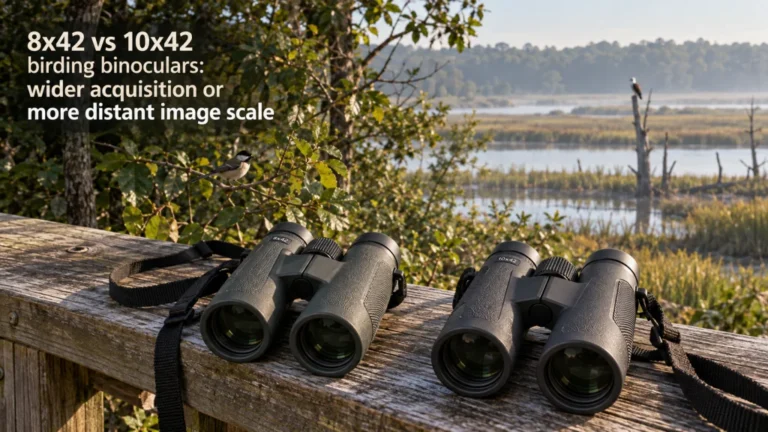
An 8x configuration is often attractive for general birding because it usually makes acquisition and handheld steadiness easier to manage. A 10x configuration can reveal a larger image of a distant bird, which may matter when your normal viewing happens across open water, fields, or broad sky. The trade is that higher magnification makes small hand movements more visible and often comes with a narrower field of view. Neither choice is automatically more advanced, and neither should be treated as the universal birding answer.
Compare the two around what you repeatedly do rather than what sounds more powerful on paper. As a same-family specification example, Vortex lists the Diamondback HD 8×42 with a 393 ft field at 1,000 yd, 17.0 mm eye relief, 5.0 ft close focus, and 21.8 oz weight, while the 10×42 version is listed at 330 ft, 15.0 mm, 5.0 ft, and 21.3 oz respectively. Those figures do not prove one configuration is better, but they show how field width and eyewear margin can change even when objective size and product family stay the same. The 8×42 versus 10×42 birding comparison goes deeper into that decision.
This 10x42 model uses a phase-coated roof prism and fully multi-coated optics. Its nitrogen-purged housing and twist-up eyecups support outdoor handling and eye-position adjustment. The 10x format fits sections where longer birding distances can justify added image scale.
Check on AmazonIf you click this link and buy, we earn a commission at no additional cost to you.
Field of view affects how quickly you can find and keep a moving bird
Field of view tells you how much scene is visible through the binocular at a stated distance, and that width becomes practical when the subject is moving. A wider view gives you more room for imperfect alignment when you raise the binocular and more space to recover if the bird hops, flies, or slips toward the edge of the image. That does not mean you should chase the widest number without checking anything else. The field still has to come with acceptable image quality, fit, focus behavior, and the magnification you actually need.
For birding, I would use field of view as a rejection check rather than invent one minimum number for everyone. Compare models at the same magnification, then ask whether one gives you meaningfully more scene without creating a different problem in eye relief, weight, or handling. Eyeglasses can also reduce the field you effectively see if the eye position is not right, which is why the published specification is only part of the fit decision. Cornell’s birding guidance similarly treats field width as central to finding and following birds, which is a better practical frame than treating magnification as the headline by itself.

This 8x42 roof-prism model lists a 142 m field of view and 19 mm eye relief. It uses center focus and fully multi-coated optics. Bushnell also describes the Engage EDX as waterproof with an EXO Barrier coating that repels water, debris, oil, and fog.
Check on AmazonIf you click this link and buy, we earn a commission at no additional cost to you.
Close focus matters when birds appear near feeders, paths, or vegetation
Close focus is easy to ignore when you imagine birding as a distant-viewing activity, but many real sightings happen surprisingly near the observer. A bird may land at a feeder, pause along a path edge, or move through nearby shrubs where a binocular that cannot focus close enough simply gives you blur. That makes close focus a real constraint for some users, not a premium feature that everyone needs to maximize. The useful question is how often your normal birding places put subjects near the minimum focus distance.
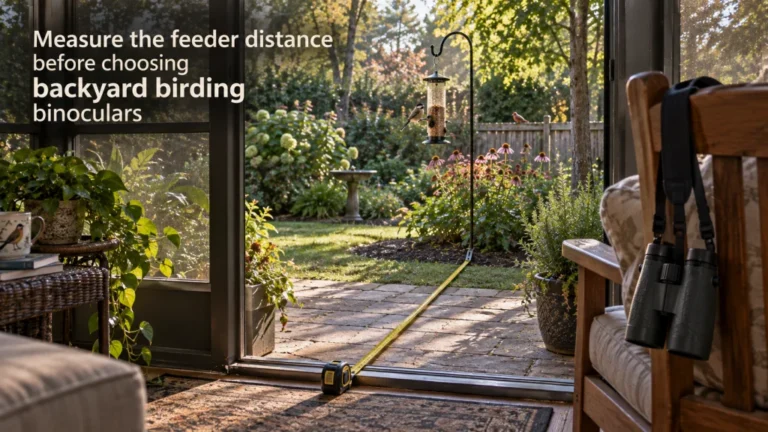
If backyard viewing is a large part of your use, check the manufacturer’s close-focus specification and compare it with the distances you actually have around feeders, windows, and garden edges. Do not assume a more expensive binocular must focus closer, and do not assume the shortest possible close focus is automatically better for your use. The backyard birding binocular guide narrows that near-distance decision further. For open-country birding where subjects are rarely close, other constraints may deserve more weight.

The Papilio II 8.5x21 is designed for both close-up and distant viewing. Its minimum focus is about 20 inches, making nearby subjects a practical part of its use case. Center focus and a compact body make it relevant where feeder, path, or vegetation distances can be unusually short.
Check on AmazonIf you click this link and buy, we earn a commission at no additional cost to you.
Focus control matters because bird distance changes repeatedly
A focus wheel is not just a control you use once at the start. Birding can require frequent movement between near and far subjects, so the wheel has to be easy to reach, predictable to turn, and precise enough that you can stop where the image looks right. Published specifications do not always tell you how the control will feel in your hand, which is one reason in-person handling can be valuable when available. The goal is not the fastest possible wheel, but a control that lets you change distance without overshooting or hunting back and forth.
Hand size, gloves, grip position, and the shape of the bridge can all change whether the control feels natural. This is also where two binoculars with the same magnification and objective size can behave differently in actual use even before optical quality is considered. If you can try a pair before buying, move the focus between near and distant objects several times and notice whether your index finger lands on the wheel without repositioning the binocular. If you cannot, treat manufacturer dimensions and independent handling observations as supporting evidence rather than assuming identical specifications mean identical control.

The Crossfire HD 10x42 uses a center focus wheel that adjusts both barrels together. Adjustable eyecups support viewing with or without eyeglasses, and the roof-prism body is waterproof. Its straightforward center-focus layout fits a section focused on repeated near-to-far refocusing.
Check on AmazonIf you click this link and buy, we earn a commission at no additional cost to you.
Eyeglasses make eye relief and eyecup fit a purchase gate
Eyeglass wearers need enough usable eye relief to see the full image with their eyes positioned farther from the eyepieces. The published eye-relief number is useful, but eyecup shape, eyecup travel, facial geometry, and how your glasses sit can still change the result. A binocular that looks strong on a specification sheet can therefore feel cramped if you cannot see the field without pressing the eyepieces awkwardly toward your lenses. Fit should be checked with the glasses you actually wear for birding whenever possible.
Set the eyecups to the position intended for glasses and check whether the view looks complete rather than clipped or tunnel-like. Then raise and lower the binocular several times to see whether you can return to the same eye position quickly, because repeated setup matters during moving sightings. The birding binocular fit guide for eyeglass wearers handles that narrower problem in more detail. Do not turn a single eye-relief figure into a guarantee when the exact eyecup design and your own fit still matter.

The Diamondback HD 8x42 lists 17 mm eye relief and adjustable eyecups. Vortex states that the eyecups twist up and down for viewing with or without eyeglasses. Its waterproof center-focus design gives eyeglass wearers a concrete model for checking usable eye position and fit.
Check on AmazonIf you click this link and buy, we earn a commission at no additional cost to you.
Dawn, dusk, and shaded habitat need a low light audit
Low light is not a reason to assume that every birder needs the largest objective lens available. A larger objective can support a brighter viewing system, but it also adds size and often weight, which affects carrying and steadiness over a long outing. Coatings, optical design, magnification, your eye position, and the actual level of available light also matter. The useful decision is whether low-light viewing is frequent enough to justify carrying a larger configuration rather than merely admiring its specification.
Compare your typical start and end conditions with the amount of time you spend walking, scanning, and holding the binocular. An 8×32 can be easier to carry than an 8×42, while the larger format may make more sense when low-light performance has greater priority than compactness. That trade is covered more directly in the 8×32 versus 8×42 birding comparison. The right answer depends on how often the light constraint actually appears, not on a rule that 42 mm is mandatory for birding.

This Engage EDX pairs 10x magnification with 50 mm objectives. The listing specifies fully multi-coated optics, center focus, and waterproof construction. Its larger objective size directly fits a section weighing low-light priorities against the extra bulk of a full-size binocular.
Check on AmazonIf you click this link and buy, we earn a commission at no additional cost to you.
Weather protection should be verified on the exact model
Birding puts binoculars around humidity, dust, light rain, temperature changes, wet vegetation, and the occasional careless moment when gear is exposed longer than intended. Marketing language such as outdoor, rugged, or all weather does not tell you enough about sealing. Check the exact manufacturer’s description for the model and variant you are considering, especially when waterproofing, fog resistance, or operating limits matter to you. If the documentation is vague, keep the claim narrow rather than assuming the binocular can tolerate conditions the maker never specifies.
Weather protection is also separate from care after exposure. Caps, a case, a clean storage routine, and sensible drying matter even when the binocular is sold as waterproof, because external moisture and grit still reach surfaces you handle. If internal fogging, water ingress, a damaged eyepiece, or a loose optical component appears, stop at owner-level cleaning and use qualified service rather than attempting internal adjustment. A birding label does not override the care instructions for the exact binocular in your hands.
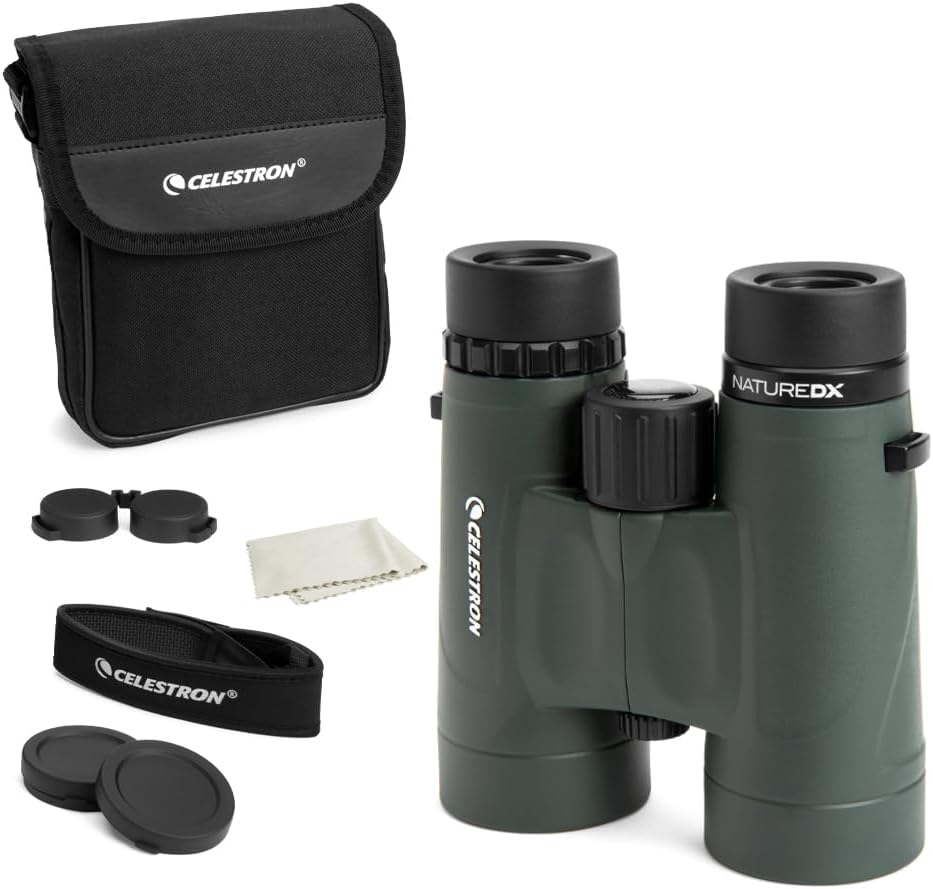
The Nature DX ED 10x42 combines ED glass with phase-corrected BaK-4 prisms and fully multi-coated optics. Celestron identifies this exact model as waterproof. Its documented outdoor protection makes it a direct fit for a section that requires weather claims to be checked on the exact model.
Check on AmazonIf you click this link and buy, we earn a commission at no additional cost to you.
Special birding situations should change one constraint at a time
A first-time birder usually does not need to solve every advanced case at once. Start with comfortable fit, manageable weight, useful field of view, predictable focusing, and a configuration that matches the distances you see most often. The beginner birding binocular decision keeps that shortlist deliberately narrower. It is often better to learn what bothers you in normal use than to buy extra capability for a problem you have not actually encountered.
Other situations deserve their own branch when the constraint is real. Repeated raptor or hawk viewing can shift attention toward distant acquisition and holding a moving subject, while image stabilization addresses steadiness in a different way and brings its own weight, power, and setup considerations. Use the hawk watching binocular guide or the image stabilized birding binocular guide when those jobs describe your normal use. Do not let a special case rewrite the whole birding framework for everyone else.

The Canon 10x30 IS II combines 10x magnification with optical image stabilization. Canon specifies 30 mm objectives, a 6-degree field of view, and 14.5 mm eye relief. It fits a special-case section where stabilization is evaluated as a targeted solution rather than a default birding requirement.
Check on AmazonIf you click this link and buy, we earn a commission at no additional cost to you.
Build the shortlist in a fixed order
A useful shortlist is a sequence of rejection checks, not a pile of models that all seem impressive. Start with the viewing problem, eliminate configurations that fight your normal distance or motion, then check field of view, focusing, fit, light needs, carrying burden, and weather protection. This order prevents one attractive specification from hiding a poor match somewhere else. It also makes it easier to compare two candidates without turning the decision into a brand contest.
Use the checks below as a working pass, then return to any child decision that matches a specific unresolved constraint. You do not need every desirable feature, and paying more does not remove trade-offs. The shortlist is finished when the remaining options fit your use, not when you have collected the longest specification list.
Distance, movement, and field of view
Write down where the birds usually are: near feeders and brush, mixed distances on trails, or consistently farther away in open habitat. Then decide whether 8x or 10x better matches that pattern before comparing models inside the configuration. Reject a candidate if the field feels unnecessarily restrictive for the way your subjects move, especially when rapid acquisition is important. If distant birds dominate, the 10×42 versus 10×50 birding comparison can help separate added objective size from magnification itself.
Focus, close focus, and eyewear
Check whether the center focus is easy to reach and whether repeated near-to-far changes feel controlled. If birds often appear close, verify the stated close-focus distance instead of assuming every birding model will handle your feeder or garden layout. Eyeglass wearers should verify usable eye relief and eyecup position with their own glasses. These fit checks can remove a candidate even when the optical specification list otherwise looks attractive.
Light, carry, and weather
Decide how often low light is actually part of your normal birding rather than an occasional possibility. Compare that need against weight and bulk, because a larger objective is only useful if its advantage matters often enough to justify carrying it. Verify the exact model’s weather claims and care instructions instead of relying on a category label. Include the strap, case, caps, and any harness you expect to use when judging the real carry burden.
Stabilization and budget
Image stabilization can address hand movement, but it should be evaluated as a separate solution with its own weight, power, control, and maintenance implications. Budget should work the same way: set the amount you are willing to spend, then reject options that fail the required fit and viewing checks rather than buying the cheapest acceptable label. The remaining decision should still answer what changes in your actual viewing. If a simpler binocular already clears the important constraints, spending more is optional rather than a requirement.
| Decision check | What to verify | Reason to reject |
|---|---|---|
| Distance and motion | Typical bird distance, movement, 8x or 10x fit | The configuration fights your normal viewing pattern |
| Field of view | Published field plus usable view with your eye position | Acquisition feels unnecessarily restrictive |
| Focus | Reach, control, repeated near-to-far changes | You overshoot, hunt, or reposition your grip too often |
| Close focus | Manufacturer minimum focus against your real distances | Nearby birds fall inside the unusable range |
| Eyewear fit | Eye relief, eyecup position, full visible field | The image clips or eye position is hard to repeat |
| Light and carry | Low-light need against weight and bulk | You carry more binocular than your normal use justifies |
| Weather | Exact manufacturer sealing and care claims | The documented protection does not match your exposure |
After the table, keep only the candidates that clear every constraint you consider essential. Optional features can break a tie, but they should not rescue poor fit, a narrow usable field, awkward focus control, or excessive carry burden. Trying the finalists in person can reveal differences specifications cannot fully capture.
- Choose the activity-level magnification before comparing brands or premium features.
- Compare field of view among models at the same magnification.
- Verify close focus if nearby birds are common in your normal locations.
- Check eye relief and eyecup fit with your actual glasses when relevant.
- Count weight, strap or harness, case, and carrying time as part of the purchase decision.
- Verify weather protection and care instructions on the exact model.
If the list still feels broad, return to the constraint causing the most missed or uncomfortable viewing. A decision becomes easier when each remaining feature has a job, and anything without a job can wait.

The TrailSeeker ED 8x32 combines ED optics with phase- and dielectric-coated BaK-4 prisms. Its magnesium-alloy body keeps the configuration centered on portable field use. The 8x32 format fits a shortlist that weighs optical features against size, carry burden, and birding practicality.
Check on AmazonIf you click this link and buy, we earn a commission at no additional cost to you.
Final Thoughts: prioritize the viewing workflow before the product list
For birding, the useful binocular is the one that helps you find the bird, focus it, keep it in view, and repeat that process comfortably in the places you actually watch. Start with distance and movement, then check field of view, focus behavior, close focus, eye relief, weight, light needs, and weather protection. Treat 8x and 10x as different compromises rather than levels on an upgrade ladder. Once those constraints are clear, a product shortlist becomes much easier to judge without relying on a leaderboard.
Every feature you pay for should solve a problem you expect to meet often enough to matter. If a lighter or simpler configuration clears the same practical gates, it may be the better choice. If raptor viewing, eyeglasses, backyard distances, or stabilization dominates, follow that branch instead of forcing a general answer. The goal is to remove friction from the way you watch birds.

The Nature DX 8x32 uses 8x magnification, 32 mm objectives, and a 7.4-degree field of view. Amazon lists 17.5 mm eye relief and waterproof construction for this compact model. It fits the final emphasis on choosing a simpler, lighter configuration when it still clears the important viewing constraints.
Check on AmazonIf you click this link and buy, we earn a commission at no additional cost to you.
Explore specific birding binocular decisions
Use these narrower guides when one constraint has become the main reason your shortlist is still unclear. Each page keeps the same birding context but goes deeper on one decision. Start with the issue actually blocking the purchase, such as magnification, eyewear fit, nearby viewing, carry size, distant tracking, or stabilization. That keeps the next step focused instead of sending you through every possible birding variation.
| Topic | What you will find |
|---|---|
| Binoculars for birding beginners | A narrower first-purchase framework focused on fit, field, focus, and manageable complexity. |
| 8×42 versus 10×42 for birding | A direct trade-off between acquisition, steadiness, field width, and added image scale. |
| Birding binoculars for eyeglass wearers | How eye relief, eyecups, and repeatable eye position affect the usable field. |
| Backyard birding binoculars | How close focus, quick handling, and shorter viewing distances change the decision. |
| 8×32 versus 8×42 for birding | A comparison of carry weight, size, low-light priority, and full-size handling. |
| Binoculars for hawk watching | How distant acquisition and tracking change priorities for open-sky birding. |
| 10×42 versus 10×50 for birding | When added objective size may or may not justify extra weight and bulk at 10x. |
| Image stabilized binoculars for birding | When stabilization addresses a real steadiness problem and what extra trade-offs come with it. |
Choose the page that matches the unresolved constraint rather than reading every branch by default. If two constraints matter equally, use the broader framework above to decide which affects more of your viewing time. A specialized page should narrow a decision, not replace the basic checks for field of view, focus, fit, weight, and weather protection. Return to the shortlist after that uncertainty is resolved.

The Triumph HD 10x42 uses HD optics in a waterproof, fogproof, and shockproof body. It is tripod adaptable and includes a GlassPak harness. The 10x42 configuration gives readers a concrete branch to compare when exploring distant-viewing, carry, and stability trade-offs.
Check on AmazonIf you click this link and buy, we earn a commission at no additional cost to you.
FAQs
🔭 Is 8x or 10x better for birding?
Neither is universally better. Many birders value the steadier view and wider field commonly associated with 8x, while 10x can be useful when repeated long-distance viewing matters more.
🌲 Why does field of view matter for bird watching?
A wider field gives you more scene around the bird, which can make initial acquisition and tracking easier. Compare field of view among binoculars at the same magnification, then check whether your eye position lets you use that field comfortably.
🐦 How close should birding binoculars focus?
The useful distance depends on where you watch. If feeders, paths, or nearby vegetation regularly put birds close to you, compare the manufacturer’s close-focus specification with those real viewing distances.
👓 What should eyeglass wearers check first?
Check usable eye relief and whether the eyecups let you see the full field with your normal glasses. The published number is helpful, but the exact eyecup design and your face and glasses still affect fit.
🌅 Do I need 42 mm objectives for birding?
No. Larger objectives can be useful when low-light performance matters, but smaller configurations can reduce weight and bulk, so the better choice depends on light conditions and carrying priorities.
🧭 Are image stabilized binoculars necessary for birding?
No. Stabilization can help when hand movement is a real constraint, but it also changes weight, power needs, controls, and cost, so it should solve a specific problem rather than be treated as a default requirement.
References and Sources
- Cornell Lab binocular testing tips: Supports the birding trade-offs around 8x and 10x, field of view, focus-wheel feel, weight, eyecups, and fit.
- Cornell Lab field of view guidance: Supports why a wider usable field can make finding and following birds easier.
- Cornell Lab close focus guidance: Supports the practical value of close focus when birds appear at short viewing distances.
- Vortex Diamondback HD 8×42 specifications: Verifies the field of view, eye relief, close focus, and weight used in the same-family 8x comparison.
- Vortex Diamondback HD 10×42 specifications: Verifies the matching 10x figures used to illustrate the configuration trade-off.