Backyard birding binoculars should be chosen around the shortest bird distance you actually use, not around a generic magnification rule. Measure from your normal viewing position to the nearest feeder, fence, branch, or perch, then reject any binocular whose published close-focus limit is farther away than that distance. After that first pass, field of view, magnification, eyeglass fit, weight, weather exposure, and price can decide which configuration fits the yard best. The goal is a pair that reaches focus quickly and comfortably where the birds really appear.
Measure the nearest normal viewing distance first
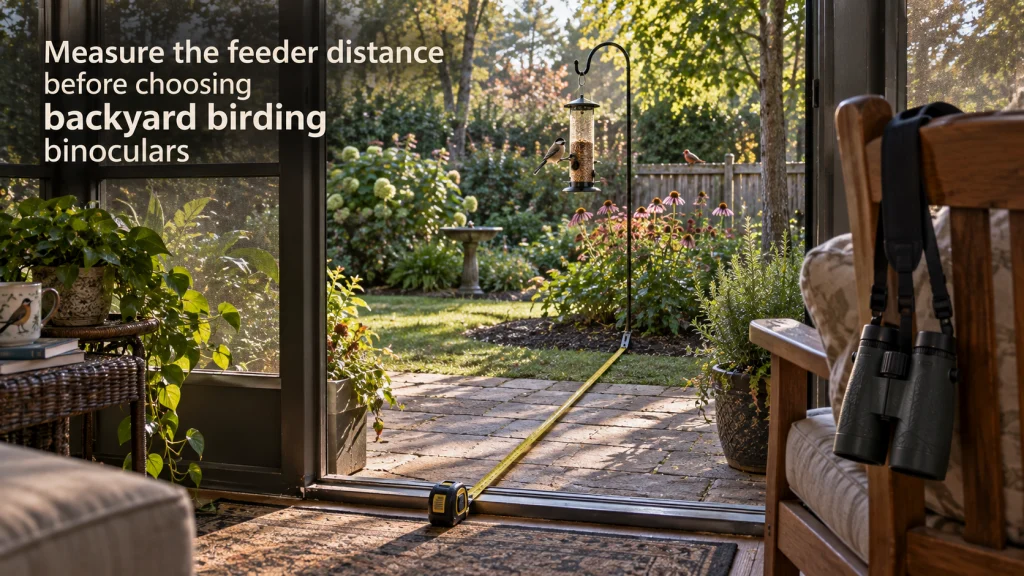
The first useful specification for backyard birding binoculars may be sitting outside the spec sheet. Stand or sit where you normally watch, then measure to the nearest place where a bird regularly lands, such as a feeder edge, fence rail, shrub, or low branch. That number tells you whether close focus is a real constraint in your yard or merely an attractive specification. It also keeps the buying process grounded in a viewing condition you can verify before spending money.
This is the same reason a general guide to choosing binoculars for birding situations has to start with distance and movement rather than one favorite configuration. A broader binocular buying framework can help with overall fit, but the yard creates its own rejection test because nearby birds may be much closer than subjects on a trail or across a field. If your nearest normal perch is 7 feet away, write down 7 feet before looking at magnification, coatings, or price. The measurement does not tell you which binocular to buy, but it tells you which ones cannot do the job from that position.

The 100-foot fiberglass tape gives you enough reach to measure from a normal viewing position to feeders, fences, branches, or other yard perches. Its open-reel format is suited to longer outdoor measurements. Recording that real distance gives you a concrete close-focus requirement before comparing binoculars.
Check on AmazonIf you click this link and buy, we earn a commission at no additional cost to you.
Compare your measurement with the published close-focus limit
Close focus is the nearest distance at which a binocular is designed to form a focused image, so it should be compared directly with the number you measured in the yard. If the nearest feeder is 7 feet away and a model lists a 10-foot close-focus limit, that model fails for that position even if every other specification looks appealing. The practical fix would be to move farther from the bird, move the viewing position, or choose a binocular that focuses closer. For a backyard pair, that is a much cleaner decision than hoping a product category label such as birding binocular will solve the mismatch.
Published numbers also show why this needs to be checked model by model rather than assumed from size or price. As reference examples, the Vortex Diamondback HD 8×42 lists a 5-foot close focus and a 393-foot field of view at 1,000 yards, while the Celestron Nature DX 8×42 lists a 6.5-foot close focus and a 388-foot field of view at 1,000 yards. Those figures are not recommendations or a ranking; they simply show that two binoculars sharing the same 8×42 format can differ in the distance at which they are expected to focus. Always verify the exact variant you are considering because a nearby model name or different magnification can carry different specifications.
| Reference example | Published close focus | Published field of view | What the number is useful for |
|---|---|---|---|
| Vortex Diamondback HD 8×42 | 5 ft | 393 ft at 1,000 yd | Shows how a model can clear a very short measured yard distance |
| Celestron Nature DX 8×42 | 6.5 ft | 388 ft at 1,000 yd | Shows why exact model specs matter even within the same 8×42 format |
The table is a verification example, not a product shortlist. Use the same process with any binocular you are considering: record the exact model and magnification, open the manufacturer’s specification page, and compare its stated close focus with the closest distance you measured at home. If the published limit is farther away than the bird, stop there instead of trying to rescue the choice with another feature. A specification only earns attention when it solves the actual geometry of the yard.

This 8x42 Nature DX combines 42 mm objective lenses with a wide 7.4-degree field of view. Phase-coated BaK-4 prisms and fully multi-coated optics support bright, detailed viewing. The waterproof and fogproof construction makes it a practical exact model to check against your measured backyard close-focus requirement.
Check on AmazonIf you click this link and buy, we earn a commission at no additional cost to you.
A shorter close-focus number is only useful when the yard needs it
Once a binocular focuses comfortably inside your nearest normal bird distance, an even shorter number may stop changing the experience. A pair that focuses to 5 feet has an obvious advantage over one that stops at 10 feet when your feeder is 7 feet away, but the same advantage can disappear if every bird you watch is 20 feet or farther away. Close focus is therefore a pass or fail specification first, not a score that should be maximized without context. Buying the shortest possible value can distract from field of view, fit, focus control, weight, or price that matters more after the distance requirement is satisfied.
Cornell’s birding guidance emphasizes that close focus becomes especially relevant when birds come near the observer, while also noting that many birding binoculars already reach fairly short distances. The useful interpretation is not that every backyard pair needs the smallest number available. It is that the binocular must focus inside the viewer’s real working distance with some practical margin. If your yard never puts birds inside 15 feet, a very close minimum focus can be nice to have, but it should not automatically outrank a wider usable field or a better fit with glasses.

The Papilio II 8.5x21 is designed for close-up viewing down to about 50 cm. Fully multi-coated optics, BaK-4 prisms, and aspherical lens elements support a clear compact view. Its unusually short close-focus capability makes it a useful example of a feature that matters only when your yard actually needs it.
Check on AmazonIf you click this link and buy, we earn a commission at no additional cost to you.
Nearby moving birds make field of view and quick acquisition matter
A bird at a feeder rarely stays frozen in the center of the scene. It may hop from the feeder to a fence, drop into a shrub, or cross a nearby branch before you have fully settled the binoculars to your eyes. A wider field of view gives you more scene around the bird, which makes initial acquisition and short tracking movements more forgiving. This matters at close range because the visible slice of the yard can feel tight even when the field-of-view number looks generous on a specification page.
Do not treat field of view as a substitute for close focus, because the two specifications solve different problems. Close focus determines whether the nearby bird can become sharp at all, while field of view affects how easily you find and keep it in the image once focus is possible. Cornell specifically notes that a wider field helps when finding birds, following movement, and working through dense foliage. After a model passes your distance test, compare field of view in the same magnification class and favor the wider usable view when quick acquisition is important to how you watch.

The MONARCH M7 8x30 provides a 435-foot field of view at 1,000 yards. Its 8x magnification and compact 30 mm format pair a wide view with a smaller body. That broad field is useful for acquiring and following birds that move quickly among nearby branches and cover.
Check on AmazonIf you click this link and buy, we earn a commission at no additional cost to you.
Compare 8x and 10x by the distances in your yard
More magnification is not automatically more useful when the subject is already close. An 8x binocular often gives a wider field and a steadier view than a comparable 10x, which can make it easier to get on a bird that moves between nearby branches. A 10x view can still make sense when the property is deeper, the birds are usually farther away, or the extra image scale solves a real viewing problem. The right choice comes from the distance pattern in the yard, not from treating 10x as a simple upgrade over 8x.
If most observations happen between a nearby feeder and a few trees across the property, compare how much scene each option shows and how easily you can hold the image steady. If the same yard opens onto a large field or distant tree line, the trade changes because the extra reach of 10x may become more useful. The dedicated 8×42 versus 10×42 comparison for birding goes deeper into that magnification trade-off without assuming one winner. For a backyard decision, let the nearest and farthest normal bird positions define which side of that trade actually matters.

The Outland X 10x42 uses 10x magnification with 42 mm objective lenses and a 5.5-degree field of view. BaK-4 prisms and multi-coated optics support detailed outdoor viewing. Its 10x configuration gives readers a concrete higher-magnification option to compare against 8x models using the actual depth of their yard.
Check on AmazonIf you click this link and buy, we earn a commission at no additional cost to you.
Do not assume objective size determines close focus
The second number in an 8×42 or 8×32 binocular describes objective lens diameter, not the nearest distance the focusing system can reach. Two models with the same objective size can publish different close-focus limits, and a smaller objective does not guarantee a shorter one. That is why sorting products by 32 mm or 42 mm before checking the exact close-focus specification can send the decision in the wrong direction. Objective size affects other parts of the viewing trade, but it does not replace a model-specific distance check.
After close focus is confirmed, objective size can matter for light, size, weight, grip, and how willing you are to carry the binocular away from the house. A 32 mm configuration may be easier to keep near a window or take outside casually, while a 42 mm configuration can offer more light-gathering margin under dimmer conditions, depending on the full optical design. The 8×32 versus 8×42 birding comparison is the better place to weigh that format choice in detail. In this decision, treat objective diameter as a second-stage fit variable after the binocular has already proved it can focus where your birds appear.

This Nature DX variant pairs 8x magnification with 32 mm objective lenses in a compact format. It provides a 7.4-degree field of view and uses phase-coated BaK-4 prisms. The exact 8x32 configuration lets readers evaluate size and handling without assuming objective diameter determines close focus.
Check on AmazonIf you click this link and buy, we earn a commission at no additional cost to you.
Eyeglass users still need a full-field fit
A binocular can pass the close-focus test and still feel wrong if you cannot see the full field while wearing glasses. Eye relief, eyecup position, face shape, and the exact eyepiece design all affect whether the published field remains usable at your eyes. This is especially relevant in a yard because a reduced visible field makes nearby movement harder to acquire and follow. The specification number is a starting point, but the practical test is whether you can place the binoculars naturally and see one complete, comfortable image without searching for a narrow sweet spot.
With glasses on, start with the eyecups fully retracted and adjust only as needed to remove blackouts while preserving as much field as possible. If you can try the exact model before buying, look at a nearby object and then shift to a second target off to one side of the yard to see whether the field feels constrained. If buying remotely, verify published eye relief and a return policy rather than assuming a generic eyeglass-friendly label guarantees fit. The important result is not a particular millimeter threshold by itself, but a full usable view with your own glasses and face position.

The MONARCH M7 8x42 combines 8x magnification, 42 mm objectives, and long eye relief for comfortable viewing. ED glass and multilayer coatings support sharp, bright images, while the body is waterproof and fogproof. Its eyecup and eye-relief design makes it a relevant exact model for readers who need to test a full field while wearing glasses.
Check on AmazonIf you click this link and buy, we earn a commission at no additional cost to you.
Weight matters differently at home, but it still matters
Backyard use can reduce the penalty for weight because the binocular may spend much of its life on a shelf, table, or hook near the viewing area. That does not mean weight becomes irrelevant. Some people walk the perimeter of a yard, carry binoculars while gardening, step onto a porch repeatedly, or keep them around the neck while moving between windows. A heavier pair can be perfectly acceptable for short stationary looks and still be annoying if your normal routine involves frequent carrying.
Judge weight against duration and movement instead of applying a hiking rule to every home user. If the binocular is picked up only for brief looks from one chair, you may reasonably tolerate more mass in exchange for another benefit. If it stays with you while you move through a large property, balance, grip, strap comfort, and overall bulk become more important. A backyard pair should fit the way you actually use the space, not an imagined version in which every observer remains seated next to the same window.

This neoprene strap is designed for binoculars and small cameras and can be worn at the neck or shoulder. Its length adjusts from about 31.5 to 38 inches, and quick-release connectors let the optic detach from the main strap. It directly addresses carry comfort when a backyard routine involves moving between windows, porch, and yard.
Check on AmazonIf you click this link and buy, we earn a commission at no additional cost to you.
Treat weather and low light as separate filters
A pair used outdoors around a garden or patio may encounter humidity, light rain, temperature changes, dust, or accidental splashes, so weather protection can matter even when the binocular never leaves home. Verify the exact manufacturer’s environmental claim rather than assuming every roof-prism design is sealed to the same level. If you normally watch from behind a closed window, that changes the exposure question but does not create a special coating requirement for window viewing. The more useful decision is whether the binocular itself will regularly be carried outside and left within reach of changing conditions.
Low-light viewing is another separate issue. A feeder used near dawn, under dense tree cover, or late in the day may place more value on objective size, exit pupil, optical transmission, and a steady view, but those factors should not be collapsed into a universal backyard formula. First make sure the binocular focuses at the required distance and gives a usable field, then decide whether dim conditions are frequent enough to justify extra size or cost. If the yard is usually viewed in good daylight, paying heavily for low-light capability may solve a problem that rarely occurs.

The Bushnell H2O 8x42 uses an IPX7 waterproof optical system with nitrogen purging to resist internal fogging. Fully multi-coated optics and BaK-4 prisms support contrast and light transmission. Its 42 mm format and weather protection make it relevant when backyard viewing includes dim light, humidity, rain, or changing outdoor conditions.
Check on AmazonIf you click this link and buy, we earn a commission at no additional cost to you.
Keep feeder setup and bird identification outside the binocular decision
A binocular buying decision can tell you whether the optics match the distance, movement, light, weather, and physical fit of the yard. It should not drift into advice about where to place feeders, what food to offer, how to attract particular species, or how birds should be handled. Those questions have different evidence and different consequences, and solving them is not necessary for choosing a pair of binoculars. Keeping the scope narrow also prevents a useful optics checklist from turning into a generic backyard birding guide.
The same boundary applies to photography through a window and species identification. Window glass can affect image quality, reflections, and color, but that does not create a reason to invent a special binocular coating requirement for home use. Likewise, magnification can help you inspect visible detail, but identifying a bird correctly depends on much more than the binocular specification. Choose the optics for the viewing geometry first, then use appropriate birding resources for feeder practices, behavior, and identification questions.

This second-edition paperback by David Allen Sibley is a 624-page bird guide. It gives backyard birders a dedicated identification reference separate from the binocular specification decision. That separation supports the article’s boundary between choosing optics and answering species-identification questions.
Check on AmazonIf you click this link and buy, we earn a commission at no additional cost to you.
Use a simple backyard acceptance card
A short acceptance card is more useful than a long wish list because it separates requirements from preferences. Write down the nearest normal bird distance, the farthest distance you care about, whether birds move quickly through cover, whether you wear glasses, and whether the binocular will usually stay indoors or travel around the property. Then compare each exact model against those conditions in the same order. This keeps one impressive specification from hiding a basic mismatch.
The card should also include a skip decision. If a binocular cannot focus at the nearest required distance, does not give you a usable field with glasses, or feels too awkward for the way you carry it, remove it from consideration rather than rationalizing around the problem. If it passes those gates, compare price, optical quality, weather protection, and secondary features. A model does not need to win every column; it needs to clear the requirements that your yard actually creates.
Nearest distance, close focus, and field of view
Record the shortest measured bird distance and compare it with the exact published close-focus limit. Require the binocular to focus inside that distance rather than merely matching a generic birding recommendation. Then compare field of view among the models that passed, especially if birds move through shrubs, fences, or nearby branches. A wider usable field is valuable when it makes acquisition easier, but it cannot rescue a binocular that fails to focus at the required range.
Magnification, eyewear, and light
Choose 8x or 10x from the actual depth of the property and how easily you can hold the view steady. With glasses, confirm that the full field remains visible at a natural eye position and that the eyecups give you workable adjustment. If much of your viewing happens in dim conditions, evaluate the complete optical configuration rather than using objective diameter alone as a brightness score. These checks should refine the shortlist only after the close-focus requirement has already been met.
Weather and price
Decide whether the binocular will routinely be exposed to moisture, dust, or abrupt temperature changes, then verify the exact environmental protection claimed for that model. Compare price only among binoculars that already fit the yard, because a bargain that cannot focus on the nearest feeder is not a bargain for this use. Do not pay extra for features you cannot connect to a real viewing condition at home. The best value is the least expensive option that meets your required distance, field, fit, and use pattern without creating a new problem.

The Rite in the Rain 954 pocket notebook has a 3.5-by-5-inch weatherproof soft cover and 112 pages. Its compact format makes it easy to record nearest distance, farthest distance, eyewear needs, weather exposure, and other acceptance criteria outdoors. Keeping those requirements on one card helps compare exact binocular models consistently.
Check on AmazonIf you click this link and buy, we earn a commission at no additional cost to you.
Final thoughts: measure the yard before buying the optics
The strongest first move is simple: measure from your normal viewing position to the nearest place a bird actually appears. Use that distance to reject binoculars that cannot focus close enough, then compare field of view, 8x versus 10x, eyeglass fit, weight, weather exposure, and price among the models that remain. This prevents a familiar specification or a higher price from overruling the geometry of your own yard. A backyard pair is successful when it works naturally at the distances you use, not when it wins an abstract spec contest.
Once a model clears that close-focus gate, the remaining specifications become useful because they are being compared among options that can already handle the nearest subjects. A wider field may make nearby movement easier to follow, a different magnification may fit the depth of the property better, and eyecup or weight differences may decide which option feels practical. Price belongs at the end of that sequence, not at the beginning, because a cheaper or more expensive binocular still has to work at the required distance. Treat those later comparisons as tie breakers among viable choices rather than reasons to excuse a model that already failed the first requirement.

The GlassPak harness keeps full-size binoculars close at hand and uses tethers to help prevent accidental drops. Two mesh side pockets and a rear zippered pocket provide storage for small field items. It gives readers a practical carry solution after they have already chosen optics that meet the yard’s distance and viewing requirements.
Check on AmazonIf you click this link and buy, we earn a commission at no additional cost to you.
FAQs
📏 How close should backyard birding binoculars focus?
They should focus closer than the nearest normal bird distance in your own yard. Measure that distance first, then compare it with the exact model’s published close-focus specification instead of using one universal threshold.
🔭 Is 8x or 10x better for backyard bird watching?
8x is often easier for nearby moving birds because it commonly offers a wider field and steadier view, while 10x can be useful when your property includes longer viewing distances. Choose from the actual near and far distances you use rather than assuming higher magnification is automatically better.
🌿 Does a wider field of view help with feeder birds?
Yes, especially when birds hop quickly between a feeder, fence, and nearby cover. A wider usable field can make acquisition and tracking easier, but the binocular still needs to focus at the bird’s distance first.
👓 What should I check if I wear glasses?
Check eye relief, eyecup adjustment, and whether you can see the full field with your glasses on. The exact fit depends on the binocular design, your frames, and your face position, so a published eyeglass-friendly label is not enough by itself.
🌅 Do I need 42 mm objectives for backyard birding?
No. A 42 mm objective can provide useful light-gathering margin in some conditions, but 32 mm and other formats can work well when distance, field, fit, and light needs line up. Objective size does not determine close focus by itself.
🏡 Can I choose a pair just from a backyard birding label?
No. Treat the label as marketing context, then verify the exact model’s close focus, field of view, eye relief, weight, and weather protection against your own use. The nearest measured bird distance should be one of the first checks.
References and sources
- Cornell Lab close-focus guidance: Explains why close focus matters when birds appear near the observer and why the number should be treated as a practical birding specification.
- Cornell Lab field-of-view guidance: Supports the role of field of view in finding and following moving birds and explains why the usable field can matter at close range.
- Vortex Diamondback HD 8×42 specifications: Verifies the model’s published 5-foot close focus and 393-foot field of view at 1,000 yards.
- Celestron Nature DX 8×42 specifications: Verifies the model’s published 6.5-foot close focus, 388-foot field of view at 1,000 yards, and eye-relief specification.