Compact binoculars can replace a full-size pair when the saved bulk changes what you are willing to carry and your normal viewing conditions do not demand the larger format’s extra operating margin. The trade is not simply small versus large: objective size changes exit-pupil geometry, while body size can also change eye relief, eyecup room, control spacing, and how easily the binocular fits your hands. A useful decision starts with what must be replaced, then checks the exact dimensions and viewing specifications of the models being considered. The goal is to choose the size class that solves a repeated problem, not the one that looks superior on one specification.

Start with the same magnification and ask what the smaller body changes
A useful comparison of compact and full-size binoculars starts with the same magnification, because otherwise size and magnification trade-offs get tangled together. Nikon’s PROSTAFF P3 8×30 and 8×42 make a clean example: both are 8x roof-prism binoculars in the same family, yet the 8×30 is shorter and lighter while the 8×42 has a larger exit pupil and longer eye relief. That is the decision this article is about, not whether one specific Nikon is the model you should buy. If you want the broader size-class context first, the compact binoculars guide explains where smaller formats fit, while the binocular types overview places them beside other common designs.
The key is to treat the saved bulk as something that must earn its keep just as much as a larger objective does. A compact body can be valuable if a 42 mm binocular repeatedly stays on a shelf because it is too bulky for the bag, coat, or travel setup you actually use. A full-size body can be valuable if you often work in dimmer light, need more forgiving eye placement, or simply fit the larger eyecups and controls better. Neither answer is universal, so the first job is to define whether the smaller pair must replace your main binocular or merely make it easier to carry optics more often.

This 8x30 roof-prism model weighs 16.75 ounces and measures 4.9 by 5.1 inches. Nikon lists a 456-foot field of view at 1,000 yards and 15.4 mm of eye relief. Its waterproof and fogproof construction makes it a concrete compact reference for comparing portability without changing the 8x magnification.
Check on AmazonIf you click this link and buy, we earn a commission at no additional cost to you.
Decide whether the compact must replace your main binocular or complement it
Replacement is a much harder test than complement. If you already own an 8×42 and want one smaller binocular to become your only general-purpose pair, the compact has to work in nearly every situation that matters to you, including longer viewing sessions, changing light, eyeglass use, and repeated focusing. A second pair has an easier job because it can be chosen for a specific gap, such as travel, a small day bag, or casual daytime observation when the larger binocular is unlikely to come along. That distinction prevents portability from becoming an automatic win before you have considered what you would give up.
Think in terms of failure conditions rather than labels. If the smaller binocular fits your face, gives you the full usable field with your normal eyecup position, and remains comfortable to operate for the duration you actually use it, then it may be a realistic replacement even if its objective is smaller. If it becomes fussy when you wear glasses, feels cramped in your hands, or leaves too little low-light margin for the viewing you do most often, it may be better as a complement. The decision is not whether compact binoculars are good, but whether the exact compact format clears the same practical checks your primary binocular must clear.

This 8x42 roof-prism model provides a 377-foot field of view at 1,000 yards and a 5.3 mm exit pupil. Nikon lists 20.2 mm of eye relief and a weight of 20.3 ounces for this model. Those specifications make it a useful full-size reference when deciding whether a compact should replace or complement a larger binocular.
Check on AmazonIf you click this link and buy, we earn a commission at no additional cost to you.
Compare actual dimensions and weight before discussing optics
Size-class names are only useful until the product dimensions are available. Nikon lists the PROSTAFF P3 8×30 at 4.9 by 5.1 inches and 16.75 ounces, while the PROSTAFF P3 8×42 is 5.9 by 5.1 inches and 20.3 ounces. In this controlled pair, moving to the smaller objective saves about one inch of length and roughly 3.5 ounces, but it does not make the binocular dramatically narrower. That is why a buyer should compare the shape that affects packing, not assume that the word compact guarantees pocketability.
Those numbers become useful only when you map them to the way the binocular will travel. A one-inch reduction can matter in a small sling, camera cube, crowded carry-on, or jacket with a short vertical pocket, while the same reduction may be irrelevant in a roomy daypack. Weight also matters differently depending on whether the binocular hangs from a neck strap, sits in a harness, rides in a bag, or is carried by hand for short periods. If your real problem is pocket size rather than general bulk, the more specific 8×25 versus 8×32 comparison is the better boundary to examine.
| Same-family evidence | PROSTAFF P3 8×30 | PROSTAFF P3 8×42 | What changes in the decision |
|---|---|---|---|
| Length and width | 4.9 x 5.1 in. | 5.9 x 5.1 in. | The smaller model saves length, but this pair has the same listed width. |
| Weight | 16.75 oz. | 20.3 oz. | The difference is meaningful only if it changes how often or how comfortably you carry the binocular. |
| Exit pupil | 3.8 mm | 5.3 mm | The larger model has more geometric margin for a dilated eye, but this does not prove whole-system image quality. |
| Eye relief | 15.4 mm | 20.2 mm | Eyeglass users should verify whether the exact smaller model still shows the full field. |
| Field of view at 1,000 yd. | 456 ft. | 377 ft. | This family shows why objective size alone cannot predict field width. |
The table is useful because it isolates a real trade without pretending that every 30 mm and 42 mm binocular behaves the same way. Exact dimensions, weight, field of view, and eye relief can change substantially across brands and even across neighboring product families. Use size class to narrow the question, then use the exact specification sheet to decide whether the saved burden is large enough to matter in your own carry system. That keeps the comparison tied to the packing and carrying problem you are actually trying to solve.

This 8x32 binocular provides a 426-foot field of view at 1,000 yards with 16.0 mm of eye relief. Vortex lists a 5.0-foot close focus for the DB-212 model. The 32 mm format gives readers a concrete mid-size reference for comparing actual dimensions and carrying burden instead of relying on a compact label.
Check on AmazonIf you click this link and buy, we earn a commission at no additional cost to you.
Larger objectives increase exit-pupil margin without guaranteeing a better view
At the same 8x magnification, objective diameter directly changes exit-pupil diameter because exit pupil is objective diameter divided by magnification. An 8×30 is therefore about 3.75 mm by geometry, while an 8×42 is about 5.25 mm, which matches the rounded 3.8 mm and 5.3 mm figures Nikon publishes for this pair. The larger beam can provide more margin when your eye pupil is wider in dim conditions or when your eye is not perfectly centered behind the eyepiece. That is a real physical advantage, but it is not a complete brightness score and should not be treated as one.
Real image quality also depends on transmission, coatings, baffling, optical design, edge performance, focus behavior, and how well the binocular fits your eyes. A poorly suited 42 mm model does not become the better viewing tool merely because its exit pupil is larger, and a well-designed smaller model does not erase the geometric difference because its glass is good. This is why the replacement decision should ask whether you actually encounter situations where the extra exit-pupil margin solves a recurring problem. If most use is in good daylight and the compact gives you a stable, complete view, the larger geometric margin may be less important than carrying the binocular consistently.

This 8x42 binocular has a 5.25 mm exit pupil and a 388-foot field of view at 1,000 yards. Celestron specifies fully multi-coated optics and phase-coated BaK-4 prisms. Its 42 mm objective provides a direct model-level example of the larger exit-pupil geometry discussed in this section.
Check on AmazonIf you click this link and buy, we earn a commission at no additional cost to you.
A bigger body can change eye relief, eyecup space, balance, and control size
Objective diameter is only one part of the format change. A larger chassis often gives designers more room for eyecups, bridge spacing, focus wheels, and hand placement, while a smaller chassis can bring controls closer together and reduce the area available around the eyes. Those tendencies are not promises, so the exact model still needs to be checked. In the Nikon pair used here, the 8×42 lists 20.2 mm of eye relief and the 8×30 lists 15.4 mm, a difference that may matter much more to an eyeglass wearer than the weight difference does.
Fit should therefore be tested as a viewing requirement, not a comfort bonus added after the optical specifications. With your normal glasses or no glasses, set the eyecups where you would actually use them and check whether you can see the full field without blackouts, excessive shadowing, or constant repositioning. Then operate the focus wheel and diopter with the grip you naturally use, rather than assuming a smaller body will automatically be easier to handle. Hand size, interpupillary distance, eyecup diameter, and control placement can make a nominally compact binocular feel either neat and efficient or unnecessarily cramped.

This 8x42 binocular provides 17.0 mm of eye relief, a 393-foot field of view at 1,000 yards, and a 5.0-foot close focus. Adjustable eyecups and a center focus wheel support the fit and control checks discussed here. The rubber-armored body gives readers a full-size handling reference to compare with smaller chassis designs.
Check on AmazonIf you click this link and buy, we earn a commission at no additional cost to you.
Compact models win when reduced carry burden changes whether the binocular comes along
The strongest case for a compact is behavioral, not theoretical. If a full-size pair routinely stays behind because it competes with a camera, water bottle, layers, or other travel gear, a smaller binocular can improve usefulness simply by being present when something worth viewing appears. Cornell’s size-class guidance makes the same broad distinction: compact models trade some physical and optical margin for a package that is easier to carry and store. That does not mean the lightest option is automatically best, only that carry burden is a legitimate decision variable rather than a superficial preference.
Be specific about what burden is causing the problem. If the issue is bag volume, compare folded dimensions and case size; if it is hanging weight, compare the binocular with the strap or harness you will actually use; if it is hand fit, handle the exact model rather than relying on ounces alone. A compact that saves four ounces but still needs the same large case may not solve your packing problem, while a modest reduction in length may be decisive in a small travel kit. Portability earns the win only when it removes a real barrier that has repeatedly kept the binocular out of your routine.

This 8x25 binocular weighs 11.85 ounces and measures 4.53 by 4.25 by 1.77 inches. Its fully multi-coated optics sit in a compact format designed for easy everyday carry. The small dimensions and low weight make it a direct test of whether reducing bag space and hanging weight changes how often a binocular comes along.
Check on AmazonIf you click this link and buy, we earn a commission at no additional cost to you.
Full-size models win only when you use the extra operating margin
A 42 mm binocular earns its extra bulk when the added margin is connected to conditions you actually encounter. The larger exit pupil can be more forgiving as ambient light falls or eye position shifts, and a larger body may provide eyecups and controls that fit some users better. Longer eye relief can also be decisive for eyeglass wearers, although the number must still be verified on the exact model because 42 mm does not guarantee generous eye relief. These are reasons to keep the full-size format when they solve your problem, not reasons to treat it as the default for every serious user.
The same logic works in reverse. If your viewing is mainly in bright daytime conditions, sessions are short, and the compact gives you a complete field without fussy eye placement, then the full-size model’s extra margin may sit unused most of the time. If dawn, dusk, wooded shade, long observation sessions, or eyeglass fit are frequent constraints, the larger format deserves more weight in the decision. The right question is not whether 42 mm is objectively better, but whether its extra physical and geometric margin repeatedly improves the conditions that limit you.

This 8x42 binocular has a 5.2 mm exit pupil and 17.8 mm of eye relief. Celestron specifies multi-coated optics, BaK-4 prisms, and a waterproof nitrogen-filled body. Those specifications make it a useful full-size example for testing whether added optical and handling margin is worth the larger 42 mm format.
Check on AmazonIf you click this link and buy, we earn a commission at no additional cost to you.
Do not turn one activity into a universal size rule
Travel does not automatically mean compact, and longer viewing does not automatically mean full size. A traveler who has ample luggage space and expects frequent low-light wildlife viewing may rationally accept a 42 mm body, while someone who walks locally in full daylight may still value a 30 or 32 mm binocular because it is easier to keep in a small everyday bag. Activity labels hide the variables that actually matter: light, viewing duration, packing space, eyeglasses, hand fit, field of view, and how often the binocular is likely to be carried. Use those variables first, then let the activity name describe the context rather than dictate the answer.
This also keeps the comparison from multiplying into rigid rules for every objective and magnification combination. The exact 8×32 versus 8×42 or 10×32 versus 10×42 question still depends on the model’s field of view, eye relief, weight, dimensions, and optical design, so the size-class framework should come before a numerical shortcut. A buyer who assumes that every 32 mm model is a lighter version of its 42 mm sibling can miss important differences in eyecups, focus behavior, and field width. The better habit is to identify the constraint first and use exact specifications to see which format addresses it with the fewest new compromises.
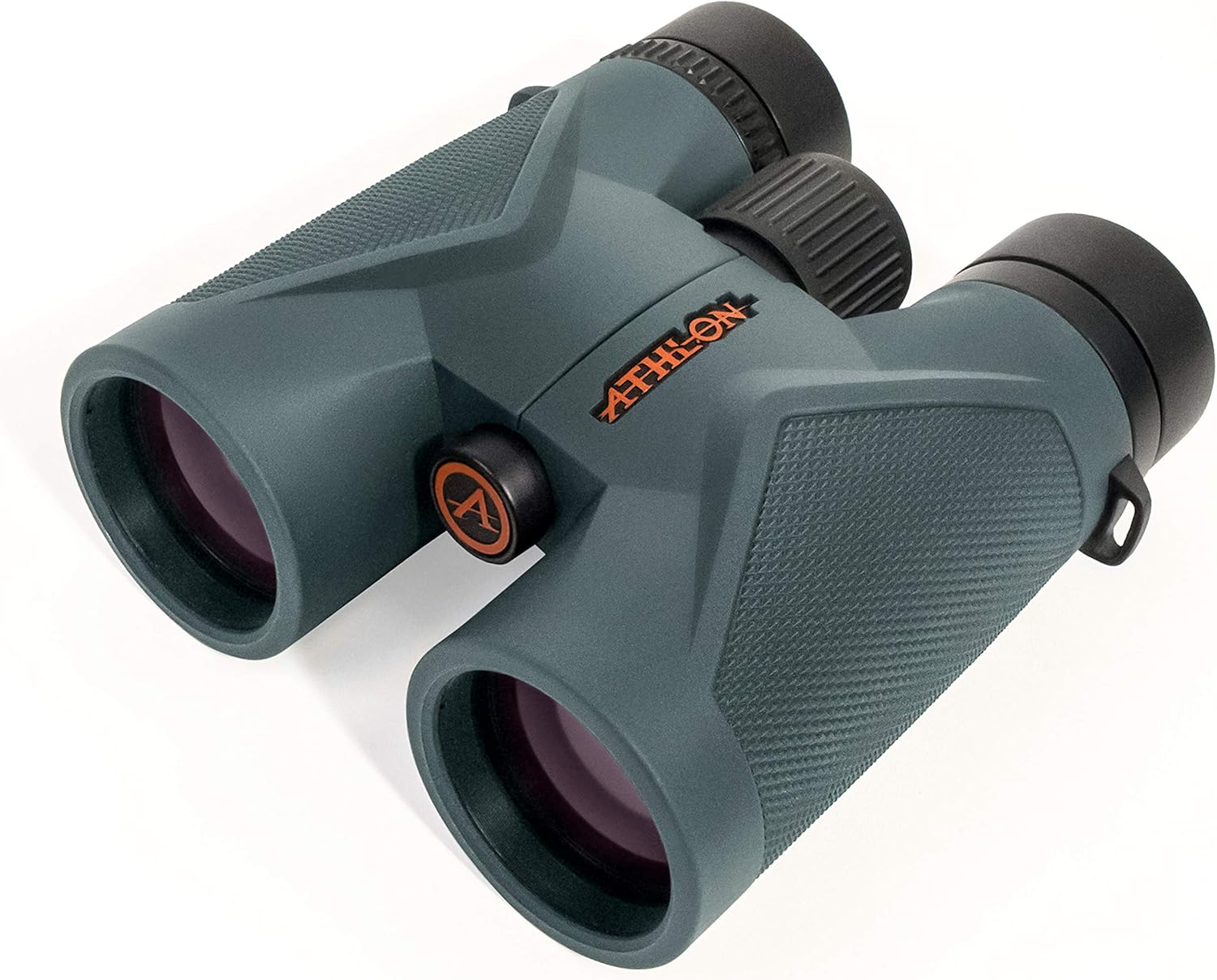
This 8x42 binocular uses ED glass, an ESP dielectric prism coating, and advanced fully multi-coated optics. Athlon also specifies argon purging and an 8.1-degree angular field of view. It gives readers a distinct full-size reference for comparing exact optical design and handling instead of applying one activity rule to every binocular.
Check on AmazonIf you click this link and buy, we earn a commission at no additional cost to you.
Use a replacement-or-complement decision card
A short decision card is more useful than declaring one size class the winner. Start with the problem that makes you consider changing formats, then ask whether the smaller binocular clears your non-negotiable fit and viewing checks. If it does, the remaining question is whether the saved dimensions and weight are large enough to change your carry behavior. If it does not, keeping the full-size pair as the main binocular and adding a smaller format only for limited situations may be the more sensible arrangement.
The table below is intentionally conditional because the same person can land on different answers for different roles. It does not rank products and it does not assume that one activity has one correct objective size. Use it to decide what you need to verify on the exact binocular in front of you, especially eye relief, field of view, dimensions, weight, eyecup fit, and low-light behavior. A replacement should pass your common conditions; a complement only needs to solve the narrower problem you bought it for.
| Your repeated constraint | Direction to test first | What must be verified |
|---|---|---|
| The 42 mm pair stays home because it does not fit the bag you normally carry. | Test a compact as a possible replacement. | Exact folded dimensions, case size, field of view, eye relief, and hand fit. |
| You use binoculars frequently in dim light and value forgiving eye placement. | Keep full size in contention. | Exit pupil, transmission evidence where available, eyecup fit, and actual low-light need. |
| You wear glasses and struggle to see the full field on smaller eyepieces. | Do not downsize on objective diameter alone. | Exact eye relief and full-field visibility with your normal glasses. |
| You already like the 42 mm view but want something easier to pack occasionally. | Treat the compact as a complement first. | Whether the smaller format solves the packing problem without needing to duplicate every strength of the main pair. |
| Your smaller binocular passes fit checks and covers nearly all of your real viewing conditions. | A replacement becomes realistic. | Whether the remaining full-size advantages solve any recurring problem you would actually miss. |
After using the card, the answer should be tied to a recurring constraint rather than a category slogan. If your compact choice only wins because it is smaller on paper, keep checking until you know whether that difference changes packing or carrying in practice. If the full-size choice only wins because it has a larger objective, identify the specific condition where that margin matters to you before accepting the extra bulk. That keeps size from becoming a stand-in for usefulness.

This 8x42 Porro-prism binocular uses fully multi-coated all-glass optics and BaK-4 prisms. Bushnell specifies IPX7 waterproofing, an aluminum chassis, and 17.5 mm of eye relief. Its model-specific fit, weather, and optical details give the decision card concrete specifications to check rather than relying on the 8x42 label alone.
Check on AmazonIf you click this link and buy, we earn a commission at no additional cost to you.
Final Thoughts: choose the size class by the problem it solves repeatedly
A compact can replace a full-size binocular when it clears your fit requirements, covers the light and viewing conditions you face most often, and saves enough bulk or weight to change whether you carry it. A full-size pair deserves its place when its larger exit pupil, roomier fit, longer eye relief, or other model-specific advantages solve conditions you encounter regularly. The controlled Nikon comparison shows why this cannot be reduced to objective diameter alone: the smaller model is lighter and shorter, yet it also has a wider listed field of view while the larger model has more eye relief and exit-pupil margin. The format choice is therefore a bundle of trade-offs, not a single ladder from worse to better.
Before changing size classes, compare exact dimensions, weight, field of view, eye relief, eyecup fit, and the way the binocular will actually be carried. If the smaller option passes those checks and removes a repeated carry barrier, it can be a legitimate main binocular rather than merely a backup. If it creates new fit or low-light problems, keep the larger format as the primary tool and let a compact solve only the situations where portability matters most. Choose the problem you want the binocular to solve every week, then verify that the exact model solves it without creating a more important one.

This 8x25 binocular weighs 11.5 ounces and measures 4.6 by 4.3 by 1.7 inches. Celestron lists a 3.1 mm exit pupil, an 8.2-degree angular field of view, and waterproof nitrogen-filled construction. Its compact dimensions make it a useful final reference for choosing a size class by the repeated problem it solves rather than by objective diameter alone.
Check on AmazonIf you click this link and buy, we earn a commission at no additional cost to you.
FAQs
🔭 Can 8×32 binoculars replace 8×42 binoculars?
Yes, for some users, if the 8×32 fits well, provides enough eye relief, and covers the light conditions they normally encounter. The 8×42 still offers a larger exit pupil at the same magnification, so replacement is less convincing if dim-light margin or forgiving eye placement is a frequent need.
🎒 Are compact binoculars small enough for a pocket?
Not necessarily. Many 30 and 32 mm binoculars are substantially smaller than 42 mm models but are still better described as bag-friendly than truly pocketable, so compare exact folded dimensions rather than relying on the compact label.
👓 Are full-size binoculars better for glasses?
Not automatically. Larger bodies can provide more room for eyecups and some models offer longer eye relief, but the exact eye-relief specification and your ability to see the full field with your glasses are what matter.
🌅 Are 8×42 binoculars always brighter than 8×30 or 8×32 binoculars?
They have a larger exit pupil at the same 8x magnification, which gives more geometric light-delivery margin when your eye can use it. Perceived image brightness and quality still depend on the complete optical system, viewing conditions, and fit, so objective size alone does not settle the comparison.
📏 Is a wider field of view more common on compact binoculars?
Do not assume it from size class. The Nikon P3 example has a wider listed field on the 8×30 than the 8×42, but other product families can differ, so field of view must be checked on the exact model.
References and Sources
- Nikon PROSTAFF P3 8×30 specifications: Supports the exact dimensions, weight, exit pupil, eye relief, field of view, and related specifications used in the same-family comparison.
- Nikon PROSTAFF P3 8×42 specifications: Supports the corresponding full-size specifications used to isolate the format trade-offs within the same product family.
- Cornell Lab guide to full-size, compact, and pocket binoculars: Supports the broad size-class framing and the distinction between portability and viewing margin.