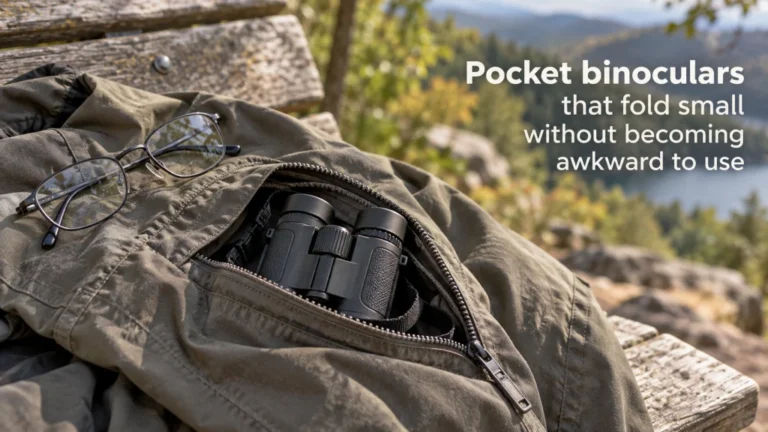
At the same 8x magnification, the useful difference between 8×25 and 8×32 binoculars is not reach. It is the trade between a genuinely pocketable body and a larger viewing interface with a wider geometric exit pupil, more room for controls, and usually more packed bulk. A 32 mm objective does not guarantee a brighter or better image because coatings, optical design, eyecups, field of view, and the user’s eye position still matter. Choose 8×25 when pocketability is a real requirement; move toward 30 to 32 mm when a small daypack is acceptable and easier, longer viewing matters more than minimum size.
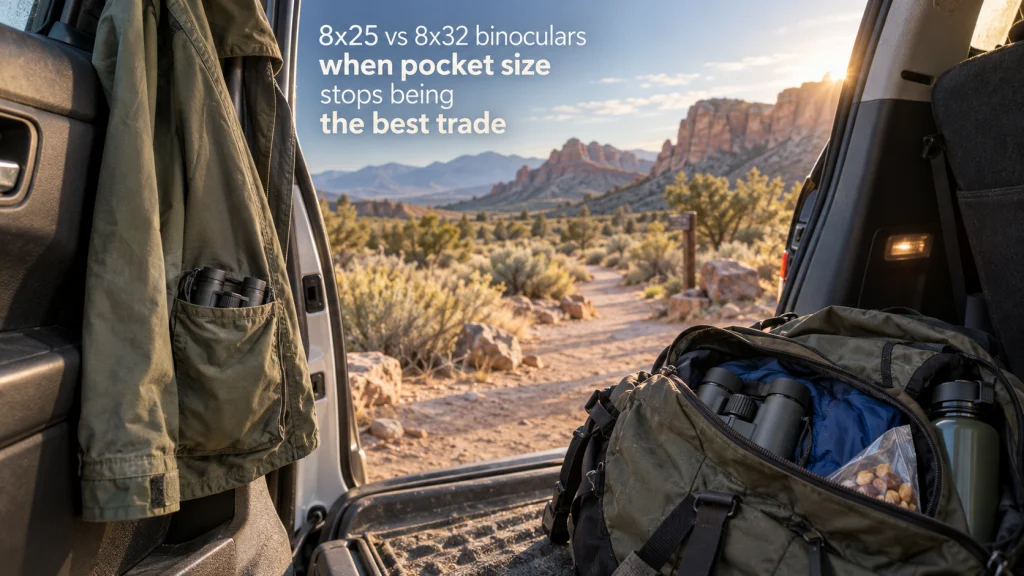
Both are 8x, so the real argument is space versus viewing margin
The comparison between 8×25 vs 8×32 binoculars starts with a bag, not a distant target. An 8×25 can be small enough to occupy a jacket pocket or a narrow side pocket that would not comfortably take many 8×32 bodies. An 8×32 usually asks for more room, but it also gives the designer more physical space for the eyecups, focus control, and the light beam leaving the eyepieces. If both binoculars are 8x, neither gains extra magnification simply because the objective is larger.
That is why this decision belongs inside the broader question of how compact binoculars balance carry size and usability, not inside a contest over which number looks more impressive. It also helps to understand where these formats sit among different binocular types and size classes. A true pocket model is valuable because it can go where a larger binocular gets left behind, while a 30 to 32 mm model may be easier to live with once it is actually at your eyes. The right answer therefore depends on whether pocket space is mandatory or merely convenient.

This 8x25 model keeps the same 8x magnification in a compact 25 mm objective format. Its waterproof construction, BaK4 prisms, and multi-coated lenses make it a complete optical system rather than a size label alone. The small format makes it a useful reference when pocket space matters more than a roomier viewing interface.
Check on AmazonIf you click this link and buy, we earn a commission at no additional cost to you.
Decide whether the binocular must fit a pocket or only a daypack
Start by naming the smallest space the binocular must reliably fit, including its case, strap, and any lens covers you plan to keep attached. If the available space is a coat pocket, small purse compartment, or already crowded carry-on pocket, the folded dimensions of an 8×25 can be the feature that makes the binocular useful at all. If the binocular can ride in the main compartment of a daypack, the size penalty of a 30 to 32 mm body becomes less important. That distinction is more useful than calling both formats compact and pretending the word settles the matter.
Published examples show why the boundary is real. Nikon lists its folding TRAILBLAZER II 8×25 at 3.9 by 4.5 inches and 10.9 ounces, while Vortex lists its Diamondback HD 8×32 at 4.4 by 5.0 inches and 15.9 ounces. Those are examples of current products, not a recommendation or a universal size rule, but the roughly 5 ounce weight gap is large enough to notice in a small bag. If that extra weight and footprint do not threaten the reason you wanted a small binocular, the larger format deserves consideration.
There is also a useful middle step. Nikon’s PROSTAFF P3 8×30 is manufacturer-labeled as a compact model and weighs 16.75 ounces, showing that a near-32 mm format can remain much smaller than a typical 42 mm binocular without behaving like a folding pocket design. A 30 mm model is not an 8×32 specification and should not be treated as one, but it illustrates the market space between pocket and full-size bodies. The practical question is whether your definition of portable means “fits in a pocket” or simply “easy to carry in a small bag.”

This 8x32 model keeps magnification at 8x while moving to 32 mm objectives. It provides 16 mm eye relief and a 426-foot field of view at 1,000 yards for this exact model. Its larger compact format makes it a useful daypack-side reference against true 8x25 pocket designs.
Check on AmazonIf you click this link and buy, we earn a commission at no additional cost to you.
Keep magnification fixed and isolate what the larger objective changes
Because both formats are 8x, the larger objective does not pull a distant subject closer. What changes first is geometry: a 25 mm objective divided by 8x gives an exit pupil of about 3.1 mm, while a 32 mm objective divided by 8x gives 4.0 mm. A 30 mm objective sits between them at about 3.75 mm. These are calculated beam diameters, not complete scores for image quality or perceived brightness.
The larger body can also create room for different eyepiece designs, eyecups, hinges, and control sizes, but none of those improvements is automatic. Two binoculars with the same 8×32 label can differ in field of view, eye relief, close focus, focus-wheel feel, optical coatings, and overall balance. The same is true inside the 8×25 class, where a tiny double-hinge body may handle differently from a single-hinge model. Treat objective size as one part of the format change, then verify the exact binocular before assuming what that change feels like.

This 8x30 model keeps magnification fixed at 8x while using 30 mm objectives. Its published specifications include a 3.8 mm exit pupil, 15.1 mm eye relief, and an 8.3-degree field of view. Those figures make it a useful middle-format example between 8x25 and 8x32.
Check on AmazonIf you click this link and buy, we earn a commission at no additional cost to you.
Group the product changes that can affect real use
The cleanest way to compare these formats is to separate the changes that come from simple geometry from the changes that depend on design. Objective diameter and calculated exit pupil are fixed by the numbers printed on the binocular. Eye relief, field of view, eyecup shape, focus-wheel size, hinge layout, and weight are not fixed by the format label. That separation prevents a useful general rule from turning into an unsupported promise.
A current 8×25 and 8×32 example makes the point. Nikon lists the TRAILBLAZER II 8×25 with a 3.1 mm exit pupil and 10 mm eye relief, while Vortex lists the Diamondback HD 8×32 with 16 mm eye relief and a 426 foot field of view at 1,000 yards. Those differences belong to those exact models, not to every 8×25 and every 8×32. Compare the label first, then compare the actual specifications that affect your eyes and hands.
25 mm and 32 mm create different geometric exit pupils at 8x
The exit-pupil calculation is objective diameter divided by magnification, so the numbers here are straightforward: 25 divided by 8 is about 3.1 mm, and 32 divided by 8 is 4.0 mm. The 4.0 mm beam has a larger cross-sectional area than the 3.1 mm beam, which gives the eye more geometric margin for alignment. That can matter when you raise the binocular quickly or when small positioning errors would otherwise darken part of the view. It still does not tell you how much light the complete optical system transmits.
A larger exit pupil can make eye placement more forgiving without proving whole-system brightness
A larger exit pupil can be easier to keep centered over the eye, especially when the binocular is moving slightly or the eyecup position is not perfect. That is a product-behavior advantage, not a medical claim and not a guarantee that every user will prefer the larger format. Lens coatings, prism quality, baffling, eyepiece design, ambient light, and the observer’s own pupil all affect the final view. Use exit pupil as one useful piece of evidence, not as a brightness score printed by arithmetic.
Compare real dimensions and weight rather than the word compact
The word compact covers bodies that behave very differently in a bag. Cornell’s size guidance separates pocket binoculars around 25 mm from compact models around 32 mm, which is useful because the distinction tracks real carrying behavior rather than marketing alone. Manufacturer dimensions then tell you whether a particular body actually fits your pocket, pouch, or case. Measure the space you plan to use and include the folded hinge position, not just the length printed on a comparison chart.
| Comparison point | 8×25 format | 8×32 format | What to verify |
|---|---|---|---|
| Magnification | 8x | 8x | No reach advantage from objective size alone |
| Geometric exit pupil | About 3.1 mm | 4.0 mm | Use as an alignment and light-beam geometry clue, not a total brightness score |
| Carry goal | Can support true pocket use | Usually better treated as small-bag or daypack gear | Exact folded dimensions, case size, strap, and covers |
| Controls and eyecups | May be smaller or more tightly packaged | Often has more physical room | Exact focus wheel, hinge, eyecup shape, and eye relief |
The table is a routing tool, not a verdict. If a specific 8×25 has better eye relief, a wider field, or a body that fits your hands better than the 8×32 beside it, the model-level evidence wins. The format tells you what trade to investigate; the exact specifications tell you whether that trade appears in the binocular you are considering. That is why a buyer should compare dimensions, eye relief, and field of view on the actual product page rather than assuming every member of a size class behaves the same way.

This 8x32 model uses phase-coated BaK-4 prisms and fully multi-coated optics. It provides 17.5 mm eye relief, a 4.0 mm exit pupil, and a 388-foot field of view at 1,000 yards. Those model-level specifications show why the exact binocular matters beyond the 8x32 label.
Check on AmazonIf you click this link and buy, we earn a commission at no additional cost to you.
A 30 to 32 mm body often allows larger controls and eyecups, but verify the exact model
Small controls are not automatically bad, but there is less physical room to work with in a true pocket body. A narrow focus wheel can be harder to find quickly with gloves, and very small eyecups can give the face less contact area for repeatable positioning. Some folding 8×25 designs also use two hinges to reach their smallest packed size, which adds another adjustment to set before viewing. A larger compact body may simplify those interactions, but the exact control layout matters more than the objective diameter by itself.
Eyeglass wearers should be especially careful about turning a format assumption into a fit conclusion. The current Nikon 8×25 example above lists 10 mm of eye relief, while the current Vortex 8×32 example lists 16 mm, but those figures describe those models only. Another 8×25 may provide longer eye relief, and another 8×32 may still fail to show the full field comfortably for a particular pair of glasses. If glasses are part of your normal viewing setup, compare published eye relief and test the usable field with the eyecups fully retracted whenever possible.
Hand size can reverse expectations as well. Some users value a body that is so small it can be wrapped securely in one hand, while others find a larger bridge and wider barrels easier to stabilize and focus without changing grip. Neither outcome can be inferred safely from 25 mm versus 32 mm alone. Check body width, hinge design, focus-wheel placement, and where your fingers actually land.

This 8x30 model uses a central focus system and a locking diopter ring. It provides 15.4 mm eye relief, a 456-foot field of view at 1,000 yards, and waterproof, fogproof construction. Those controls and fit specifications make it useful for checking handling rather than assuming objective diameter determines usability.
Check on AmazonIf you click this link and buy, we earn a commission at no additional cost to you.
Low-light performance depends on more than objective diameter
A 32 mm objective gives an 8x binocular a larger calculated exit pupil than a 25 mm objective, so there is a sound geometric reason to expect more available light at the eyepiece before other losses are considered. That does not mean every 8×32 will look brighter than every 8×25. Transmission depends on the complete optical path, including glass, prism design, coatings, internal reflections, and eyepiece design. Perceived contrast and usable detail can also change independently of a simple objective-size calculation.
Lighting conditions decide how much that extra geometric margin matters. In bright outdoor conditions, the observer’s pupil may be smaller than either exit pupil, which can reduce the practical difference attributable to beam diameter alone. As ambient light falls and the eye’s pupil opens, the larger exit pupil can become more relevant, but optical quality still sets a ceiling on what reaches the eye. This is why “25 mm is daylight only” is too absolute and “32 mm is always bright” is equally weak advice.
For a buyer, the safer rule is to treat low-light use as a reason to scrutinize the larger format, not as proof that any larger-objective model wins. If dawn, dusk, shaded woodland, or indoor viewing is a frequent part of the job, look for trustworthy transmission testing when available and compare exact optical specifications. If most use is in good light and carrying space is tight, the smaller format may still be the more useful tool because it is actually with you. Match the format to how often difficult light appears in your real viewing schedule rather than to a single number on the specification sheet.

This 8x32 model uses ED objective lenses with phase- and dielectric-coated BaK-4 prisms. Its 4.0 mm exit pupil and fully broadband multi-coated optics keep transmission-related design in view alongside objective diameter. The waterproof, nitrogen-filled body also makes it a field-oriented example rather than a geometry-only comparison.
Check on AmazonIf you click this link and buy, we earn a commission at no additional cost to you.
Choose 8×25 when true pocketability is the non-negotiable constraint
An 8×25 makes the strongest case when the binocular must fit a space that a 30 to 32 mm body simply will not. That might mean a jacket pocket, a very small crossbody bag, a crowded carry-on, or a kit where every few ounces compete with something else you already need. In that situation, the smaller objective is not a compromise made by accident; it is the reason the binocular qualifies for the job. The format succeeds when reducing packed size changes whether you carry binoculars at all.
Do not turn that portability win into permission to ignore fit. Check folded dimensions, eye relief, field of view, eyecup diameter, hinge layout, and focus-wheel access before buying. If the pocket model requires constant eye-position correction or its controls are difficult for your hands, the smallest body may create friction every time you use it. A pocket binocular only earns its advantage when both the carry size and the viewing interface work for you.
If you are still deciding what counts as a true pocket design, the more focused discussion of pocket binoculars and their size trade-offs is the better next step. Keep the boundary clear: 8×25 should not be dismissed as a backup category, and 8×32 should not be treated as an automatic upgrade. The useful question is whether the smaller body solves a real packing problem that the larger one cannot. If that problem disappears once you allow a daypack, reassess the larger format on fit and viewing behavior rather than on size alone.

This waterproof 8x25 model keeps the objective format compact for travel and outdoor use. The exact AD 8x25 WP variant pairs 8x magnification with 25 mm objectives in a small binocular body. It is a direct fit for a section where true pocket-oriented carry is the non-negotiable constraint.
Check on AmazonIf you click this link and buy, we earn a commission at no additional cost to you.
Choose the larger compact format when the pocket is optional and longer viewing matters more
If the binocular already has permission to live in a daypack, the 30 to 32 mm class often becomes easier to justify. The extra body size can support a 3.75 to 4.0 mm exit pupil at 8x, and many models provide more room around the eyepieces and focus controls. That can make repeated viewing less fussy when you are raising the binocular, refocusing, lowering it, and doing the same thing again. The important word is can, because the exact body and eyepiece design still decide whether that advantage appears.
This format also makes sense when the binocular will spend more time at your eyes than in your pocket. A five-ounce weight increase can feel unnecessary during packing but reasonable if it buys a control layout, eye relief figure, field of view, or eye-placement margin that fits you better. Compare those gains against the extra space rather than against an abstract idea that larger is superior. If you are already comfortable carrying something in this size range, the decision may shift from minimum bulk toward the quality of the viewing interface.
Do not let this comparison drift into the separate question of compact versus 42 mm binoculars. Once you are deciding whether a 32 mm body should become a full-size binocular, the trade includes another step in weight, objective diameter, and carry behavior. That boundary is covered in the comparison of compact versus full-size binoculars. Here, the decision stops at whether moving out of the pocket class is worth the first increase in size.
Run a carry-versus-viewing checklist before buying
The best comparison is one you can apply to your own bag, face, and viewing routine. Start with the non-negotiable physical limit, then check whether the smaller binocular introduces usability costs that matter often enough to defeat its portability advantage. If you can handle both sizes in person, set the eyecups for your normal use, focus on several targets, lower the binocular, and raise it again without carefully placing it each time. Repeatability tells you more than a single sharp view obtained after several seconds of adjustment.
If you cannot compare in person, use the product pages as a measurement exercise rather than a ranking exercise. Record weight, folded dimensions, eye relief, field of view, close focus if relevant, interpupillary range, hinge design, and included case size when the manufacturer provides them. Then compare those facts with the space you actually have and the way you expect to carry the binocular. The list below keeps the decision tied to constraints you can verify.
- Pocket test: Does the binocular, with the accessories you will actually carry, fit the exact pocket or pouch you intend to use?
- Weight test: Is the extra several ounces meaningful in your existing kit, or is it small compared with everything else you already carry?
- Eye-placement test: Can you reach a full, stable view quickly without hunting for the correct position?
- Eyeglass test: Does the published eye relief and eyecup design work with your glasses rather than merely looking adequate on paper?
- Control test: Can you operate the focus wheel, diopter, and hinge naturally with your normal grip?
- Light test: Are your important viewing periods mostly bright, or do lower-light conditions occur often enough to justify more geometric exit-pupil margin?
One failed item can be enough to decide the format. A binocular that will not fit the required pocket is disqualified no matter how pleasant its specifications look, while a pocket model that repeatedly loses the view because the fit is wrong may be equally poor for its owner. This is a threshold decision, not a scorecard where the format with more check marks automatically wins. Choose the smallest body that satisfies the viewing constraints you actually care about.

This compact 8x26 model weighs 12.7 ounces and measures about 4.7 by 4.4 inches. It provides 15 mm eye relief and a 352-foot field of view at 1,000 yards. Those published dimensions and fit specifications make it useful for a carry-versus-viewing checklist.
Check on AmazonIf you click this link and buy, we earn a commission at no additional cost to you.
Final Thoughts: spend the extra volume only when it solves a real limitation
At 8x, moving from 25 mm to 32 mm is a format decision more than a magnification decision. The larger objective raises the calculated exit pupil from about 3.1 mm to 4.0 mm and usually comes with a larger body, but neither fact guarantees a better binocular. What matters is whether that added size gives you useful eye-placement margin, controls, eye relief, or viewing behavior in the exact model you are considering. If it does not solve a problem you actually have, the extra volume is just extra volume.
Choose 8×25 when true pocket carry is the requirement that makes the binocular worth owning. Choose the larger compact class when a small bag is acceptable and you value a less constrained viewing interface enough to carry more weight and bulk. Verify dimensions, eye relief, field of view, controls, and optical evidence on the exact model rather than trusting the size label alone. The better format is the one that clears your real carrying limit without creating a new viewing limitation you will notice every time you raise it.

This 8x25 model pairs 8x magnification with 25 mm objectives in a waterproof, nitrogen-filled body. It uses a 3.1 mm exit pupil, BaK-4 prisms, and multi-coated optics for this exact model. Its compact format fits the final decision point where saving volume matters only if the viewing interface still meets the user's needs.
Check on AmazonIf you click this link and buy, we earn a commission at no additional cost to you.
FAQs
🎒 Is 8×32 too large for travel?
Not if your travel setup includes a daypack, shoulder bag, or carry-on space that comfortably fits the exact body and case. It becomes too large when your real requirement is pocket carry and the binocular starts competing with items that must occupy the same small compartment.
👖 Will every 8×25 binocular fit in a pocket?
No. Hinge design, folded width, depth, eyecups, case, and strap can change whether a nominally pocket-size binocular fits the pocket you have in mind. Check the manufacturer’s folded dimensions and measure your actual pocket before buying.
🌆 Is an 8×25 only useful in bright daylight?
No. An 8×25 has a smaller geometric exit pupil than an 8×32, but complete low-light performance also depends on optical transmission and design. Treat frequent lower-light viewing as a reason to compare the larger format carefully, not as proof that every 8×25 is unusable outside bright conditions.
👓 Is 8×32 always better for people who wear glasses?
No. Some 8×32 models offer generous eye relief, but the format itself does not guarantee glasses-friendly fit. Compare the exact eye relief, eyecup shape, and usable field with your glasses whenever possible.
🔭 Does the 32 mm objective make an 8×32 more powerful?
No. Both formats magnify the view eight times, so the larger objective does not add reach. It changes the light-gathering geometry and usually changes the physical format of the binocular.
📏 What is the exit pupil of 8×25 and 8×32 binoculars?
An 8×25 has a calculated exit pupil of about 3.1 mm, while an 8×32 has a 4.0 mm exit pupil. Those numbers come from dividing objective diameter by magnification and should not be treated as complete brightness ratings.
References and Sources
- Cornell Lab binocular size guidance: Supports the practical distinction between pocket, compact, and full-size binocular formats.
- Cornell Lab size and weight comparison: Provides independent context for how pocket and compact binoculars differ in typical size and carrying weight.
- Nikon TRAILBLAZER II 8×25 specifications: Verifies the current 8×25 example’s objective size, exit pupil, dimensions, weight, eye relief, and field specifications.
- Nikon PROSTAFF P3 8×30 specifications: Verifies the near-32 mm compact example and its published size, weight, and exit-pupil data.
- Vortex Diamondback HD 8×32 specifications: Verifies the exact 8×32 example’s objective size, eye relief, field of view, dimensions, and weight.