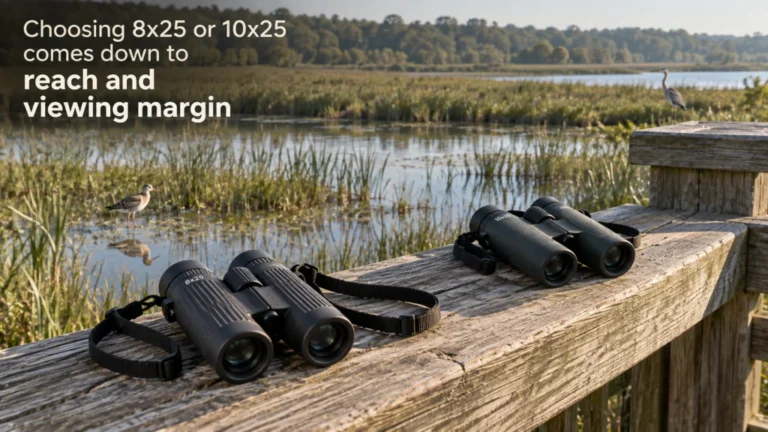
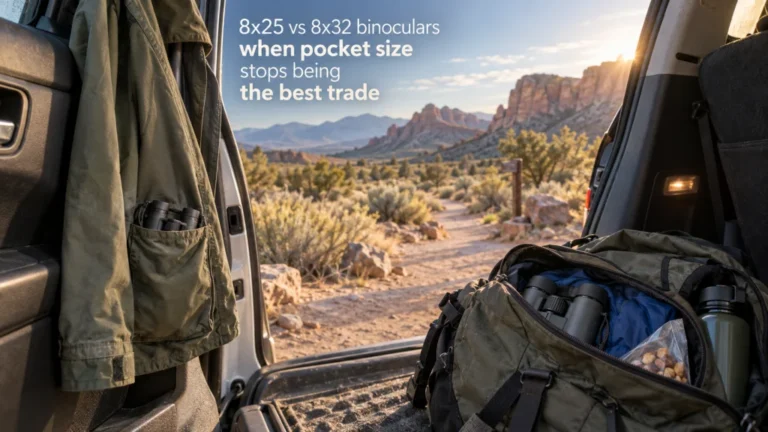
Pocket binoculars are genuinely useful only when their folded shape fits the space you plan to carry them in and their controls still work for your face and hands. Two 8×25 binoculars can share the same objective size while folding to different shapes, using different hinge layouts, and demanding different setup steps before the view is ready. Check packed dimensions, hinge behavior, interpupillary distance range, eye relief, eyecups, and focus access before treating a small specification as proof of pocketability. The goal is not to find the smallest body at any cost, but to find the smallest format you can deploy and use without fighting it.
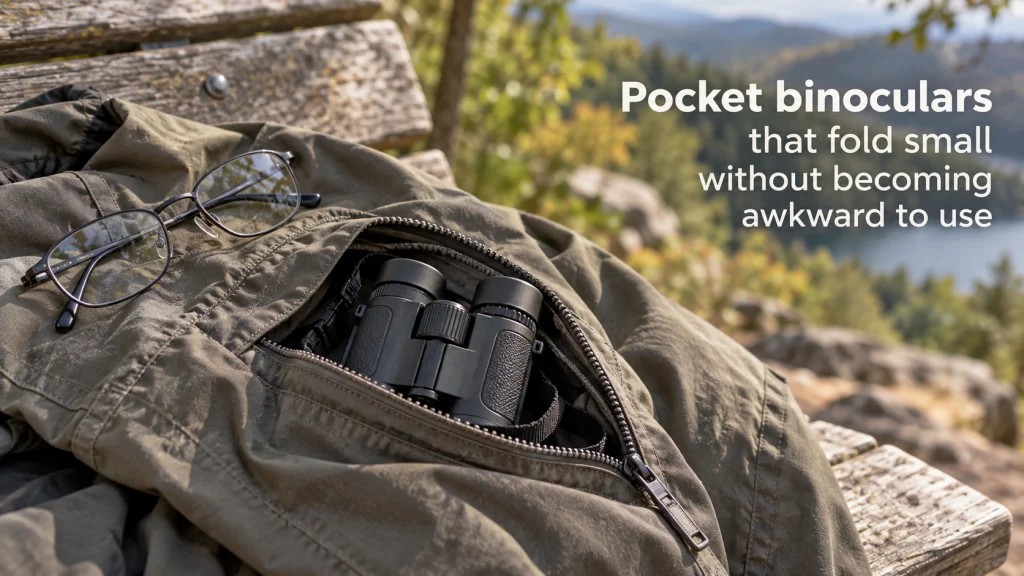
A 25 mm objective does not tell you the folded shape
Pocket binoculars are easy to misjudge because the familiar 8×25 label describes magnification and objective diameter, not the package that has to pass through a pocket opening. Put two current 8×25 bodies beside the same fixed opening, one with barrels that fold inward on two hinges and another with an asymmetric or simpler hinge layout, and their shared 25 mm objective size tells you almost nothing about which folded shape will clear it. The first measurement should therefore come from the place where you intend to carry the binocular, not from the front lens diameter. If your real need is broader than true pocket carry, the compact binoculars guide gives the wider size context before you force yourself into the smallest format.
Passing through the opening is only the first gate because the body still has to become a usable binocular after it comes out. The narrower double-hinge package may require both barrels to be reset, while a different folding architecture may preserve a simpler deployment sequence but occupy the pocket differently. The broader major binocular design types are worth understanding if you are still deciding whether a pocket format is the right physical design at all. Once that boundary is clear, the useful question becomes much narrower: which folded body fits the fixed opening, then opens, adjusts, and focuses with the least unnecessary friction?

This compact 12x25 model uses a center-focus system and 15 mm eyepieces. Its rubber eyecups can be folded down for users who wear glasses. The 25 mm objective format keeps it relevant when comparing how much usable viewing hardware fits into a small carry package.
Check on AmazonIf you click this link and buy, we earn a commission at no additional cost to you.
Define the actual pocket or bag constraint before shopping
Measure the opening and usable depth of the pocket, purse compartment, or small bag space that will carry the binocular. A body that fits inside may still be awkward to push through a narrow zipper or pocket mouth. Other items and a case can also reduce usable space. Treat the carry location as fixed and make the binocular fit it.
Weight belongs in the same check, but it should not replace geometry. A very light binocular can still be too wide, while a slightly heavier body may fold into a cleaner shape. Decide whether you will carry it bare, in a pouch, or in its case because body dimensions may not represent the packed package. At this point, “pocketable” becomes a pass or fail test against your own storage space.
- Measure the narrowest pocket or zipper opening the binocular must pass through.
- Measure the usable internal depth and width after other everyday items are present.
- Decide whether the case, lens covers, or strap must fit in the same space.
- Set a weight limit you are actually willing to carry in that location.
- Leave enough clearance to remove the binocular without snagging or forcing it.
Write those limits down before comparing specifications. If a candidate exceeds one, reject it even if the optical specifications look attractive. A small binocular that always ends up in a larger bag has failed a strict pocket requirement, although it may still be a useful compact binocular. That distinction keeps marketing language from replacing your actual carry test.

The Outland X 8x25 combines 8x magnification with 25 mm objectives in a compact roof-prism body. It measures about 4.45 by 4.6 by 1.69 inches and uses center focus with twist-up eyecups. Its published body dimensions give you concrete numbers to compare with a fixed pocket or bag opening.
Check on AmazonIf you click this link and buy, we earn a commission at no additional cost to you.
Check folded dimensions, not only operating dimensions
Published dimensions need context because some makers list operating size while others also publish folded measurements. Nikon lists the Trailblazer II 8×25 at 4.5 inches wide normally and 2.7 inches wide when folded, while depth changes from 1.7 to 2.2 inches. Folding therefore does not shrink every dimension at once. Checking only the smallest number can misrepresent the shape that must pass through a pocket opening.
If a manufacturer does not state folded dimensions, do not infer them from photos or objective size. Look for a dimension drawing, manual, support page, or listing that explains the measurement. If packed form remains unknown, rely on an in-person check or a workable return policy. A strict carry limit leaves little room for guessing.
| Carry check | What to verify | Why it can reject a candidate |
|---|---|---|
| Pocket opening | Folded width and thickest depth | A body can fit inside but still be difficult to insert or remove. |
| Internal space | Folded height, width, depth, and case size if used | The binocular may displace items you intended to carry beside it. |
| Removal clearance | Strap, eyecup, hinge, and armor protrusions | A nominal fit can still snag on fabric, zippers, or adjacent objects. |
| Ready to view | How many hinge and eyecup adjustments are needed after removal | Maximum compactness may create more setup before the image is usable. |
Use the table as a rejection filter, not a scorecard. Passing means only that the body fits your carry format. It still has to fit your eyes and offer usable controls. That is where hinge design begins to matter.

This 10x25 compact binocular measures 4.33 by 3.94 by 1.97 inches and weighs 9.6 ounces. It uses center focus and provides 10 mm eye relief. Those published dimensions give you concrete numbers to compare with the opening, depth, and clearance of the place where the binocular will actually be carried.
Check on AmazonIf you click this link and buy, we earn a commission at no additional cost to you.
Double hinges can reduce packed width while adding another alignment step
A double-hinge pocket binocular lets the two barrels fold inward more independently than a conventional center-hinge body. Leica explicitly describes the Noctivid Compact as using a functional double hinge so the binocular can fold for space saving, which illustrates the basic packaging advantage without proving that the layout is automatically better for every user. The same extra movement that helps the barrels tuck inward also means both sides have to return to the correct spacing before the view settles. For a strict pocket limit, that trade can be worthwhile, but it should be treated as a trade rather than a free benefit.
Independent handling work from the Cornell Lab has repeatedly found that some double-hinge pocket designs can require more readjustment after the barrels are moved or jostled. That does not mean every double hinge is loose, slow, or difficult, and it does not mean a single hinge will fit every pocket. It means deployment should be part of the buying test: fold the binocular to its packed position, open it, set your eye spacing, raise it to your eyes, and see whether you can reach focus without rebuilding the setup several times. If that sequence feels irritating in a store, it is unlikely to become more charming when a moving subject is disappearing from view.
Asymmetric or single-hinge pocket designs solve the carry problem differently
A pocket binocular does not need two hinges to fold into a compact package. ZEISS uses an asymmetrical bridge on the Victory Pocket and describes it as a way to combine stability with adjustment of eye distance, while independent handling observations note that the offset layout can fold compactly without the same two-barrel readjustment pattern found on many double-hinge bodies. That is a different mechanical answer to the same carry problem, not evidence that every asymmetric design will suit every hand. Focus-wheel position, dominant focusing hand, barrel diameter, and finger reach can all change whether the layout feels convenient.
Conventional single-hinge bodies usually give up some folding freedom because both barrels pivot around one central joint. In return, the eye-spacing relationship is often simpler to restore because there is only one primary hinge position to set. The practical choice is therefore not “double hinge bad, single hinge good” or the reverse. Choose the architecture that meets your packed-size limit with the least setup friction for your own face and hand position, and reject any design that solves storage by creating a handling problem you notice every time you raise it.
Small eyecups and focus wheels can make a tiny binocular slower to use
Shrinking the body also shrinks the space available for controls, and that can matter more than a few saved millimeters in a pocket. Cornell’s pocket-binocular testing has documented examples where very small focus wheels demanded more care, while other small bodies used larger eyecups or more accessible controls and were easier to settle behind the eyes. Those observations are model-specific, but the buying lesson is general: check the actual control geometry instead of assuming that every 8×25 will handle the same way. A dimension that looks efficient on paper can become wasted compactness if your finger cannot reach focus naturally.
Try the binocular with the same conditions you expect in normal use. If you often wear gloves, use them during the control check; if you normally focus with your left hand, make sure the wheel position still works from that side; if you wear glasses, test the eyecups in the position you will actually use. Rotate the diopter only enough to confirm that it is accessible and unlikely to move accidentally, then return to normal focusing rather than treating the store visit like a mechanical endurance test. The aim is to see whether the controls disappear into the task or keep calling attention to themselves.
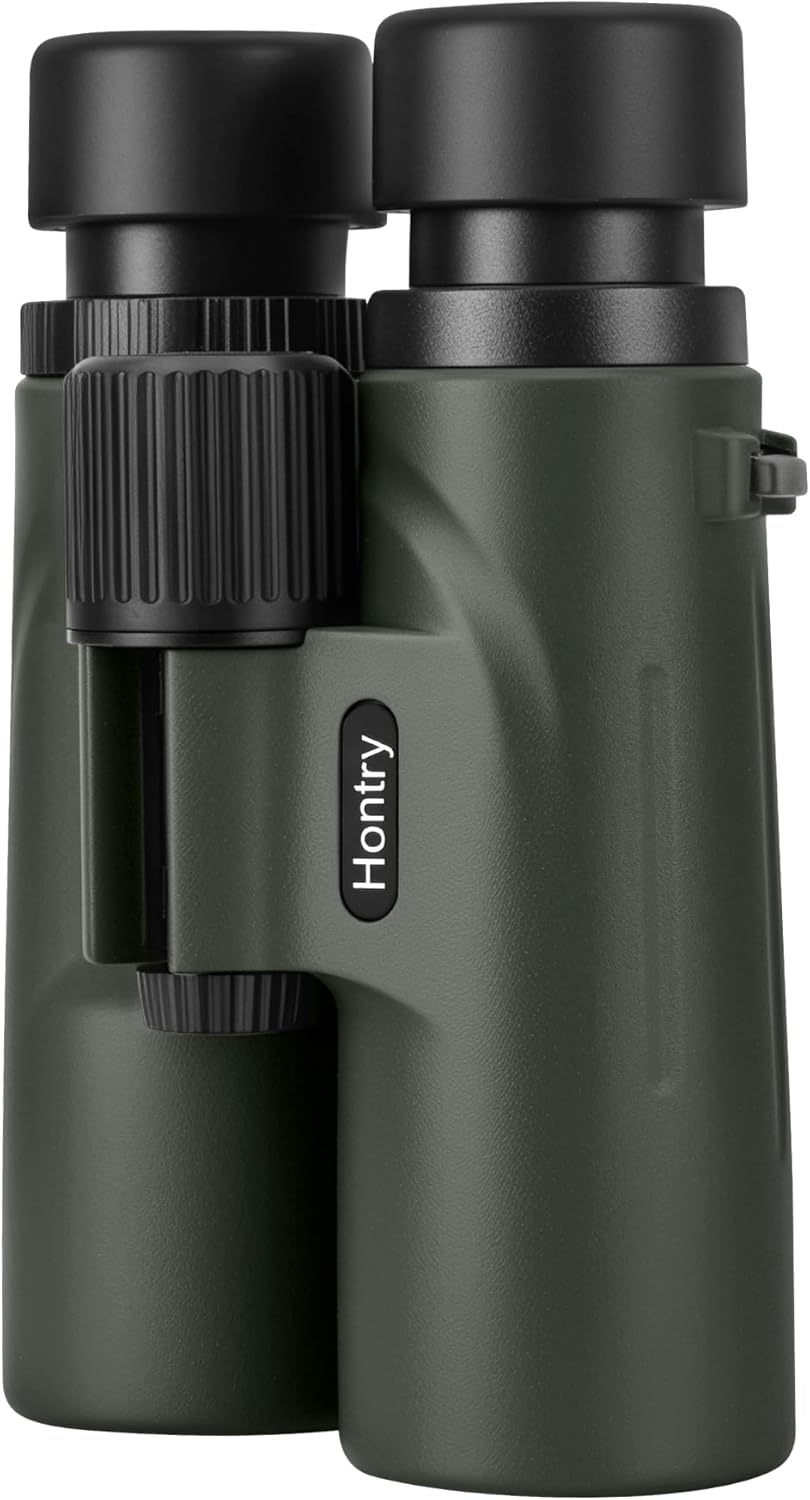
The Hontry 8010 uses 8x magnification, 42 mm objectives, and 15 mm soft twist-up eyecups. It pairs those eyecups with a center-focus system and an IPX6 water-resistant body. Its 8x42 format provides a larger physical reference point beside the pocket models discussed in this section.
Check on AmazonIf you click this link and buy, we earn a commission at no additional cost to you.
IPD range matters because the body has to fit the face after it leaves the pocket
Interpupillary distance, usually listed as an IPD range, tells you how far apart the two optical axes can be set. The number matters because a beautifully folded binocular is useless to you if the barrels cannot align with both eyes when opened. Current pocket designs can have surprisingly different adjustment ranges even within the same 8×25 format, so do not infer face fit from objective diameter, brand, or hinge appearance. Check the published range for the exact model and confirm the view becomes one clean circular field rather than two overlapping circles.
Hinge architecture can influence the available adjustment, but it should not be used as a shortcut for the specification. A double hinge may allow a wide range on one model, while a different design may also cover your spacing comfortably with fewer moving joints. The reliable decision is simply to compare your measured requirement with the exact manufacturer’s range and then verify the fit in use when possible. If your spacing sits near an endpoint, hands-on confirmation or a returnable purchase becomes more important because manufacturing tolerances, eyecup shape, and how you place the binocular can affect comfort around the limit.

The Outland X 10x25 has an interpupillary-distance range of 56 to 72 mm. It combines 10x magnification with 25 mm objectives, twist-up eyecups, and center focus. The published IPD range makes this exact model a useful fit check before deciding whether its compact format works for your face.
Check on AmazonIf you click this link and buy, we earn a commission at no additional cost to you.
Eye relief can disqualify a tiny body without becoming a pocket-size specification
Eye relief is not a measure of pocketability, but it can still eliminate a pocket binocular from consideration, especially for people who view through eyeglasses. The difference between current 8×25 specifications is real: Nikon publishes 10 mm of eye relief for the Trailblazer II 8×25, Leica lists 15 mm for the Noctivid Compact 8×25, and ZEISS lists 16.5 mm for the Victory Pocket 8×25. Those numbers do not by themselves guarantee comfort or a full field for a particular person. Eyecup shape, glasses position, lens recess, facial geometry, and the manufacturer’s measurement method can all affect the usable result.
Use eye relief as a fit gate rather than as a reason to buy the largest number on a spec sheet. With glasses, retract the eyecups as intended and check whether you can see the full field without pressing the binocular hard into the lenses. Without glasses, extend the eyecups to a stable position and check for blackouts as you settle your eyes behind the oculars. If the view requires constant head repositioning, the binocular has failed a practical fit test even if its folded dimensions are perfect.

The Nikon PROSTAFF P3 8x42 provides 20.2 mm of eye relief and a 5 mm exit pupil. It uses center focus and has a 377-foot field of view at 1,000 yards. The long published eye-relief figure provides a useful reference when judging whether a pocket model leaves enough room for your normal glasses position.
Check on AmazonIf you click this link and buy, we earn a commission at no additional cost to you.
Keep 8x versus 10x as a separate choice inside the 25 mm format
Once you have decided that a 25 mm pocket body fits your carry requirement, magnification becomes a separate decision. An 8×25 and a 10×25 can share almost the same chassis while differing in field of view, exit pupil, steadiness demands, and how easily a moving subject is acquired. Do not let the desire for more magnification override the reason you chose a pocket binocular in the first place, which is usually fast, convenient observation from a very small package. If that choice is still unresolved, compare the viewing tradeoffs in 8×25 versus 10×25 binoculars rather than turning this carry-size decision into a second argument at the same time.
The key point is sequencing. First establish that the body can be carried and fitted, then decide which magnification suits the subjects, distance, light, and steadiness you expect. That order prevents a specification such as 10x from becoming the excuse for accepting an awkward hinge or poor eye placement. A binocular that is optically ambitious but slow to deploy may be the wrong tool if your real priority is something small that can be raised and used quickly.

This Hontry variant pairs 12x magnification with 25 mm objectives. Amazon identifies it as the 12x25 black variant in the same compact product family as the 10x25 model. The unchanged 25 mm objective class makes it a direct example of magnification changing while objective size stays fixed.
Check on AmazonIf you click this link and buy, we earn a commission at no additional cost to you.
Step up to 8×32 when the pocket constraint is not actually strict
Many buyers start with 8×25 because they want something smaller than a full-size binocular, then discover that their actual requirement is only “easy to carry in a small bag.” If the binocular does not need to disappear into a jacket pocket or narrow purse compartment, an 8×32 can offer more room for eyecups, focus controls, grip, and eye placement while remaining much smaller than a typical 8×42. That does not make 8×32 universally better, because the added width, length, and weight may defeat a genuine pocket requirement. It simply means you should not pay a usability penalty for miniaturization you do not need.
This is especially important if your acceptance test keeps rejecting 8×25 bodies for the same reason. If every candidate feels cramped, requires fussy eye placement, or barely fits only after removing the case and strap, your constraint may be pointing toward a different size class rather than a different brand. The comparison in 8×25 versus 8×32 binoculars is the better next step when carry space has some flexibility. Use the larger format only if its extra bulk still fits your real routine, not because a bigger objective is automatically superior.

The Celestron Nature DX 8x32 uses 8x magnification and 32 mm objectives in a compact roof-prism body. It provides 17.5 mm eye relief and weighs about 1.25 pounds. This 8x32 format is a direct step-up candidate when a strict 25 mm pocket constraint is no longer necessary.
Check on AmazonIf you click this link and buy, we earn a commission at no additional cost to you.
Run a pocket-binocular acceptance check before buying
A useful acceptance check separates storage, deployment, physical fit, and viewing requirements. Start with dimensions, then move to the hinge and controls, and finish with the view through your normal eyecup position. There is no value in debating optical nuance after a body has failed the pocket opening or your eye spacing. This order keeps premium features from hiding a basic fit problem.
Do not score the checklist as if the most passes must win. Some items are hard rejection points, while others are preferences you may trade for smaller size. A body that cannot reach your IPD is disqualified, while a small focus wheel may remain acceptable if deployment is easy. Set your nonnegotiable constraints before shopping so they do not change around a model you like.
Folded size, deployment, and controls
Fold the binocular as you would carry it, including attached caps or strap. Confirm that it passes through the intended opening with normal removal clearance. Open it and note how many adjustments are needed before both barrels line up. Then check that focus, diopter, and eyecups are reachable without an awkward grip.
Fit and optical requirement
Set the IPD until you see one complete field and confirm the exact model does not leave you at a hard stop. Set the eyecups for glasses or bare-eye viewing and check whether the field stays visible. Only after those fit gates pass should you compare field of view, close focus, brightness, or 8x versus 10x. If eye placement or physical fit fails, optical preferences do not rescue the binocular.
| Question | Pass condition | Reject when |
|---|---|---|
| Does the packed body fit? | It enters, sits, and comes out without forcing or snagging. | The pocket only works with an awkward angle, compression, or removal of items you need. |
| Can you restore eye spacing quickly? | The barrels return to a usable IPD without repeated correction. | You keep chasing barrel alignment after normal folding and handling. |
| Can you reach the controls? | Focus, eyecups, and diopter are accessible in your normal grip. | The compact body forces cramped finger placement or accidental adjustments. |
| Does the view fit your eyes? | You get one stable field with your normal glasses or bare-eye setup. | You cannot see the full field or must constantly reposition your eyes. |
| Is the size reduction worth the handling trade? | The binocular is small enough to change how often and where you carry it. | A slightly larger format would fit your routine while being easier to use. |
Keep only candidates that pass every nonnegotiable item. Then compare optical preferences, warranty, case, or price without confusing them with basic suitability. If no 8×25 or 10×25 body passes, move up in size instead of forcing a miniature design that fights your face or hands. Pocketability matters only when the binocular remains natural to use.
Final Thoughts: pocketable only matters if the binocular is still easy to use
The most useful definition of a pocket binocular begins with the space you intend to carry it in and ends with a view that settles quickly when you raise it. Objective diameter alone cannot tell you folded width, packed thickness, hinge motion, IPD range, eye relief, or whether your finger can find the focus wheel naturally. Verify those pieces in that order and you can reject unsuitable bodies before price or branding complicates the decision. The smallest binocular is not a victory if every observation starts with a wrestling match.
For a strict jacket-pocket or minimal-bag requirement, folding geometry deserves the same attention as the familiar optical specifications. For a looser carry requirement, allow yourself to move up in size if that produces easier eye placement, controls, and deployment without breaking the way you actually carry gear. Keep 8x versus 10x as a separate viewing decision after physical fit is settled. The right endpoint is a binocular that disappears when stored but does not become awkward the moment you need to use it.
FAQs
📏 Are all 8×25 binoculars about the same size?
No. Objective diameter does not define folded width, thickness, hinge layout, or case size. Compare the exact packed dimensions and the shape of the folded body against the space where you plan to carry it.
🔭 Do double-hinge binoculars always fold smaller?
They can provide more folding freedom, but the actual result depends on the exact design. Verify published folded dimensions instead of assuming the hinge count proves which body will be smallest.
👓 Can I use pocket binoculars with glasses?
Yes, if the exact model gives you workable eye relief and eyecup geometry. Test the binocular with the eyecups set for glasses and make sure you can see the full field without pressing hard against your lenses.
🧭 Why does IPD matter on such a small binocular?
The two barrels still have to align with your eyes after the binocular unfolds. Check the manufacturer’s stated IPD range for the exact model and confirm that you can merge the two views into one stable circular field.
🎒 Is 8×32 still considered pocket size?
Usually it is better treated as compact rather than truly pocket oriented, but the answer depends on your actual pocket or bag. If an 8×32 fits the carry space you use and is easier for you to handle, there is no benefit in forcing a smaller 8×25 format.
⚙️ Is a single hinge easier to use than a double hinge?
It can require fewer independent barrel adjustments, but that does not make every single-hinge design easier for every user. Compare deployment, IPD adjustment, control access, and packed size on the exact models you are considering.
References and Sources
- Nikon Trailblazer II specifications: Provides published 8×25 operating and folded dimensions, eye relief, weight, and fold-up design details.
- Leica Noctivid Compact 8×25 technical specifications: Provides eye relief, adjustable IPD range, dimensions, weight, and eyecup information for the exact 8×25 model.
- ZEISS Victory Pocket specifications: Documents the asymmetrical bridge, IPD range, eye relief, dimensions, and weight for the current 8×25 configuration.
- Cornell Lab pocket binocular review: Supplies independent handling observations on hinge behavior, eyecups, focus controls, and the practical compromises of very small binocular bodies.