Magnification tells you how large or apparently close a distant subject looks through binoculars, but the larger number is not automatically the more useful view. Moving from 8x to 10x or 12x increases image scale while also changing how visible hand movement becomes and, in many designs, how much scene fits inside the view. At a fixed objective diameter, higher magnification also produces a smaller exit pupil. The practical choice is therefore about usable detail, stability, field width, fit, and optical quality together, not the x-number by itself.
Why choosing 8x can feel like giving up detail
If you want binocular magnification explained without the usual bigger is better shortcut, start with the anxiety behind the number. A first-time buyer can look at 8x and 10x on the same shelf and feel that choosing 8x means voluntarily leaving detail behind. The 10x label promises a larger apparent subject, so the smaller number can seem like the cautious choice rather than the capable one. That conclusion arrives before stability, field width, exit pupil, eye relief, optical quality, and the way you actually hold the binocular have been counted.
The useful question is not whether 10x enlarges more than 8x, because it does. The useful question is how much of that extra image scale survives normal hand movement and the rest of the optical system well enough to reveal more information to your eyes. I would treat magnification as a tradeoff variable, not a ranking. Before comparing the x-number in isolation, it helps to understand what the numbers on binoculars describe as a group, because magnification is only one part of the label.

Bushnell H2O Xtreme 10x42 Binoculars combine 10x magnification with 42 mm objective lenses and a 4.2 mm exit pupil. Fully multi-coated optics support light transmission, while the body is waterproof and fogproof. The design provides 17 mm eye relief and a 6.8-degree field of view for a concrete full-size 10x comparison.
Check on AmazonIf you click this link and buy, we earn a commission at no additional cost to you.
What 8x, 10x, and 12x actually enlarge
Understanding magnification on binoculars starts with apparent image size relative to the naked-eye view. Nikon gives the familiar example that an object viewed at 8x appears about the same size it would to the unaided eye from one eighth of the distance. That does not mean the binocular physically moves the subject closer, and it does not mean every fine detail becomes eight times easier to resolve. It means the angular image presented to your eyes is enlarged by the stated factor.
That distinction matters because a 2x step is easy to misread. Moving from 8x to 10x increases nominal image scale by 25 percent, not by some vague category called “a little more power.” Moving from 10x to 12x increases nominal image scale by another 20 percent. Those are real changes, but they describe enlargement only, not whether the final view will be steadier, wider, brighter to your eye, better corrected, or easier to use for the length of time you intend to observe. Read the change as a measurable increase in image scale, not as proof of an equally large increase in usable detail.
- 8x: a subject appears eight times larger in angular terms than it does to the naked eye.
- 10x: the same subject is presented at a larger apparent scale than at 8x, assuming the same viewing distance.
- 12x: the subject is larger again, but the higher power also makes the rest of the optical and handling package more important.
The number therefore answers one narrow question very well: how much is the image enlarged? It does not answer whether you can hold that image steadily enough, whether the field is wide enough for the way the subject moves, or whether the optical system can preserve useful contrast and sharpness at that scale. Those separate questions are where nominal magnification turns into an actual viewing decision. Keeping them separate prevents the x-number from doing more work than it can support.

Binoteck 10x42 Roof Binoculars provide 10x magnification through 42 mm objective lenses. The listing specifies BAK4 prisms and multi-coated objective lenses and eyepieces. The 1.1-pound body and included carrying bag make this a concrete 10x42 example for comparing nominal magnification with handling.
Check on AmazonIf you click this link and buy, we earn a commission at no additional cost to you.
Image scale is not the same thing as resolved detail
A larger image can make an already resolved feature easier to inspect, but enlargement alone cannot create detail that the binocular does not deliver cleanly. Resolution, contrast, focus accuracy, aberration control, alignment, atmospheric conditions, and your ability to keep the image still all affect what you can actually distinguish. A high-power view that is visibly vibrating may present a larger subject while giving your eye less stable information from one moment to the next. A lower-power view can therefore be easier to read even though the subject looks smaller.
This is why comparing only the x-number can mislead a buyer. Two binoculars with the same 10×42 marking can still differ meaningfully in field of view, eye relief, weight, focus behavior, optical correction, and how comfortable the eyepieces are for your face. Likewise, an excellent 8x binocular can show cleaner usable detail than a poor 10x binocular without violating anything about magnification. For a broader check of the specifications that work together, use the binocular specifications guide rather than treating power as a stand-alone quality score.
Key point: More magnification guarantees a larger apparent image. It does not guarantee more usable detail, because usable detail depends on the full optical system, the viewing conditions, and how steadily the binocular can be held.
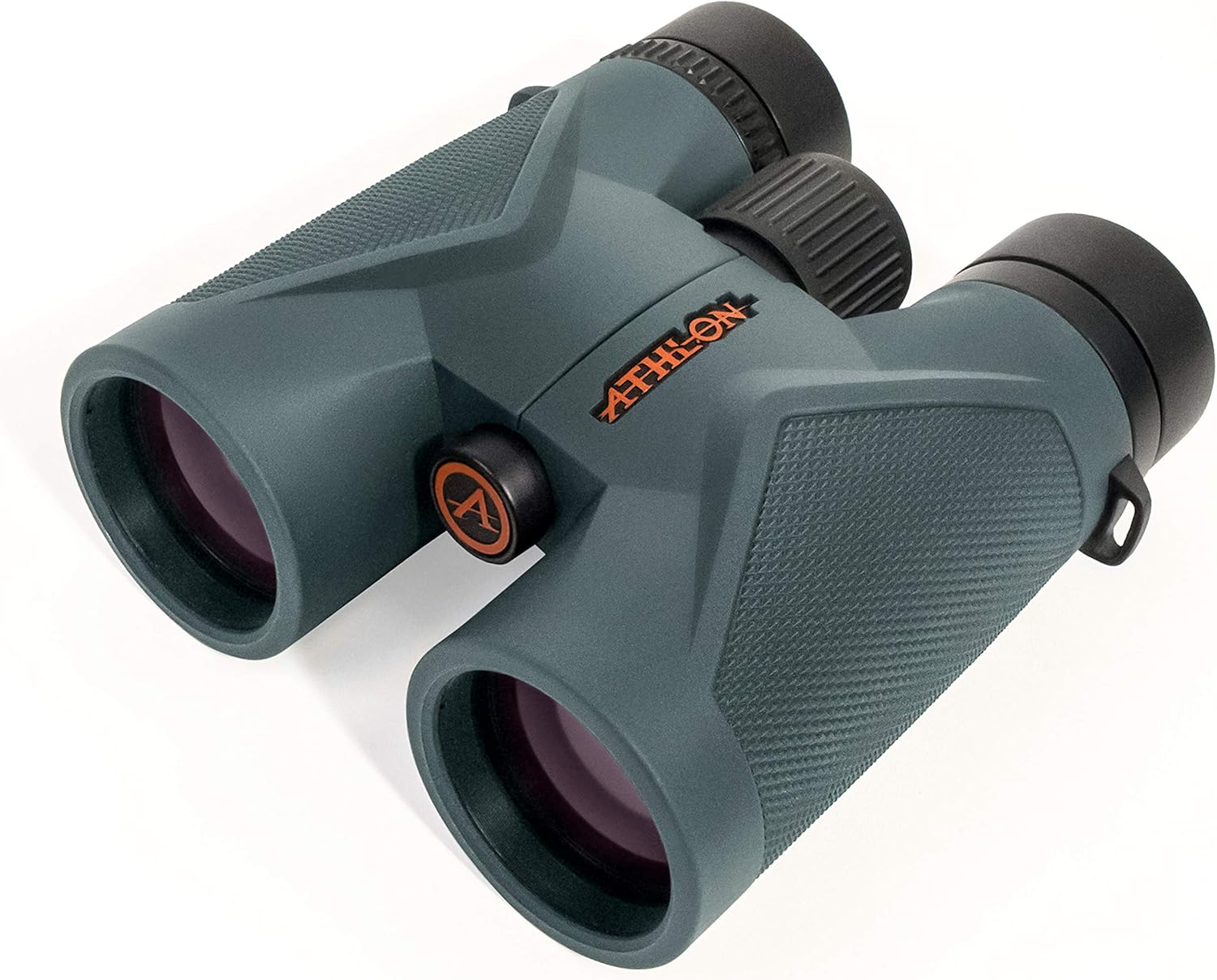
Athlon Midas UHD 8x42 Binoculars use ED glass to reduce chromatic fringing and a dielectric prism coating designed for high reflectivity. Fully multi-coated lenses support light transmission across the optical system. The 8.1-degree field of view gives a wide 8x42 example where optical quality matters alongside image scale.
Check on AmazonIf you click this link and buy, we earn a commission at no additional cost to you.
Binocular magnification explained without turning it into a buying verdict
Magnification is connected to several other parts of the viewing experience, but those connections are not a complete buying verdict by themselves. Higher power makes angular movement more visible, and many binocular families pair higher magnification with a narrower real field of view. At the same objective diameter, the exit pupil becomes smaller because exit pupil is calculated by dividing objective diameter by magnification. These effects are useful to understand before deciding whether extra power is actually helping your particular view.
A same-family example makes the relationships concrete without pretending every binocular follows identical specifications. Nikon lists its MONARCH M5 42 mm family with a 335-foot field at 1,000 yards and 5.3 mm exit pupil for the 8×42, 293 feet and 4.2 mm for the 10×42, and 267 feet and 3.5 mm for the 12×42. Because these models share the same objective diameter, the exit-pupil change follows directly from the magnification change. The field-of-view change is a product-design result, which is why the exact specification still needs to be checked rather than assumed from magnification alone.
The stability tax that arrives with more power
Hand movement does not suddenly appear when you cross a magic magnification threshold. The movement is already there, but higher magnification enlarges its apparent effect along with the subject. That can make fine edges wander more visibly and can reduce how long a detail stays in exactly the same place in the view. The amount that matters varies with the user, grip, posture, binocular weight and balance, viewing duration, and whether there is any physical support.
This is also why universal claims such as “10x is too shaky” are too crude. One person may use a well-balanced 10x comfortably for short observations while another prefers the calmer view of an 8x for the same scene. The technical point is only that higher power asks more of stability, not that every user reaches the same limit at the same number. If you cannot compare in person, treat the higher x-number as a reason to scrutinize handling rather than as automatic evidence of extra usable detail.
Why field width often shrinks as magnification rises
Real field of view tells you how much scene fits inside the binocular without moving it. In many same-family designs, the higher-magnification version shows a narrower real field, which can make initial target acquisition and following movement less forgiving. Nikon’s same 42 mm example shows that pattern clearly from 8x through 12x. The pattern is common enough to expect as a possibility, but the exact field width remains a specification to verify for the exact model.
That last point matters because magnification does not uniquely determine field of view. Eyepiece design can give two 10x binoculars meaningfully different viewing widths, so you should not reject or choose a model from power alone. If field width is central to your use, compare the actual feet at 1,000 yards or angular field listed by the manufacturer. The separate guide to field of view in binoculars explains how to read those numbers without confusing real and apparent field.
What happens to exit pupil when objective diameter stays fixed
Exit pupil is one of the cleanest mathematical links to magnification. Divide the objective diameter by the magnification, so an 8×42 produces about 5.3 mm, a 10×42 produces 4.2 mm, and a 12×42 produces 3.5 mm. At the same objective diameter, raising magnification therefore reduces the diameter of the light bundle leaving the eyepiece. That does not let you rank complete binocular brightness from the exit-pupil number alone, because transmission, coatings, optical losses, and ambient light still matter.
The practical value of the calculation is that it tells you one thing that definitely changes when objective diameter stays constant. It also explains why two binoculars with the same 42 mm front lenses can behave differently as magnification changes. If you want to separate the geometry from broader low-light performance, the guide to exit pupil in binoculars goes deeper into that specification. Keep that distinction intact so a simple formula does not get mistaken for a complete brightness score.

Adasion 12x42 HD Binoculars provide 12x magnification, 42 mm objective lenses, and a listed 367-foot field of view at 1,000 yards. The roof-prism design uses BAK4 prisms and fully multi-coated optics. The package includes a phone adapter, tripod, and tripod adapter, giving the higher-power configuration a practical support option.
Check on AmazonIf you click this link and buy, we earn a commission at no additional cost to you.
When optical quality, not magnification, becomes the limiting factor
Imagine two distant signs viewed from the same position. One binocular enlarges the lettering more, but its image has weaker contrast, obvious color fringing around high-contrast edges, or softness that prevents the letters from separating cleanly. Another binocular shows a slightly smaller image but preserves sharper boundaries and steadier contrast. In that situation, the larger image scale has not delivered the more informative view.
This does not mean lower magnification is inherently sharper, nor does it mean premium optics always beat a higher-power alternative. It means magnification and optical quality answer different questions. Power tells you how large the image is presented, while the optical system determines how faithfully useful information is carried into that enlarged image. Once you understand that split, comparing 8x and 10x stops being a race between two numbers and becomes a check of the complete view.
Focus behavior matters here as well. If the focus wheel makes it difficult to land precisely on the sharpest point, extra image scale can magnify the appearance of a slightly missed focus. Eye relief and eyecup fit can also determine whether you actually see the full designed field, especially with glasses. These are model-specific characteristics, so they should be verified on the exact binocular rather than inferred from 8x, 10x, or 12x printed on the body.

Vortex Crossfire HD 10x42 Binoculars pair 10x magnification with 42 mm objective lenses and an HD optical system. Fully multi-coated lenses support light transmission, while the roof-prism body is waterproof and fogproof. Adjustable eyecups, center focus, and a right-eye diopter provide fit and focusing controls that can affect usable detail.
Check on AmazonIf you click this link and buy, we earn a commission at no additional cost to you.
Why one universal handheld magnification rule does not work
A single handheld limit sounds convenient because it turns a messy decision into one number. The problem is that users differ in grip, steadiness, hand size, posture, viewing duration, and tolerance for image movement. Binoculars also differ in weight distribution, barrel shape, eyecup fit, focus-wheel position, and overall balance. Those differences can change how controllable the same nominal magnification feels in practice.
The viewing situation changes the answer too. A brief look at a stationary distant object does not place the same demands on stability and field width as following something that changes position quickly. A wide, forgiving view may matter more in one situation, while extra image scale may be worth the handling cost in another. That is why a useful rule should describe the tradeoff and the conditions, not declare one handheld magnification universally correct.
- Check how long you normally hold the binocular continuously, not just whether you can steady it for a few seconds.
- Check whether the subjects are mostly stationary or whether you often have to acquire and follow movement.
- Check the actual field of view, eye relief, weight, and balance of the exact model you are considering.
- Check whether you wear glasses and can see the full field with the eyecups in the correct position.
Those checks are more useful than copying another person’s favorite magnification. Community discussions are valuable because they reveal how often buyers struggle with the 8x-versus-10x question, but preference reports are not technical proof that one choice will fit you. Treat other owners’ experience as a prompt for what to verify, not as a universal prescription. Your own use conditions remain the final filter.

Occer 12x25 Compact Binoculars put 12x magnification into a 25 mm format, creating a useful contrast with full-size 42 mm binoculars. The listing specifies a large eyepiece, easy focus, and waterproof construction. Their compact format makes handling and grip part of the comparison instead of treating magnification as the only handheld variable.
Check on AmazonIf you click this link and buy, we earn a commission at no additional cost to you.
When the question has become a high-power or stabilized binocular decision
At some point, asking whether you should keep adding magnification stops being a simple specification question. If the desired power creates enough visible movement that support or stabilization becomes central to getting a usable view, the decision has moved into a different equipment category. The same is true when the field becomes so narrow that finding and holding the subject becomes a major part of the experience. At that point, evaluating the x-number alone leaves out the feature that may determine whether the system is practical.
This article does not choose a high-power configuration, recommend a tripod, or rank image-stabilized binoculars. Those decisions depend on the exact viewing job, required portability, observation duration, field width, weight, and how much setup you are willing to accept. The boundary is simple: once support or stabilization is necessary to make the desired magnification useful, treat that as a new decision rather than a routine step up from 8x or 10x. That prevents a magnification upgrade from quietly turning into a completely different ownership pattern.

Vortex Triumph HD 12x50 Binoculars combine 12x magnification with 50 mm objective lenses and a 4.17 mm exit pupil. The model is tripod mountable and provides 16 mm eye relief. Its 1.6-pound body and included GlassPak harness make support and carrying method concrete parts of the high-power setup.
Check on AmazonIf you click this link and buy, we earn a commission at no additional cost to you.
A pre-purchase magnification check before choosing the larger x-number
Before choosing the higher power, write down what extra image scale is supposed to solve. If the answer is simply “more detail,” identify what detail you cannot currently see and at what distance, because the limitation may be optical quality, focus, stability, atmospheric conditions, or the subject itself rather than magnification. Then compare the higher-power candidate against the lower-power one on the specifications that magnification can affect or expose. This turns a vague fear of missing out into a short list of verifiable tradeoffs.
Do not assume the same x-number feels the same across models. Check the exact field of view, eye relief, weight, dimensions, and any specification that affects physical fit, especially if you wear glasses or expect long viewing sessions. If possible, compare the candidates while looking at a target similar in distance and movement to what you normally observe. The goal is not to prove that lower or higher power wins, but to find out whether the extra image scale remains useful after the rest of the view is counted.
| Check | What to verify | Why it matters |
|---|---|---|
| Image scale | What specific distant detail should become easier to inspect? | Prevents choosing more power without a concrete viewing benefit. |
| Stability | Can you keep the detail steady for the length of observation you expect? | A larger image is less useful if movement constantly hides the feature you wanted to see. |
| Field width | Compare the exact real field or feet at 1,000 yards. | Shows how much scene you give up, if any, in the exact model. |
| Exit pupil | Divide objective diameter by magnification, then consider actual light conditions. | Shows the geometric change in the light bundle without pretending it is a complete brightness score. |
| Fit and optics | Check eye relief, eyecups, focus behavior, weight, and image quality. | Confirms whether the binocular lets you use the nominal magnification comfortably and cleanly. |
The table is deliberately not a scorecard. A wider field can matter more than extra image scale in one use, while the opposite can be true in another. The right conclusion comes from the constraint you are trying to solve, not from adding points to specifications. If the larger x-number does not improve the view you actually need, skipping it is a technically defensible choice.

FLYANT 20x50 High Powered Binoculars use 20x magnification with 50 mm objective lenses and a listed 168-yard field of view at 1,000 yards. The listing specifies multilayer-coated optics and a BAK4 Porro prism. This high-power configuration gives the pre-purchase checklist a concrete case for testing whether extra image scale still serves the viewing task.
Check on AmazonIf you click this link and buy, we earn a commission at no additional cost to you.
Final Thoughts: buy the power you can use
Magnification is real, measurable, and useful, but it is only image scale. Higher power can make a distant subject appear larger while also making hand movement more obvious, changing the field presented by a particular design, and reducing exit pupil when objective diameter stays fixed. None of those tradeoffs automatically makes high magnification bad. They simply mean the x-number should be judged as part of a complete viewing system.
Before buying, ask what the extra power lets you see that you could not usefully see before, then verify the exact binocular’s field of view, fit, optical quality, and handling. If the extra scale survives those checks, it may be worthwhile for your situation. If it does not, choosing less magnification is not surrendering detail. It is choosing the amount of power that still produces a view you can actually use.

Celestron Nature DX 8x42 Binoculars use 8x magnification, 42 mm objective lenses, and a 7.4-degree field of view. Fully multi-coated optics and BaK-4 prisms support the optical system. The waterproof, nitrogen-filled body provides 17.5 mm eye relief and is tripod adaptable, making usable power part of a complete viewing setup.
Check on AmazonIf you click this link and buy, we earn a commission at no additional cost to you.
FAQs
🔍 What does binocular magnification mean?
It describes how large a subject appears compared with the naked-eye view. An 8x binocular presents the subject at eight times the angular image scale, but that number alone does not describe sharpness, field width, stability, or fit.
👀 Is the difference between 8x and 10x actually noticeable?
Yes, 10x presents a larger image than 8x, so the difference is real. Whether it produces more usable detail depends on stability, optical quality, field of view, focus, viewing distance, and the exact model.
🤲 Does higher magnification always look shakier?
Higher magnification makes the apparent effect of hand movement larger, but how disruptive that feels varies with the user and binocular. Grip, balance, weight, posture, and viewing duration all affect the result.
🌄 Does 10x always have a narrower field of view than 8x?
Many same-family binoculars become narrower in real field as magnification increases, but the exact field depends on eyepiece and optical design. Compare the manufacturer’s field-of-view specification for the exact models instead of assuming from magnification alone.
💡 Why does exit pupil get smaller when magnification increases?
Exit pupil equals objective diameter divided by magnification. With the same 42 mm objective, 8x gives about 5.3 mm, 10x gives 4.2 mm, and 12x gives 3.5 mm, while actual perceived brightness still depends on more than this number alone.
🧭 Is 12x too much for handheld binoculars?
There is no universal handheld cutoff that fits every user and binocular. At 12x, stability deserves closer scrutiny, so evaluate the exact model, your viewing duration, and whether image movement prevents you from using the additional scale.
References and Sources
- Nikon magnification guide: Supports the magnification definition and the relationship between higher power, visible hand movement, field width, and brightness.
- Nikon specification guide: Supports the exit-pupil formula and explains why magnification must be considered with field of view and other specifications.
- Nikon MONARCH M5 family specifications: Provides the same-family 8×42, 10×42, and 12×42 field-of-view and exit-pupil figures used as the article example.
- Kowa optics basics: Provides an independent manufacturer explanation of magnification, stability, field width, and exit pupil.