The numbers printed on binoculars tell you less than a full specification sheet does. In 8×42, the first number is magnification and the second is the objective lens diameter in millimeters, while field of view, close focus, eye relief, and physical fit still need separate checks. Exit pupil is one useful value you can calculate from the pair, but it does not replace those other specifications. The practical goal is to decode the label, identify what remains unknown, and check the next number that matches the viewing problem you are trying to solve.
Start with 8×42, then look beyond it
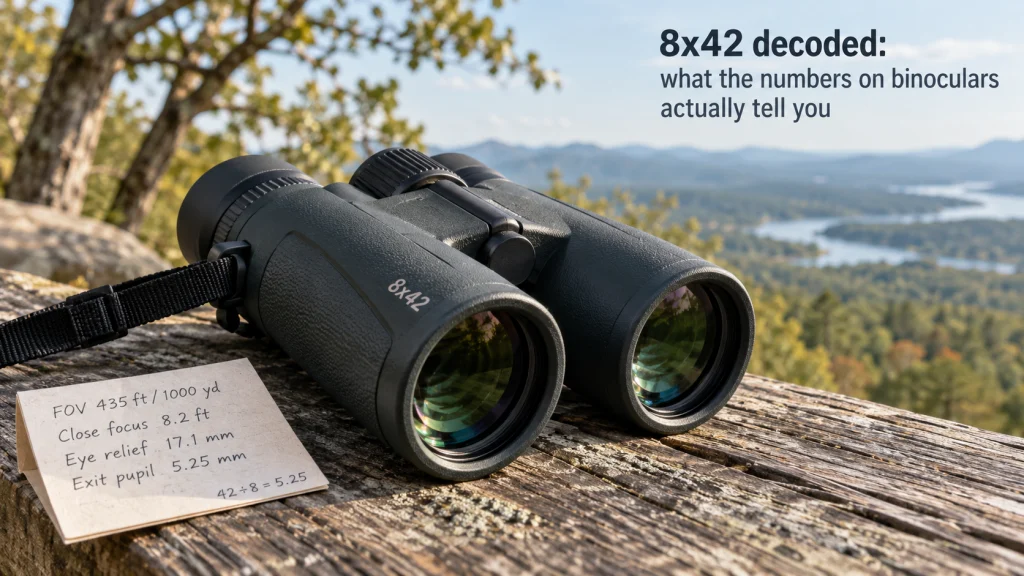
8×42. What do the numbers on binoculars mean when that is the label in front of you? The 8 means the binocular magnifies the view eight times, and the 42 means each objective lens has a diameter of 42 millimeters. That is the complete meaning of the pair itself. It does not quietly encode viewing width, minimum focus distance, comfort with glasses, or overall optical quality.
Now open a current 8×42 specification page and more numbers appear beside that same label. Nikon, for example, lists separate values for real field of view, apparent field of view, field of view at 1,000 yards, close focus distance, exit pupil, eye relief, weight, and interpupillary adjustment on one current 8×42 model. Those extra lines are not decorative details added after the important numbers. They answer different questions that 8×42 cannot answer, which is why the broader binocular specifications guide matters once the headline pair has been decoded.
Read the 8×42 label: 8x is magnification, while 42 mm is the objective lens diameter. The multiplication sign separates two different measurements rather than combining them into one performance score. Read the pair literally first, then move to the rest of the specification sheet.
8×42 does not tell you: field of view, apparent field of view, close focus, eye relief, IPD range, weight, optical quality, focus behavior, or whether the binocular will fit you comfortably.
Those values have to be listed, calculated, or verified separately. Treating them as independent checks is what prevents the headline configuration from carrying more meaning than it actually contains.
This 8x42 model pairs 8x magnification with 42 mm objective lenses. It lists 17.2 mm eye relief, an 8.1-degree angular field of view, and a 6.5-foot close focus. Those independent values make it a useful example of why the 8x42 label does not contain the full specification sheet.
Check on AmazonIf you click this link and buy, we earn a commission at no additional cost to you.
The two-number answer in one minute
The first number is magnification. An 8x binocular produces an angular view that makes a subject appear eight times larger than it would to the unaided eye, while a 10x binocular provides ten times magnification. That number changes the apparent size of distant detail, but it does not create a fixed maximum viewing distance. You can focus on very distant subjects with either configuration as long as the binocular is designed to focus that far.
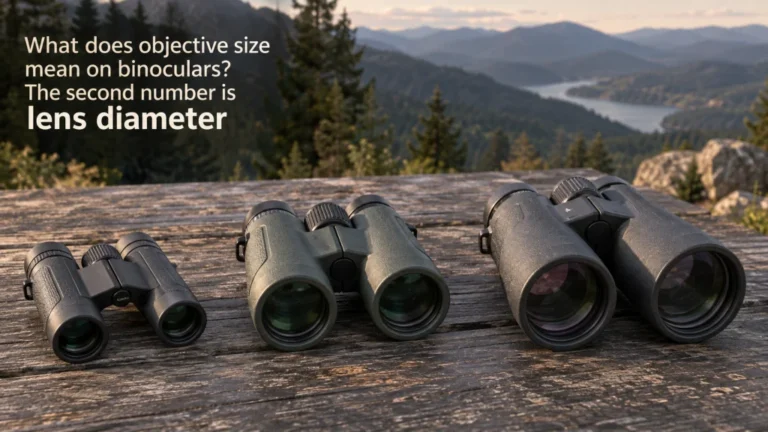
The second number is the effective diameter of the objective lenses, measured in millimeters. In 8×42, the objectives are 42 millimeters across, and in 10×50 they are 50 millimeters across. Objective diameter influences how much light the optical system can collect and also affects the physical size and weight that designers have to manage. It is not a field-of-view measurement, and it should not be read as a simple score where a larger number is automatically better.

This 12x25 model combines 12x magnification with 25 mm objective lenses. Its listed field of view is 273 feet at 1,000 yards, and the design uses FMC coatings with BaK-4 prisms. It gives a second configuration for separating the first number from the second without treating either as a complete performance score.
Check on AmazonIf you click this link and buy, we earn a commission at no additional cost to you.
What the first number changes and what it cannot promise
Magnification changes how large the subject appears in the view, so it matters when you are trying to resolve detail at distance. It also changes how visible hand movement becomes, because a higher-power view magnifies your motion along with the subject. That is why the practical effect of moving from 8x to 10x is not just a little more reach. The viewing experience can also change in stability, subject acquisition, and how easily you keep a moving target inside the view.
What magnification cannot promise is image quality, brightness, comfortable fit, or a particular field of view. Two binoculars with the same 8x label can use different eyepiece designs, coatings, prisms, housings, focus systems, and objective constructions. If magnification is the unresolved part of your decision, use the separate explanation of how binocular magnification changes the view rather than treating the first number as a universal quality score. The right question is what more magnification changes in your viewing situation, not whether the bigger number wins.

This 10x42 model uses 10x magnification with 42 mm objective lenses. It lists 17 mm eye relief, a 6.4-degree angular field of view, and a 15.3-foot close focus. Comparing those values with an 8x42 model shows how changing magnification affects the configuration while other specifications still require separate checks.
Check on AmazonIf you click this link and buy, we earn a commission at no additional cost to you.
Group the specification checks that change the decision
A useful way to read a binocular specification sheet is to separate direct label values from derived values and independent values. Magnification and objective diameter are printed in the headline configuration, while exit pupil can be calculated from those two numbers. Field of view and close focus cannot be recovered from 8×42 alone, because they depend on additional parts of the optical design. Keeping those groups separate prevents one number from being asked to answer a question it was never meant to answer.
This also makes comparison faster. When two binoculars share the same 8×42 label, you do not need to re-decode the pair each time. You can move straight to the independent specifications that matter for your use, such as viewing width, near-focus ability, eye relief, weight, or interpupillary range. The table below is a reading order, not a ranking system, and it is meant to show which numbers are given directly, which can be calculated, and which must be checked separately.
What the second number measures and why it is not viewing width
The 42 in 8×42 is the objective lens diameter in millimeters, not the width of the scene you will see. A larger objective can collect more light, but the final field of view also depends on the eyepiece and optical design, so objective diameter alone cannot establish viewing width. If the second number is the part you need to understand more deeply, read what objective size means on binoculars before using it as a buying shortcut. The practical check is to separate light-gathering aperture from the independent field-of-view specification.
The useful number you can calculate from the pair
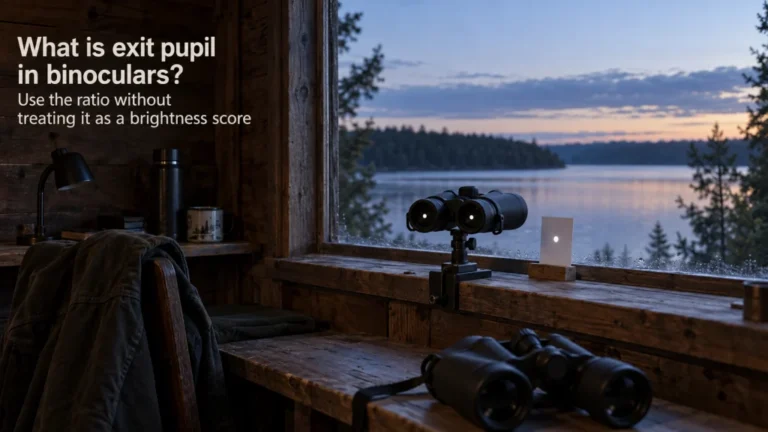
Exit pupil is calculated by dividing objective diameter by magnification, so 42 divided by 8 gives 5.25 millimeters. Manufacturers may round that value, which is why a specification sheet can show 5.3 millimeters for an 8×42. Exit pupil describes the diameter of the light bundle leaving the eyepiece, but it is still only one part of low-light performance and viewing comfort. For the calculation, limits, and practical use of that number, continue with what exit pupil means in binoculars.
The viewing-width numbers manufacturers have to list separately
Real field of view describes how wide an angular area you can see without moving the binocular, while linear field of view expresses that visible width at a stated distance such as 1,000 yards. Apparent field of view describes how wide the magnified scene appears to the viewer and is calculated under a different relationship. These values need their own specification lines because neither 8 nor 42 uniquely determines them. Use the field-of-view guide for real and linear FOV, and the apparent field-of-view guide when the apparent width of the view is the unresolved question.
| Specification | How you get it | What it tells you |
|---|---|---|
| Magnification | First number in 8×42 | How much the binocular magnifies the angular view |
| Objective diameter | Second number in 8×42 | Effective diameter of the objective lenses in millimeters |
| Exit pupil | Objective diameter divided by magnification | Diameter of the light bundle leaving the eyepiece |
| Real or linear field of view | Listed separately by the manufacturer | How much width you can see at once |
| Apparent field of view | Listed separately or calculated with the stated method | How wide the magnified scene appears |
| Close focus | Listed separately by the manufacturer | The nearest distance at which the binocular can focus |
Read the table from the problem backward. If you want to know how much the view is magnified, the first number answers it immediately, and if you want the exit pupil, the pair provides the inputs for a calculation. If you want to know how much landscape fits into the view or how close you can focus, the label does not contain that answer. That distinction is the core habit that keeps a simple 8×42 label from becoming a misleading shortcut.

The 8x42 configuration yields a 5.25 mm exit pupil. Vortex lists 17 mm eye relief, a 393-foot field of view at 1,000 yards, and a 5-foot close focus. It puts direct, derived, and separately listed specifications together in one model for comparison.
Check on AmazonIf you click this link and buy, we earn a commission at no additional cost to you.
The nearest-focus number that 8×42 does not encode
Close focus, also called close focusing distance or minimum focus distance, is the nearest point at which the binocular can bring a subject into focus. That value matters when your viewing can move from distant scenery to nearby birds, insects, artwork, or details at short range. It is a property of the focusing system and optical design, not a number that can be calculated from magnification and objective diameter. Two 8×42 binoculars can therefore share the same headline label while focusing to noticeably different minimum distances.
The practical check is simple: if nearby viewing matters, find the manufacturer line for close focus before assuming that an 8×42 will handle the distance you have in mind. Do not convert magnification into a fake minimum distance, because the first number does not work that way. The separate guide to close focus in binoculars explains how to interpret that specification without turning it into a universal quality score. A shorter figure is useful only when your actual subjects are close enough for it to matter.

This 8x42 binocular has a manufacturer-listed close focus of 6.5 feet. Celestron also lists a 7.4-degree field of view, 17.5 mm eye relief, and a 5.25 mm exit pupil. The model is useful here because its near-focus distance is a separate specification rather than something encoded by the 8x42 label.
Check on AmazonIf you click this link and buy, we earn a commission at no additional cost to you.
Eye relief, IPD and diopter range belong to physical fit or setup
Some numbers on a specification sheet describe whether your eyes can use the optical view comfortably rather than how much the binocular magnifies. Eye relief is the distance from the eyepiece surface to the eyepoint where the full field can be seen, and it becomes especially important when eyeglasses keep your eyes farther from the eyepieces. Interpupillary distance, usually shortened to IPD, describes how far apart the two optical barrels can be adjusted to match your eyes. Diopter range describes how much the binocular can compensate for a difference in focus between your eyes within the design limits.
None of those values is encoded in 8×42, so they have to be verified on the exact model when fit matters. A person can like the magnification and objective size yet still struggle if the eyecups, eye relief, IPD range, or focus setup does not suit them. If glasses are the main concern, the next useful route is what eye relief means in binoculars, because that specification owns a different decision from magnification or objective diameter. The headline pair identifies the optical configuration, but it does not certify physical fit.

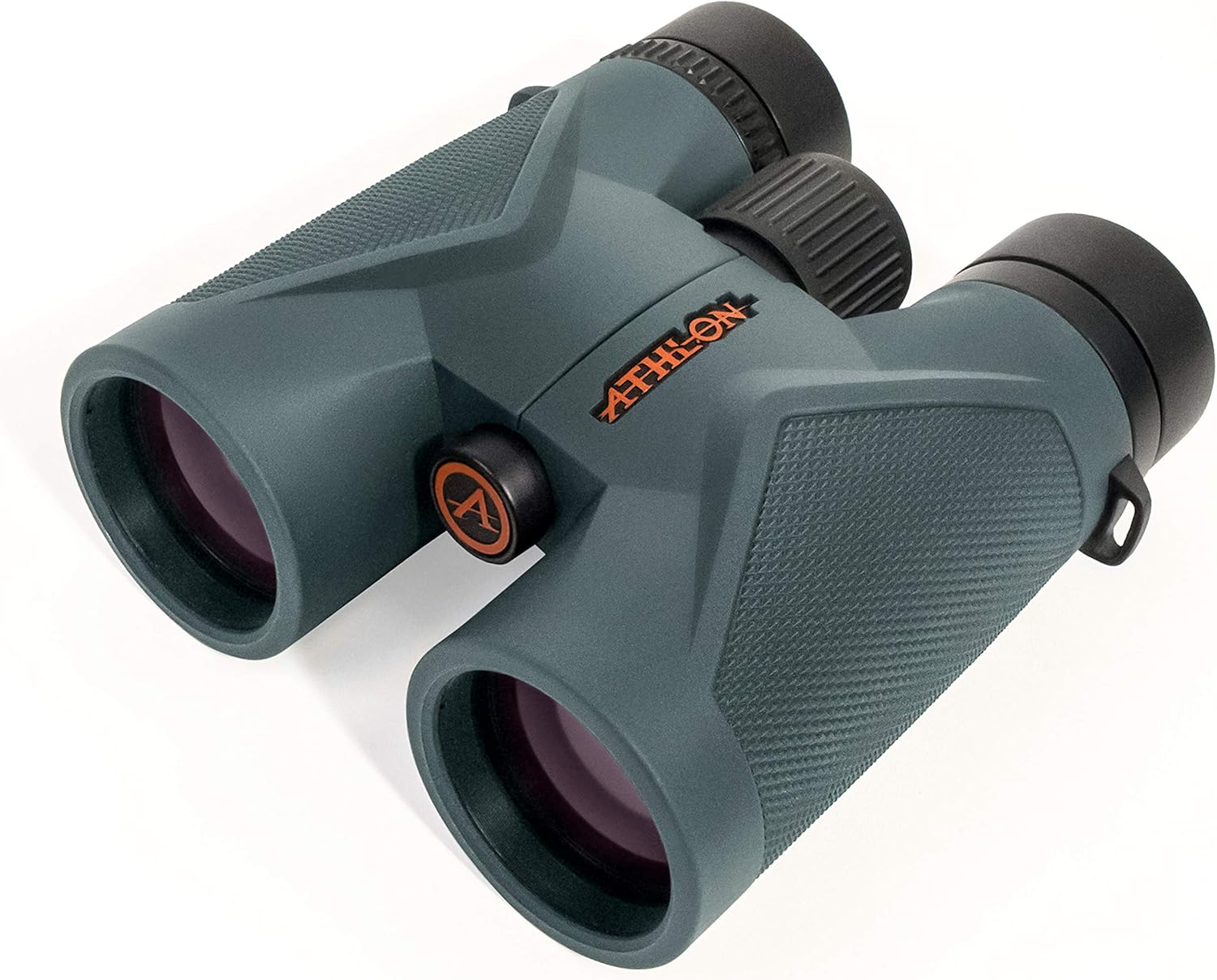
This 8x42 model lists 19.5 mm of eye relief for a fit-related specification that sits outside the headline configuration. Nikon uses central focusing, roof prisms, and ED glass in this model. Its long eye relief makes it a concrete example for checking eyeglass comfort separately from magnification and objective diameter.
Check on AmazonIf you click this link and buy, we earn a commission at no additional cost to you.
Why identical 8×42 labels can still describe very different products
A current Nikon specification comparison makes the limitation visible without requiring any subjective review. Nikon lists its MONARCH M7 8×42 with a field of view of 435 feet at 1,000 yards, while the MONARCH M5 8×42 is listed at 335 feet at 1,000 yards. Both are 8×42 binoculars, so the magnification and objective diameter are the same, yet the viewing-width specification is not. This is an evidence example rather than a product recommendation, and it shows why the headline label cannot stand in for the rest of the sheet.
The same logic applies to eye relief, weight, close focus, prism design, coatings, focus feel, and housing dimensions. Some of those differences can be read directly from verified specifications, while others require careful model-specific evidence before making a claim about real-world behavior. The important point is not that one 8×42 must be better than another. It is that the shared label defines only two measurements, so any conclusion about quality, fit, handling, or viewing width needs additional evidence.

This is another 8x42 binocular, but Celestron lists a 7-degree angular field of view, 17.8 mm eye relief, and a 13.1-foot close focus. It also has multi-coated optics and BaK-4 prisms. Those independent specifications differ from other 8x42 models even though the two headline numbers are identical.
Check on AmazonIf you click this link and buy, we earn a commission at no additional cost to you.
Choose the next number by the problem you still need to solve
Once you know what the two headline numbers mean, stop reading the spec sheet from top to bottom as if every line has equal importance. Start with the viewing problem that remains unresolved and choose the next specification that can actually answer it. A moving subject may push field of view higher on the list, nearby viewing may make close focus important, and eyeglasses may make eye relief the first fit number to verify. This keeps the decision tied to use rather than to whichever number looks most impressive.
It also prevents the common mistake of asking one specification to stand in for several unrelated ones. Objective diameter cannot tell you the field of view, exit pupil cannot prove optical quality, and magnification cannot tell you whether the eyecups or IPD range will fit your face. A short checklist is more reliable than a bigger-is-better rule because each number gets one job. Use the routes below according to the question you still have after decoding the label.
- If the first number is unclear, check magnification and its stability trade-offs.
- If the second number is unclear, check objective diameter and the size and light-gathering trade-offs it creates.
- If you need a derived light-bundle value, calculate exit pupil.
- If you need viewing width, check real or linear field of view and apparent field of view separately.
- If nearby subjects matter, verify the exact close-focus specification.
- If glasses or facial fit are the problem, verify eye relief and the exact model’s adjustment range.
That sequence is intentionally selective. You do not need to memorize every optics term before comparing two specification sheets, but you do need to know which number owns the question you are asking. Once you separate headline configuration, derived values, viewing-width numbers, near-focus numbers, and fit numbers, the sheet becomes much easier to read. The label is the beginning of the decision, not the verdict.

This 10x42 model lists a 325-foot field of view at 1,000 yards, 15 mm eye relief, and a 6-foot close focus. It also provides a 58 to 75 mm interpupillary-distance range. Those separate numbers let you choose the next specification according to viewing width, near focus, or fit rather than reading 10x42 as a complete answer.
Check on AmazonIf you click this link and buy, we earn a commission at no additional cost to you.
Final Thoughts: decode the label, then keep reading
Read 8×42 literally: 8x magnification and 42 millimeter objective lenses. From there, calculate exit pupil only when that value answers a real question, and look up field of view, apparent field of view, close focus, eye relief, IPD, weight, and other independent specifications when they affect your use. Do not let the simplicity of the pair turn into assumptions about quality or fit. The safest interpretation is narrow, precise, and easy to verify.
The next step depends on what the label still leaves unresolved for you. If you are comparing viewing width, go to field of view; if nearby focus matters, go to close focus; if glasses or fit are the problem, go to eye relief and physical adjustment. That problem-first reading order is more useful than memorizing a list of numbers with no context. Decode the pair, identify the missing decision variable, and verify that value on the exact binocular you are considering.

This 10x42 model uses BaK-4 prisms and fully multi-coated optics. Bushnell lists 17 mm eye relief, a 6.8-degree field of view, and waterproof and fogproof construction for this model. The configuration gives you the headline pair, while viewing width, fit, coatings, and environmental protection remain separate checks.
Check on AmazonIf you click this link and buy, we earn a commission at no additional cost to you.
Explore related binocular number guides
Each guide below takes one numerical specification from the broader system and gives it a single job. Use the row that matches the question the 8×42 label still cannot answer for you. If the uncertainty is about viewing width, there is no reason to detour through objective diameter again. If the uncertainty is about fit with glasses, eye relief deserves attention before another magnification comparison.
The routes are separated because the numbers solve different problems. Magnification, objective diameter, exit pupil, field of view, apparent field of view, and close focus may appear together on one specification sheet, but they are not interchangeable measures of performance. Moving to the specific guide that owns the unresolved question keeps the comparison focused and reduces the chance of treating a larger number as automatically better. The table is therefore a next-step map for reading specifications, not a ranking of which specification matters most.
| Topic | What you’ll find |
|---|---|
| Binocular magnification explained | How the first number changes apparent detail, stability, and subject acquisition. |
| What objective size means on binoculars | What the second number measures and what objective diameter does not tell you. |
| What exit pupil means in binoculars | How to calculate the derived value and when it is useful. |
| What field of view means in binoculars | How to read angular and linear viewing width without confusing it with objective size. |
| Binocular apparent field of view | How apparent viewing width differs from the real field listed on a spec sheet. |
| What close focus means in binoculars | How to interpret the nearest distance at which a binocular can focus. |
If more than one number is still unresolved, start with the one tied most directly to your actual viewing condition and work outward from there. A wider field can matter before a smaller close-focus number when you mainly follow moving subjects at distance, while the order can reverse for nearby viewing. The same principle applies to fit, because eye relief or adjustment range can matter more than another optical number when the binocular does not sit correctly at your eyes. Let the remaining problem choose the next specification rather than reading the sheet as a contest for the largest figure.
Once that next question is answered, return to the exact model and verify the specification instead of carrying over a value from another binocular with the same 8×42 label. This is especially important when two models share magnification and objective diameter but differ in field of view, close focus, weight, or fit-related dimensions. The headline pair narrows the category, while the remaining numbers refine the decision. That is the point where the specification sheet becomes useful rather than merely dense.

This 7x50 Porro-prism binocular combines 7x magnification with 50 mm objective lenses. Celestron lists a 6.6-degree angular field of view, a 7.1 mm exit pupil, and 13 mm eye relief. The different 7x50 configuration provides another concrete case for decoding the label first and then moving to the independent specifications.
Check on AmazonIf you click this link and buy, we earn a commission at no additional cost to you.
FAQs
🔭 What does 8×42 mean on binoculars?
The 8 means 8x magnification, and the 42 means the objective lenses are 42 millimeters in diameter. The label does not tell you field of view, close focus, eye relief, weight, or overall optical quality.
📐 Does the second number tell me the field of view?
No. The second number is objective lens diameter in millimeters, while field of view is a separate specification created by the complete optical design. Check the manufacturer’s real or linear FOV value on the exact model.
💡 How do I calculate exit pupil from 8×42?
Divide the 42 millimeter objective diameter by 8x magnification, which gives 5.25 millimeters. A manufacturer may round that to 5.3 millimeters on the specification sheet.
🌲 Can two 8×42 binoculars have different fields of view?
Yes. The shared 8×42 label fixes magnification and objective diameter, but the eyepiece and overall optical design can produce different fields of view. Always compare the listed FOV rather than assuming the configuration determines it.
👓 Does 8×42 tell me whether binoculars will work with glasses?
No. Eyeglass fit depends on eye relief, eyecup design, and your own glasses and facial geometry. Verify the exact model’s eye relief and test the usable field if fit is important.
🎯 Does 8×42 have a maximum viewing distance?
Not in the way many first-time buyers expect. Magnification changes apparent size, but the label does not define a fixed far-distance limit. What detail you can resolve also depends on the subject, atmosphere, steadiness, light, and optical quality.
References and Sources
- Nikon guide to binocular numbers: Supports the definitions of magnification, objective diameter, exit pupil, and field of view.
- Nikon field-of-view guide: Supports the distinction between real field of view, apparent field of view, and linear viewing width.
- Nikon specification guide: Supports the definitions of eye relief and close focusing distance.
- Nikon MONARCH M7 8×42 specifications: Provides the current model-specific values used to show that 8×42 does not encode field of view or close focus.
- Nikon MONARCH M5 8×42 specifications: Provides the second current 8×42 example used to show that identical headline labels can have different field-of-view values.