Close focus is the nearest distance at which a binocular can bring a subject into a clear focus, and a subject inside that boundary can stay blurred even when the binocular works normally farther away. The published value belongs to the exact model, not to a label such as 8×42 by itself. A shorter minimum focus distance matters most when you regularly look at nearby subjects, while many long distance viewing situations gain little from chasing the smallest possible number. The practical test is to compare your subject distance with the manufacturer’s stated limit before deciding that near blur means something is wrong.
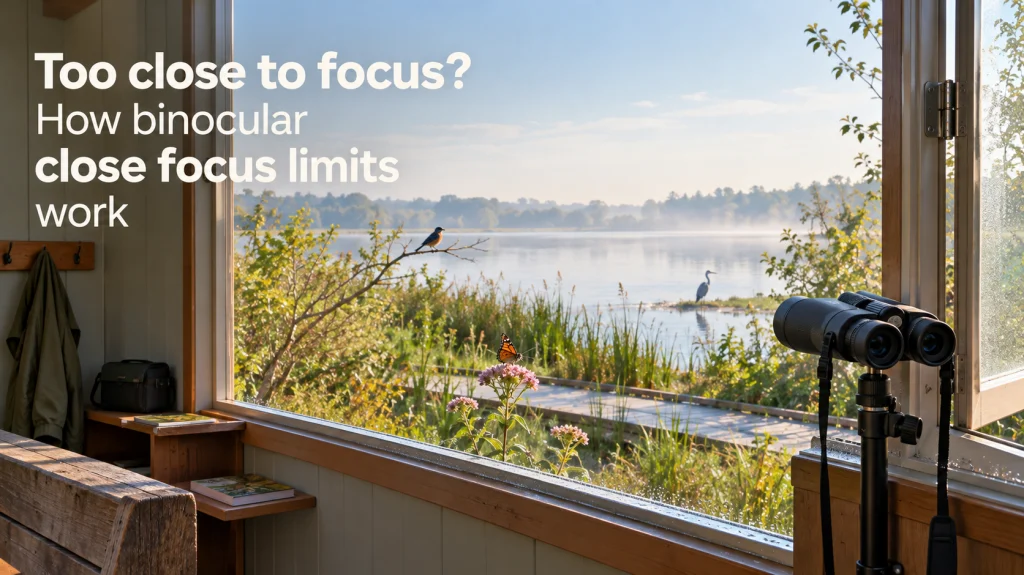
An eight foot subject can fall inside the published no focus zone
You raise the binocular to look at something about eight feet away, turn the focus wheel through its useful travel, and the subject never becomes sharp. Farther objects look normal, so the immediate worry is that the focus mechanism is defective. If you’re trying to understand close focus in binoculars, this is the most useful place to start: every model has a nearest distance at which it is designed to reach focus. If your subject is closer than that published boundary, blur can be normal rather than evidence of a fault.
The first move is therefore not to diagnose the binocular but to read the exact specification for the exact model. The broader guide to what the numbers on binoculars actually tell you explains how magnification and objective size fit into the rest of the specification sheet, while reading binocular specifications in context helps keep one number from taking over the whole buying decision. Close focus deserves the same treatment because it answers one narrow question: how near can the subject be before the optical system runs out of usable focusing range? Once that boundary is clear, you can separate an expected limitation from a problem that deserves a different check.

Celestron lists a 13.1-foot close-focus distance for this 8x42 model, so a target at eight feet sits inside its published no-focus zone. The 42 mm objectives and 7-degree angular field provide a conventional full-size 8x42 setup. Twist-up eyecups, a large focus knob, waterproof construction, and nitrogen filling support normal field use.
Check on AmazonIf you click this link and buy, we earn a commission at no additional cost to you.
What the close focus boundary actually means
Manufacturers may label this specification as close focus, close focusing distance, minimum focus distance, or minimum focusing distance, but the practical meaning is the same. Fujifilm defines minimum focus distance as the shortest distance at which binoculars can focus, which makes the number a boundary rather than a promise about everything nearer than it. If a model lists 15 feet, a subject at 10 feet is inside the stated no focus zone, while a subject comfortably beyond 15 feet should be within the intended focusing range. The number does not tell you how large the subject will appear, how wide the field will be, or how easy the focus wheel will feel.
That distinction matters because close focus and magnification solve different problems. Magnification describes how large the subject appears relative to unaided viewing, while minimum focus distance describes whether the binocular can bring a nearby subject into focus at all. A short value can be useful when the viewing distance is small, but it does not automatically make the image brighter, steadier, wider, or more comfortable. Treat close focus as one line on the specification sheet, then judge it alongside the conditions in which you actually expect to use the binocular.
| What you observe | What the specification suggests | What to do next |
|---|---|---|
| The subject is clearly nearer than the published minimum focus distance | Blur can be a normal design limit | Move farther back and test again beyond the stated boundary |
| The subject is around the published boundary | You are testing at the edge of the stated range | Use a more comfortably distant target before judging the binocular |
| The subject is well beyond the published boundary but still will not focus | The close focus limit no longer explains the problem by itself | Check normal setup and then move to troubleshooting if needed |
The table is deliberately conservative because a published boundary is most useful as a decision line, not as a challenge to focus at the last possible inch. Start with a target beyond the stated minimum and confirm that the binocular behaves normally there. If it does, near blur inside the limit is expected. If it does not, the next question is no longer simply about close focus.

Nikon specifies a 9.8-foot close-focus distance for the PROSTAFF P3 8x42, giving a clear reference point for near-target tests. Its 8x magnification and 42 mm objectives are paired with a 377-foot field of view at 1,000 yards. The model uses central focus and is waterproof and fogproof for routine outdoor viewing.
Check on AmazonIf you click this link and buy, we earn a commission at no additional cost to you.
Why minimum focus distance is model specific rather than encoded by 8×42
The familiar 8×42 label tells you two things: 8x magnification and 42 mm objective lenses. It does not tell you the full focusing range, because that depends on the completed optical and focusing design of the model. Current manufacturer specifications make the point cleanly without requiring a theory lesson. Two current 8×42 binoculars from the same manufacturer list different close focusing distances, one at 9.8 feet and another at 8.2 feet, even though both carry the same 8×42 configuration.
That is why a rule such as “all 8×42 binoculars focus this close” is unreliable. The same caution applies when comparing roof prism and Porro prism designs, compact and full-size bodies, or older and newer product families. Those labels may describe useful design tendencies, but they do not replace the exact published specification for the exact binocular in your hands. If minimum focus distance matters to your use, verify that line directly instead of trying to infer it from magnification, objective diameter, price, or body shape.
- Check the exact model name and configuration before reading the number.
- Confirm whether the manufacturer reports feet, meters, or both.
- Do not transfer a close focus value from a related model that merely looks similar.
- Do not assume that a higher price or newer design guarantees a shorter minimum distance.
This is also why close focus is a poor place for shorthand buying rules. A buyer who only sees 8×42 may think one model can replace another without changing near distance behavior. In reality, the close focus line can differ even when the headline configuration looks identical. The useful comparison is exact model against exact model, with the viewing distance you care about kept in the foreground.

Nikon specifies an 8.2-foot close-focus distance for this MONARCH M5 8x42, showing that the same 8x42 format can have a different minimum focus than another model. It provides a 335-foot field of view at 1,000 yards and 19.5 mm of eye relief. ED glass, central focus, and waterproof and fogproof construction are part of the verified configuration.
Check on AmazonIf you click this link and buy, we earn a commission at no additional cost to you.
Shorter close focus matters only when the viewing situation needs nearby subjects
A shorter close focus distance is valuable when your subjects regularly appear near you. A person watching a feeder from a short indoor viewing distance, studying a flower across a narrow path, or looking at a small subject that may move close can run into the minimum focus boundary often. Cornell’s discussion of close focus makes the same practical point by tying the specification to nearby birds and other small subjects rather than treating a short number as universally superior. In those situations, a difference of several feet can change whether the subject is viewable without stepping backward.
Now change the situation and the priority can drop quickly. If your normal targets are across a field, at the far side of a stadium, or otherwise well beyond the close focus boundary, moving from a moderate minimum distance to an extremely short one may not improve the viewing experience at all. Field of view, eye relief, weight, stability, and physical fit may matter more because you interact with those characteristics on every viewing session. A buyer should therefore ask how often a nearby subject actually falls inside the current or prospective binocular’s limit before paying attention to small differences in close focus.
Key point: A smaller minimum focus distance is useful when it solves a recurring distance problem. It is not a general quality score.
That last distinction protects against a common specification trap. It is easy to sort a table by the smallest number and assume the first row is better, but that only works if near distance viewing is one of your real constraints. A binocular that focuses closer can still be the worse fit because of weight, eye relief, field of view, or another factor that matters more to you. Use close focus to eliminate a distance mismatch, not to crown a universal winner.

PENTAX specifies a 0.5 m minimum focusing distance for the Papilio II 8.5x21, making it suited to flowers, insects, museum displays, and other nearby subjects. The compact Porro-prism model uses 8.5x magnification and 21 mm objectives. Its 15 mm eye relief and center-focusing design support both close-range and normal-distance observation.
Check on AmazonIf you click this link and buy, we earn a commission at no additional cost to you.
Verify the exact product before treating near blur as a fault
The most useful real-world pattern is simple: someone tries to focus at a nearby target, the image stays blurred, and the binocular seems suspicious until the specification is checked. In one owner discussion, the problem started around eight to ten feet and the user later found that the binocular’s published close focus was 15 feet. That turns the situation from a vague defect fear into a measurable boundary question. The important step is not the forum answer itself, but the habit of checking the manufacturer’s exact model page before diagnosing the hardware.
Start by confirming the complete model identity because related binoculars can share branding while using different specifications. Then find the manufacturer’s close focus or minimum focus line and compare it with the actual subject distance, leaving enough room that you are not testing exactly at the edge. If the binocular focuses normally at a clearly greater distance, that result supports the published boundary explanation. If it still refuses to reach focus well beyond that range, you have crossed into a different problem and should stop treating close focus as the complete answer.
- Confirm the exact model and configuration.
- Read the current manufacturer specification rather than a remembered value.
- Estimate or measure the subject distance instead of relying on how close it feels.
- Retest on a target comfortably beyond the published minimum.
- If normal focus is still unavailable, continue with setup or troubleshooting guidance rather than forcing the focus mechanism.
This sequence is especially useful for a new owner because it prevents two opposite mistakes. One is assuming normal near distance blur means the product is defective. The other is assuming every failure to focus must be normal because close focus exists as a specification. The published boundary answers the first question, while behavior beyond that boundary tells you when to ask the second.

The Klein Tools 93LDM100C measures from 2 inches to 100 feet, making it practical for checking whether a target is actually beyond a binocular close-focus limit. It supports single or continuous distance readings and can display inches, feet and inches, or meters. Accuracy is rated to 1/16 inch over the first 30 feet and 1/8 inch out to 100 feet.
Check on AmazonIf you click this link and buy, we earn a commission at no additional cost to you.
When the published boundary ends and troubleshooting begins
Close focus explains blur only when the subject is too near, or when you are testing right around the stated minimum distance. It does not explain a binocular that cannot reach a clear focus on a normal target well beyond that range. At that point, basic setup becomes the relevant next step: interpupillary distance, eyecup position, center focus, and diopter setup can all affect whether the view seems usable. The scope of this article stops at that handoff because a normal specification limit and a focusing problem are different questions.
If setup is correct and the binocular still cannot focus normally at distances where it should, follow the exact manufacturer’s manual or support guidance. Do not disassemble the binocular, attempt internal optical adjustment, or force a focus mechanism that feels mechanically abnormal. Severe double image, obvious internal damage, water ingress, a broken hinge, or a damaged eyepiece or objective is also beyond an owner-level close focus check. Those conditions belong with qualified service or the manufacturer’s support path, not with attempts to beat the published minimum focus distance.
There is also a useful limit on what close focus behavior can tell you about yourself. This specification is about the binocular’s focusing range, and this page does not use binocular behavior to diagnose eyesight conditions. If a visual issue appears independently of the binocular, that falls outside product guidance. Keeping that boundary clear prevents a straightforward equipment specification from becoming an unsupported medical explanation.
The decision is therefore clean once the distances are separated. Blur inside the stated minimum can be normal, blur comfortably beyond it deserves setup checks, and persistent abnormal behavior after correct setup deserves the manufacturer’s troubleshooting or service route. That sequence is safer and more useful than labeling the binocular defective from one near target. It also keeps the close focus specification doing the job it was meant to do.

The Vortex Diamondback HD 8x42 provides the same user controls highlighted in basic focus setup: adjustable eyecups, a center focus wheel, and a right-eye diopter. Vortex specifies a 5-foot close focus and a 393-foot field of view at 1,000 yards. The DB-214 is waterproof, fogproof, and tripod adaptable for routine field use.
Check on AmazonIf you click this link and buy, we earn a commission at no additional cost to you.
Final Thoughts: check the boundary before diagnosing the product
Close focus is best understood as a model-specific distance boundary, not as a quality grade. If a nearby subject falls inside that boundary, blur can be completely normal even when farther subjects focus cleanly. If nearby viewing matters often, compare the exact published minimum distance before buying. If it rarely matters, give more weight to the specifications and fit factors you will notice every time you raise the binocular.
For an existing binocular, the next step is equally practical. Check the exact model, read the manufacturer’s current close focus value, and retest on a subject comfortably beyond that distance. Normal focus there points back to a specification limit rather than a defect. Failure to focus beyond the expected range is where this explanation ends and normal setup or manufacturer-supported troubleshooting should begin.

Celestron specifies a 6.5-foot close focus for the Nature DX 8x42, giving a concrete model-specific boundary to compare with the distance of a real target. The binocular has a 7.4-degree angular field of view, 17.5 mm eye relief, and a ±3 diopter range. It is waterproof, nitrogen filled, tripod adaptable, and uses fully multi-coated optics with phase-coated BaK-4 prisms.
Check on AmazonIf you click this link and buy, we earn a commission at no additional cost to you.
Frequently asked questions
Close focus questions usually become easier once subject distance and model identity are known. The same binocular can appear completely normal on a distant target and useless on a nearby one simply because the near subject is inside its focusing range. That is why the answers below keep returning to the published specification rather than using a universal distance. Exact values should always come from the current information for the exact model.
These questions also separate close focus from nearby issues such as magnification, field of view, and troubleshooting. A short minimum distance can be useful, but it does not guarantee better overall performance. Likewise, near blur does not prove a defect until you test at a distance where the binocular should be able to focus. Use the answers as quick decision checks, then verify the model-specific line when the number matters.
🔍 Is close focus the same as minimum focus distance?
In binocular specifications, the terms usually describe the same practical boundary: the nearest distance at which the binocular can focus. Check the manufacturer’s wording for the exact model because labels can vary.
📏 Why will my binoculars not focus on something eight feet away?
The subject may simply be inside the model’s published close focus distance. Check the exact specification and test again on a target comfortably farther away before treating the blur as a fault.
🔭 Does 8×42 tell me the minimum focus distance?
No. The 8×42 label gives magnification and objective diameter, while close focus is a separate model-specific specification. Two 8×42 binoculars can have different minimum focus distances.
🌼 Is a shorter close focus distance always better?
No. It is better only when you regularly need to focus on nearby subjects. If most of your viewing is at longer distances, other factors such as field of view, eye relief, weight, and fit may matter more.
🛠️ When should I stop blaming the close focus limit?
Stop using the close focus limit as the explanation when a correctly set up binocular still cannot focus on a target comfortably beyond the manufacturer’s stated minimum distance. At that point, follow model-specific setup and troubleshooting guidance rather than forcing the mechanism.
References and Sources
Published close focus values should be checked on the current manufacturer page for the exact binocular. A general definition can explain what the specification means, but it cannot supply the value for a different model. Official model pages are therefore the strongest source for exact minimum focus distance. Independent activity context is useful only after that specification is established.
Owner discussions are useful for showing how the confusion appears in practice, especially when near blur is mistaken for a defect. They do not replace the manufacturer’s specification or service guidance. The sources below are limited to material used for the definition, model-specific variation, practical relevance, and the normal limit versus defect decision. No source is included merely to expand the link list.
- Fujifilm basic knowledge: Defines minimum focus distance as the shortest distance at which binoculars can focus.
- Nikon PROSTAFF P7 8×42 specifications: Provides an official 8×42 close focusing distance used to show that the value is model-specific.
- Nikon MONARCH M5 8×42 specifications: Provides a different official close focusing distance for another 8×42 configuration.
- Cornell Lab close focus overview: Shows why close focus becomes practically important when subjects are nearby.
- Binoculars owner discussion: Documents a real confusion case in which near blur was resolved by checking the published close focus specification.