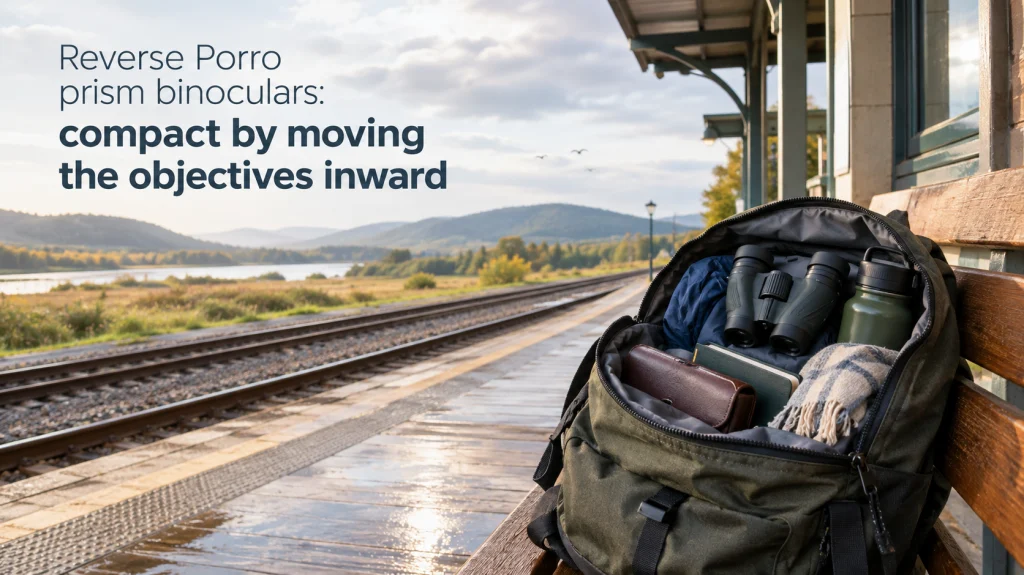
Reverse Porro prism binoculars keep the folded Porro optical path but move the objective lenses closer together than the eyepieces, which can make the body notably compact without giving it the straight barrel shape of a roof prism model. That geometry changes the silhouette and the packing problem, but it does not tell you whether a specific binocular will fit your eyes, give you enough field of view, or handle wet weather. The useful way to judge this subtype is to recognize the architecture first, then verify the exact model’s dimensions, eye relief, interpupillary range, field of view, weight, and sealing. A reverse Porro layout is a design choice, not a shortcut for judging optical quality or value.
The objective spacing gives away the architecture
Look at a Vortex Vanquish 8×26 from the objective end and the shape explains the idea before the label does. Reverse Porro prism binoculars place the front objective lenses closer together than the eyepieces, so the body narrows toward the front instead of spreading outward like a classic Porro. That visual cue matters because it tells you the compact shape is coming from the prism layout, not from a roof prism’s straight optical barrels. It is a useful first check when a compact binocular looks neither conventionally Porro shaped nor like a slim roof model.
The geometry should be the start of the decision, not the verdict. A compact body can solve a packing problem, but it does not automatically solve eye relief, grip, field of view, or weather protection. If the broader question is how this layout fits among the two major prism families, the guide to roof and Porro binocular designs provides the parent comparison without turning this page into a generic roof versus Porro article. For a wider look at the main configurations beyond this subtype, the overview of different types of binoculars is the better next step.

This 7x50 model uses a conventional Porro prism layout with 50 mm objective lenses. Amazon lists multi-coated optics and tripod-mount capability. Its full-size Porro body gives a useful visual contrast to the inward objective spacing discussed in this section.
Check on AmazonIf you click this link and buy, we earn a commission at no additional cost to you.
Reverse Porro keeps Porro prisms but changes where the objectives sit
A classic Porro binocular usually has objective lenses spaced farther apart than the eyepieces, creating the familiar stepped outward body. Reverse Porro turns that relationship inward, with the eyepieces sitting wider than the objectives. The optical path is still folded by Porro prisms, but the package is arranged around a different physical goal. That is why the subtype can look unusually compact even though it is not using roof prisms.
This distinction prevents a common buying mistake: treating every small binocular with an unusual barrel shape as the same architecture. A compact roof model may fold around a dual hinge, a reverse Porro may narrow toward the objectives, and another compact Porro may use a different mechanical arrangement entirely. The external silhouette can give you a clue, but model documentation is what should settle the classification when it matters. Do not infer prism type from size alone, and do not assume that every compact Porro is reverse Porro.

This 8x40 UpClose G2 uses a Porro prism design with 40 mm objective lenses. Amazon lists multi-coated optics, 12 mm eye relief, and an 8.2-degree field of view. It provides a conventional Porro reference point for comparing the objective and eyepiece spacing described here.
Check on AmazonIf you click this link and buy, we earn a commission at no additional cost to you.
Why inward objective spacing can make the body compact
Moving the objective lenses inward reduces the wide front stance associated with a conventional Porro body. That can produce a binocular that occupies less lateral space in a small case, jacket pocket, daypack compartment, or travel bag, depending on its hinge and overall dimensions. The benefit is practical because packed size is a three-dimensional problem, not a single objective diameter number. An 8×26 label tells you magnification and objective size, but it does not tell you how wide the body is when set to your interpupillary distance.
Compactness also needs to be checked against how the binocular actually folds and carries. A roof prism compact with a double hinge may collapse more narrowly than some reverse Porro bodies, while a reverse Porro can still feel simple and space-efficient because the objectives already sit close together. That means architecture creates a tendency, not a guaranteed winner on packed volume. Compare the listed height, width, thickness, weight, and folded shape of the exact models you are considering instead of assuming that the smaller objective lens always creates the smaller package.

The Papilio II 8.5x21 pairs 8.5x magnification with 21 mm objectives in a compact Porro-prism body. Amazon lists a 10.4-ounce weight and 15 mm eye relief. Its compact dimensions make it a concrete example for comparing how a folded Porro design can save packing space.
Check on AmazonIf you click this link and buy, we earn a commission at no additional cost to you.
Reverse Porro is not the same shape as a roof prism binocular
A roof prism binocular usually keeps each objective lens broadly in line with its eyepiece, which is why the two barrels can look straight from front to back. Reverse Porro does not share that alignment. Its eyepieces are spaced wider than the objectives, so the body still has an offset geometry even when the overall package is compact. That difference matters when you are judging how a binocular will fit in a case, how the barrels meet your hands, and how much room the body needs at your normal interpupillary setting.
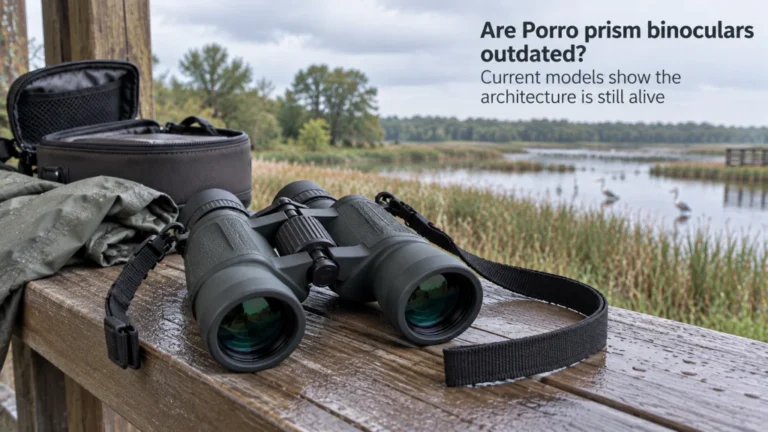
None of those shape cues should be turned into an automatic quality judgment. Roof and Porro systems can each appear in inexpensive or expensive products, and the finished viewing experience depends on far more than the prism family. If you are wondering whether conventional Porro designs have simply become obsolete, the discussion of whether Porro prism binoculars are outdated addresses that question directly. Here, the narrower task is identifying what reverse Porro changes physically so you can compare compact bodies on the right terms.
| Architecture cue | What it suggests | What it does not prove |
|---|---|---|
| Objectives wider than eyepieces | Classic Porro style spacing | Better image quality or better fit |
| Eyepieces wider than objectives | Reverse Porro style geometry when documentation confirms it | Smaller packed size than every roof compact |
| Objectives broadly aligned with eyepieces | Roof prism style body | Better waterproofing, durability, or value |
Use the body shape as a classification clue, then confirm the prism description on the manufacturer’s product page or manual. Record the model-specific dimensions at the interpupillary setting you expect to use, especially if the binocular must fit a small case or pocket. If case fit is tight, compare those measurements with the usable interior space rather than judging from product photos. That sequence makes the silhouette useful without turning it into a purchasing shortcut.

This H2O variant is an 8x25 roof-prism binocular, giving a straight-barrel compact to compare with reverse Porro geometry. Bushnell lists the model as waterproof and fogproof. Its roof layout makes the body-shape contrast in this section easy to examine with a real compact product.
Check on AmazonIf you click this link and buy, we earn a commission at no additional cost to you.
The classic Porro stereoscopic baseline changes when objective spacing narrows
One reason classic Porro binoculars are often associated with a pronounced sense of depth is that their objective lenses can sit farther apart than the observer’s eyes. Reverse Porro narrows that objective spacing instead of widening it, so you should not assume that it will reproduce the same spatial impression as a full-size classic Porro. That is a geometric consequence worth understanding, but it is not a promise that every reverse Porro will look flat or that every classic Porro will look dramatically three dimensional. Viewing distance, magnification, subject spacing, optical design, and the individual observer all affect what is perceived.
This is also an area where owner comments can become broader than the evidence supports. A person may report a flatter or stronger depth impression with one model, but that experience does not establish a universal performance rule for an entire prism subtype. For buying purposes, treat objective spacing as one architectural difference rather than a standalone image quality score. If depth rendering matters to you, compare the exact binoculars under the distances you actually observe instead of buying from a generalized claim about Porro geometry.

The Vanquish 10x26 uses a reverse Porro configuration with 26 mm objectives. Amazon lists 16 mm eye relief and a 294-foot field of view at 1,000 yards for this variant. That model-specific geometry and viewing data fit the section's point that objective spacing should not be treated as a universal depth score.
Check on AmazonIf you click this link and buy, we earn a commission at no additional cost to you.
Verify field of view, eye relief, IPD, dimensions, and waterproofing on the exact model
Once you recognize the architecture, the buying decision returns to ordinary fit and use variables. Field of view affects how easily you can find and follow moving subjects, eye relief matters when you need to see the full field with glasses, and interpupillary range determines whether the eyepieces can align with your eyes. Width and height tell you more about packed size than the word compact does, while weight determines whether the binocular really solves a carry problem. Waterproofing and fog protection also have to be verified from the exact product documentation rather than inferred from prism type.
These checks matter because two reverse Porro binoculars can share the same basic architecture and still behave very differently in use. A model with adequate eye relief for one glasses wearer may clip the field for another, and a narrow interpupillary minimum can rule out an otherwise appealing body shape. A wider field can matter more than a few ounces of weight if you mainly follow fast-moving subjects, while weather sealing can matter more than either if the binocular is routinely used outdoors in damp conditions. Architecture narrows the category, but the specification sheet still decides whether the individual model belongs on your shortlist.
- Check the listed field of view at the exact magnification you want.
- Verify eye relief with your normal eyeglasses if you wear them while viewing.
- Confirm the interpupillary range includes your comfortable setting.
- Compare actual width, height, thickness, and weight rather than relying on a compact label.
- Verify waterproofing and fog protection from the manufacturer documentation for that model.
If one of those specifications is missing, treat it as unknown rather than filling the gap with assumptions from a related model. Prioritize the measurements connected to your actual constraint: eye relief and IPD for glasses and facial fit, dimensions and weight for packing, and documented sealing for damp use. A promising body shape is not enough when one of those requirements is nonnegotiable. Drop the model from the shortlist when a critical specification fails the requirement or cannot be verified.

The Bantam HD 6.5x32 provides a separate compact model for checking specifications instead of inferring them from prism family. Its Amazon listing identifies waterproof and fogproof construction plus tripod adaptability. The 6.5x32 configuration gives readers a concrete model on which to verify fit, field, dimensions, and weather features individually.
Check on AmazonIf you click this link and buy, we earn a commission at no additional cost to you.
Vortex Vanquish shows an explicit reverse Porro example
Vortex explicitly describes the Vanquish 8×26 as a Reverse Porro Prism design and defines that layout as having eyepieces spaced wider apart than the objective lenses. That makes it a useful architecture example because the classification does not have to be guessed from photos. The same product documentation lists 15 mm of eye relief, a 352 foot field of view at 1,000 yards, a 57 to 71 mm interpupillary range, a 4.3 inch height, a 4.6 inch width, and a 12.7 ounce weight. Those numbers show why architecture and exact fit data need to be read together.
The model also illustrates the limit of subtype labels. Its reverse Porro geometry explains the inward objective spacing, but the geometry itself does not prove that 15 mm of eye relief will work for every glasses wearer or that its field of view suits every moving subject. Vortex separately documents waterproof and fogproof construction, so those features should be credited to the model rather than to reverse Porro design in general. Use the Vanquish as a clear example of the layout, not as a template for what every reverse Porro binocular must provide.
The Vanquish 8x26 is an explicit Vortex reverse Porro model with 26 mm objectives. Amazon lists 15 mm eye relief, a 352-foot field of view at 1,000 yards, and a 12.7-ounce weight. Waterproof construction is listed separately, reinforcing the section's point that sealing and fit are properties of the exact model.
Check on AmazonIf you click this link and buy, we earn a commission at no additional cost to you.
PENTAX Papilio shows why specialized features must stay model-specific
PENTAX Papilio is useful here for a different reason. RICOH documents the Papilio line as compact Porro-based binoculars with a minimum focusing distance of 0.5 m, including 6.5×21 and 8.5×21 configurations. That close focusing behavior is distinctive to the product design, not a feature you can safely transfer to every compact Porro or every reverse Porro. The same caution applies to eye relief, weather resistance, dimensions, and any other specification that varies by model or generation.
It is also important not to force a reverse Porro label onto a product unless reliable documentation supports that exact architecture. A compact Porro can demonstrate how manufacturers use folded optical paths to create specialized bodies without proving that every compact Porro shares the same objective and eyepiece spacing. This distinction keeps the subtype useful instead of turning it into a catchall category. When a model has a notable close focus system or another specialized feature, evaluate that feature on its own evidence and keep the architecture claim separate.

The Papilio II 6.5x21 is a compact Pentax Porro-prism binocular built for both close and distant viewing. Amazon documents 50 cm close-up focusing for the Papilio II line. That specialized focusing system is exactly the kind of model-specific feature this section says should not be generalized to every compact Porro.
Check on AmazonIf you click this link and buy, we earn a commission at no additional cost to you.
Return to compact binocular selection when packed size becomes the main decision
Reverse Porro is most useful as a filter when your real problem is carrying size rather than prism theory. If a binocular must fit a small bag, ride in a coat pocket, or stay light enough that you actually bring it, the inward objective spacing may earn a place on the shortlist. At that point, compare the reverse Porro body with compact roof alternatives using the dimensions and fit variables that matter to you. The architecture explains one path to compactness, but it does not remove the need to compare the finished packages.
That handoff also keeps this subtype page from swallowing every compact binocular decision. Questions such as 8x versus 10x, objective size tradeoffs, activity-specific use, and the smallest practical travel setup belong to broader compact selection rather than to reverse Porro geometry alone. Keep the decision sequence simple: identify the body architecture, verify the model-specific fit and weather features, then decide whether its actual packed size solves your carry constraint. If it does not, there is no reason to favor the subtype just because the optical path is interesting.

The PROSTAFF P3 8x30 is a compact roof-prism alternative with 8x magnification and 30 mm objectives. Nikon lists a 456-foot field of view at 1,000 yards and 15.4 mm eye relief. Its compact roof layout gives a practical comparison point when packed size becomes more important than prism architecture alone.
Check on AmazonIf you click this link and buy, we earn a commission at no additional cost to you.
Final Thoughts: reverse Porro is a compact architecture, not a quality grade
Reverse Porro binoculars are easiest to understand by looking at where the objectives sit. Bringing them inward can create a compact body while preserving a Porro prism optical path, but that geometry does not decide field of view, eye relief, weather protection, or overall value. Treat the layout as one design tool, then verify the exact binocular that interests you. A model belongs on your shortlist only when its real dimensions, fit, and viewing specifications match the way you plan to carry and use it.
The practical advantage is that you can now recognize what the architecture is trying to accomplish without giving it more credit than it deserves. If compactness is the constraint, compare actual packed dimensions and weight alongside eye relief, interpupillary range, and field of view. If those measurements do not work for you, the reverse Porro label does not rescue the model. Choose by the finished binocular and your viewing conditions, not by prism geometry alone.

This adjustable Vortex harness shifts binocular weight to the shoulders instead of the neck. Its flexible straps keep binoculars close to the body while still allowing them to slide up for viewing. It is a useful carry accessory for the section's emphasis on choosing the finished binocular around real carrying and viewing conditions.
Check on AmazonIf you click this link and buy, we earn a commission at no additional cost to you.
FAQs
🔭 What is a reverse Porro prism binocular?
It is a Porro prism binocular arranged with the eyepieces spaced wider apart than the objective lenses. That inward objective spacing can help produce a compact body, but exact size and fit still depend on the model.
🎒 Are reverse Porro binoculars always smaller than compact roof binoculars?
No. Reverse Porro geometry can reduce front end width, but a folding roof compact may pack just as small or smaller. Compare actual dimensions and the folded shape at your normal interpupillary setting.
👓 Are reverse Porro binoculars good for glasses?
Prism layout alone cannot answer that. Check the exact model’s eye relief and eyecup design, then confirm that you can see the full field while wearing your normal glasses.
🌧️ Are reverse Porro binoculars waterproof?
Some are and some are not. Waterproofing, sealing, and fog protection are model-specific features, so verify them in the manufacturer documentation instead of inferring them from the prism design.
📐 Do reverse Porro binoculars have less of a three-dimensional effect?
Their objectives are typically closer together than those of a classic Porro, so the objective spacing is different. Do not turn that geometry into a universal viewing claim, because perceived depth also depends on distance, magnification, the individual optical design, and the observer.
References and Sources
- Vortex Vanquish 8×26 product documentation: Confirms the Reverse Porro Prism classification, objective and eyepiece spacing description, dimensions, weight, field of view, eye relief, interpupillary range, and weather protection claims used in this article.
- RICOH Imaging PENTAX Papilio specifications: Confirms Papilio configurations, dimensions, eye relief, and minimum focusing distance used to separate model-specific features from general architecture claims.