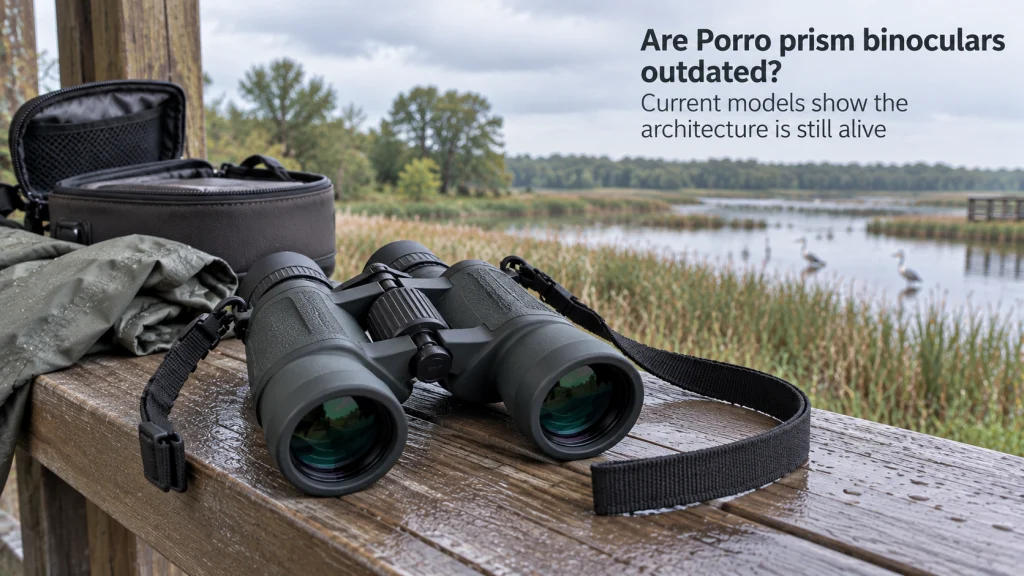
Porro prism binoculars are not obsolete simply because roof-prism models now occupy more of the premium and compact shelf space. Current manufacturer lineups still use the architecture in newly developed general-purpose models, waterproof designs, and specialized large binoculars. The practical question is not whether the prism layout looks old, but whether the finished binocular fits your carrying needs, viewing conditions, eye relief, field of view, handling, and support expectations. A current Porro can be a sensible design choice, while an old or poorly matched Porro can still be the wrong purchase.
A current Porro launch breaks the obsolete-technology assumption
Are Porro prism binoculars outdated? A useful way to answer that question is to look at what manufacturers are developing and selling now, not at whether the familiar offset shape looks old beside a straight-barrel roof prism. Nikon’s current ACTION family is a direct counterexample to the idea that Porro construction survives only as leftover inventory. Nikon describes ACTION as the successor to its ACULON A211 family and identifies it as a standard Porro-prism type in the company’s binocular lineup.
That matters because a new product family requires current optical, mechanical, ergonomic, and manufacturing decisions even when the underlying prism architecture is mature. Nikon lists newly developed optical systems, updated exterior designs, multilayer-coated lenses, long eye relief on most configurations, modern eyecup designs, and tripod compatibility across the family. None of those details proves that every ACTION configuration is better than a roof-prism alternative, and that is not the point. They show that an old optical layout can still be used inside a current consumer product rather than existing only as a historical artifact.
| Launch sequence | Manufacturer evidence | Why it matters |
|---|---|---|
| Previous mainstream family | ACULON A211 established Nikon’s general-purpose Porro line | Porro was already an active consumer architecture rather than a vintage-only format |
| Current successor family | Nikon positions ACTION as the successor and identifies it as a standard Porro-prism type | The company is still making current design and product-line decisions around Porro geometry |
| Buying implication | Current specifications, support, and configuration choices still need to be checked model by model | The launch proves relevance, not automatic superiority over a roof-prism alternative |
The launch evidence answers the relevance question, but it does not finish the buying decision. If you are comparing a current Porro with a current roof model, start with viewing and carrying requirements, then verify the specifications that affect you. The broader roof vs Porro binocular comparison owns that architecture-level decision, while the guide to binocular types puts both prism layouts in the wider set of binocular configurations. Those two questions are more useful than treating the silhouette as an age label.

This 10x50 model uses a traditional Porro prism layout with multi-coated optics and 50 mm objectives. The configuration is intended for wildlife and astronomy viewing. A soft carrying case is included for storage and transport.
Check on AmazonIf you click this link and buy, we earn a commission at no additional cost to you.
Mature optical architecture is not the same thing as a discontinued product category
A mature architecture can remain useful even when its basic geometry no longer changes dramatically. Porro prisms route the optical path through an offset body, and that physical arrangement is easy to recognize, but recognition is not evidence of obsolescence. A product category becomes more meaningfully obsolete when current support, manufacturing, replacement choices, or practical compatibility disappear. Current Porro families from established optics manufacturers do not fit that description.
The stronger test is whether the architecture can coexist with features buyers now expect. Kowa’s YF II family is a clear example because the company pairs traditional Porro geometry with waterproof construction, nitrogen filling, fully multicoated optical surfaces, modern eyecups, and a current warranty. That combination does not make Porro inherently waterproof, just as roof geometry alone does not guarantee sealing. It shows why prism type and finished-product feature set need to be evaluated separately.
| Question | What actually answers it | What does not answer it |
|---|---|---|
| Is the design still current? | Active manufacturer pages, current families, current support, and newly developed products | The body shape looking traditional |
| Is it weather-ready? | Exact-model sealing and waterproof specifications | Porro or roof labeling by itself |
| Will it suit eyeglasses? | Exact eye relief and eyecup design | Prism architecture alone |
| Will it be easy to carry? | Weight, width, dimensions, case fit, and your carry method | A general claim that one architecture is always portable |
That separation keeps one feature from becoming a verdict on the whole binocular. Prism layout can influence body geometry and optical design choices, while weather sealing, eye relief, field of view, focus behavior, and weight remain model-level facts. A current Porro can therefore be modern in construction without being ideal for every buyer. Treat architecture as one part of the design, then judge the rest of the product on evidence that applies to that exact model.

This 7x50 Porro binocular uses multi-coated optics and a 6.6-degree field of view. Its 50 mm objectives are designed to gather ample light for twilight and night-sky observation. The housing is water resistant and tripod adaptable, and a carrying case is included.
Check on AmazonIf you click this link and buy, we earn a commission at no additional cost to you.
Why roof prisms dominate many modern premium and portable product lines
Roof-prism binoculars have an obvious packaging advantage for buyers who want a narrower, straighter body that slips more easily into a harness, case, daypack, or one-handed carry position. That geometry works especially well in product lines built around compactness, low bulk, and weather-ready field use. Premium brands can also invest heavily in coatings, mechanical precision, focusing systems, armor, and sealing around that format. The result is a modern shelf where roof models often look like the default choice even though that does not make Porro optics technically obsolete.
This is where market fashion and user preference can be mistaken for an engineering verdict. A buyer who hikes for hours may reasonably value the slimmer form of a roof model more than the wider stance of a conventional Porro. Another buyer who mostly observes from a porch, window, fixed viewpoint, or tripod may care less about pack width and more about field of view, handling, or price. Neither use case proves that one prism architecture has replaced the other in every practical sense.
It is also worth separating roof-prism subtypes from the broader Porro question. Schmidt-Pechan and Abbe-Koenig are both roof architectures, and they involve their own design trade-offs inside the roof category. If that is the decision you are actually making, the Schmidt-Pechan vs Abbe-Koenig comparison is the relevant next step. Mixing that issue into a Porro relevance check makes the buying decision less clear, not more complete.

This 8x42 roof-prism binocular pairs a straight-barrel layout with a 7.4-degree field of view and 17.5 mm of eye relief. Its BaK-4 prisms are phase coated, and the optical system is fully multi-coated. Waterproof construction and nitrogen purging make it a current all-weather roof model.
Check on AmazonIf you click this link and buy, we earn a commission at no additional cost to you.
Check the architecture trade-offs before comparing finished products
Current product evidence is useful because manufacturers apply Porro geometry to very different jobs. Nikon uses it in a broad general-purpose family, Kowa pairs it with compact 30 mm-class waterproof models, and Nikon also keeps the architecture in a specialized large binocular. Those examples are not interchangeable shopping choices. Together, they show that Porro remains a live design option across more than one product role.
For an actual purchase, the next filters are practical: dimensions, weight, field of view, eye relief, close focus, sealing, focus system, and support. Glasses can make usable eye relief decisive, long carries can make bulk decisive, and wet use can make verified waterproofing decisive. Those constraints can eliminate an otherwise appealing model before prism preference matters. The point of the current examples is to establish relevance, then hand the decision back to fit and use.
| Current Porro evidence | Modern feature evidence | What the evidence establishes |
|---|---|---|
| Nikon ACTION | Current successor family, updated optical design, multilayer-coated lenses, modern eyecups, and tripod compatibility across the family | Porro remains part of active general-purpose product development |
| Kowa YF II | Waterproof construction, nitrogen filling, multicoated optics, adjustable eyecups, and current warranty coverage | Traditional Porro geometry can coexist with features buyers associate with current field binoculars |
Read that evidence narrowly. It does not show that all Porros share those features, and it does not show that either family is a better purchase than every roof model. It shows that the architecture itself is compatible with current product development and modern construction choices. The remaining decision still belongs to the exact configuration and your use conditions.
Nikon ACTION shows active Porro product development
Nikon’s ACTION family is useful evidence because the company presents it as a current successor family rather than an old model left quietly in a catalog. The official material identifies Porro prisms and describes updated optics, handling, eyecups, and multiple configurations within the line. That is stronger evidence of continued product relevance than the visual impression that the offset body belongs to another era. It still does not mean ACTION should be the automatic choice for a buyer who prioritizes compactness, waterproofing, or another model-specific feature.
Kowa YF II shows traditional Porro geometry can coexist with modern waterproof construction
Kowa’s YF II family makes a different point. Its official specifications combine Porro prisms with waterproofing, nitrogen filling, multicoated optics, eyecup adjustment, and current warranty coverage. That undercuts the shortcut that an offset body automatically means an old feature set. The right conclusion is narrower: modern construction features must be checked on the exact binocular instead of inferred from prism geometry.
Specialized Porros also survive outside the entry-level market
Nikon’s Astroluxe 18×70 is a useful specialized counterexample to the idea that current Porros exist only because they are cheap. Nikon lists it as a Porro design with a wide apparent field, multilayer coatings, long eye relief, waterproof and fogproof construction, and tripod compatibility. Its large size and high magnification also make clear why specialized Porros should not be turned into general buying recommendations. The evidence shows continuing use of the architecture, not a universal argument for carrying a large Porro everywhere.

The SkyMaster 15x70 pairs 15x magnification with 70 mm objectives for long-range and night-sky viewing. Its optical system uses BaK-4 prisms with multi-coated optics. The package includes a tripod adapter and carrying case for steadier extended viewing.
Check on AmazonIf you click this link and buy, we earn a commission at no additional cost to you.

This 10x50 Porro binocular uses BK7 prisms and Bushnell InstaFocus for quick center focusing. Fold-down eyecups and a non-slip grip support straightforward handheld operation. It combines 10x magnification with 50 mm objective lenses in a full-size format.
Check on AmazonIf you click this link and buy, we earn a commission at no additional cost to you.
Market availability matters because fewer choices can affect fit, features, and support
Even when an architecture remains technically relevant, a narrower product selection changes the shopping process. Fewer current choices can make it harder to match an unusual interpupillary distance, a particular eye-relief requirement, a preferred focus feel, a strict weight limit, or a compact storage space. It can also reduce the number of directly comparable models at the same price and objective size. That is a real disadvantage for some buyers, and it is more useful to say so than to pretend architecture alone settles the decision.
Support and replacement availability deserve the same attention. A current model with a live product page, current manual, warranty path, and available accessories is easier to evaluate than an old model whose documentation is scattered or whose parts support is uncertain. If you plan to keep binoculars for years, current support can matter more than whether the design itself has existed for generations. That is one reason current product status should be checked separately from optical architecture.
Compactness can also become a practical filter before optical comparison even begins. A conventional Porro body may be wider than a similarly specified roof model, which can affect case fit, chest-harness access, and how comfortably it rides against the body. Reverse-Porro designs take the offset concept in a different direction and can be much more compact, so they should not be lumped together with every full-size Porro. The reverse-Porro binocular guide covers that separate geometry without turning this relevance check into a compact-binocular article.

This hard EVA binocular case has a water-resistant exterior, a carry handle, and an adjustable shoulder strap. Its 7x7x2.5-inch interior is intended for many compact and mid-size binoculars, including common 8x42-class models. An interior mesh pocket and securing strap organize small accessories and help limit movement during transport.
Check on AmazonIf you click this link and buy, we earn a commission at no additional cost to you.
Vintage Porro buying adds condition risk beyond the architecture question
Older Porro binoculars create a different problem because age introduces condition variables that are not inherent to the prism layout. Haze, fungus, damaged coatings, stiff focus mechanisms, worn eyecups, internal contamination, impact damage, or alignment problems can turn a historically respected binocular into a poor user experience. A vintage model may also have shorter eye relief or less convenient accessories than a current buyer expects. None of those issues proves Porro architecture is obsolete, but they can make a particular old binocular a risky purchase.
This is also why a vintage comparison should not be used to judge current Porro products. A current waterproof model with active support should be evaluated on its own specifications and condition, not on assumptions formed from an inherited binocular that has spent decades in a closet. If an older binocular shows severe double images, internal damage, water ingress, or a loose optical assembly, do not treat that as a normal characteristic of Porro viewing. Internal alignment and prism repair belong with qualified service rather than owner-level adjustment.

This LensPen combines a retractable dust brush with a dry cleaning tip for optical surfaces. It is designed for binoculars, telescopes, cameras, and other coated optics without requiring liquid cleaner. Its compact pocket-size format makes it easy to keep with binocular gear for routine exterior lens maintenance.
Check on AmazonIf you click this link and buy, we earn a commission at no additional cost to you.
Return to roof vs Porro when the question becomes which architecture fits the purchase
Once current product evidence settles the obsolescence question, move on. The practical choice is whether the wider Porro body works with your hands and carry system, and whether a candidate meets your viewing requirements. Buyers who prioritize compact carry may find more roof options that fit, while buyers who tolerate more width can keep current Porros in the comparison. That is a normal trade-off, not a penalty for choosing an older architecture.
I would use the prism label to narrow the comparison, then verify the details that can actually disqualify a model. Check dimensions against your case or harness, confirm usable eye relief if you wear glasses, and compare field of view, weight, sealing, and support against alternatives for the same job. If a roof model fits those constraints better, choose it for that reason. If a current Porro fits better, its traditional shape does not need defending.

This 8x42 roof binocular uses BaK-4 prisms with multi-coated optics in a rubber-armored body. It is waterproof and nitrogen purged for fog-resistant outdoor use. The model provides 18 mm of eye relief and includes a carrying case and lens cloth.
Check on AmazonIf you click this link and buy, we earn a commission at no additional cost to you.
Final Thoughts: judge a current Porro by the current product, not the silhouette’s age
Porro prism binoculars are a mature architecture, but mature is not the same as obsolete. Current manufacturer families show that the design is still being used with updated optics, modern eyecups, waterproof construction in some models, current warranties, and specialized configurations. The architecture survives because it can still serve real design goals, even though roof prisms dominate many compact and premium product lines. That is a more precise conclusion than calling one shape modern and the other old.
If you are considering a Porro, ignore nostalgia and ignore stigma. Check whether the exact binocular fits your hands, eyes, carry method, weather exposure, viewing distance, and support expectations, then compare it with current alternatives. If a roof model solves those constraints better, choose the roof for those reasons. If a current Porro fits them better, its traditional outline is not a reason to reject it.

This 8x40 model uses a traditional Porro prism design with multi-coated optics and 40 mm objectives. Its 8.2-degree field of view supports broad nature and wildlife viewing. The water-resistant body and center-focus design provide specific model-level features for everyday outdoor observation.
Check on AmazonIf you click this link and buy, we earn a commission at no additional cost to you.
FAQs
🔭 Are Porro binoculars outdated?
No. Current manufacturers still sell and develop Porro-prism binoculars, so the architecture is better described as mature than obsolete. Judge a specific model by its current specifications, support, fit, and intended use.
🎒 Why are roof-prism binoculars more common in premium portable lines?
The straight-barrel roof format is well suited to narrower bodies and compact carrying. Premium product lines can combine that geometry with advanced coatings, sealing, armor, and mechanical design, which makes roof models especially common when portability is a major requirement.
🌧️ Can modern Porro binoculars be waterproof?
Yes, some current Porro models are explicitly sold as waterproof, but do not assume that from prism type alone. Verify the exact model’s sealing and waterproof specification before using it in wet conditions.
👓 Are Porro binoculars good for people who wear glasses?
They can be, but eye relief and eyecup design matter more than the prism label. Check the exact eye-relief specification and make sure you can see the full field comfortably with your glasses on.
💰 Are Porro binoculars always cheaper than roof binoculars?
No. Price varies with optics, mechanical quality, size, sealing, brand, and specialization. Compare finished products that meet the same requirement instead of assuming prism type determines price.
🧭 Should I buy a vintage Porro instead of a current model?
Only if you are comfortable evaluating condition as well as specifications. Older binoculars can add risks such as haze, damaged coatings, stiff mechanisms, or alignment problems that are separate from the Porro architecture itself.
References and Sources
- Nikon ACTION announcement: Confirms the current ACTION and ACTION ZOOM family, its Porro-prism positioning, and the updated optical and ergonomic design.
- Nikon ACTION family: Confirms the current family remains an active Porro-prism product line.
- Kowa YF II family: Confirms current Porro geometry with waterproof construction, nitrogen filling, multicoated optics, and current product support.
- Nikon Astroluxe 18×70: Confirms a current specialized Porro model with multilayer coatings, long eye relief, waterproof and fogproof construction, and tripod compatibility.