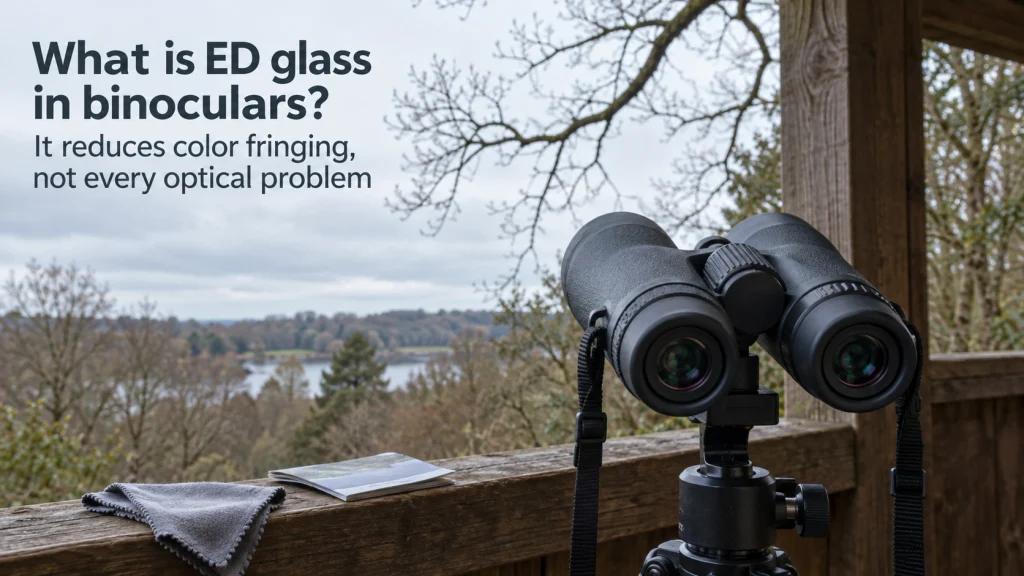
ED glass in binoculars is primarily a tool for reducing chromatic aberration, the purple or green color fringing that can appear around high-contrast edges. That correction can matter when the defect is visible, but the ED label alone does not prove that a binocular is brighter, sharper across the whole field, or better built. A useful buying decision starts by identifying the optical problem, then checking how the complete optical system handles it. The rest of the specification sheet still matters, including coatings, prism treatment, field behavior, eye relief, weight, and physical fit.
Color fringing is the problem, ED is one tool
Picture a pale branch against a bright sky and a thin purple or green edge appearing where the branch should end cleanly. That is the kind of defect that makes ED glass relevant, because extra-low-dispersion glass gives an optical designer another way to control chromatic aberration. It does not automatically settle the larger question of optical quality in binoculars, because a binocular is a system rather than one lens material. If the fringe is not the problem you are trying to solve, the ED badge may be less important than another specification.
This is also why reading binocular specifications works better when each feature is tied to a visible or practical problem. ED tells you something specific about dispersion control, not everything about the finished view. A buyer comparing two otherwise plausible binoculars should first ask whether color fringing is likely to interfere with the subjects and contrast conditions that matter to them. Only then does the label become useful evidence instead of a shortcut for ranking the whole binocular.

ED glass is paired with phase- and dielectric-coated BaK-4 prisms to support sharp detail and chromatic correction. Fully broadband multi-coated optics add a separate transmission-related treatment to the optical system. The 10x42 configuration is built around a magnesium alloy body.
Check on AmazonIf you click this link and buy, we earn a commission at no additional cost to you.
What ED means on a binocular specification sheet
ED stands for extra-low dispersion, a description of optical glass with dispersion behavior intended to help control how different wavelengths are focused. Nikon describes ED glass as an optical material that can reduce residual chromatic aberration when it is combined with other glass types in an objective design. The important phrase is combined with other glass, because the ED element does not work in isolation. Lens curvature, mating elements, spacing, manufacturing tolerances, coatings, and the rest of the optical path still affect the finished image.
On a specification sheet, then, ED is best treated as evidence that the designer has a dispersion-control tool available. It is not a standardized score for the entire binocular, and it does not tell you how much residual color fringing remains in every part of the field. It also does not reveal the exact glass formulation unless the manufacturer supplies more detail. The practical reading is narrow but useful: the objective design includes a material intended to improve chromatic aberration correction.

The Monarch M5 8x42 uses ED glass optics to address chromatic aberration within the optical system. Its dielectric prism coating is a separate optical treatment from the ED glass itself. Nikon lists the binocular as waterproof and fogproof for outdoor viewing.
Check on AmazonIf you click this link and buy, we earn a commission at no additional cost to you.
Why different wavelengths create visible color fringes
Visible light contains different wavelengths, and ordinary optical materials do not bend every wavelength by exactly the same amount. If those colors do not come to the same focus, the image can show chromatic aberration rather than one clean boundary. In binocular use, one of the easiest forms to recognize is visible color fringing around a strongly contrasted edge, such as a dark trunk against bright sky or a pale sign against deep shade. The defect can make a boundary look less clean even when focus is otherwise correctly adjusted.
Conventional objective designs already use more than one glass type to bring wavelengths closer together, so the choice is not simply correction versus no correction. ED material gives the designer different dispersion properties that can reduce residual color error further. That is why an explanation of binoculars with extra-low-dispersion glass should start with wavelength control rather than with vague promises of a better view. The useful question is how well the complete design suppresses the color error that remains after ordinary correction.

The upgraded SV202 8x42 uses an extra-low dispersion objective lens as part of its optical design. Its BAK4 prism and fully multi-coated system add separate optical components beyond the ED element. The listing specifies a viewing angle over 8 degrees and IPX7 waterproof and fogproof construction.
Check on AmazonIf you click this link and buy, we earn a commission at no additional cost to you.
Group the specification checks that change the decision
ED matters most when the scene makes chromatic aberration easy to expose, but the specification should still be read beside the viewing conditions. High contrast, fine edges, brighter backgrounds, and demanding detail can make color errors easier to notice than a flat, low-contrast scene. Magnification can also make optical defects more obvious because the binocular enlarges the image along with its imperfections. That does not mean a particular magnification requires ED, only that the tolerance for residual aberration may become more important as demands increase.
The second check is whether the rest of the binocular matches the job you actually have. Field of view, eye relief, focus behavior, weight, grip, and physical fit can decide whether an optically ambitious design is pleasant to use. A binocular that reduces color fringing but does not fit your eyes or is burdensome to carry has not solved the whole buying problem. ED should therefore stay inside a group of checks rather than becoming a single yes-or-no filter.
The high-contrast situations where chromatic aberration becomes easiest to notice
Color fringing is easiest to judge on edges where brightness changes abruptly. A leafless branch against a bright overcast sky, a dark roofline against pale cloud, or a white bird beside deep shadow can reveal a colored rim that is much harder to see in an evenly lit scene. The point is not to hunt for defects under every possible condition, but to recognize the kind of contrast that stresses color correction. If your normal viewing rarely produces those edges, another feature may affect daily use more strongly.
What extra-low-dispersion glass changes in the objective design
ED material gives the designer a glass with dispersion characteristics that differ from more conventional optical glass. Used with complementary elements, it can bring different wavelengths closer to a common focus and reduce residual chromatic aberration. The result can be cleaner high-contrast boundaries when the rest of the design and execution support that goal. The material is therefore an enabling component, not a guarantee that every ED-labeled objective reaches the same level of correction.
Why ED does not directly increase magnification or guarantee brightness
ED glass does not change the magnification printed on the binocular, and the ED label is not itself a light-transmission specification. Nikon separates chromatic-aberration correction from multilayer coatings that are used to improve transmission through optical surfaces, which is a useful distinction when reading feature lists. A cleaner edge can make detail look more distinct, but that should not be confused with proof that more light is reaching the eye. If the question is how bright the image appears at the eye, objective size, magnification, exit pupil, ambient light, and the viewer’s pupil all matter. If the question is optical transmission, coatings, glass-to-air surfaces, prism design and treatment, and measured or documented transmission deserve separate checks.

The Midas G2 UHD 8x42 uses ED glass within its optical system and adds ESP dielectric coating as a separate treatment. A magnesium chassis reduces structural weight while the XPL lens coating is intended to resist scratches and dirt buildup. The listing positions the binocular for birdwatching, hunting, stargazing, and travel.
Check on AmazonIf you click this link and buy, we earn a commission at no additional cost to you.
Why one ED label does not describe glass grade, optical design or execution
The letters ED do not function like a universal performance grade. Kowa notes that there is wide variation among ED formulations and no single universal standard that every product must meet simply to use the designation. That means two binoculars can both advertise ED while differing in glass formulation, lens design, coatings, manufacturing control, and correction across the field. The label is meaningful as a design clue, but it is too broad to rank finished binoculars by itself.
This is where cautious interpretation prevents a common buying mistake. A feature list can confirm that ED material is present, yet it usually cannot tell you how well the complete objective has been optimized or how consistently it has been manufactured. It also cannot substitute for fit checks such as eye relief, interpupillary range, eyecup behavior, and handling. I would treat ED as evidence that the designer has an additional correction tool, then keep evaluating the rest of the binocular instead of stopping at the badge.

The Engage 8x42 pairs ED Prime glass with fully multi-coated optics rather than relying on the glass element alone. Dielectric prism coating and ultra wide-band coating add separate treatments for the prism and transmission path. A magnesium chassis and EXO Barrier lens coating add mechanical and surface-protection features beyond the objective glass.
Check on AmazonIf you click this link and buy, we earn a commission at no additional cost to you.
HD and XD naming can be brand language rather than a universal material grade
HD, XD, ED, and similar abbreviations do not form one cross-brand grading ladder that you can safely read from low to high. Kowa specifically notes that ED-type optics may be described with labels such as HD or XD, while manufacturers can use those terms differently within their own product language. A name that sounds more advanced therefore does not prove a particular glass chemistry or correction level. The safest approach is to read the manufacturer explanation for the exact binocular instead of translating the acronym on your own.
This also keeps marketing language from replacing optical evidence. If a page says HD but does not explain whether that means an extra-low-dispersion element, a broader optical package, or simply a product-family name, leave the material claim unresolved. If it does document ED or another specific material, you still need to judge what problem that feature is intended to correct. The acronym can guide the next question, but it should not be the verdict.

The BX-4 Pro Guide HD is model 172666 in the 10x42 Shadow Gray configuration. It uses high-definition calcium-fluoride lenses and BAK4 prisms as documented optical components. The open-bridge dual-hinge design is listed as lightweight and ergonomic, with waterproof and fogproof construction.
Check on AmazonIf you click this link and buy, we earn a commission at no additional cost to you.
When a well-designed non-ED binocular can still be the better optical system
A non-ED binocular is not automatically poor at controlling color, because chromatic aberration depends on the entire objective design rather than one label. Conventional glass combinations can correct chromatic aberration to a useful degree, and some designs may keep residual color low enough for the intended magnification and field. At the same time, a binocular carrying an ED badge can still disappoint if other parts of the optical or mechanical system are weak. That means the useful comparison is not label versus no label, but residual color control versus the rest of the system’s strengths and weaknesses.
The comparison becomes even more practical when fit and use duration enter the picture. A binocular with comfortable eye relief, a usable field of view, predictable focus, and manageable weight may be the stronger choice if its residual color fringing is not objectionable in the scenes you actually view. Conversely, a buyer who repeatedly notices strong colored edges on high-contrast subjects has a clearer reason to prioritize better chromatic correction. The better optical system is the one that solves the visible problem without creating a larger usability problem elsewhere.

The Crossfire HD uses a 10x42 configuration and select glass elements intended to reduce chromatic aberration. Its optical system is also described for resolution, color fidelity, edge-to-edge sharpness, and light transmission. The listing identifies the binocular as tripod adaptable, waterproof, fogproof, and supplied with a GlassPak harness.
Check on AmazonIf you click this link and buy, we earn a commission at no additional cost to you.
When the decision is really about another optical feature
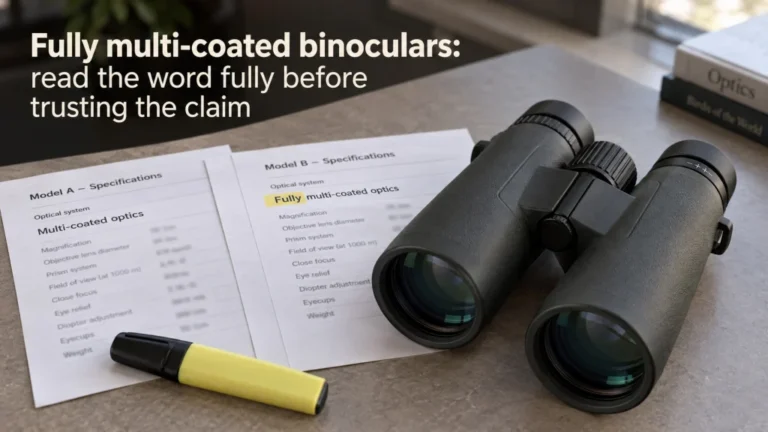
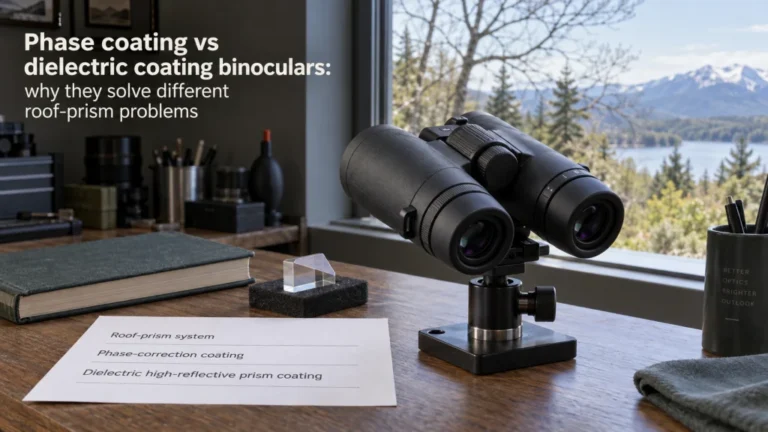
Sometimes the comparison looks like ED versus non-ED when the real difference lies elsewhere. If one view loses contrast to reflections or seems dimmer because of transmission losses, the more relevant questions may concern fully multi-coated binocular optics rather than dispersion. On a roof-prism design, phase correction and dielectric prism coatings solve different problems from ED glass. Keeping those functions separate prevents one attractive specification from receiving credit for every improvement in the view.
Edge sharpness is another example because field curvature and off-axis behavior are not the same problem as chromatic aberration. A design using a field flattener in binoculars is addressing how focus behaves across the field, not simply whether wavelengths converge together. Low-light performance also depends on more than an ED element, while price by itself proves none of these corrections. When the complaint is not color fringing, follow the symptom to the feature that actually addresses it.

The Diamondback HD uses an 8x42 configuration and select glass elements intended to reduce chromatic aberration. Its optical system is described for resolution, color fidelity, sharpness, and light transmission. The listing identifies the binocular as tripod adaptable, waterproof, fogproof, and supplied with a GlassPak harness.
Check on AmazonIf you click this link and buy, we earn a commission at no additional cost to you.
A pre-purchase ED check that starts with the optical problem, not the badge
Before paying extra for ED, write down what you are trying to improve in the view. If the issue is a purple or green fringe on high-contrast edges, better chromatic correction belongs near the top of the comparison. If the issue is narrow field of view, short eye relief, awkward focus, excess weight, or poor transmission, ED does not directly answer it. This simple separation keeps the shopping process tied to evidence rather than feature count.
Then verify what the exact specification actually says and what it leaves unknown. Look for a manufacturer explanation of the objective material, keep brightness claims separate from chromatic correction, and compare the physical specifications that determine whether the binocular fits you. If two candidates both meet those needs, ED can become a useful tiebreaker when color fringing is a real concern. If one candidate fits substantially better and already controls color well enough, the non-ED option may still be the more rational system.
| What you notice or need | What to verify | What the ED label tells you |
|---|---|---|
| Purple or green edges on strong contrast | Documented ED element or other chromatic correction, plus the complete optical design | The designer is using a material intended to reduce dispersion and color fringing |
| View seems dim or loses contrast | Coatings, prism treatment, objective size, exit pupil, and any documented transmission information | Not enough by itself to prove higher light transmission |
| Edges soften while the center remains focused | Field behavior, field-flattener design, and independent evidence if available | Does not directly describe field curvature correction |
| Glasses cut off part of the view | Eye relief, eyecup design, and fit with your glasses | Nothing about eye relief or eyecup fit |
| Binocular feels tiring or unstable | Weight, balance, grip, magnification, and intended viewing duration | Nothing about handling or stability |
Use the table as a sorting tool rather than a scorecard. The goal is to connect each complaint to the specification or evidence that can actually explain it. A short checklist helps keep the same logic when product pages use different terminology. The more clearly you define the problem, the less likely one optical acronym is to dominate the whole decision.
- Identify whether color fringing is visible in the kinds of high-contrast scenes you care about.
- Verify whether the manufacturer documents ED or another specific chromatic-correction approach.
- Keep transmission, coatings, prism treatment, and field behavior as separate checks.
- Confirm eye relief, field of view, weight, grip, and fit before treating optical materials as the final decision.
- Prefer the complete system that solves your actual problem over the longer feature list.
If you can compare binoculars in person, use a repeatable scene rather than a casual glance around the store. Focus carefully, view the same high-contrast edge, set the eyecups correctly, and make sure interpupillary distance is adjusted before judging color error. Do not turn one quick impression into a universal claim about all ED or all non-ED designs. The check is valuable because it connects the specification to the optical symptom the specification is supposed to address.

The Celestron 93524 adapter mounts compatible roof- or Porro-prism binoculars to a tripod for steadier hands-free viewing. Its standard 1/4-20 thread fits ordinary photo-tripod interfaces. The durable metal construction provides a fixed support point for repeatable optical comparisons.
Check on AmazonIf you click this link and buy, we earn a commission at no additional cost to you.
Final Thoughts: pay for the correction you can justify
ED glass has a real optical job: helping reduce chromatic aberration and the color fringing that can come with it. That job is specific enough to be useful, but too specific to stand in for total optical quality. Treat the label as one piece of evidence about objective design, then verify the rest of the binocular around your own viewing conditions and fit requirements. A badge becomes valuable only when it addresses a problem you can identify.
If color fringing is the weakness you keep seeing, better dispersion control is a sensible thing to prioritize. If the real limitation is field of view, eye relief, transmission, edge focus, weight, or handling, solve that problem instead. A well-chosen binocular does not need to win every specification category, and it does not need the longest list of acronyms. It needs to correct the weaknesses that matter while remaining comfortable and practical enough to use.

The TrailSeeker ED 8x32 uses extra-low-dispersion objective lenses in a compact configuration. Phase- and dielectric-coated BaK-4 prisms add separate prism treatments, while the optics are fully broadband multi-coated. The listing describes a lightweight 8x32 form factor built around a magnesium alloy body.
Check on AmazonIf you click this link and buy, we earn a commission at no additional cost to you.
FAQs
🔭 What does ED mean in binoculars?
ED means extra-low dispersion. It describes optical glass used as part of a lens design to help reduce chromatic aberration, especially visible color fringing around high-contrast edges.
🌈 Does ED glass eliminate chromatic aberration?
No. ED glass can reduce chromatic aberration substantially, but the remaining correction depends on the full objective design, glass combination, manufacturing, and viewing conditions. Treat ED as a correction tool rather than a promise of zero color error.
💡 Does ED glass make binoculars brighter?
Not directly. Apparent brightness at the eye is influenced by factors such as exit pupil, ambient light, and the viewer’s pupil, while optical transmission is a separate property influenced by coatings, glass-to-air surfaces, prism design, and other losses in the optical path. The ED designation itself does not quantify either one.
👀 Are ED glass binoculars worth it?
They can be worth paying for when color fringing is a visible problem in the scenes you regularly observe. If another limitation matters more, such as eye relief, field of view, weight, or handling, fixing that issue may produce a larger practical improvement.
🏷️ Are HD and ED binoculars the same thing?
Not necessarily. HD can be a brand or product-family term, while some manufacturers use it alongside or in place of language about special dispersion glass. Check the exact manufacturer’s documentation instead of assuming the acronym identifies a universal material grade.
🌲 Can a non-ED binocular have good image quality?
Yes. Conventional optical designs can control chromatic aberration well enough for many uses, and overall image quality also depends on coatings, prisms, field behavior, focus, mechanical execution, and fit. Compare the complete binocular rather than judging only the presence or absence of ED.
References and Sources
- Kowa optical glass explainer: Supports the limits of the ED label, the lack of one universal ED standard, and the role of dispersion control in reducing color fringing.
- Nikon chromatic aberration guide: Explains how different wavelengths focus differently and how ED glass can reduce residual chromatic aberration.
- Nikon binocular technology glossary: Separates the role of ED glass in chromatic-aberration correction from multilayer coatings used to improve light transmission.