Two binoculars can share the same 8×42 label and still deliver noticeably different color control, contrast, glare resistance, and edge behavior. The optical quality of binoculars comes from how the whole optical train handles several separate image problems, not from one premium term on the box. ED glass, anti-reflection coatings, roof-prism coatings, prism-glass labels, and field-flattener claims each provide a different piece of evidence. A useful comparison therefore asks what problem each feature addresses, what the specification sheet still cannot prove, and which difference matters for the viewing conditions you actually expect.
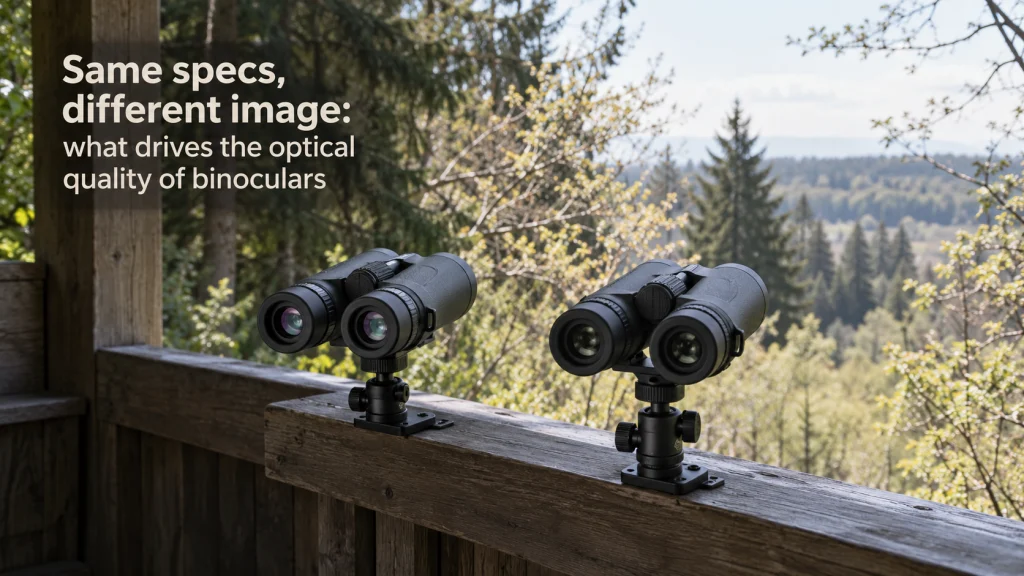
The same 8×42 label can hide a very different view
Imagine comparing two current 8×42 binoculars on paper. Magnification matches, objective diameter matches, and both may even list roof prisms and multiple optical coatings. Those headline numbers tell you the basic configuration, but they do not tell you how well either instrument controls color fringing around a backlit branch, preserves contrast when stray light enters the system, or keeps detail recognizable away from the center. That is why binocular optical quality is better judged as a set of image-performance questions than as a single specification.
I would start by separating those questions before comparing feature lists. If one model advertises ED glass and another highlights dielectric prism coating, the labels are not competing answers to the same problem. One is mainly evidence about dispersion and color control, while the other concerns reflectivity at a particular prism surface in relevant roof-prism designs. Once each feature is tied to the image failure it is meant to address, the spec sheet becomes much more useful and much less persuasive as marketing shorthand.
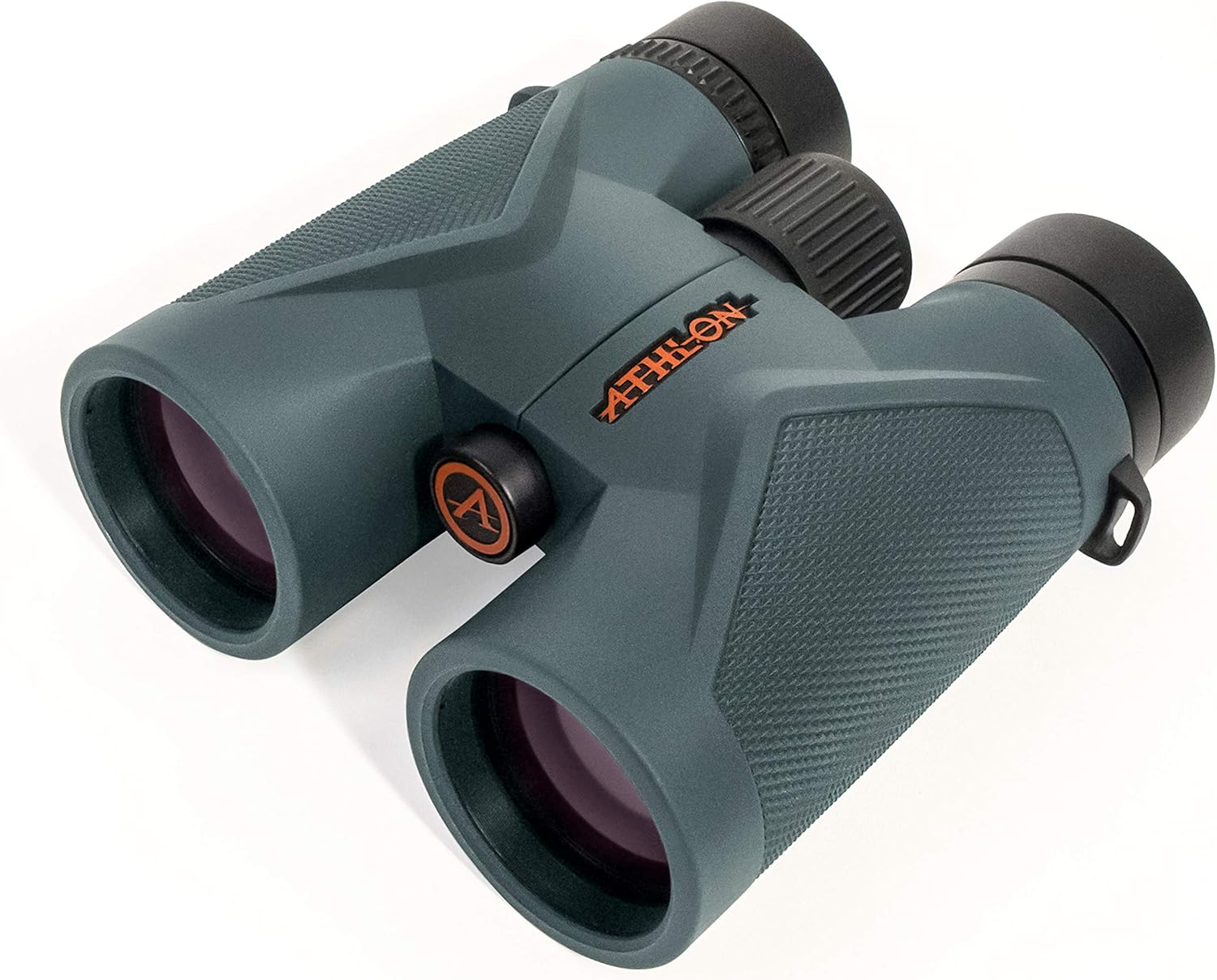
This 8x42 Midas UHD model uses ED glass in a waterproof, fogproof body. Its documented feature set shows why two binoculars with the same 8x42 headline can differ in the optical tools they use. Compare each feature by the image problem it addresses rather than treating one premium label as a complete quality verdict.
Check on AmazonIf you click this link and buy, we earn a commission at no additional cost to you.
Define a good binocular by the image failures it controls
A clear center is only one part of a useful view. A binocular can resolve fine detail near the middle yet show distracting color fringes along high-contrast edges, flare when bright light sits near the field, or soften enough toward the perimeter that scanning becomes less comfortable. Another model may control those weaknesses differently even if its basic configuration looks identical on a shopping page. The practical question is not how many premium labels appear in the description, but which visible problems the optical design is built to reduce.
This is also why one impressive feature should not be allowed to stand in for the finished system. Lens coatings affect reflections at air-to-glass surfaces, roof-prism phase correction addresses a phase problem created by the roof geometry, dielectric mirror coatings improve reflectivity on a prism surface that needs a reflective coating, and field flattening addresses curvature toward the edge. None of those claims alone establishes polish quality, alignment, focusing precision, or how consistently a production sample meets the intended design. Treat each claim as evidence with a limited job, then look for the rest of the evidence.
Quality-label limit: A feature name should earn confidence only for the optical problem it is documented to address. It should not be promoted into a verdict about unrelated parts of the image. A model with one sophisticated feature can still leave other important questions unanswered. The comparison becomes stronger when every label is matched to a specific function and every missing fact stays marked as unknown.
That limitation is useful rather than frustrating because it keeps unlike claims from being ranked against one another. It also makes vague marketing language easier to spot. If a label cannot be connected to an image problem, a documented optical function, or a meaningful ownership decision, it should carry less weight in the comparison. With that filter in place, a routing map becomes a practical way to organize the evidence.
| Image question | Useful evidence | What that evidence does not prove by itself |
|---|---|---|
| Are high-contrast edges well controlled for color fringing? | ED or other dispersion-control design details | Overall contrast, edge sharpness, alignment, or mechanical quality |
| Are reflections and flare reduced through the lens system? | Coating type and coverage across optical surfaces | Exact total transmission or glare performance in every lighting angle |
| Does a roof prism preserve contrast and resolution well? | Phase-correction coating plus appropriate reflective treatment where required | Quality of the entire objective, eyepiece, focusing system, or assembly |
| Does detail remain useful near the edge? | Field-flattener claim or documented edge-correction design | A perfectly sharp edge under every condition or a distortion-free view |
Use the table as a routing map rather than a scorecard. A feature earns weight only when it addresses a problem you care about. The manufacturer should also describe enough of the implementation to make the claim meaningful. Then inspect the optical train in the order the image itself gives you clues.

This Nature DX uses an 8x42 configuration with phase-coated BaK-4 prisms and fully multi-coated optics. Those documented features address prism behavior and surface reflections rather than every possible image failure. It is a useful example for separating contrast-related evidence from color control, edge correction, and mechanical execution.
Check on AmazonIf you click this link and buy, we earn a commission at no additional cost to you.
Center detail and contrast depend on the whole optical train
Center sharpness is tempting to treat as the master test because it is easy to notice when a stationary subject is well focused. In practice, fine center detail depends on more than one named glass type or coating. Objective design, eyepiece design, prism treatment, surface quality, alignment, and control of internal reflections all contribute to the image that reaches your eyes. A strong claim about one component therefore raises confidence only in that component’s intended job, not in every other part of the view.
Contrast deserves the same caution. A pale subject against a bright sky can look washed out by stray light even when center resolution is adequate. Nikon’s optical guidance explains that lens coatings reduce reflections that would otherwise lower transmission and contribute to ghosting and flare. That gives a coating claim a clear function, while the full-system result still depends on coating quality, coverage, optical design, and assembly.
- Look for evidence tied to a specific image problem, not a general claim of clarity.
- Prefer descriptions of coating coverage or prism treatment over a bare premium label.
- Keep center detail, contrast, color control, glare control, and edge behavior as separate comparison lines.
- Leave room for unknowns when the manufacturer does not publish enough detail to support a stronger conclusion.
This approach also helps when two specification sheets appear almost identical. Mark which optical questions each sheet answers. Keep the unanswered questions open rather than declaring a winner from one badge. The comparison then remains useful even before direct viewing is available.

This 8x42 Outland X uses BaK-4 prisms and multi-coated optics in a waterproof, fogproof body. The listing documents separate optical and mechanical features rather than a single all-purpose quality claim. It is a useful example of why center detail and contrast should be judged across the whole optical train instead of from one badge.
Check on AmazonIf you click this link and buy, we earn a commission at no additional cost to you.
Check the evidence that can overturn the headline specification
The useful evidence starts where magnification and objective size stop. Two 8×42 binoculars can gather light through objectives of the same diameter and still manage dispersion, surface reflection, prism behavior, and off-axis focus differently. Those differences are why the wording under the headline specification matters, but only when each term is interpreted according to its actual optical job. The broader binocular specifications guide is the better place for magnification, objective diameter, exit pupil, field of view, and other headline numbers.
For optical quality, the goal is to ask whether the evidence addresses the failure you are seeing or trying to avoid. Color fringing is not the same problem as reflection loss, and reflection loss is not the same problem as roof-prism phase shift. A feature list becomes informative only after those jobs are separated. That distinction is the most reliable way to avoid paying for a label that sounds broad but solves a narrower issue than the buyer assumes.
Color fringing is a different problem from low contrast or reflection loss
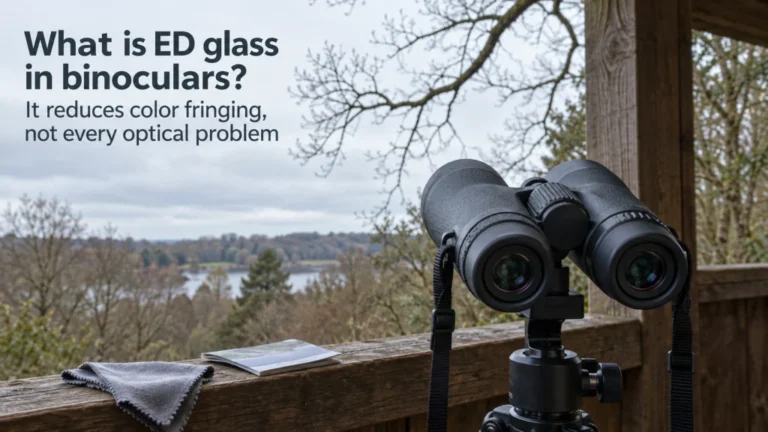
ED glass is used to reduce dispersion so different wavelengths can be brought into better agreement in the optical design. That matters when high-contrast edges develop colored fringes, especially where a dark subject meets a bright background. It does not follow that any binocular carrying an ED label must have better glare control, better edge correction, or better mechanical alignment. If color control is the question you need to investigate, the deeper explanation of what ED glass changes in binoculars keeps that claim in its proper lane.
Surface reflections and glare make coating coverage matter
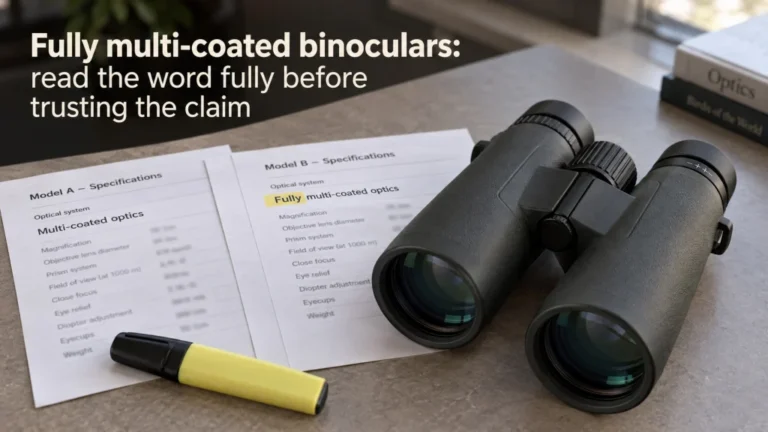
Every air-to-glass surface can reflect some light instead of passing it onward, which can reduce transmission and contribute to flare or ghosting. Anti-reflection coatings are intended to reduce those losses, but the familiar terms coated, multi-coated, and fully multi-coated describe different levels of application. That makes coverage meaningful when comparing spec sheets, while still leaving the exact coating recipe and total system performance partly unknown. The detailed breakdown of fully multi-coated binoculars is the right next step when coating language is the main difference between two candidates.
Roof-prism coatings solve two different prism problems
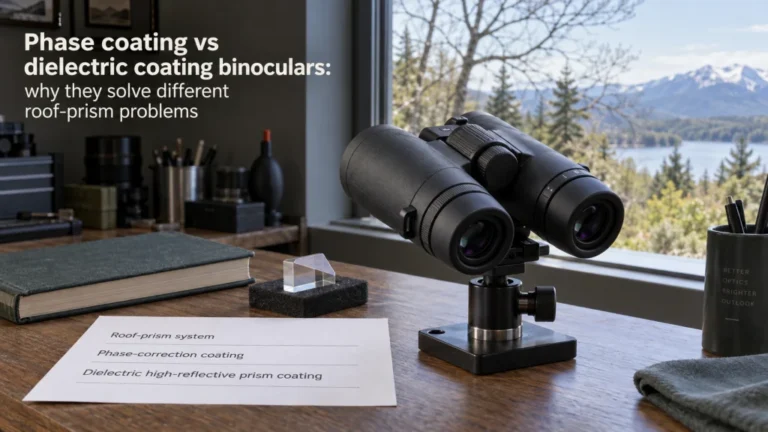
Phase correction and dielectric mirror coating should not be treated as interchangeable upgrades. Nikon’s technical material explains that phase-correction coating is applied to reduce the resolution and contrast loss associated with phase differences at a roof surface. It separately describes dielectric high-reflective multilayer coating as a way to raise reflectivity on a prism surface that does not rely on total internal reflection in the relevant roof-prism design. If those terms are competing for your attention on a spec sheet, compare them by function in the phase coating and dielectric coating guide rather than asking which badge is universally better.

This SV202 is an 8x42 ED binocular with BAK4 prisms, fully multi-coated optics, and an IPX7 waterproof rating. The combination provides several separate specification claims beyond magnification and objective diameter. Reading each claim by function makes it easier to see what the headline 8x42 specification leaves unanswered.
Check on AmazonIf you click this link and buy, we earn a commission at no additional cost to you.
Prism-glass labels need design context before they become quality evidence
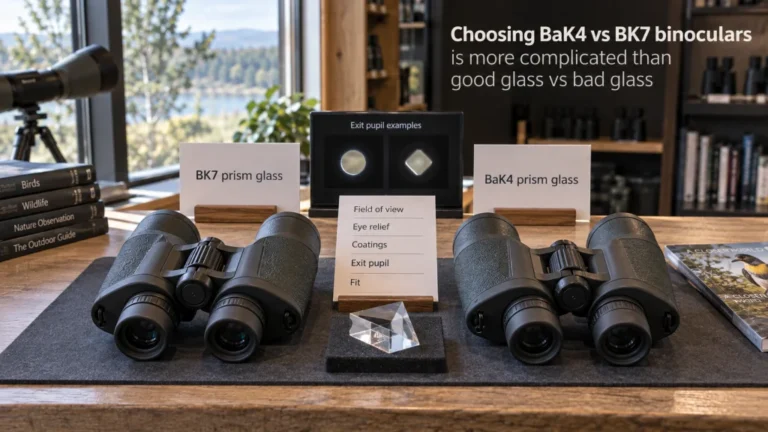
BaK4 and BK7 are often presented as if one name automatically certifies a better binocular. That shortcut is too aggressive. Optical glass families differ in properties, but a consumer label does not tell you the prism dimensions, polish, tolerances, coating system, optical path, or whether the stated term maps to a precisely identified formulation. Even technical glass catalogs distinguish specific formulations rather than treating every similar shorthand label as a complete design description.
Use a prism-glass claim as one input in the design check. Ask what prism architecture is used and whether relevant phase correction or reflective treatment is documented. If the listing offers only a BaK4 badge, do not let that badge erase the unknowns. For the terminology and its limits, use the BaK4 and BK7 prism-glass comparison.

This SkyMaster uses 15x70 Porro-prism optics with BaK-4 glass and multi-coated optical surfaces. The BaK-4 label is only one part of a design that also differs in magnification, objective size, and prism architecture. It is a useful reminder that prism-glass terminology needs full design context before becoming quality evidence.
Check on AmazonIf you click this link and buy, we earn a commission at no additional cost to you.
A sharp center does not guarantee sharp edges
Edge performance becomes important when you scan rather than stare at a single centered subject. Field curvature can cause the best focus position to change away from the center, and other off-axis aberrations can also affect peripheral detail. A manufacturer that documents a field-flattener system is therefore making a claim about a different part of image performance than a manufacturer that highlights ED glass or prism reflectivity. The claim is relevant, but it still does not promise identical sharpness from center to rim under every viewing condition.
That distinction matters because edge softness is not always a purchasing problem. A user who keeps a small subject centered may care more about center contrast and color control, while someone scanning a broad scene may place more value on useful peripheral detail. The correct question is how much of the field you need to remain informative while your eyes or the binocular move. If that is a deciding factor, the explanation of field-flattener binoculars gives the claim the attention it deserves without turning it into a universal quality score.

This Regal ED 8x42 combines ED objectives with phase- and dielectric-coated BaK-4 prisms. Its optical design also uses field-flattener technology to address performance away from the center of the view. That makes it directly relevant when comparing center sharpness with edge behavior as separate image-quality questions.
Check on AmazonIf you click this link and buy, we earn a commission at no additional cost to you.
What specification sheets still cannot prove
A specification sheet can document materials, coating categories, optical architecture, dimensions, and other design claims, but it usually cannot show how well a particular sample is aligned or how consistently its moving parts feel. It also cannot fully establish surface polish, internal stray-light control, assembly tolerances, or sample variation unless the manufacturer publishes relevant measurements. Those gaps matter because the finished instrument is the result of manufacturing and assembly as well as optical design. A strong feature list should therefore increase confidence in specific areas without being mistaken for a complete performance test.
Focus feel is a good example of the boundary. A sheet may identify central focusing and give close-focus distance, but that does not tell you whether the wheel has the resistance, backlash, travel, or temperature behavior you prefer. Likewise, a field-flattener claim says something about design intent, not whether every sample will arrive perfectly aligned. When possible, use a seller with a workable return process and check the exact unit for stable focus, a single merged image, normal mechanical operation, and a view that remains comfortable for your own eyes.

This Celestron adapter uses a standard 1/4-20 thread and is designed for compatible roof and Porro binoculars. A steadier setup can make direct inspection of focus, alignment, and image behavior easier than relying on a specification sheet alone. It supports the section's distinction between documented design claims and what still needs checking on the actual instrument.
Check on AmazonIf you click this link and buy, we earn a commission at no additional cost to you.
Separate optical quality from fit, sealing, low-light needs, and price
Optical quality can be excellent and the binocular can still be wrong for you. Eye relief, eyecup geometry, interpupillary fit, body weight, grip, and viewing duration can determine whether you actually see the full field comfortably. If glasses or facial fit are limiting the view, start with eye relief and eyecup fit instead of assuming an optical upgrade will solve the problem. A more refined image has little value if the instrument cannot be positioned consistently at your eyes.
Low-light use, weather sealing, and price deserve the same separation. Transmission-related features can matter in dim conditions, but the practical low-light decision also depends on configuration, exit pupil, steadiness, and the light level you actually face, which belongs in the low-light binocular selection guide. Sealing and fog resistance are ownership questions covered in the waterproof binocular features guide, while price should be judged against the specific improvements you can use in the guide to when more expensive binoculars are worth it. Prism architecture itself is a separate design choice, so compare roof and Porro binoculars before treating a roof-prism coating discussion as a verdict on every binocular type.

This GlassPak harness uses adjustable straps and provides storage for carrying binoculars in the field. Carry method and handling comfort are ownership factors that sit outside optical image quality. It is therefore a useful companion to a section that separates optics from fit, carrying practicality, sealing, low-light needs, and price.
Check on AmazonIf you click this link and buy, we earn a commission at no additional cost to you.
Build a quality-evidence checklist for two current spec sheets
Suppose two current 8×42 spec sheets sit side by side and both look persuasive. Start by copying only claims that answer a defined image question, then leave a blank where the sheet is silent. One model might document ED glass, full multilayer coating, and phase-corrected roof prisms, while the other might document full multilayer coating, dielectric prism treatment, and a field-flattener system. The point is not to count three claims against three claims, but to see which image problems each sheet actually addresses.
Then mark what neither sheet can settle. If neither provides meaningful evidence about glare behavior, production consistency, focusing feel, or how the view fits your eyes, those remain test or return-window questions rather than opportunities for guesswork. This process is especially useful when two models share magnification, objective size, and a similar price because it stops a single familiar acronym from dominating the comparison. The checklist below keeps the evidence and the unknowns separate.
| Check | What a spec sheet may prove | What still needs caution or direct verification |
|---|---|---|
| Color control | ED or other documented dispersion-control design | How much fringing remains in demanding scenes |
| Lens reflections | Coating category and stated coverage | Exact glare resistance and total system transmission |
| Roof-prism treatment | Phase correction and reflective coating claims | Finished-system contrast and sample quality |
| Edge behavior | Documented field-flattener or related optical design | How the full field looks to you in actual use |
| Mechanical execution | Focus type, dimensions, weight, adjustment ranges | Focus feel, alignment, tolerances, and sample variation |
The better-documented model is not automatically the better binocular. It is simply the model for which more questions have defensible answers. Keep the remaining unknowns separate from the documented facts. Handle them with direct inspection, a realistic return option, or a narrower conclusion rather than marketing inference.

This PROSTAFF P3 uses an 8x42 configuration in a waterproof, fogproof, rubber-armored body. Its listing also documents a wide field of view and long eye relief, giving several lines of evidence beyond the 8x42 headline. It works well as a current spec-sheet example for separating documented facts from questions that still require direct verification.
Check on AmazonIf you click this link and buy, we earn a commission at no additional cost to you.
Which optical problem should you investigate next?
Start with the symptom or uncertainty that could actually change your choice. If colored fringes around bright edges are the concern, investigate dispersion control and ED claims. If the question is reflections, flare, or coating coverage, inspect anti-reflection terminology. If two roof-prism models differ in their prism treatment, separate phase correction from reflective coating instead of combining them into one quality label.
If your concern sits near the field edge, look at field-flattener claims and other evidence for off-axis correction. If the only difference you can find is a prism-glass badge, keep that evidence in context and look for details about the complete optical design. Prioritize the uncertainty most likely to change what you see or what you are willing to pay for, then leave unrelated feature questions alone. That keeps the comparison focused on the remaining decision instead of turning every optical term into another upgrade to investigate.

The LensPen NLP-1 combines a retractable dust brush with a non-liquid cleaning element for optical surfaces. Its listed compatible uses include binoculars, spotting scopes, telescopes, and camera lenses. Cleaning obvious dust or smudges first helps keep surface contamination from being mistaken for glare, contrast loss, or another optical problem worth investigating.
Check on AmazonIf you click this link and buy, we earn a commission at no additional cost to you.
Final Thoughts: judge the system before the badge
When two binoculars share the same headline configuration, compare the image problems they are designed to control rather than counting premium terms. ED glass, anti-reflection coatings, roof-prism treatments, prism-glass labels, and field flatteners are pieces of evidence with different jobs. A careful buying decision keeps those jobs separate and records what the spec sheet cannot establish. That is more useful than turning one familiar acronym into a universal quality score.
The final check is to match those documented strengths to the viewing conditions that matter to you. Color control, glare resistance, edge behavior, fit, and mechanical execution can matter in different proportions for different users. Where the documentation stops, direct inspection and a workable return option are more honest tools than guesswork. Judge the finished optical system, not the badge that happens to be easiest to recognize.

This Crossfire HD uses a 10x42 configuration with an HD optical system and a tripod-adaptable body. The listing also documents waterproof, fogproof, and shockproof construction and includes a GlassPak harness. It is a useful whole-system example because optical features, field usability, and ownership features all contribute to the finished binocular experience.
Check on AmazonIf you click this link and buy, we earn a commission at no additional cost to you.
Explore the optical-quality questions in more detail
Use the next topic that matches the unresolved image question in your comparison. A color-fringing concern needs a different explanation from a prism-reflectivity concern, and edge softness needs a different explanation again. Separating those questions keeps one feature from dominating the whole decision. Each guide below takes one optical claim far enough to explain what it can and cannot establish.
You do not need to read every topic before comparing two spec sheets. Start with the feature that actually differs between the models or with the image behavior you most want to understand. Then return to the full-system comparison and see whether the new evidence changes the decision. That sequence keeps the research focused instead of turning the feature list into a checklist of upgrades.
| Topic | What you’ll find |
|---|---|
| What ED glass does in binoculars | How dispersion control relates to color fringing and why the ED label is not a complete quality verdict. |
| How fully multi-coated optics should be read | What coating coverage terms mean and where they stop short of proving the finished view. |
| Phase coating versus dielectric coating | Why these roof-prism coatings address different optical problems and should not be ranked as substitutes. |
| BaK4 versus BK7 prism glass | How to interpret prism-glass labels without turning one material name into an automatic quality score. |
| What field flatteners change | How field curvature and edge correction relate to a view that stays useful away from the center. |
Once the unresolved problem is specific, the evidence becomes easier to judge and the marketing language becomes easier to ignore. The linked guides are most useful when they answer a concrete question rather than when they are treated as a shopping sequence. A binocular does not become better simply because more of these terms appear on its page. The system still has to solve the problems that matter in your own viewing conditions.

This Papilio II uses an 8.5x21 compact configuration with fully multi-coated optics, a BAK4 prism, and an aspherical lens. It is designed for both close-up and distant viewing, so its optical priorities differ from a conventional full-size 8x42 comparison. That makes it useful for exploring specific optical questions without turning one familiar badge into a universal quality score.
Check on AmazonIf you click this link and buy, we earn a commission at no additional cost to you.
FAQs
🔭 Why can two 8×42 binoculars look so different?
The 8×42 label describes magnification and objective diameter, not the complete optical design. Glass selection, coatings, prism treatment, edge correction, alignment, and manufacturing tolerances can all affect the finished view.
🌈 Does ED glass always mean better image quality?
No. ED glass is evidence that the design includes a tool for controlling dispersion and color fringing, but it does not prove better glare control, edge sharpness, alignment, or overall execution. Compare the whole optical system.
🪞 Is dielectric coating more important than phase correction?
They solve different roof-prism problems. Phase correction addresses phase shift at the roof surface, while dielectric mirror coating improves reflectivity at a surface that requires reflective treatment in the relevant prism design. Do not treat them as interchangeable upgrades.
✨ Does fully multi-coated mean the binocular will have high contrast?
It is useful evidence that multiple anti-reflection coating layers are applied across the stated optical surfaces. Actual contrast still depends on coating quality, internal reflection control, prism treatment, optical design, and assembly.
👁️ Can a binocular be sharp in the center but soft at the edges?
Yes. Center focus does not eliminate field curvature or other off-axis aberrations. If peripheral detail matters to how you scan, look for evidence about edge correction and evaluate how much of the field remains useful.
📋 What should I compare first when two spec sheets look similar?
Separate the questions into color control, reflections, roof-prism treatment, edge behavior, and physical fit. Record what each sheet actually proves, then leave unresolved points as direct-inspection or return-window checks instead of guessing.
References and Sources
- Nikon lens coatings: Explains how anti-reflection coatings reduce surface reflections, flare, and ghosting while improving transmission.
- Nikon roof-prism coatings: Distinguishes phase-correction coating from dielectric and metal reflective prism coatings.
- Kowa optical glass explainer: Describes ED glass as a dispersion-control tool and notes that the ED label is not a universal quality standard.
- Celestron optical coating definitions: Defines coated, fully coated, multi-coated, and fully multi-coated terminology.
- Fujifilm field-flattener example: Shows a manufacturer using a field-flattener lens specifically to address edge performance.
- SCHOTT optical glass properties: Provides formulation-specific optical glass data and illustrates why broad consumer glass labels need exact material context.