BaK4 and BK7 are prism-glass labels, not complete quality grades for a finished binocular. BaK4 can make total internal reflection easier to maintain in demanding prism geometry because a representative BaK4 formulation has a higher refractive index than a representative BK7 formulation. A diamond-edged exit pupil can be a useful clue that part of the light bundle is being clipped or only partly reflected, but it does not identify the glass with certainty or prove that the binocular is defective. The useful buying question is what the material label explains about the actual optical design, and what still needs to be verified elsewhere.
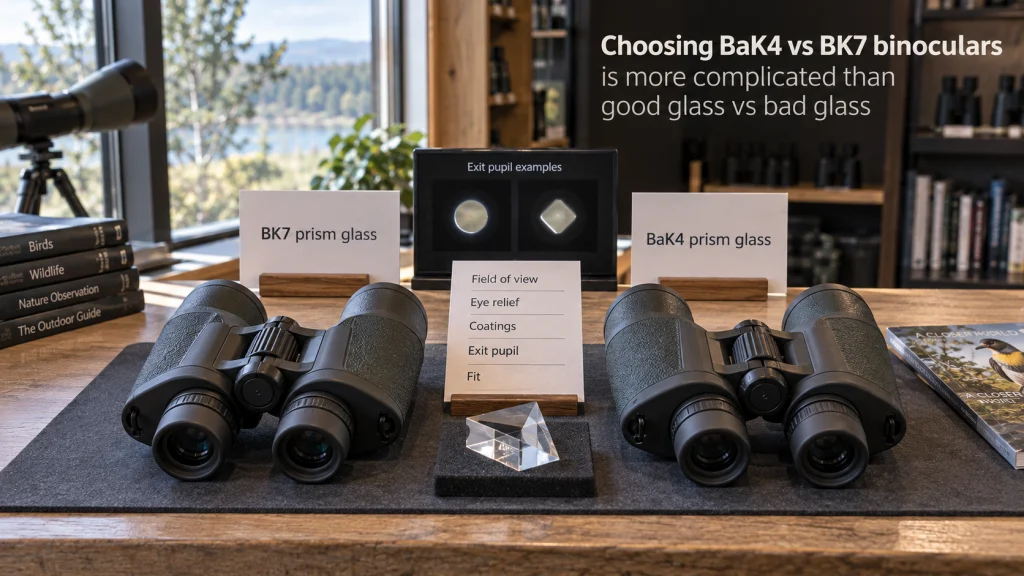
A diamond-edged exit pupil is a clue, not a complete prism verdict
Hold a binocular at arm’s length, look straight into the eyepieces, and you may notice that the bright exit pupils are not perfectly round. A comparison of BaK4 and BK7 binocular prisms often starts right there, because a squared or diamond-like edge is commonly associated with BK7 prism systems. That association has a real optical basis, but the shortcut becomes misleading when it turns into “diamond means bad” or “round means premium.” Exit-pupil shape tells you something about how the light bundle is being handled by the complete prism system, not a laboratory identification of the glass family.
The safer way to read that clue is to place it inside the broader picture of what determines optical quality in binoculars and the practical task of reading binocular specifications without treating one line as a verdict. Prism material can affect how readily rays meet the condition for total internal reflection, while prism size, geometry, alignment, coatings, field angle, and the rest of the optical path still matter. That is why I would not reject a binocular solely because a listing says BK7, and I would not approve one solely because it says BaK4. The glass name is evidence, but it is only one piece of evidence.

This 8x42 binocular uses BaK-4 prisms and multi-coated optics in a waterproof, rubber-armored body. It is built for birding and nature viewing with 42 mm objective lenses. The listing identifies the prism material alongside the rest of the optical and outdoor-use features.
Check on AmazonIf you click this link and buy, we earn a commission at no additional cost to you.
What the BK7 and BaK4 names actually identify
BK7 and BaK4 refer to families of optical glass used for prisms and other optical components. The distinction matters because different glasses bend light differently, which is represented in part by refractive index. In consumer binocular listings, however, a simple BK7 or BaK4 label usually does not tell you the exact manufacturer, exact formulation, melt data, polishing quality, prism dimensions, or optical tolerances. Treating the family name as if it were a complete material certificate therefore goes beyond what the listing actually establishes.
SCHOTT data provides a useful reference example because it publishes exact properties for named formulations. Its N-BK7 and N-BAK4 glasses have different refractive indices, so they are a good way to show why the material choice can matter physically. Those numbers should not be copied onto a generic binocular listing that merely says BK7 or BaK4, because another manufacturer may use a different but related formulation. The table below is therefore a formulation example, not a universal specification card for every binocular carrying either label.
| Reference property | SCHOTT N-BK7 | SCHOTT N-BAK4 | What the comparison shows |
|---|---|---|---|
| Refractive index at the d line | 1.51680 | 1.56883 | The named N-BAK4 formulation has the higher refractive index. |
| Approximate glass-to-air critical angle from those indices | 41.25 degrees | 39.60 degrees | The higher-index example reaches the total-internal-reflection condition at a lower incidence angle. |
| Scope of the numbers | Exact SCHOTT formulation only | Exact SCHOTT formulation only | Do not assign these constants to an unspecified consumer prism by name alone. |
That distinction keeps the material discussion honest. The useful takeaway is not that one number declares a winner, but that the two named glass formulations have different optical properties that can influence a prism design. Once the listing stops at a family label, the rest of the design still has to be judged from other evidence. That is where prism geometry becomes more important than the marketing hierarchy implied by the label.

This 8x42 binocular combines phase-coated BaK-4 prisms with fully multi-coated optics and 42 mm objective lenses. Its waterproof body uses durable rubber armor for outdoor handling. The listing explicitly identifies both the prism material and the prism coating treatment.
Check on AmazonIf you click this link and buy, we earn a commission at no additional cost to you.
Refractive properties matter inside a specific prism geometry
Total internal reflection occurs when light inside a higher-index material reaches a boundary with a lower-index material at an incidence angle greater than the critical angle. In a prism, that lets a surface redirect light without relying on an ordinary mirror coating at that interface. A higher refractive index lowers the critical angle at a glass-to-air boundary, so a wider range of ray angles can satisfy the condition. That is the optical reason a BaK4-type material can be useful when a binocular design sends relatively steep rays through the prism system.
The design dependency is the part that simple buying advice often removes. A ray that falls outside the total-internal-reflection condition in one geometry may be comfortably inside it in another, so the glass family does not operate in isolation. Prism dimensions, the convergence of the incoming light cone, field angle, and the path through the prism all affect which rays reach which surfaces and at what angle. This is why a competent BK7 design can exist without contradicting the fact that a higher-index BaK4 formulation gives the designer more margin in some geometries.

This 8x42 binocular uses phase- and dielectric-coated prisms with fully broadband multi-coated optics. Its magnesium body and twist-up eyecups are paired with a 6.5-foot close-focus specification. The listing exposes several optical and mechanical details beyond a single prism-glass label.
Check on AmazonIf you click this link and buy, we earn a commission at no additional cost to you.
Vignetting can appear without turning the glass family into a universal quality grade
The familiar diamond or squared edge around an exit pupil is usually discussed as a vignetting clue because part of the outer light bundle is not contributing as strongly as the central region. In prism systems where some rays do not satisfy the total-internal-reflection condition, those outer regions can appear dimmer and make the bright pupil look clipped. That observation can be useful because it shows a real behavior of the assembled optical path. It still does not tell you, by itself, the exact cause, severity in normal viewing, or material formulation.
A straight-on inspection is also different from forcing your eye far off axis and then treating every odd pupil shape as a diagnosis. The visible result can change with viewing angle, prism size, field geometry, and the way the exit pupil is sampled. A round exit pupil therefore does not prove premium optical quality, just as a slightly squared pupil does not prove that the binocular is unusable. What matters is whether the observed vignetting is meaningful in the normal view and whether other parts of the instrument support a coherent optical design.

This full-size 8x42 binocular is waterproof, fogproof, and rubber armored. Nikon lists a wide field of view and long eye relief for this model. Its 8x42 configuration is suitable for checking exit-pupil shape while judging the normal view as a complete optical system.
Check on AmazonIf you click this link and buy, we earn a commission at no additional cost to you.
BaK4 often appears as a step-up feature, but BK7 can still belong in a competent design
Manufacturers frequently position BaK4 above BK7 in consumer optics, and there is a technical reason the distinction can matter. The higher refractive index associated with a representative BaK4 formulation can provide more total-internal-reflection margin for rays traveling through a demanding prism path. That can help avoid the edge dimming commonly discussed around some BK7 prism systems. The mistake is converting that advantage into a claim that the finished binocular must be better in every other respect.
BK7 can still be appropriate when the geometry does not demand the same reflection margin and when the rest of the optical system is competently executed. Surface polish, coatings, baffling, alignment, eyepiece design, field of view, and mechanical fit can all affect what the user actually sees. A well-made binocular does not become poor merely because one component family sits lower in a marketing hierarchy. I would treat BaK4 as a favorable design clue when it is relevant, not as permission to stop evaluating the instrument.
- A BaK4 label can tell you that the maker is claiming a higher-index prism-glass family.
- A BK7 label can tell you that a different prism-glass family is being used, but not that the design is automatically inadequate.
- Neither label tells you the prism size, polish quality, coating quality, alignment, field performance, or complete transmission of the binocular.
- Neither label should replace a check of fit, field of view, eye relief, focus behavior, and the actual viewing conditions that matter to you.
The list is deliberately asymmetric with typical marketing. One label may be a useful positive sign in a particular design, while the absence of that label is not enough information to reject the alternative. This distinction matters most for budget buyers, because a single premium-sounding term can easily pull attention away from more practical limitations. The next step is to keep prism glass separate from other optical features that solve different problems.

This 7x50 Porro binocular uses BK7 prism glass and multi-coated optics. Celestron specifies a 7.1 mm exit pupil, 6.6-degree angular field of view, and 13 mm eye relief. The model is tripod adaptable and water resistant, placing the BK7 specification inside a broader set of design features.
Check on AmazonIf you click this link and buy, we earn a commission at no additional cost to you.
Keep ED glass and prism architecture separate from the prism-glass family
ED glass and BaK4 are not comparable upgrades even though both may appear as prominent material claims on a specification page. ED glass is typically discussed in the objective system because its job is related to controlling chromatic dispersion. BaK4 and BK7 in this context describe prism glass, where refractive behavior and the ray path through the prism are the relevant issues. A binocular can therefore use ED objective elements and a particular prism glass without those two labels answering the same optical question.
Roof and Porro are also architecture terms, not grades of prism glass. The architecture changes the light path, packaging, and coating requirements, while the material label identifies the glass family used for a prism component. A buyer who collapses those categories can end up comparing a material claim against a layout choice as though one replaces the other. Keep the questions separate: first identify the prism architecture, then the prism material claim, then the coatings and other optical details that matter for that architecture.

This 8x42 binocular combines ED objective glass with phase- and dielectric-coated BaK-4 prisms. It also uses fully multi-coated glass and is tripod adaptable, with a listed 4.9-foot close focus. The separate ED and prism specifications keep objective-glass claims distinct from prism-glass claims.
Check on AmazonIf you click this link and buy, we earn a commission at no additional cost to you.
What to verify when a listing gives only the material label
If a listing says only BaK4 or BK7, start by treating that wording as a narrow fact rather than a complete quality statement. Check whether the manufacturer identifies the prism architecture, coating type, field of view, eye relief, exit pupil, and other specifications that affect real use. Then inspect whether the overall specification set is internally coherent for the viewing job you have in mind. A material label becomes more useful when it sits beside enough verified information to explain the design rather than substitute for it.
If you can inspect the binocular, look at the exit pupils straight on under ordinary conditions and note obvious clipping or asymmetric shading without trying to infer an exact glass chemistry from the shape. Then evaluate the normal view for field brightness, edge behavior, ease of eye placement, focus behavior, and whether the image remains comfortable for the time you expect to use it. If you cannot inspect before buying, prioritize clear manufacturer specifications and a practical return policy over a single premium badge. The goal is to reduce uncertainty with several checks, not to find one label that eliminates the need to judge the finished binocular.
| The label can help indicate | The label does not establish by itself |
|---|---|
| The claimed prism-glass family | The exact glass manufacturer or exact formulation |
| A likely difference in refractive behavior | The quality of prism polish, alignment, sizing, or coatings |
| Why one design may have more margin for total internal reflection | That the complete binocular has better contrast, sharpness, transmission, or fit |
| A useful clue to investigate alongside the exit pupil | A certain diagnosis from exit-pupil shape alone |
That final distinction is the practical stopping point. A buyer does not need to reverse-engineer the prism prescription to make a sensible decision, but the buyer should know what has and has not been proven. When the listing provides only a material word, keep the conclusion equally narrow. Better evidence about the whole instrument should always outrank a stronger-sounding label with little supporting detail.

This 8x42 binocular uses ED glass with multilayer lens and prism coatings. Nikon lists a field of view up to 435 feet at 1,000 yards, along with long eye relief, waterproofing, and fogproofing. Those published specifications provide multiple checks beyond a single material label.
Check on AmazonIf you click this link and buy, we earn a commission at no additional cost to you.
Final Thoughts: treat the glass name as one design clue
BaK4 and BK7 are meaningfully different prism-glass families, and refractive index is one reason the distinction can matter inside a binocular. A higher-index BaK4-type glass can make it easier for steep rays to remain within the total-internal-reflection condition in some prism geometries. That helps explain why diamond-edged exit pupils are often discussed alongside BK7 systems. It does not turn either material name into a universal score for the finished binocular.
Use the glass label to ask a better next question rather than to end the comparison. Check the exit pupil without overdiagnosing it, separate prism material from ED glass and prism architecture, and verify the specifications that affect your actual viewing conditions. A round pupil and a BaK4 label are reassuring only when the rest of the design also holds together. A BK7 label deserves the same evidence-based treatment: inspect the system, not the badge.

This 8x42 binocular uses Vortex HD optics and is tripod adaptable. Its body is listed as waterproof, fogproof, and shockproof, and it includes a GlassPak harness. The product presents optical, mechanical, and handling features together rather than reducing the instrument to one material badge.
Check on AmazonIf you click this link and buy, we earn a commission at no additional cost to you.
FAQs
🔍 Is BaK4 always better than BK7 in binoculars?
No. BaK4 can offer more total-internal-reflection margin in some prism geometries, but the finished result also depends on prism size, coatings, alignment, eyepiece design, field geometry, and overall execution.
💎 Does a diamond-shaped exit pupil prove the prisms are BK7?
No. A diamond-like pupil can be a clue to prism-related vignetting, but shape alone does not identify the glass formulation with certainty. Inspect it straight on and treat the observation as one part of the optical evidence.
⭕ Does a round exit pupil prove a binocular is high quality?
No. A round pupil is generally preferable to obvious clipping, but it does not verify polish quality, coatings, alignment, sharpness, field performance, eye relief, or mechanical fit.
🧪 Are SCHOTT N-BK7 and N-BAK4 numbers valid for every BK7 and BaK4 binocular?
No. Those values describe exact named SCHOTT formulations. A generic consumer listing that says only BK7 or BaK4 does not establish that the prism uses the corresponding SCHOTT glass.
👓 Is BaK4 the same kind of upgrade as ED glass?
No. BaK4 in this context is a prism-glass claim, while ED glass is normally associated with controlling dispersion in the objective system. They address different parts of the optical path.
📋 What should I check if a listing only says BaK4 or BK7?
Verify the prism architecture, coatings, field of view, eye relief, exit pupil, weight, and other specifications relevant to your use. If possible, inspect the exit pupils and normal view, or rely on clear manufacturer documentation and reasonable return terms.
References and Sources
- SCHOTT optical glass datasheets: Provides the exact refractive-index data used for the N-BK7 and N-BAK4 formulation example.
- Edmund Optics introduction to optical prisms: Explains the critical-angle condition for total internal reflection in prisms.
- Celestron explanation of BaK4 and BK7 glass: Documents how the two material labels are used in consumer sport optics and cautions against relying absolutely on exit-pupil shape.
- Binoculars community discussion about prism identification: Shows the recurring buyer question about identifying prism glass from a diamond-shaped exit pupil.