Fully multi-coated binoculars claim broader multilayer anti-reflection treatment than wording such as coated, fully coated, or multi-coated. The word fully matters because it changes the claimed coverage, but the label still does not tell you the coating recipe, application quality, prism treatment, or measured transmission of the complete binocular. Read the exact phrase first, then verify how the manufacturer defines it before treating the wording as evidence of optical performance. This distinction is especially useful when two listings use similar coating language but leave very different amounts of information unstated.
One missing word changes the coating claim
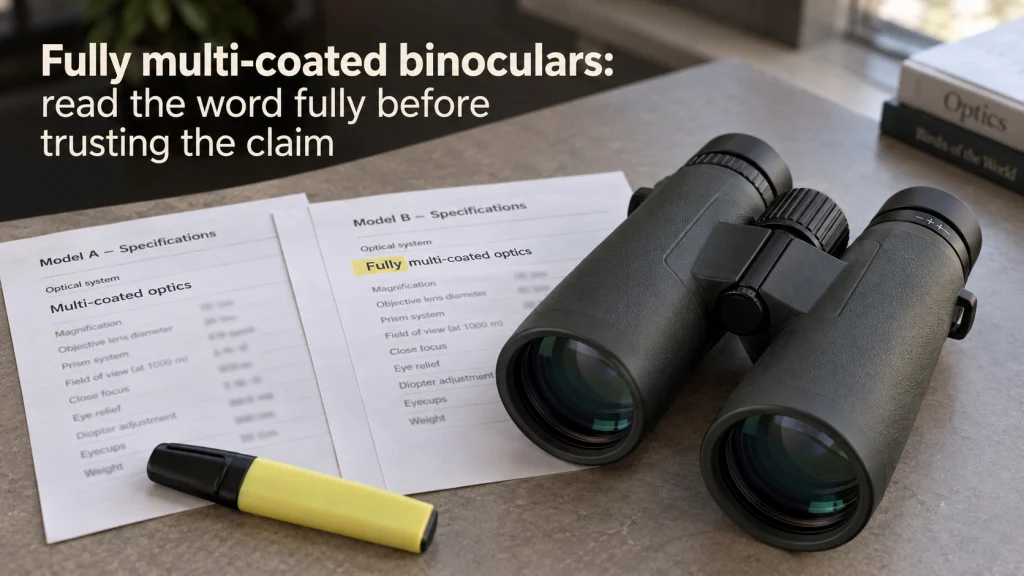
Two listings can look nearly identical until you slow down and read one word: fully. With fully multi-coated binoculars, that word is intended to describe broader coverage than a simple multi-coated claim, not just a fancier version of the same phrase. That is why I would not skim past the coating line when comparing otherwise similar specifications. The wording tells you something about what the maker claims to have treated, but only if you read the entire phrase rather than stopping at the word coated.
This is also where a buyer can avoid making the label do more work than it actually can. If you are still sorting out how coatings fit into the wider optical picture, the optical quality factors that shape a binocular view provide the broader context, while the binocular specifications that deserve careful reading help separate useful evidence from marketing shorthand. Those two steps matter because coating terminology is only one line on a specification sheet. A careful comparison starts with the wording, then keeps going.

Celestron Outland X 8x42 uses BaK-4 prisms and multi-coated optics in a waterproof, rubber-armored body. Its 8x magnification and 42 mm objectives provide a concrete listing where Multi-Coated is the stated coating level. That makes the model useful for noticing how one missing word changes the scope of the coating claim.
Check on AmazonIf you click this link and buy, we earn a commission at no additional cost to you.
Read coating terms as coverage and layer language
The usual coating ladder becomes much easier to understand when you separate two questions: how many surfaces are claimed to be treated, and whether the treatment uses a single layer or multiple layers. In manufacturer definitions, coated generally points to treatment on at least some optical surfaces, while fully coated expands the claimed coverage. Multi-coated adds the idea of multiple anti-reflection layers on at least some surfaces. Fully multi-coated combines both ideas by claiming multilayer treatment across the covered optical surfaces defined by that manufacturer.
The important caution is that these phrases are labels, not laboratory measurements. One maker may describe coverage using all glass surfaces, another may use air-to-glass language, and a product listing may shorten the manufacturer’s fuller description. That is why the safest interpretation is not to memorize a universal percentage or assume every retailer uses the terms with identical precision. Read the maker’s own definition whenever the distinction affects a purchase decision.
| Wording | What the wording is trying to tell you | What it still does not prove |
|---|---|---|
| Coated | At least some optical surfaces receive anti-reflection treatment. | Complete coverage or multilayer treatment. |
| Fully coated | Broader claimed coverage, generally with single-layer treatment. | Multilayer treatment or measured whole-system transmission. |
| Multi-coated | Multiple anti-reflection layers are used on at least some surfaces. | That every relevant surface receives the same multilayer treatment. |
| Fully multi-coated | Multiple anti-reflection layers are claimed across the maker’s defined full coverage. | Coating recipe, uniformity, prism treatment, or total binocular performance. |
The practical takeaway is simple: use the four terms to understand the claim’s scope, not to rank entire binoculars by one line of copy. If a listing only says multi-coated, do not quietly upgrade that wording in your head to fully multi-coated. If it says fully multi-coated, treat that as stronger coverage information, then check what else the manufacturer documents. The phrase is useful evidence, but it is still only one piece of evidence.

Celestron Nature DX 8x42 combines fully multi-coated optics with phase-coated BaK-4 prisms and 42 mm objectives. The listing states the general optical coating and the prism treatment separately. That separation makes it a clear example of reading coating language by both coverage and optical function.
Check on AmazonIf you click this link and buy, we earn a commission at no additional cost to you.
Reflection control matters across many optical surfaces
Anti-reflection coatings matter because every relevant interface in an optical path can reflect some light instead of passing it onward. A binocular contains multiple optical elements, so small losses and stray reflections can accumulate as light travels from the objective end toward your eyes. Coatings are intended to reduce those reflections, which is why broader treatment can be meaningful rather than cosmetic. The same basic reason also explains why coating language should be read in terms of coverage instead of assuming that one treated outer lens tells you what happened inside the instrument.
This does not mean you can look at the color of a lens reflection and grade the coating by eye. Green, blue, purple, or another visible tint is not a reliable shortcut to the quality, recipe, or consistency of the applied layers. A coating system has to work across wavelengths and surfaces, and the visible reflection you notice from one angle is not a complete report on the whole optical path. I would therefore treat color as an appearance, not as a buying metric.
- Read the exact coating phrase instead of relying on product photography.
- Check whether the manufacturer explains what surfaces its wording covers.
- Do not turn a coating color into a transmission or quality claim.
- Keep coating coverage separate from the rest of the binocular’s optical design.
That last point keeps the decision grounded. Coatings can reduce reflection without telling you whether the eyepiece design, prism system, baffling, alignment, or other optical choices are equally strong. A binocular is a system, and the system is what you eventually look through. Coverage language is useful precisely because it answers a narrow question well when you let it stay narrow.

ZEISS Terra ED 8x42 uses ZEISS anti-reflective coating for outdoor viewing. The exact Amazon variant is the Black-Green 8x42 model with waterproof construction. Its coating wording is a useful example of treating reflection control as one specific part of the binocular optical system.
Check on AmazonIf you click this link and buy, we earn a commission at no additional cost to you.
FMC can establish claimed coverage but not coating quality
FMC is often treated as if it were a performance score, but that is the wrong level of confidence. A fully multi-coated claim can tell you that the maker is claiming multilayer anti-reflection treatment across the surfaces included in its definition. It does not tell you the chemical recipe, thickness control, application uniformity, durability, spectral behavior, or quality control behind those layers. Two binoculars can therefore carry similar coating wording while still differing in real optical behavior.
The label also does not provide a measured transmission figure for the complete binocular. Whole-system transmission depends on more than one category of coating, and a percentage quoted for a particular surface, material, or proprietary process should not be recycled as a universal FMC number. This is why I would reject any shortcut such as “FMC means a fixed percentage of light gets through.” A valid system figure has to come from evidence that actually measures the relevant optical path.
Key point: The word fully strengthens the coverage claim. It does not convert a coating label into proof that the entire binocular is brighter, sharper, or better than another model. It also does not tell you whether every other part of the optical system is equally well executed. Keep the claim narrow enough to match the evidence.
That boundary becomes especially important when a listing is vague elsewhere. If a maker documents only “FMC optics” and gives no useful explanation of the prism system or other optical treatments, you know what the coating phrase claims and what remains unknown. Do not fill those gaps with assumptions based on price, lens color, or premium-sounding copy. An honest unknown is more useful than a confident guess.

Vortex Triumph HD 10x42 pairs an HD optical system with fully multi-coated lenses. Amazon also lists nitrogen-purged waterproof and fogproof construction for the model. The combination shows why an FMC claim describes coating coverage while other design features still need their own evidence.
Check on AmazonIf you click this link and buy, we earn a commission at no additional cost to you.
Prism phase and dielectric coatings solve different jobs
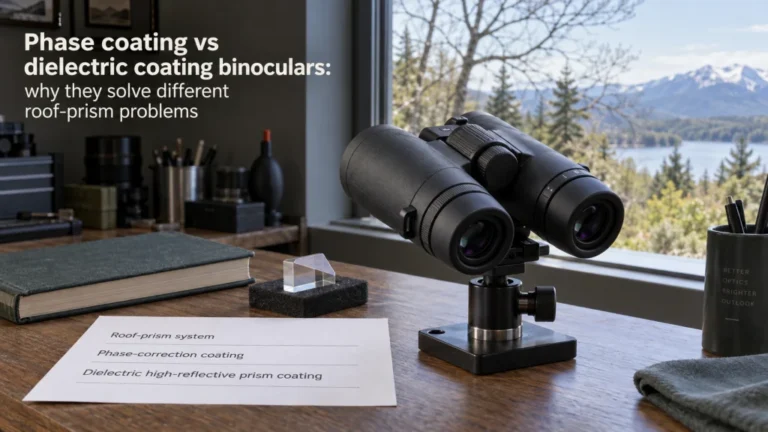
General anti-reflection coating language should not be stretched to cover every coating inside a roof-prism binocular. Roof prisms can use coatings that address different optical problems, including reflective treatment on a prism surface and phase-correction treatment on the roof surface. Nikon’s technical material, for example, describes dielectric high-reflective multilayer prism coating as a reflectivity treatment and phase-correction coating as a way to reduce resolution loss caused by phase differences in a roof prism. Those are different jobs from the basic question of whether lens and air-to-glass surfaces receive anti-reflection layers.
That separation is useful because a listing can truthfully say fully multi-coated and still leave the prism details unspecified. If the prism treatment matters to your comparison, look for explicit wording rather than assuming FMC includes every premium prism technology. The same rule works in reverse: a named phase or dielectric coating does not tell you that every lens surface has the broadest anti-reflection coverage. For a deeper comparison of those roof-prism treatments, see how phase and dielectric coatings differ in function.
This distinction also protects you from a common shopping mistake: stacking every use of the word coating into one imaginary quality tier. Anti-reflection layers, reflective prism coatings, phase correction, and water-repellent outer treatments can all be called coatings, yet they are not interchangeable. A specification sheet is clearer when you ask what surface is being treated and what optical problem the treatment is intended to address. Once you do that, the labels stop competing with each other and start providing separate pieces of information.
For a buyer, the next step is therefore verification rather than ranking jargon. Find the exact line for general optical coatings, then find any separate prism-coating description. If one of those lines is missing, treat it as missing information rather than silently borrowing a feature from another model or price class. That habit produces a cleaner comparison than counting how many premium words appear on the page.

Bushnell A5 8x42 uses fully multi-coated lenses plus dielectric and phase-coated roof prisms. The Amazon listing identifies the Onyx Black 8x42 variant as waterproof and fogproof. Its separate lens and prism coating claims make the model a direct fit for comparing what phase and dielectric treatments actually describe.
Check on AmazonIf you click this link and buy, we earn a commission at no additional cost to you.
Move to low-light evidence when the question becomes actual transmission
Coating terminology can help explain how a maker says it controls reflections, but it becomes insufficient when your real question is how a binocular performs in dim conditions. At that point, the decision has moved from label literacy to total optical behavior. Objective size, magnification, exit pupil, prism design, internal reflections, the rest of the optical train, and the viewer’s conditions can all matter. An FMC label by itself cannot settle that wider comparison.
This is why I would not use “fully multi-coated” as a shortcut for “better in low light.” The label can be one favorable piece of evidence, especially compared with vaguer coating coverage, but it is not a measured low-light result. If two models differ in objective diameter, magnification, prism treatment, eyepiece design, or overall transmission, the coating category alone cannot tell you which view will appear more useful in the conditions you care about. The decision needs evidence that matches the question being asked.
So when the comparison changes from “what does this coating phrase mean?” to “which binocular will give me the view I want in dimmer light?”, change the evidence too. Look for whole-system information and conditions that resemble your intended use rather than repeating the coating label. That keeps the original term useful without letting it become a catch-all verdict. It also prevents a legitimate feature from being turned into an unsupported promise.
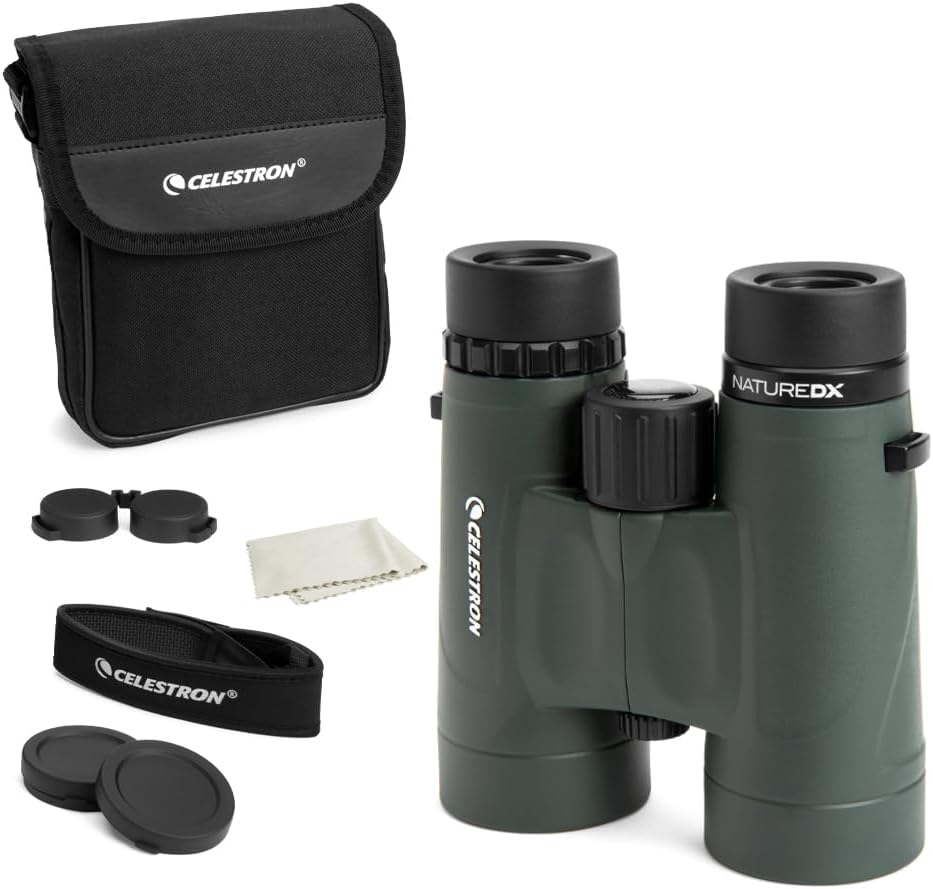
Celestron Nature DX 10x42 pairs 10x magnification with 42 mm objectives and a phase-coated roof prism. Amazon identifies the housing as nitrogen-purged and built for all-weather use. Those separate specifications give a low-light comparison more evidence than a coating label alone.
Check on AmazonIf you click this link and buy, we earn a commission at no additional cost to you.
Use a listing check before trusting coating wording
A quick verification pass can expose most of the ambiguity before you compare prices or other features. Start with the manufacturer’s own product or support page rather than a shortened marketplace title. Copy the exact coating phrase as written, then see whether the maker defines the term in a glossary, knowledge base, or technical page. If the retailer and manufacturer use different wording, treat the manufacturer’s documented description as the stronger source for that model.
Next, separate the general coating line from any roof-prism treatment, outer protective coating, or proprietary branded process. Those details may all be useful, but they should answer separate questions. If the maker provides only a broad label with no definition, record the uncertainty instead of converting it into a stronger claim. This takes less effort than trying to reverse-engineer quality from lens color or advertising adjectives.
- Write down the exact phrase: coated, fully coated, multi-coated, or fully multi-coated.
- Verify how the manufacturer defines that phrase.
- Check whether prism coatings are described separately.
- Ignore claims that infer coating quality from visible color alone.
- Do not assign a fixed whole-binocular transmission percentage unless the complete system was actually measured and documented.
- Keep unknown details marked as unknown when the manufacturer does not disclose them.
That checklist works because it forces the evidence to stay attached to the exact claim. You are not asking a marketing phrase to predict every part of the viewing experience. You are asking what surfaces are claimed to be treated, how many layers are claimed, and what separate prism information is available. Once those points are clear, the rest of the binocular can be judged on its own evidence.

Vortex Diamondback HD 8x42 uses fully multi-coated lenses, dielectric prism coatings, and phase correction. Its 8x42 configuration uses the Diamondback HD optical system in a waterproof, fogproof body. The separate coating claims make the model useful for checking each term independently instead of treating coating language as one quality label.
Check on AmazonIf you click this link and buy, we earn a commission at no additional cost to you.
Final Thoughts: read the whole phrase, then verify the manufacturer
The useful difference between multi-coated and fully multi-coated wording is the claimed scope of multilayer anti-reflection treatment. That makes the word fully worth noticing, especially when two listings otherwise look similar. It does not make FMC a universal score for brightness, contrast, or overall optical quality. Read the phrase precisely, then stop the claim where the evidence stops.
From there, verify the manufacturer’s definition and keep prism treatments in their own category. If a detail is missing, leave it missing rather than inventing a conclusion from price, color, or marketing tone. That approach is less dramatic than ranking labels, but it gives you a cleaner comparison. A coating term is most useful when it answers the narrow question it can actually support.

Nikon MONARCH M5 8x42 uses ED glass and dielectric high-reflective multilayer prism coatings. The Amazon variant is the binocular-only 8x42 model with waterproof and fogproof construction. Its clearly separated optical claims reinforce the habit of reading the complete specification and verifying what each term actually refers to.
Check on AmazonIf you click this link and buy, we earn a commission at no additional cost to you.
FAQs
🔍 What does fully multi-coated mean on binoculars?
It generally means the manufacturer claims multiple anti-reflection coating layers across all optical surfaces included in its definition of full coverage. Check the manufacturer’s own terminology because the exact wording about covered surfaces can vary.
🧭 Is multi-coated the same as fully multi-coated?
No. Multi-coated usually means multiple anti-reflection layers are used on at least some surfaces, while fully multi-coated claims broader multilayer coverage. The word fully is the meaningful difference.
🌈 Can coating color tell me which binocular is better?
No. A visible green, blue, purple, or other reflection does not reveal the full coating recipe, consistency, or whole-system performance. Use documented coating information instead of judging quality from color.
🔬 Does FMC prove a fixed transmission percentage?
No. FMC is a coating-category claim, not a universal measurement of complete binocular transmission. Use a transmission figure only when it is documented for the relevant optical system and test conditions.
🪞 Are phase and dielectric coatings included in FMC?
Do not assume they are. Phase-correction and dielectric reflective coatings perform specific jobs in roof-prism systems and should be verified separately when a model uses them.
🌙 Does fully multi-coated automatically mean better low-light performance?
No. Broader anti-reflection treatment can be useful, but low-light performance depends on the complete optical system and viewing conditions. Compare the rest of the design instead of using FMC as the final verdict.
References and Sources
- Celestron optical coating definitions: Defines coated, fully coated, multi-coated, and fully multi-coated terminology and explains the anti-reflection role of optical coatings.
- Carson optics FAQ: Explains fully multi-coated wording and the purpose of anti-reflective coating treatment in binocular optics.
- Nikon roof-prism coating technology: Separates multilayer prism treatment, dielectric reflective coating, and phase-correction coating by optical function.