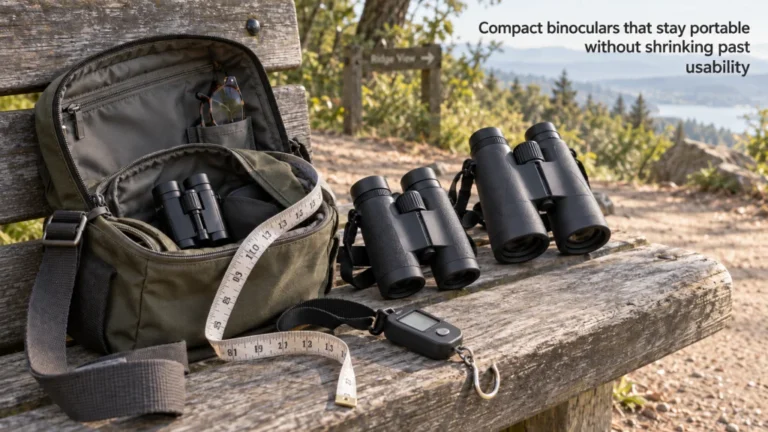
Types of binoculars make more sense when you separate the physical format, prism architecture, added technology, and specialized design instead of treating every label as an equal category. A compact binocular can also be a roof prism model, a stabilized model can still have its own prism architecture, and a marine design can add durability features without changing the basic optical vocabulary. The practical decision is to identify which product change solves your constraint first, then compare magnification, objective size, field of view, eye relief, weight, and other specifications within that class. This keeps labels from doing more decision making than the actual viewing situation deserves.
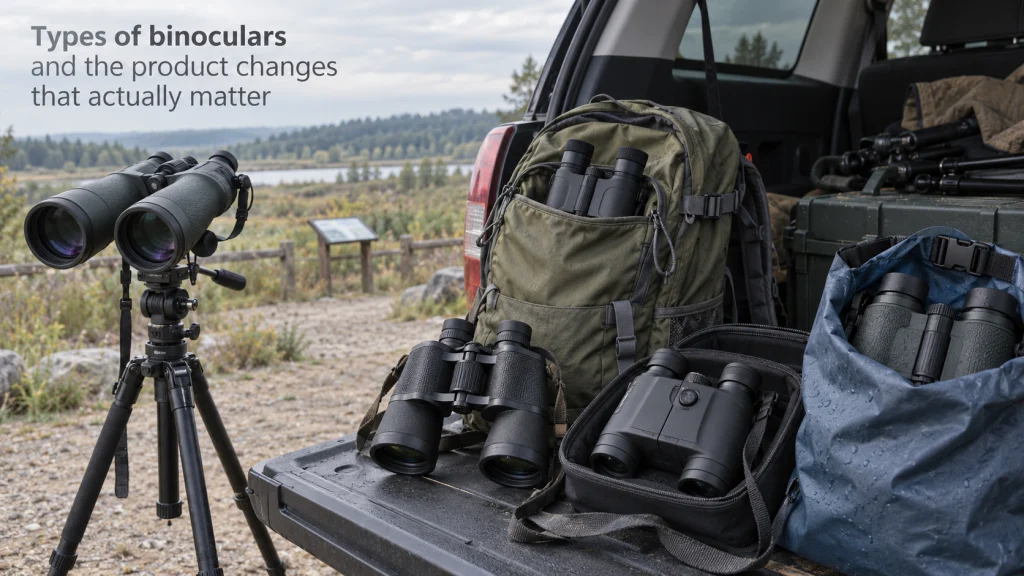
One binocular can belong to several type labels at once
Put the labels compact, roof prism, image stabilized, marine, and 10×42 on separate cards and the problem appears quickly. Some labels describe body format, some describe the internal optical path, some describe an added capability, and one is simply a magnification and objective configuration. That is why a search for the different types of binoculars can produce lists that look complete while mixing several different decisions together. Before comparing products, I would first ask what physical or functional change each label actually describes.
A current stabilized binocular can be compact in size, use a roof prism system, and add electronic vibration reduction at the same time. None of those labels cancels the others, because they answer different questions about the same product. The same logic applies to waterproofing, focusing systems, digital capture, and distance measurement. Once you separate the labels by what they change, the rest of the buying process becomes much easier to control.
| Classification axis | What the label actually changes | Question to ask first |
|---|---|---|
| Carrying format | Overall size, weight, and packing burden | How much bulk can you comfortably carry? |
| Prism architecture | Internal optical path and body layout | Do the size, handling, and design trade-offs fit your use? |
| Added technology | Stabilization, digital imaging, ranging, or variable magnification | Does the capability solve a problem you actually have? |
| Specialized design | Construction choices for a demanding environment or viewing job | Which design requirement is essential rather than merely nice to have? |
The table is not a ranking system. It is a way to stop one marketing label from standing in for an entire buying decision. Use one axis at a time, then check how those axes interact in the product you are actually considering.

This 8x42 full-size binocular uses a roof-prism design with Nikon multilayer-coated lenses. The body is waterproof and fogproof, and rubber armor provides a more secure grip. Its fixed 8x magnification keeps the underlying optical configuration distinct from the added durability features.
Check on AmazonIf you click this link and buy, we earn a commission at no additional cost to you.
Start with the physical carrying format
Size is often the first useful classification because it changes what you are willing to bring with you before optical performance even enters the conversation. A small binocular that fits a jacket pocket or small bag solves a different carrying problem from a full-size model that spends the day on a neck strap or harness. That does not mean compact automatically means better for travel, or that a larger body automatically gives a better view. It means the physical burden is a real constraint that should be decided before you chase features you may rarely use.
If portability is the constraint, compare folded dimensions, weight, grip, eye relief, and field of view instead of treating the word compact as a guarantee of comfort. Small objective lenses can reduce bulk, but the exact eyecup design and eye relief still matter for people who wear glasses, and a narrow body may not suit every hand. Our guide to compact binoculars and their carry trade-offs takes that decision farther without turning compactness into an activity label. The useful question is not whether a product is called compact, but whether its size reduction improves the way you will actually carry and use it.

The 8x25 Trailblazer uses a compact roof-prism design that folds down for easier storage and carrying. Its multilayer-coated optics are paired with a central focus knob for quick adjustments. The body is nitrogen purged and O-ring sealed for waterproof and fogproof use.
Check on AmazonIf you click this link and buy, we earn a commission at no additional cost to you.
Separate the design changes that actually change the product
After carrying format, move to the changes that alter the optical path, handheld behavior, or construction in a more fundamental way. Roof and Porro describe prism architecture, stabilization changes how hand movement reaches the view, and a marine design adds construction choices for wet and demanding environments. These are not three competing answers to the same question. They are separate design layers that can interact inside one binocular.
This is also where a flat type list becomes risky because it encourages false shortcuts. A roof prism body is not automatically premium, image stabilization is not automatically necessary, and a marine label does not turn binoculars into navigation equipment. Each design change should earn its place by solving a specific constraint such as packing width, visible shake, weather exposure, focus behavior, or long observation time. Compare individual models only after you know which of those constraints matters to you.
First separate Galilean from prism designs, then roof from Porro
Nikon separates Galilean binoculars from prism binoculars before dividing prism designs into Porro and roof types. Galilean designs use convex objective lenses and concave eyepieces without an erecting prism, which allows a compact, lightweight form but generally limits magnification and field of view. Prism binoculars use an erecting prism system, and the familiar roof and Porro distinction describes how that prism architecture is arranged. Roof designs keep the objective and eyepiece paths more nearly aligned, while traditional Porro designs offset the objective lenses from the eyepieces, but that construction difference alone does not tell you which binocular will suit you better. If prism architecture is the decision you are trying to make, compare roof vs Porro binoculars before letting price or appearance settle the question for you.
Image stabilization changes handheld behavior rather than prism category
Image stabilization is an added system intended to reduce visible movement caused by the binocular or the person holding it. It does not replace magnification, objective diameter, prism type, field of view, or eye relief, and a stabilized model still has those ordinary specifications underneath the electronic or mechanical system. Nikon currently lists compact stabilized models with a roof prism design, which is a useful real-world example of two classification axes coexisting. If shake is the problem you are trying to solve, our guide to image stabilized binoculars focuses on stabilization as a capability rather than pretending it is a separate optical universe.
Marine binoculars add a use-built design package without replacing the optical basics
Marine binoculars are best understood as a construction package for exposure, handling, and reliability around water rather than as a new prism law. Depending on the design, manufacturers may combine water resistance, individual focusing, protective construction, high-visibility finishes, or other features with an otherwise familiar prism system and magnification. Those features need model-specific verification, because the word marine alone does not tell you the water resistance level, focusing method, field of view, or included accessories. Our overview of marine binoculars and their design requirements stays with product selection and ownership rather than maritime navigation advice.

The Legacy WP pairs 10x magnification and 50mm objectives with a Porro prism system. It uses BaK-4 prism glass and fully multi-coated lenses, with a 341-foot field of view at 1,000 yards. The center-focus body is water and fog proof and is also tripod adaptable.
Check on AmazonIf you click this link and buy, we earn a commission at no additional cost to you.
Digital binoculars add sensors, displays, or capture electronics
Digital binoculars deserve their own decision branch because electronics can change what reaches your eyes and what the device can record. Some models add an image sensor and screen while retaining a binocular-shaped body, while others rely more heavily on electronic viewing than on a direct optical path. That means familiar numbers such as magnification and objective size no longer tell the whole story. Display resolution, sensor behavior, battery dependence, recording functions, and interface design can become part of the ownership decision.
The label digital also does not automatically mean night vision, thermal imaging, augmented reality, or better low-light performance. Those are separate capabilities that must be verified on the product page rather than inferred from the category name. A current consumer example can combine roof prism optics with a digital camera, LCD display, and recording system, which again shows why one device can occupy several classifications at once. Use our guide to digital binoculars and electronic viewing features when the electronics themselves are the reason you are considering a different product type.
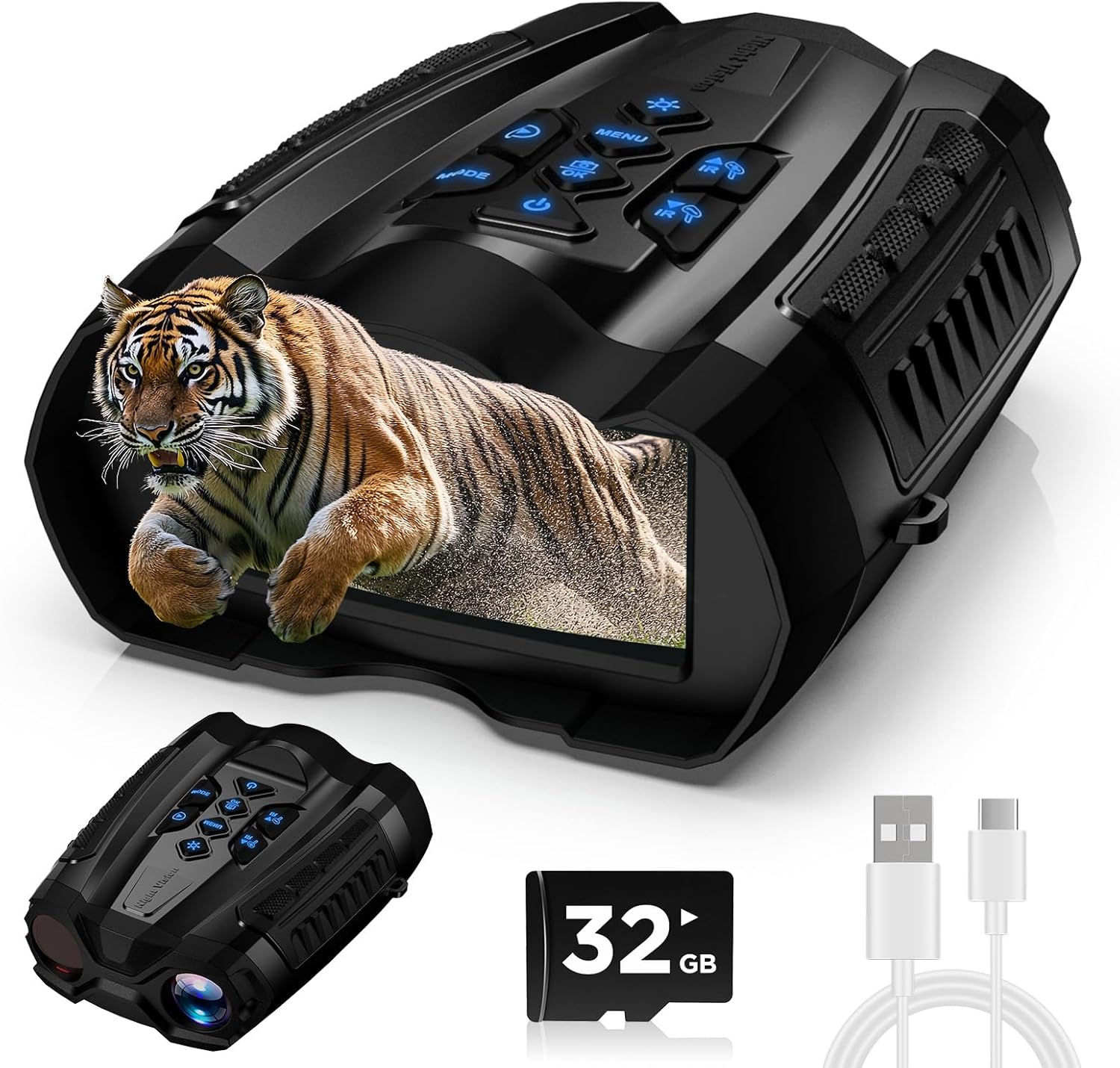
These digital binoculars combine a camera with a 3.5-inch HD display and 4K video capability. The unit supports 36MP photos, 16x digital zoom, and a 32GB TF card. A built-in 5000mAh rechargeable battery powers the electronic viewing and recording functions.
Check on AmazonIf you click this link and buy, we earn a commission at no additional cost to you.
Rangefinding binoculars integrate distance measurement into the viewing system
Rangefinding binoculars add an electronic distance measurement function to a binocular viewing system. That change matters because the product now has to combine optics, controls, power, display information, and a ranging system in one body. A manufacturer may still offer familiar configurations such as 8x or 10x, but the integrated electronics affect weight, controls, battery dependence, and price. The relevant question is whether you actually need distance measurement built into the binocular rather than carried as a separate device.
This category is easy to overread because marketing often surrounds the ranging feature with activity-specific claims. For a general binocular decision, the safe boundary is simpler: verify the measurement function, usable display, power requirements, optical specifications, and overall handling of the model under consideration. Do not treat an integrated rangefinder as proof that the underlying binocular fits your eyes, hands, viewing duration, or field of view preference. Our guide to rangefinding binoculars and integrated distance measurement keeps the focus on product architecture and ownership trade-offs rather than weapon use or targeting.

The Fusion X combines a 10x42 binocular with an integrated ranging system in one body. Its ActivSync display presents ranging readouts while ARC technology provides angle compensation. HDOS optics and an IPX7 waterproof rating add conventional optical and environmental specifications alongside the electronics.
Check on AmazonIf you click this link and buy, we earn a commission at no additional cost to you.
Zoom binoculars change magnification architecture
Zoom binoculars let the user change magnification within a stated range instead of staying at one fixed power. That is a real architecture change because the optical system and controls have to support more than one magnification setting. Nikon, for example, currently lists a compact 8x to 24x zoom model with its field of view specified at the low end of the zoom range. The important buying point is that a zoom label tells you magnification can vary, not that every setting will preserve the same field of view, exit pupil, handling, or viewing comfort.
A beginner may see variable power and assume it removes the need to choose magnification, but it really changes the set of trade-offs that need checking. Compare the range, field of view at relevant settings, eye relief behavior, focus and zoom controls, size, weight, and the steadiness you can maintain at the higher powers. If you do not need variable magnification, a simpler fixed-power binocular may be the cleaner answer. Our guide to zoom binoculars and variable magnification trade-offs handles that decision in more depth.

The ACULON A211 changes magnification from 10x to 22x through its zoom system while retaining 50mm objectives. It uses a Porro prism design and multilayer-coated optics. The model is tripod adaptable, so higher magnification can be paired with external support when needed.
Check on AmazonIf you click this link and buy, we earn a commission at no additional cost to you.
High-power binoculars create a stability and support problem large enough to become a product class
High magnification is still a specification, but once magnification and body size climb far enough, stability and support can dominate the ownership experience. Small hand movements become more obvious in the view, field of view often narrows, and large objectives can add substantial weight and bulk. Some current 20×80 binoculars are built with an integrated tripod adapter, which is a useful clue that support is not an afterthought at this scale. That is why high-power binoculars are more practical to treat as a distinct product decision even though magnification remains one of their underlying specifications.
Do not translate high power into universally better detail, because the useful result still depends on target distance, light, steadiness, field of view, and how long you need to observe. A lower-power handheld model can be the better choice when fast target acquisition, wide coverage, or easy carrying matters more than image scale. If support hardware becomes part of the plan, verify the exact mounting interface instead of assuming every adapter is universal. Our guide to high-power binoculars and support requirements starts with stability rather than magnification bragging rights.

The SkyMaster uses 20x magnification with 80mm objective lenses, making stability a central part of the setup. It has BaK-4 prisms and multi-coated optics. A built-in tripod adapter is included, allowing the large binocular to be mounted for steadier viewing.
Check on AmazonIf you click this link and buy, we earn a commission at no additional cost to you.
Activity labels describe viewing jobs, not product architecture
Birding, travel, astronomy, sports watching, and other activities can help describe the viewing job, but they are not equivalent to roof prism, Porro prism, stabilized, or digital. An activity tells you what constraints to expect, such as moving subjects, long carrying time, dim light, long distance, or a need for quick focus. Those constraints then point you toward specifications and product features that deserve attention. The activity name itself does not create a unique optical architecture.
This distinction matters because two people doing the same activity can still need different binoculars. One person may prioritize low weight and a wide field, while another may accept more bulk for additional image scale or stabilization. Eyeglasses, hand size, viewing duration, and carrying method can change the answer even when the subject being observed is identical. Use the activity to define the job, then use product architecture and exact specifications to choose the tool.

This adjustable neoprene strap is designed for binoculars and cameras and uses loop connectors for attachment. Its length adjusts from 32 to 52 inches. The elastic neoprene spreads carried weight across the shoulder, making carrying method a practical variable across different viewing activities.
Check on AmazonIf you click this link and buy, we earn a commission at no additional cost to you.
Use a type selection sequence instead of a flat list
A cleaner selection process starts with the constraint you cannot ignore and only then moves toward features. First decide how much size and weight you are willing to carry, then decide whether prism architecture creates a meaningful handling or packaging preference. After that, ask whether an added capability such as stabilization, digital imaging, ranging, or zoom solves a real problem. Specialized construction belongs last unless your environment makes it mandatory from the beginning.
Once the product type is narrowed, return to the specifications that determine fit and viewing behavior in the binocular itself. Magnification, objective diameter, field of view, eye relief, close focus, weight, focus mechanism, weather sealing, and accessory compatibility can vary widely inside one category. A type label should reduce the search space, not replace the final comparison. The sequence below keeps the decision grounded in constraints rather than in whichever label sounds most advanced.
| Decision step | What to decide | What not to assume |
|---|---|---|
| Carry constraint | Acceptable size, weight, and packed volume | Compact means comfortable for everyone |
| Optical architecture | Roof or Porro if the difference matters to your handling and design priorities | One prism type is always superior |
| Added capability | Stabilization, digital viewing, ranging, or zoom only when it solves a real problem | More features automatically improve the view |
| Specialized requirement | Weather resistance, support, focusing system, or other model-specific need | A category label proves the exact feature you need |
| Model check | Field of view, eye relief, weight, fit, controls, accessories, and warranty | Two models in the same category behave the same |
When the sequence points to a simpler product, let it. There is no prize for buying more technology than your viewing problem requires. The best classification is the one that removes irrelevant choices and leaves you comparing the specifications that will actually affect use.

This adapter mounts compatible roof or Porro binoculars to a tripod for steadier viewing. It uses a standard 1/4-20 thread and is designed for hands-free support. The binocular still needs a compatible threaded mounting socket, making interface checks part of the accessory decision.
Check on AmazonIf you click this link and buy, we earn a commission at no additional cost to you.
Final Thoughts: choose the axis that changes the product
The useful way to understand binocular types is not to memorize a long list of labels. Start by identifying whether a term describes carrying format, prism architecture, an added capability, or a specialized design requirement. That keeps a compact roof prism binocular from being treated as two unrelated products and prevents electronic features from hiding ordinary fit questions. It also makes it easier to reject labels that do not solve your actual viewing constraint.
After you choose the relevant axis, compare models on the specifications that still matter: field of view, eye relief, weight, focus behavior, size, weather protection, and compatibility where relevant. If a simpler fixed-power or non-electronic binocular already fits the job, there is no reason to upgrade categories for the sake of complexity. If stabilization, ranging, digital capture, zoom, or support solves a specific limitation, verify that capability on the specific product before paying for it. Classification should make the decision smaller and clearer, not make the product sound more impressive.

The Outland X is a fixed-power 8x42 binocular with BaK-4 prisms and multi-coated optics. Its body is waterproof and fogproof, with rubber armoring and twist-up eyecups. A carrying case, neck strap, objective lens caps, and rainguard are included for routine field use.
Check on AmazonIf you click this link and buy, we earn a commission at no additional cost to you.
FAQs
🔭 What are the main types of binoculars?
There is no single clean count because common labels describe different classification axes. Start with carrying format, prism architecture, added capabilities such as stabilization or digital imaging, and specialized construction, then compare exact specifications within the group that matters to you.
🧭 Are roof prism and Porro prism the two basic binocular designs?
They are the two common prism architectures for prism binoculars, but they are not the only labels you will encounter when shopping. Size, stabilization, digital electronics, zoom, ranging, and specialized construction describe other aspects of the same product.
🎒 Does compact mean a binocular is a different optical type?
Compact mainly describes the carrying format and overall size class. A compact model can still use roof or Porro prisms and may also add stabilization or other technology, so verify the exact architecture and specifications separately.
🫨 Are image stabilized binoculars a separate prism type?
No. Stabilization is an added capability intended to reduce visible movement, while the binocular still has an underlying prism architecture and normal specifications such as magnification, field of view, eye relief, and weight.
🔢 Are zoom binoculars better because they offer several magnifications?
Not automatically. Variable magnification adds flexibility, but you still need to compare field of view, steadiness, eye relief behavior, controls, and optical performance across the range, and a fixed-power model may be simpler when you do not need zoom.
⚓ Does a marine label mean the binocular can be used for navigation?
No. The label generally points to construction intended for demanding conditions around water, but the exact waterproofing, focus system, and other features must be verified model by model, and binocular selection should not be treated as maritime navigation guidance.
📷 Do digital binoculars always include night vision?
No. Digital only tells you that electronic imaging or display components are involved. Night vision, thermal imaging, recording, ranging, and other functions are separate features that must be confirmed for the specific product.
📏 When do high-power binoculars need support?
Support becomes more important as magnification, weight, and observation time increase, but the threshold is not identical for every user or model. Check the exact binocular’s weight and mounting interface, then decide whether a tripod or other support is practical for your viewing situation.
References and Sources
- Nikon types of binoculars: Supports the distinction between Galilean and prism binoculars, plus the roof and Porro architectures within prism binoculars.
- PENTAX choosing binoculars: Cross-checks the construction differences between roof prism and Porro prism binoculars.
- Nikon stabilized binoculars: Shows that compact format, roof prism architecture, and stabilization can coexist in the same current product family.
- Nikon zoom binoculars: Verifies a current variable-magnification binocular and the way field of view is specified at a stated zoom setting.
- Minolta digital binoculars: Shows a current binocular combining optical specifications with a digital sensor, display, and recording system.
- Leica rangefinding binoculars: Verifies the integration of laser distance measurement with a binocular viewing system.
- Celestron high-power binoculars: Provides a current example of a high-magnification, large-objective binocular with an integrated tripod adapter.
- Fujifilm stabilized binoculars: Supports the distinction between stabilization, waterproof construction, and other design features that can coexist within one binocular family.