Roof vs Porro binoculars are not a simple contest between a modern design and an old one. Prism architecture changes the light path and strongly influences body layout, but field of view, eye relief, sealing, weight, coatings, transmission, and durability still belong to the finished binocular. A roof design usually favors a straighter, narrower form, while a classic Porro design offsets the objective and eyepiece axes and can create a wider objective spacing. The useful buying method is to identify the architecture first, then verify the exact model instead of treating prism type as a complete performance rating.

The same 10×42 label can hide two very different binocular layouts
Place Nikon’s ACTION 10×42 beside its PROSTAFF P7 10×42 and hide everything except the 10×42 label. The magnification and objective diameter match, but the body shapes reveal different internal layouts. This is where a roof vs Porro binoculars comparison should begin, because architecture explains part of the visible difference before the rest of the specification sheet is read. The main binocular types guide gives the broader context without treating prism shape as a winner by itself.
The important discipline is separating an architecture tendency from a model result. Nikon lists the ACTION 10×42 as Porro and the PROSTAFF P7 10×42 as roof, while their weight, width, field of view, coatings, and weather protection also differ. Those facts do not prove that every Porro shares the ACTION’s measurements or every roof model matches the P7. Architecture is the first clue, not the final verdict.
| Exact model evidence | Nikon ACTION 10×42 | Nikon PROSTAFF P7 10×42 | What can safely be concluded |
|---|---|---|---|
| Prism system | Porro | Roof | The internal layouts are different. |
| Listed size | 5.9 x 7.6 in. | 5.9 x 5.1 in. | The roof example is noticeably narrower, but exact dimensions still belong to the model. |
| Listed weight | 27.9 oz. | 21.2 oz. | This pair differs in weight, but prism type alone does not set every model’s weight. |
| Real angular field of view | 6.8 degrees | 7.0 degrees | A Porro design does not automatically guarantee the wider field. |
| Eye relief | 16.1 mm | 15.7 mm | Eye relief must be checked on the exact binocular. |
The table is useful because it does not turn one product pair into a universal law. Body layout can follow architecture strongly while other specifications remain model decisions. When two binoculars share a headline configuration, compare the exact numbers that affect carry, fit, and use. That keeps the prism label in its proper place.

This 10x42 roof-prism model uses phase-correction and dielectric high-reflective prism coatings. It provides a 367-foot field of view at 1,000 yards with 15.7 mm of eye relief. Nitrogen filling and O-ring sealing support waterproof and fog-resistant field use.
Check on AmazonIf you click this link and buy, we earn a commission at no additional cost to you.
What the prism system changes before any feature list is read
Binocular objectives form an image that must be erected before it reaches your eyes, and the prism system handles that job while folding the optical path into a manageable body. A classic Porro arrangement and a roof arrangement solve that problem with different internal routes. That difference affects where the objective lenses sit relative to the eyepieces and therefore influences the external silhouette. It also changes which optical surfaces require especially precise manufacturing or reflective treatment.
What the prism system does not do is assign a complete quality grade. Resolution, contrast, transmission, glare control, field of view, close focus, eye relief, focus behavior, and mechanical quality depend on the entire optical and mechanical design. Two roof models can differ dramatically from each other, just as two Porro models can. Treat the prism type as architecture, then move immediately to the specifications and evidence that describe the finished binocular.

This 8x42 roof-prism binocular uses fully multi-coated optics and phase-coated BaK-4 prisms. It provides a 388-foot field of view at 1,000 yards and 17.5 mm of eye relief. The rubber-armored body is waterproof and nitrogen filled for outdoor observation.
Check on AmazonIf you click this link and buy, we earn a commission at no additional cost to you.
Classic Porro designs offset the objective and eyepiece axes
In a classic Porro binocular, the light path bends through paired prisms and the objective axis is displaced from the eyepiece axis. That produces the familiar stepped body with the objective lenses sitting farther apart than the eyepieces. Nikon describes the Porro path as a bent or Z shaped route, which helps explain why the body typically occupies more lateral space. This geometry is a genuine architecture effect and does not depend on marketing language.
The practical consequence is a shape that may feel broad in a small bag or narrow hand even when the headline magnification and objective diameter look ordinary. That does not make the design inconvenient by definition, because grip shape, hinge placement, body contour, and total dimensions can change the experience substantially. It also does not mean every Porro is large, since compact variants rearrange the spacing in different ways. If the main concern is a small carry package, compare the actual dimensions rather than assuming one silhouette tells the whole story.

This 7x50 Porro-prism binocular pairs large 50 mm objectives with multi-coated optics. Its wide body clearly shows the offset geometry associated with a classic Porro layout. The binocular is tripod adaptable for steadier extended viewing.
Check on AmazonIf you click this link and buy, we earn a commission at no additional cost to you.
Roof prisms support a straighter barrel layout but demand tighter optical control
Roof prism binoculars keep the objective and eyepiece axes much closer to a straight line, which is why their barrels usually look narrow and parallel. Nikon notes that this straight optical path makes a slim, compact body possible. The optical advantage is not that the roof shape magically improves every image characteristic, but that it packages the optical system efficiently. For someone carrying binoculars on a strap or fitting them into a crowded day bag, that packaging can matter every time the binocular is picked up.
The internal roof surfaces also raise manufacturing and coating questions that do not appear in exactly the same way in a classic Porro system. Precise roof geometry matters, and roof designs can use phase correction coatings to preserve detail that would otherwise be affected by phase differences. Some roof prism subtypes also require a reflective coating on a surface that does not work by total internal reflection. This is why the phrase roof prism tells you the family, but not the complete coating recipe or transmission result.

This 10x42 roof-prism binocular combines fully multi-coated optics with dielectric and phase-corrected prism coatings. It provides a 330-foot field of view at 1,000 yards and 15 mm of eye relief. Argon purging and O-ring seals support waterproof and fogproof performance.
Check on AmazonIf you click this link and buy, we earn a commission at no additional cost to you.
Compactness is an architecture tendency, not a complete size specification
A roof layout usually makes it easier to build a narrow straight barrel, so roof binoculars often win the first visual comparison for packability. That tendency is useful, but a buyer still needs length, width, depth, weight, hinge geometry, and the shape of the armor. A long roof model can be less convenient in a particular pouch than a shorter but wider alternative. The only reliable fit test is the exact model, the exact case or bag, and the way the binocular will actually be carried.
Porro architecture also has more than one physical arrangement. A reverse Porro design flips the classic spacing relationship and can be used to make a distinctly compact binocular, so it deserves its own fit logic rather than being lumped into the broad classic shape. That is a useful reminder that prism names describe internal architecture before they describe finished dimensions. If portability is the deciding constraint, the compact binocular guide is the better next step after identifying the prism family.

This compact 6.5x21 Porro-prism binocular can focus as close as about 20 inches for nearby subjects. Fully multi-coated optics, BaK-4 prisms, and aspherical lenses support detailed close-range views. Its small body shows why finished dimensions still matter even within a Porro design.
Check on AmazonIf you click this link and buy, we earn a commission at no additional cost to you.
Wider Porro objective spacing can strengthen stereo and parallax cues at closer distances
Classic Porro binoculars usually place the objective lenses farther apart than the user’s eyes, which increases the separation between the two optical viewpoints. Technical optics material from the Open University describes that wider objective spacing as capable of enhancing stereoscopic viewing. The geometry is real, but the practical effect is distance dependent because binocular disparity becomes less pronounced as subjects move farther away. That is why a stronger layered impression at shorter viewing distances should not be rewritten as a universal image quality advantage.
People often describe this impression as a more three dimensional view, but that phrase is subjective and should stay labeled that way. Subject spacing, distance, magnification, scene structure, and the individual observer all influence what is noticed. A roof binocular can still give an excellent sense of spatial separation, and a Porro body does not guarantee that every observer will prefer the effect. The useful takeaway is simply that objective spacing can change stereo cues, while preference still belongs to the person and the viewing distance.
Do not call Porro universally brighter because transmission belongs to the whole optical system
Classic Porro prisms can use total internal reflection on their reflective surfaces, which avoids the mirror coating requirement found on certain roof prism paths. That is a meaningful optical distinction, but it is not enough to predict the brightness of two finished binoculars by itself. Lens coatings, glass, prism quality, internal baffling, objective size, exit pupil, and the transmission of the complete system all matter. A strong architecture tendency becomes misleading when it is presented as a guaranteed side by side result.
The same caution applies in the other direction. A well executed roof design can use phase correction and high reflectivity coatings to control losses and maintain strong image quality. Nikon’s PROSTAFF P7, for example, lists both phase correction and dielectric high reflective prism coatings, but that is evidence about that model line rather than every roof binocular. For a deeper look at finished system performance, use the binocular optical quality guide instead of trying to rank every binocular from prism architecture alone.
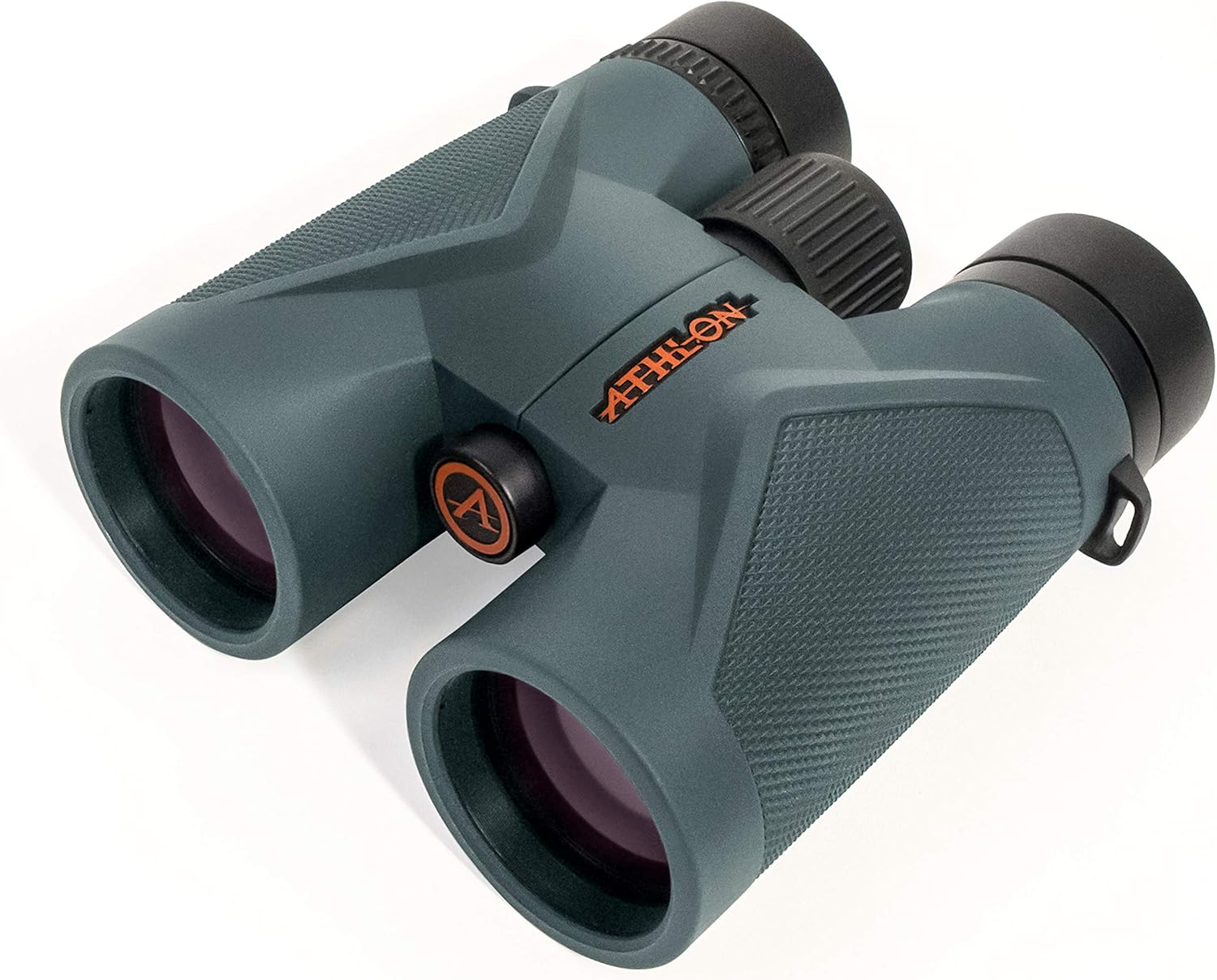
This 8x42 roof-prism binocular uses ED glass, fully multi-coated lenses, and ESP dielectric prism coatings. It provides an 8.1-degree field of view and 17.2 mm of eye relief. Argon purging supports waterproof and fogproof performance for outdoor use.
Check on AmazonIf you click this link and buy, we earn a commission at no additional cost to you.
Do not call roof universally waterproof or Porro fragile by design
A straight roof body can be convenient for compact packaging and sealing, but waterproofing is still a property that has to be documented for the exact product. Kowa’s YF II line is a useful counterexample to the lazy claim that Porro binoculars cannot be waterproof, because Kowa explicitly describes those Porro models as waterproof. That single fact does not make every Porro weather ready, just as a roof silhouette does not prove a specific depth or duration rating. The product page, manual, or support documentation must carry that claim.
Durability works the same way. Armor thickness, hinge construction, focus mechanism, chassis materials, sealing, manufacturing tolerances, and impact history all matter more than a one word prism label. Community discussions often repeat that one architecture is tougher, but those discussions are useful mainly because they reveal the buyer concern, not because they establish a universal mechanical law. If rain, splashes, humidity, or fogging risk is central to the purchase, verify the exact evidence described in the waterproof binocular features guide.

This 10x42 roof-prism binocular uses fully multi-coated optics and BaK-4 prisms. It provides 17 mm of eye relief with a 6.8-degree field of view. O-ring sealing and nitrogen purging support waterproof and fogproof use around rain, boating, and humid conditions.
Check on AmazonIf you click this link and buy, we earn a commission at no additional cost to you.
Roof prism is not one internal design
The phrase roof prism hides important internal differences, especially between Schmidt Pechan and Abbe Koenig systems. ZEISS describes Schmidt Pechan as the more compact arrangement and notes that it includes a surface that requires reflective treatment, while Abbe Koenig uses a different path that can rely on total internal reflection. That difference matters when someone tries to make a blanket statement about mirror coatings or transmission. The architecture inside a straight barrel therefore deserves one more level of identification before coating claims are made.
This is also why it is incorrect to say that every roof prism binocular needs a dielectric mirror coating. The need depends on the roof prism subtype and the exact optical implementation. If a specification sheet identifies only roof without naming the internal subtype, do not invent the missing detail from the outside shape. The Schmidt Pechan versus Abbe Koenig comparison handles that narrower decision without turning it into a general roof versus Porro argument.
Current Porro models show that the architecture is not simply obsolete
Calling Porro an obsolete technology confuses age with usefulness. Manufacturers still offer modern Porro binoculars with contemporary coatings, updated ergonomics, and weather protection, which means the architecture remains a live design choice rather than a museum category. Kowa’s YF II line is one clear example because it combines classic Porro geometry with multicoated optics and documented waterproof construction. The right question is not whether the design is old, but whether the finished binocular fits the user’s viewing and carrying constraints.
That distinction matters most at lower budgets, where buyers often hear that Porro automatically offers better value. The manufacturing path can support strong value, but price, optical execution, warranty, accessories, and exact specifications still vary model by model. A low price does not rescue poor fit or weak quality control, and a higher price does not prove superior usefulness. The separate guide on whether Porro prism binoculars are outdated takes that question on directly.

This 15x70 Porro-prism binocular uses large 70 mm objectives with multi-coated optics and BaK-4 prisms. Its current Porro design is tripod adaptable and includes a tripod adapter for steadier long-range viewing. The 15x70 format shows that classic Porro architecture remains in active use for specialized observation.
Check on AmazonIf you click this link and buy, we earn a commission at no additional cost to you.
Verify coating, sealing, field of view, and low light claims on the finished binocular
At this stage, each claim should have its own evidence test. Field of view belongs on the exact specification sheet, eye relief matters when glasses are involved, close focus matters for nearby subjects, and listed weight matters when the binocular will be carried for long periods. Coating claims should match the manufacturer’s wording for that model, especially when phase correction or reflective prism coatings are involved. Waterproof or fogproof language should also come from explicit product documentation, not from a straight barrel or a broad Porro body.
Low light performance deserves a separate check because several variables interact before light reaches the eye. Magnification and objective diameter determine exit pupil, while lens coatings, prism treatment, glass, baffling, and overall transmission influence what the complete system can deliver. A larger objective can improve the available light budget in some conditions, but it also increases size and often weight, so the trade is not free. If dim conditions are the actual purchase constraint, use the low light binocular selection guide and compare finished configurations rather than treating prism family as the answer.
Architecture alone cannot settle transmission, sealing, or final value
Price comparisons become useful only after the practical differences are named. One model may cost more because it combines a narrower chassis, documented sealing, more elaborate prism coatings, lower weight, a different focus system, or stronger warranty support. Another may deliver the specifications that matter to the buyer with a simpler body and lower price. The meaningful question is which paid differences remove an actual constraint, not which prism family carries the higher typical price.
This is where value can diverge sharply between two buyers looking at the same pair. Someone prioritizing a slim body and wet weather use may reasonably pay more for the model that documents those advantages, while someone carrying binoculars only short distances in dry conditions may gain little from the same premium. A lower priced Porro is not automatically the value winner, and a premium roof is not automatically an upgrade. The binocular price and value guide is the better next step when the remaining question is whether the added cost buys something the buyer will actually use.
Use a roof versus Porro decision sequence instead of choosing by stereotype
Begin with the constraint that is hardest to compromise. A narrow carry profile and straight grip point toward roof models, while a buyer comfortable with a broader body can keep classic Porro options in play. Next, define the conditions that can expose a weak choice: moving subjects, eyeglasses, close viewing, long carrying periods, rain, dim light, or a strict budget. Then compare model specifications against those conditions.
The final pass is a rejection test rather than a search for an abstract winner. Reject a roof model when its premium does not solve a real fit, sealing, weight, or optical requirement. Reject a Porro model when its dimensions, handling, weather protection, close focus, or other documented limits conflict with the intended use. Keep both families eligible until a real constraint eliminates one.
- Identify classic Porro, reverse Porro, or the documented roof subtype.
- Check exact dimensions and weight against the carry method.
- Verify field of view, eye relief, close focus, coatings, and sealing.
- Match those facts to distance, light, motion, glasses, hand fit, and use duration.
- Judge price only after the practical differences are clear.
Each step now answers a different question: what shape is likely to fit, what model evidence exists, and which option survives the intended conditions. Product pages can establish dimensions and specifications, while manuals may be needed for sealing or operating limits. If a required fact is not documented, treat it as unknown rather than filling the gap from prism stereotypes. The surviving option should have passed concrete checks, not a category preference.
Carry form, optical architecture, and exact model evidence
For daily carrying, begin with dimensions, weight, grip, and available bag or case space. Use prism architecture to explain body shape, not to predict total optical quality. Then verify field of view, eye relief, close focus, coatings, and sealing from exact model documentation. Practical fit stays ahead of the technical label.
Conditions and price
Viewing distance, light, subject movement, eyeglasses, weather exposure, and observation duration should decide which specifications matter. Price comes after those conditions because a cheaper binocular that fails a carry or sealing requirement is not good value. A premium model also needs to solve a real problem. The verdict should stay conditional rather than declaring either architecture the winner.
Final Thoughts: choose the architecture, then verify the binocular
Roof and Porro designs genuinely change the internal light path and usually change the body layout, so the distinction matters. Roof architecture tends to support a straighter, narrower body, while classic Porro architecture offsets the objective and eyepiece axes and can widen the objective spacing. Those are useful starting facts, not universal rankings for brightness, field of view, waterproofing, durability, or value. The finished binocular still has to prove those qualities with exact specifications and credible documentation.
Use prism type to understand the shape and to anticipate which technical questions need checking next. Then compare field of view, eye relief, close focus, weight, dimensions, coatings, sealing, and price against the way the binocular will actually be used. If the evidence stops at a generic roof or Porro label, the decision is not finished. Choose the architecture that fits the constraint, then verify the individual binocular before treating any advantage as real.
Explore the prism questions that need their own decision
The broad roof versus Porro comparison leaves three narrower questions that should not be compressed into one paragraph. Compact reverse Porro bodies use a different spacing strategy, roof binoculars can use different internal prism systems, and the age of the classic Porro layout does not tell you whether a modern model is useful. Each topic changes the evidence you should look for. Use the table to continue with the specific question that matches the binocular in front of you.
| Topic | What you’ll find |
|---|---|
| Reverse Porro prism binoculars | How reversing the classic spacing changes body shape, compactness, and model selection. |
| Schmidt Pechan vs Abbe Koenig binoculars | How two roof prism systems differ in optical path, size tendency, and reflective treatment. |
| Are Porro prism binoculars outdated? | Why design age is not the same as obsolescence, and what a modern buyer should verify instead. |
These topics are separated because each can be answered more accurately when the scope is narrow. A reverse Porro fit question is different from a roof subtype coating question, and both are different from asking whether classic Porro products still make sense. Following the specific branch prevents the same stereotypes from being repeated under different names. It also keeps the final model decision tied to evidence rather than architecture folklore.
FAQs
🔭 Are roof prism binoculars always better than Porro prism binoculars?
No. Roof designs usually favor a narrower straight body, while classic Porro designs use offset geometry, but image quality and usability depend on the complete model. Compare field of view, eye relief, weight, coatings, sealing, and fit before choosing.
🌧️ Are Porro prism binoculars waterproof?
Some are and some are not. Kowa documents waterproof construction on its YF II Porro line, which is enough to disprove a universal rule. Verify the exact model’s waterproof statement or manual instead of judging by body shape.
✨ Are Porro prism binoculars always brighter?
No. Porro geometry can avoid a mirror coating requirement on its reflective prism surfaces, but finished transmission also depends on lenses, coatings, glass, baffling, and the rest of the optical system. Use exact model evidence for brightness and low light claims.
🎒 Are roof prism binoculars always smaller?
They are often narrower because the optical path supports straight barrels, but exact length, width, depth, and weight still vary. Reverse Porro designs can also be compact. Check the actual dimensions against your bag, case, and carry method.
👀 Do Porro binoculars really look more three dimensional?
Classic Porro objective spacing can strengthen stereo and parallax cues, especially at closer distances. Whether that looks noticeably more layered is subjective and depends on distance, scene structure, magnification, and the observer. Treat it as a possible viewing characteristic, not a guaranteed advantage.
🔬 Do all roof prism binoculars need dielectric coatings?
No. Reflective coating requirements depend on the roof prism subtype and optical implementation. Schmidt Pechan and Abbe Koenig systems do not route light in exactly the same way, so verify the documented prism and coating design before making that claim.
References and Sources
- Nikon prism technology guide: Supports Porro and roof light paths, reflection behavior, and roof precision.
- Nikon ACTION 10×42: Provides the Porro designation and exact specifications used in the example.
- Nikon PROSTAFF P7 10×42: Provides the roof designation, specifications, coatings, and waterproof information.
- Kowa YF II series: Supports a modern Porro example with multicoated optics and waterproof construction.
- ZEISS binocular prism overview: Supports Schmidt Pechan and Abbe Koenig differences and reflective requirements.
- Open University optical instruments material: Supports the stereoscopic effect of wider Porro objective spacing.