Choosing between 8×32 vs 8×42 binoculars for birding is mostly a choice between carrying less binocular and keeping more optical margin when light or eye placement gets demanding. Both formats give the same 8x image scale, so the useful comparison is not reach but the physical envelope, field of view, exit pupil, close focus, and the burden you notice over a full outing. A current same-family ZEISS Conquest HDX comparison shows why the larger objective is not automatically the better birding choice. The right size is the one that solves a repeated constraint rather than a theoretical advantage you rarely use.
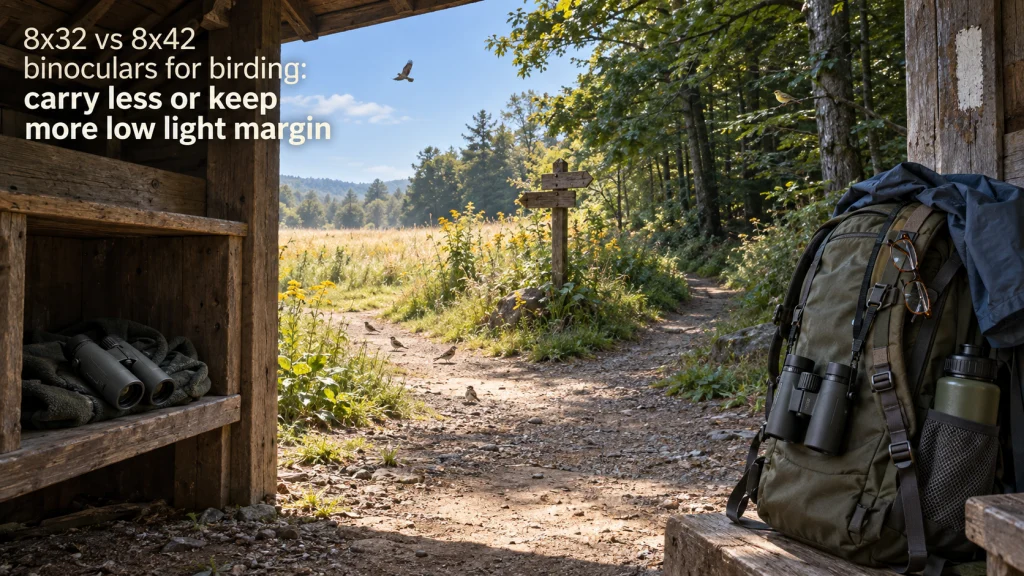
Hold magnification constant before comparing 32 mm and 42 mm
If you have already settled on 8x, do not reopen the magnification decision just because the 42 mm body looks more substantial. The broader birding binoculars guide covers the larger set of birding choices, while choosing binoculars around your actual viewing conditions puts size in the context of fit, field, carry, and budget. Here, both candidates magnify a bird by the same amount. What changes is how much glass and body you carry around that shared 8x view.
That distinction matters on a trail because image scale is only one part of finding and following a bird. A lighter binocular can be easier to keep on a strap, bring to the eyes quickly, and tolerate over a long walk, while a larger exit pupil can leave more margin when light gets dimmer or eye placement is less exact. Neither advantage needs to win every hour of the day to matter. The decision is which one solves the condition that repeats often enough to justify its trade-off.

This Nature DX pairs 8x magnification with 32 mm objectives, keeping image scale at 8x in a compact roof-prism format. Celestron lists phase-coated BaK-4 prisms and waterproof, fogproof construction for this exact 8x32 model. It fits a comparison where magnification stays fixed and objective size is the variable to evaluate.
Check on AmazonIf you click this link and buy, we earn a commission at no additional cost to you.
8×32 and 8×42 solve the same image scale with different physical envelopes
An 8×32 and an 8×42 can point at the same warbler at the same distance and present the same nominal 8x magnification. The 32 mm objective lets designers build a smaller front end, but the finished dimensions still depend on the exact optical and mechanical design. The 42 mm version usually needs more lens area and housing around it, so it commonly carries more mass and bulk. That is a physical tendency, not permission to assume every 8×32 is smaller than every 8×42 on the market.
The practical test is simple: think about where the binocular spends most of the outing. If it rides on your neck or chest for hours between short bursts of viewing, a few ounces and a shorter body can matter repeatedly. If you mostly stand in one area, move less, or spend long periods glassing shaded habitat, the extra size may bother you less. Compare actual dimensions and weight before treating the objective number as a complete description of portability.
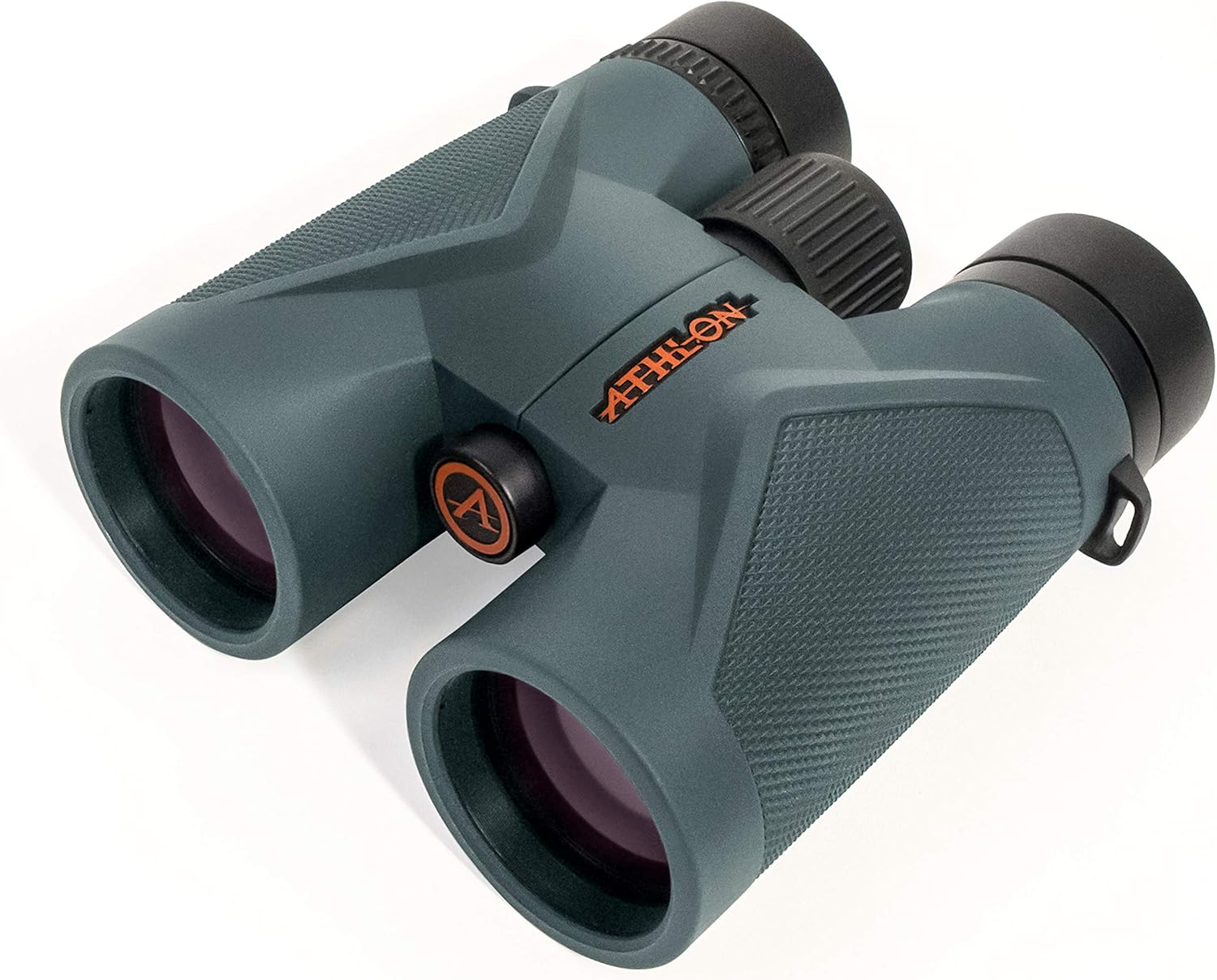
This Midas UHD uses 8x magnification with 42 mm objectives and ED glass in a waterproof, fogproof body. The 8x42 format represents the larger physical envelope discussed in this section without changing image scale. Its exact model specifications should still be compared against a 32 mm option rather than inferred from the objective number alone.
Check on AmazonIf you click this link and buy, we earn a commission at no additional cost to you.
32 divided by 8 gives a 4 mm geometric exit pupil
Exit pupil is straightforward optical geometry: divide the objective diameter by magnification. For an 8×32, 32 divided by 8 equals 4 mm. That tells you the nominal diameter of the light beam leaving the eyepiece, not how bright a particular scene will look to every person. It is useful because it gives a clean way to compare two configurations while keeping magnification fixed.
A 4 mm exit pupil can be entirely workable for everyday birding, especially when the repeated priority is keeping the binocular smaller and lighter. It does not make an 8×32 a travel-only instrument, and it does not make low-light use impossible. Optical transmission, contrast, coatings, field conditions, and the observer still affect the experience of a finished binocular. Treat the 4 mm figure as one design variable that must be read alongside the exact model rather than as a verdict by itself.

This TrailSeeker ED combines 8x magnification with 32 mm objectives, which gives a 4 mm geometric exit pupil. Celestron lists ED objectives, phase- and dielectric-coated BaK-4 prisms, and fully broadband multi-coated optics on this model. Its 8x32 configuration makes the exit-pupil calculation concrete without changing magnification.
Check on AmazonIf you click this link and buy, we earn a commission at no additional cost to you.
42 divided by 8 gives a 5.25 mm geometric exit pupil
For an 8×42, the same arithmetic gives 42 divided by 8, or 5.25 mm. A manufacturer may round that value in its technical table, but the underlying comparison is unchanged. The larger exit pupil creates a wider outgoing beam than the 4 mm beam of an 8×32. That is the optical reason a 42 mm version can offer more margin when conditions are less forgiving.
The larger beam is useful only if that extra margin connects to a real birding constraint. Someone who repeatedly watches under dense canopy, in dim weather, or near the edges of usable daylight has a stronger reason to value it than someone who mainly walks in open daylight. The benefit also has to be weighed against the larger body that produces it. If the 42 mm binocular stays home more often because it is annoying to carry, its geometric advantage is not helping much.

This Nature DX combines 8x magnification with 42 mm objectives, producing a 5.25 mm geometric exit pupil. Celestron lists phase-coated BaK-4 prisms and fully multi-coated optics for this exact 8x42 model. It is a direct example of the larger outgoing beam discussed in this section while keeping magnification fixed at 8x.
Check on AmazonIf you click this link and buy, we earn a commission at no additional cost to you.
Exit pupil is not a personal brightness guarantee
The 5.25 mm versus 4 mm comparison should not be turned into a universal claim that every 8×42 will look brighter to every observer in every condition. Exit pupil describes beam geometry, while the finished view also depends on optical transmission, contrast, baffling, coatings, alignment, and the amount of ambient light. Two binoculars from different quality levels can therefore complicate a simple objective-size comparison. That is why a same-family pair is especially useful when you want to isolate what changes without pretending every other variable is equal.
There is also no need to make physiology claims to choose sensibly. You can decide from observable conditions: how often you bird in dim habitat, whether eye placement feels finicky, and how much extra bulk you are willing to carry for more optical margin. If most of your viewing happens in good light, the larger exit pupil may be an occasional benefit rather than a daily one. Keep the claim narrow and let your actual birding pattern determine how much weight it deserves.

These individually packaged ZEISS wipes are pre-moistened for single-use lens cleaning and come in a 200-count box. ZEISS lists them as suitable for eyeglasses, prescription lenses, and anti-reflective coatings. Keeping optical surfaces clean supports consistent viewing without treating exit-pupil size as a guarantee of perceived brightness.
Check on AmazonIf you click this link and buy, we earn a commission at no additional cost to you.
A same-family comparison shows why exact models matter
The ZEISS Conquest HDX 8×32 and 8×42 make a useful controlled example because the magnification and product family stay the same. ZEISS lists the 8×32 at 21.9 oz, 5.2 in long, and 4.5 in wide at a 65 mm interpupillary distance, while the 8×42 is 25.2 oz, 5.9 in long, and 4.7 in wide at the same interpupillary setting. The 8×32 also has a 420 ft field of view at 1,000 yd and 4.9 ft close focus, compared with 384 ft and 6.6 ft for the 8×42. Published eye relief is 16.5 mm for both, so the larger objective does not buy more eye relief in this particular family.
Those numbers are not a recommendation for either model. They show why the category label alone is too crude for a buying decision: in this pair, the smaller binocular is lighter, has the wider published field, and focuses closer, while the larger one provides the larger exit pupil. Another product family can arrange those trade-offs differently. The family name controls some variables, but it does not turn objective size into a universal predictor. Compare the exact pair you are considering before repeating rules such as “8×32 is always wider” or “8×42 is always easier with glasses.”
| Specification | ZEISS Conquest HDX 8×32 | ZEISS Conquest HDX 8×42 | Decision meaning |
|---|---|---|---|
| Magnification | 8x | 8x | Image scale stays constant |
| Geometric exit pupil | 4.0 mm | 5.25 mm | The 42 mm version provides more exit-pupil margin |
| Weight | 21.9 oz | 25.2 oz | The 32 mm version removes 3.3 oz in this family |
| Length | 5.2 in | 5.9 in | The 32 mm version is 0.7 in shorter in this family |
| Width at 65 mm interpupillary distance | 4.5 in | 4.7 in | The 32 mm version is also slightly narrower at the same setting |
| Field of view at 1,000 yd | 420 ft | 384 ft | The 32 mm version is wider in this family |
| Close focus | 4.9 ft | 6.6 ft | The 32 mm version focuses closer in this family |
| Published eye relief | 16.5 mm | 16.5 mm | No published eye-relief advantage for the 42 mm version here |
Use this strip as a model for your own comparison. Hold magnification constant, then write down the specifications that actually change and connect each one to a birding task. A larger objective should earn its place through a repeated benefit rather than through reputation alone. A smaller objective should earn its place by solving carry or handling problems without giving up something you rely on.

This Conquest HDX is the 8x42 member of the ZEISS family discussed in the article. The Amazon listing identifies HD glass, LotuTec coating, and waterproof all-weather construction for this model. It is useful for exact-model comparison because the family and magnification stay controlled while the objective format is explicit.
Check on AmazonIf you click this link and buy, we earn a commission at no additional cost to you.
Choose 8×32 when all-day carry and normal daylight dominate
An 8×32 makes the strongest case when the binocular is with you for hours but at your eyes for shorter intervals. Hiking trails, city parks, open woodland, and mixed outdoor days can reward a body that is easier to pack and less noticeable on a strap. The benefit repeats every minute you carry it, not just when you raise it to your eyes. That repeated carry advantage can be more important than extra optical margin you rarely need.
Do not reduce that choice to “compact equals compromise.” A good 8×32 can still offer a generous field, useful close focus, and enough eye relief for many users, but those are model-specific checks. Balance and grip still vary by design, so lower weight should not be confused with automatically better handling. The strongest case is practical rather than categorical. Choose 8×32 when smaller size solves a persistent problem and the conditions in which you bird do not repeatedly expose a limitation you care about.

This Hawke Endurance ED is the 8x32 roof-prism version with a rubber-armored black body. Its 32 mm objective format keeps the binocular in the smaller class discussed for long days on foot. It is a relevant model to check when carry size matters but the decision still needs to stay tied to the exact binocular rather than the category label.
Check on AmazonIf you click this link and buy, we earn a commission at no additional cost to you.
Choose 8×42 when dim habitat or a larger viewing envelope repeatedly matters
An 8×42 earns its extra size when the larger exit pupil answers a condition you meet often rather than occasionally. Birding under dense canopy, in dull weather, or during the dimmer parts of a session gives the 42 mm format a clearer reason to exist. Some users may also prefer the more generous eye-placement margin that a larger exit pupil can provide. That is a handling benefit worth checking in person because eyecup shape, eye relief, and facial fit still affect the result.
The 42 mm choice is less convincing when it is made from the assumption that “serious birders use 8×42.” A configuration is useful because of what it changes for you, not because it sounds more capable on paper. If the extra weight in the exact models you are comparing becomes irritating during long walks, count that as a real cost. That cost exists on every carry, even when the light is excellent. Choose 8×42 when you repeatedly use the margin it provides and are comfortable carrying the physical package that comes with it.

This TrailSeeker pairs 8x magnification with 42 mm objectives and a lightweight magnesium body. Celestron lists phase- and dielectric-coated optics, twist-up eyecups, and a 6.5-foot close focus for this exact model. The 8x42 format is directly relevant when larger-objective viewing margin matters often enough to justify the bigger physical package.
Check on AmazonIf you click this link and buy, we earn a commission at no additional cost to you.
Field of view and close focus still require exact-model checks
Objective size does not determine field of view by itself. In the Conquest HDX example, the 8×32 is wider than the 8×42, but that relationship cannot be generalized to every product line. A wider field can help you acquire a moving bird and keep it in view as it crosses branches or open sky. If field width matters to your birding, compare the published number on the exact models rather than using 32 mm or 42 mm as a shortcut.
Close focus deserves the same treatment, especially for feeders, nearby shrubs, butterflies encountered during birding walks, or birds that land surprisingly close. The same-family example happens to favor the 8×32, but another family may not. If much of your viewing happens around a yard or feeder setup, the practical checks in our backyard birding binoculars guide can help you decide how much close focus matters. Measure the distances you actually use, then compare them with the manufacturer specification.
This Nature DX 10x32 shows why field of view has to be checked on the exact model rather than inferred from objective size. Amazon lists a 7.4-degree field of view along with 10x magnification and 32 mm objectives for this variant. Its published configuration is a useful reminder that magnification and optical design both affect the viewing envelope.
Check on AmazonIf you click this link and buy, we earn a commission at no additional cost to you.
Eye relief and weight can decide the size choice faster than objective diameter
For eyeglass wearers, published eye relief should be checked directly rather than inferred from objective size. The Conquest HDX pair lists the same 16.5 mm eye relief even though one uses 32 mm objectives and the other uses 42 mm objectives. That does not guarantee identical usable eye relief after eyecup geometry and personal fit are considered. It simply shows that a larger objective is not automatically a better answer for glasses.
Weight is more direct because you carry every ounce whether the light is challenging or not. Compare bare binocular weight, then remember that a strap, harness, caps, and case can increase the load you manage through the day. A 3.3 oz difference may sound small on a spec sheet but can become more noticeable after hours of walking, especially if the binocular hangs from the neck. If weight is already a known annoyance, treat it as a primary constraint instead of a tie-breaker.

The Vortex GlassPak uses adjustable harness straps and provides additional storage around the binocular setup. That makes it directly relevant when total carried weight includes more than the bare binocular. A harness can change how the load is supported, so it belongs in the real-world carry calculation alongside binocular weight.
Check on AmazonIf you click this link and buy, we earn a commission at no additional cost to you.
If 8x versus 10x is still unresolved, settle that before objective size
This comparison only works cleanly because magnification stays fixed at 8x. If you are still deciding whether you need more reach, then an 8×32 versus 8×42 choice is premature because changing magnification also changes field, steadiness, and exit pupil. Resolve that decision first, then return to the objective-size question with image scale no longer moving underneath you. Otherwise you can mistake a magnification trade-off for an objective-size trade-off.
For the 42 mm format, the dedicated 8×42 versus 10×42 birding comparison keeps objective size fixed while magnification changes. That is the cleaner place to decide whether 10x solves a real distance problem strongly enough to accept its own compromises. Once 8x is settled, the 32 mm versus 42 mm decision becomes much easier to read. One variable at a time produces a more useful comparison than mixing both at once.

This PROSTAFF P7 is the 10x42 variant, so it changes magnification while keeping a 42 mm objective format. Nikon lists waterproof and fogproof construction, rubber armor, and an oil- and water-repellent coating for this model. It is a useful reference when deciding whether 10x solves a real distance need before returning to the 32 mm versus 42 mm question.
Check on AmazonIf you click this link and buy, we earn a commission at no additional cost to you.
Use a birding size worksheet before buying
A short worksheet is more useful than asking which format is “best” in the abstract. Write down the situations that repeat in your birding, not the edge cases you encounter once or twice. Then compare the exact 8×32 and 8×42 models against those conditions using manufacturer specifications and your own fit checks. The format that wins more of the repeated constraints is usually the better purchase.
Do not let one impressive number erase the rest of the decision. A larger exit pupil can be valuable, but so can a wider field, shorter close focus, lower weight, or a body that fits your hands better. Eye relief can be identical across sizes or differ substantially depending on the models. Current price also matters, but it should come after you know which physical and optical trade-offs you are actually paying for.
| Check | Favor 8×32 when | Favor 8×42 when |
|---|---|---|
| Light | Most birding is in ordinary daylight | Dim habitat is a repeated part of your routine |
| Field of view | The exact 8×32 is wider and you value fast acquisition | The exact 8×42 is wide enough for your tracking needs |
| Close focus | The exact 8×32 better covers your near viewing distances | The exact 8×42 already focuses close enough |
| Eye relief | The exact model works with your glasses and eyecup position | The exact model fits your eyes better despite the larger body |
| Weight | You notice carry burden over long walks | The extra ounces do not change how often you carry it |
| Body size | Packability and one-hand handling matter often | You prefer the larger grip and have room to carry it |
| Price | The smaller model meets your constraints for less | The larger model solves a repeated need worth paying for |
Finish by ranking the checks instead of counting them equally. If carry burden bothers you every outing, it should outweigh a low-light advantage you use twice a year. If dim woodland is where you do most of your birding, the larger exit pupil may deserve more weight than a modest reduction in size. The worksheet works because it forces the configuration to solve your pattern rather than someone else’s.
- Choose the viewing conditions that repeat most often.
- Check exact field of view, close focus, eye relief, weight, and dimensions.
- Confirm the eyecup positions work with your face and glasses if you wear them.
- Compare current price only after the fit and optical priorities are clear.
- Skip an upgrade when your current binocular already solves the repeated constraints.
The last point is easy to overlook. A new objective size is not automatically an improvement if it fixes a problem you do not have. If your present 8x binocular is comfortable to carry, wide enough, close-focusing enough, and usable in the light where you bird, keeping it can be the rational choice. Buying should follow a demonstrated constraint, not create one.

This Rite in the Rain top-spiral notebook measures 3 by 5 inches and comes as a three-pack with yellow weatherproof covers. Its compact field format is suited to recording repeated birding conditions, model specifications, and fit notes outdoors. Writing the comparison down helps keep the decision tied to the constraints that actually recur.
Check on AmazonIf you click this link and buy, we earn a commission at no additional cost to you.
Final Thoughts: carry the objective size that solves a repeated birding constraint
The cleanest 8×32 versus 8×42 decision starts by refusing to call either format the automatic upgrade. Both preserve 8x magnification, but they package that view differently in weight, dimensions, exit pupil, field of view, and sometimes close focus. An 8×32 is compelling when lower carry burden keeps the binocular with you and the smaller exit pupil does not create a repeated problem. An 8×42 is compelling when dim habitat or a more forgiving viewing envelope matters often enough to justify the extra body.
Use exact specifications to verify the final choice because the size label cannot tell you the whole product. Check field of view, close focus, eye relief, weight, dimensions, and current price on the two models you are actually considering. Then give the most weight to the constraint you encounter most often. The better birding binocular is the one whose trade-offs match your routine, not the one with the larger objective number.

This PROSTAFF P3 uses 8x magnification with 42 mm objectives in a waterproof, fogproof full-size body. Nikon lists a wide field of view and long eye relief for this exact 8x42 model. It fits the final decision framework because field, eye relief, and carried size all need to be judged on the specific binocular rather than the 8x42 label alone.
Check on AmazonIf you click this link and buy, we earn a commission at no additional cost to you.
FAQs
🔭 Is 8×32 enough for serious birding?
Yes, if its field of view, eye relief, close focus, and low-light margin fit the conditions in which you actually bird. Do not treat 8×32 as a travel-only format; compare the exact model and your repeated use conditions.
🌲 Is 8×42 always better in low light?
No. An 8×42 has a larger geometric exit pupil than an 8×32, but perceived image quality also depends on the finished optical system and viewing conditions. Treat the larger exit pupil as added margin, not a universal brightness guarantee.
🎒 How much lighter is an 8×32 than an 8×42?
There is no fixed difference across all models. In the ZEISS Conquest HDX family used here, the published difference is 3.3 oz, but another product line can differ more or less.
👓 Is 8×42 automatically better for eyeglass wearers?
No. Eye relief and eyecup design are model-specific, and the same-family example in this article publishes identical eye relief for both sizes. Check the exact specification and, when possible, verify the usable view with your glasses.
🦅 Does 8×32 always have a wider field of view?
No. The 8×32 is wider in the controlled example here, but objective diameter does not determine field width by itself. Compare the published field of view for the exact binoculars you are considering.
📏 Does an 8×32 always focus closer than an 8×42?
No. Close focus depends on the exact optical and focusing design. Use the manufacturer specification and compare it with the shortest viewing distance that matters in your birding.
References and Sources
- ZEISS Conquest HDX technical data: Supports the model-specific field of view, exit pupil, weight, close focus, dimensions, and eye-relief figures used in the controlled comparison.