
Choosing between 8×42 and 10×42 binoculars for birding is not a free upgrade from less magnification to more. Holding the 42 mm objective size constant, 10x gives more image scale while 8x often gives a wider viewing window and makes hand movement less conspicuous. Exact field of view, eye relief, close focus, weight, and fit still depend on the specific models being compared. The better choice is the one that solves the viewing constraint you encounter repeatedly, not the one with the larger first number.
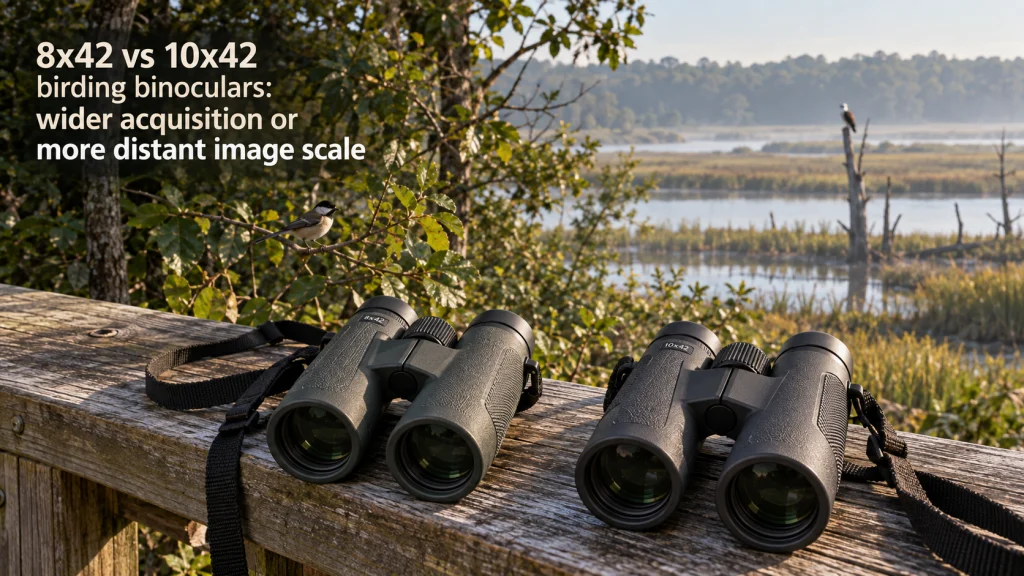
The same 42 mm objective does not create the same birding view
For 8×42 vs 10×42 binoculars for birding, the useful comparison starts with what changes while objective diameter stays the same. In the current Vortex Diamondback HD family, the 8×42 lists a 393-foot field of view at 1,000 yards and 17 mm of eye relief, while the 10×42 lists 330 feet and 15 mm; both list the same 5-foot close focus. The extra 2x therefore changes image scale, field of view, and eye-relief geometry in this pair, but it does not change the listed close-focus distance. That is the decision to keep in view: what did the additional magnification actually change, and which of those changes matters in the birding situations you repeat?
The decision therefore belongs in the viewing situation, not in a magnification ranking. If you are still deciding how a 42 mm model fits into your broader options, our birding binoculars guide provides the larger birding context. For a wider selection framework that includes fit, field of view, weight, and other use constraints, see our guide to choosing the best binoculars for your use. Here, the job is narrower: decide whether faster acquisition and a broader field or additional distant image scale solves the problem you encounter more often.

This 8x42 Diamondback HD uses Vortex HD optics and fully multi-coated lenses. The model is listed as waterproof, fogproof, and shockproof for outdoor use. Its 8x magnification and 42 mm objectives make it a direct fit for comparing the broader-view side of this article.
Check on AmazonIf you click this link and buy, we earn a commission at no additional cost to you.
Hold the 42 mm objective and product family constant before judging 8x against 10x
Comparing an 8×42 from one family with a 10×42 from another can mix magnification differences with unrelated changes in optical design, eyecups, focus behavior, coatings, body shape, and weight. A same-family pair is cleaner because more of the surrounding design stays comparable. That is why the Diamondback HD 8×42 and 10×42 are useful here as a controlled specification example rather than as product recommendations. They let the magnification change remain visible without pretending that every difference between every 8×42 and 10×42 comes from magnification alone.
Several buyer-relevant specifications can move independently. In the Vortex pair, close focus is 5 feet for both powers, while field of view and eye relief differ. Nikon’s MONARCH M5 pair also shares one close-focus figure while field of view, eye relief, and weight differ. Compare the exact variants you could buy, then treat magnification as one variable inside that design.

This PROSTAFF P7 is the official Nikon USA 10x42 model with a rubber-armored body. It is listed as waterproof and fogproof, with an oil- and water-repellent coating on the outer lenses. A locking diopter helps preserve the user-specific adjustment once it is set.
Check on AmazonIf you click this link and buy, we earn a commission at no additional cost to you.
10x provides more image scale, not automatically more useful detail
A 10x binocular makes the angular size of a distant bird larger than an 8x binocular does, assuming the viewing distance is unchanged. That extra scale can be useful when the bird is small in the scene or repeatedly far away. It does not guarantee that you will resolve proportionally more useful detail, because optical quality, atmospheric conditions, focus accuracy, eye position, and movement still affect what reaches your eye. The practical question is whether the additional scale remains usable in the situations you actually encounter.
A simple percentage comparison can mislead. Moving from 8x to 10x increases nominal magnification, but it does not erase a narrower field or more visible hand movement. A stationary distant bird may give the extra scale time to matter, while a nearby bird hopping through branches may expose the acquisition cost first. I would credit 10x for added image scale without treating that scale as a universal measure of useful detail.

This Copperhead HD pairs 10x magnification with 42 mm objective lenses. Vortex lists an HD optical system and fully multi-coated lenses, while the package includes a GlassPak binocular harness. The 10x42 configuration makes it a direct example of the added image-scale side of this comparison.
Check on AmazonIf you click this link and buy, we earn a commission at no additional cost to you.
8x usually leaves more field for locating and following birds in comparable designs
Cornell’s birding guidance describes a wide and steady field as one reason many birders settle on 8x, especially when locating and following birds matters. The benefit is easy to understand in use: a wider field gives you more visual room when the binocular reaches your eyes slightly off target. It also gives a moving bird more space before it exits the frame, which can reduce the need for abrupt corrections. That advantage is about acquisition and tracking, not about claiming that 8x has better optics by definition.
The word usually matters because field of view is an exact-model specification, not a law attached to 8x. Models at the same magnification can differ, and eyeglass position can reduce the effective field. In many same-family pairs, the 8x version still lists a wider field than the 10x version. If you repeatedly lose moving birds as you raise the binocular, exact field of view deserves more weight than extra magnification.

This MONARCH M5 is Nikon's 8x42 model with ED glass and dielectric prism coatings. It is listed as waterproof and fogproof with a rubber-armored body. The 8x42 format is well suited to a section focused on acquisition and field width rather than maximum image scale.
Check on AmazonIf you click this link and buy, we earn a commission at no additional cost to you.
Current same-family Vortex data show why exact field of view should be checked rather than assumed
The Diamondback HD pair gives a concrete comparison with the same 42 mm objective. Vortex lists 393 feet at 1,000 yards for the 8×42 and 330 feet for the 10×42. That 63-foot difference can matter when a bird moves through a broad scene. The numbers do not define every pair, but exact manufacturer data can reveal a real handling consequence before purchase.
Nikon’s MONARCH M5 family reinforces the need to check rather than generalize. Nikon lists 335 feet at 1,000 yards for the 8×42 and 293 feet for the 10×42, so the same direction appears in a second current family even though the absolute values are different. That is the right way to use a pattern: as a reason to verify a specification, not as permission to invent one. When comparing two models, use the field figure for those exact models and then ask whether the narrower or wider view affects how you find and stay with birds.

This Nature DX is an 8x42 roof-prism binocular with a listed 7.4-degree field of view. It uses phase-coated BaK-4 prisms and fully multi-coated optics, and the body is waterproof and fogproof. Its published field figure gives readers another exact-model specification to compare instead of assuming field of view from magnification alone.
Check on AmazonIf you click this link and buy, we earn a commission at no additional cost to you.
The exit pupil changes from 5.25 mm at 8×42 to 4.2 mm at 10×42
Exit pupil is straightforward geometry: divide objective diameter by magnification. A 42 mm objective divided by 8 gives 5.25 mm, while 42 divided by 10 gives 4.2 mm. That difference helps explain why equal-objective binoculars can present different light-delivery geometry at the eyepiece. It does not, by itself, prove that every user will see the 8×42 as brighter in every condition.
Whole-binocular performance still depends on transmission, coatings, prism design, contrast, stray-light control, eye position, and the light level in the scene. Your own eye also limits how much of the exit pupil is useful at a given moment, so exit-pupil diameter should not be converted into a universal low-light verdict. The calculation is valuable because it is transparent and exact, not because it replaces evaluation of the actual model. Use it to understand what magnification changes geometrically, then keep optical quality and viewing conditions in the decision.

This Bushnell H2O Xtreme combines 10x magnification with 42 mm objective lenses. Its listed exit pupil is 4.2 mm, with 17 mm eye relief and fully multi-coated optics. The waterproof and fogproof design makes it a concrete 10x42 example for the section's exit-pupil calculation.
Check on AmazonIf you click this link and buy, we earn a commission at no additional cost to you.
Higher magnification makes hand movement more visible without creating a universal handheld cutoff
Any motion in the binocular also becomes part of the magnified view, so higher magnification makes the apparent movement of the scene more noticeable. Cornell specifically cautions that 10x can exaggerate unsteadiness from shaking or jostling. That does not mean 10×42 binoculars require a tripod, nor does it establish a medical or physical threshold for who can use them. Grip, body position, binocular balance, viewing duration, and the observer all affect whether the movement becomes distracting.
This is best treated as a trial condition rather than a label. Bring the binocular to your eyes, settle on a distant fine-detail target, and see whether the image stays readable long enough for the type of observation you expect to make. A brief view of a perched bird may be easy with 10x, while a longer scan across open habitat may make the same movement more tiring to work around. If extra image scale is repeatedly canceled by a restless view, 8x may deliver more usable information even though it magnifies less.
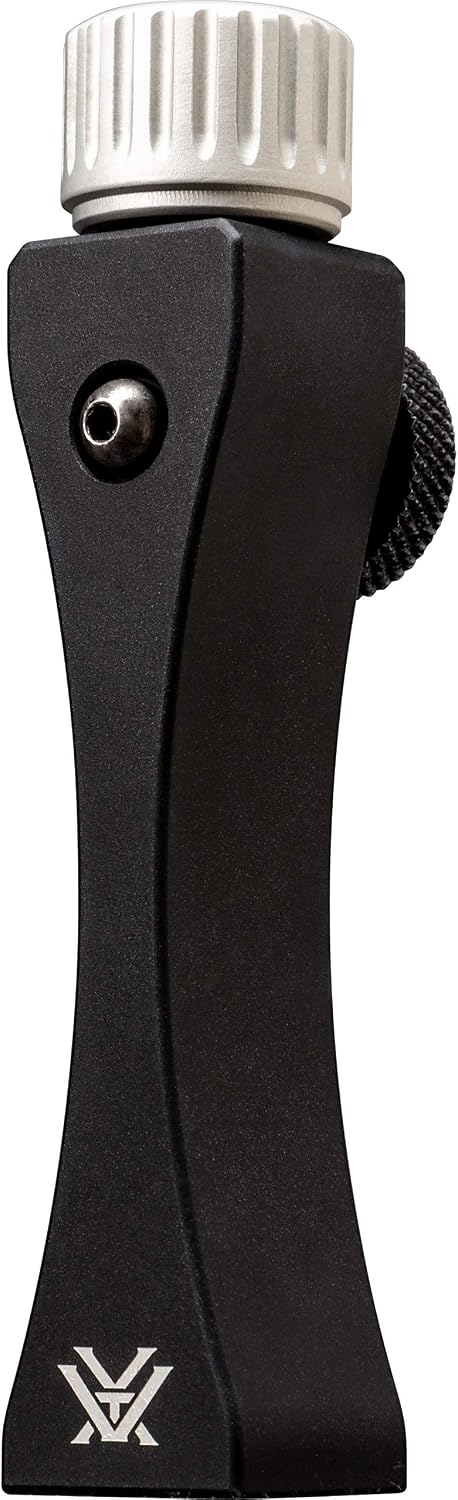
This Vortex Pro Binocular Adapter is designed to support compatible tripod-adaptable binoculars on a tripod or similar support. It provides a rigid mounting connection using standard 1/4-20 hardware. That makes it directly relevant when higher magnification reveals more hand movement during longer observations.
Check on AmazonIf you click this link and buy, we earn a commission at no additional cost to you.
Close focus can be identical across the two powers in one family and different in another
Close focus is a good example of why magnification should not be asked to explain every specification. Vortex lists the Diamondback HD 8×42 and 10×42 at the same 5-foot close focus. Nikon likewise lists the MONARCH M5 8×42 and 10×42 at the same 8.2-foot close focus. In both controlled pairs, changing from 8x to 10x did not change the manufacturer’s listed minimum focusing distance.
That does not mean all 8×42 and 10×42 versions will match. Different focus mechanisms and optical layouts can produce different close-focus specifications, even when the magnification labels look familiar. If nearby feeder activity, insects, or birds at short garden distances are part of your routine, verify the actual close-focus number on the exact variant instead of assuming 8x or 10x decides it. The useful lesson is that some important ownership characteristics belong to the model design, not to the magnification number alone.

This official Nikon USA PROSTAFF P3 is a 10x42 waterproof and fogproof binocular with a rubber-armored body. The listed close focus is 9.8 feet, with a 367-foot field of view at 1,000 yards. Those exact model specifications make it useful when showing that close focus must be checked rather than inferred from magnification.
Check on AmazonIf you click this link and buy, we earn a commission at no additional cost to you.
Eye relief can also change between powers, which matters for eyeglass users
Eye relief deserves its own check because the same family can provide different listed values at 8x and 10x. Vortex lists 17 mm for the Diamondback HD 8×42 and 15 mm for the 10×42. Nikon lists 19.5 mm for the MONARCH M5 8×42 and 18.4 mm for the 10×42. Those figures show why an eyeglass wearer should not assume that choosing a different power leaves the viewing geometry around the eyepiece unchanged.
A published eye-relief number is still only the start of the fit check. Eyecup shape, usable eye relief, frame position, facial anatomy, and how easily you can see the full field all matter. With glasses on, test whether you can obtain a complete image without pressing the binocular into the lenses or hunting constantly for eye position. If one power gives extra magnification but cuts away the field you can actually see, the nominal advantage may not solve your real birding problem.

This Bushnell Prime is a 10x42 roof-prism binocular with 19 mm of listed eye relief. It uses fully multi-coated optics and BaK-4 prism glass, and the body is waterproof. The generous published eye-relief figure makes it a relevant model for a section focused on eyeglass fit.
Check on AmazonIf you click this link and buy, we earn a commission at no additional cost to you.
Choose 8×42 when rapid acquisition and a broader viewing window are the recurring constraint
8x earns its place when the repeated problem is getting onto a bird quickly and keeping it in view. That can happen in dense branches, along an active woodland edge, at a feeder with frequent short movements, or anywhere the bird changes direction before you have time to settle the frame. A wider field can make the transition from unaided view to magnified view more forgiving. Lower magnification also makes hand movement less enlarged, which can help the view feel calmer during active scanning.
None of those contexts creates a permanent habitat rule. An open meadow can still favor 8x if birds are close and moving quickly, and a wooded setting can still reward 10x when the sightline is long and stable. The choice becomes persuasive when the same constraint appears again and again during your normal viewing. If you keep missing birds at acquisition or losing them at the edge of the frame, prioritize field of view, fit, and handling before paying for image scale you may not keep on target.

This Bushnell H2O uses 8x magnification with 42 mm objective lenses. The optical system is O-ring sealed and the model is listed as waterproof and fogproof. Its 8x42 configuration fits a section where a wider, calmer handheld viewing setup is the recurring priority.
Check on AmazonIf you click this link and buy, we earn a commission at no additional cost to you.
Choose 10×42 when repeated long-distance viewing earns the additional image scale
10x becomes more convincing when the birds you care about are routinely small in the scene and remain far enough away that added scale has time to help. Cornell points to long-distance situations such as shorebirds, raptors, and seabirds as cases where some observers prefer 10x. The important phrase is repeated long-distance viewing, because an occasional distant bird is not the same as building most of your birding around long sightlines. If the distant view is your normal view, accepting a narrower field can be a rational trade.
Before making that trade, test whether you can hold the image steadily enough and whether the exact 10x model still works with your glasses, grip, and focus needs. Also compare field of view rather than assuming every 10x feels equally narrow. If long-distance image scale solves a frequent problem and the handling costs remain acceptable, 10×42 can be the better fit. If the distance advantage is rare, the extra power can become something you carry all day but use only occasionally.

This Celestron Outland X uses 10x magnification and 42 mm objectives with BaK-4 prisms and multi-coated optics. It is listed as waterproof and fogproof with a 5.5-degree field of view. That 10x42 configuration gives a concrete long-distance-oriented option while keeping the field tradeoff visible in an exact specification.
Check on AmazonIf you click this link and buy, we earn a commission at no additional cost to you.
Treat woodland, shorebird, waterfowl, and raptor examples as contexts, not permanent rules
Habitat labels are useful only when they point to a real viewing constraint. Woodland often implies shorter sightlines, visual clutter, and fast target acquisition, which can make a wider field attractive. Shorebird or raptor viewing can imply greater distance and longer time on a target, which can make additional image scale useful. But habitat names do not tell you the exact distance, movement pattern, lighting, or fit demands you will face on a particular outing.
A better decision starts with the recurring scene rather than the species category. Ask whether your birds are usually near or far, whether they move unpredictably, whether you scan for long periods, and whether glasses or hand fit reduce the field you can use. If your birding includes sustained distant raptor viewing, our binocular guidance for hawk watching goes deeper into that specific viewing pattern. For this comparison, keep the rule simple: use habitat as evidence about distance and movement, never as a shortcut that assigns one magnification permanently.

This Vortex GlassPak carries binoculars in a chest-mounted pouch with integrated tethers for retention. The harness includes quick-access side mesh pockets and a rear zippered pocket for small field items. It is useful when birding contexts change because the binocular can stay secured and accessible without turning a habitat label into a magnification rule.
Check on AmazonIf you click this link and buy, we earn a commission at no additional cost to you.
A practical comparison worksheet for 8×42 vs 10×42 birding
A useful worksheet should return the decision to the exact models and viewing situations. Write the two model names, then copy specifications that affect acquisition, holding, focus, or fit. Do not fill missing data with category averages, because a comfortable 10x can beat a poorly fitting 8x for one user. Compare the trade you will live with instead of scoring magnification as if one number wins every row.
Use the table first, then try the binocular if possible. Field of view, eye relief, close focus, and weight can narrow the choice, but eye position and steadiness still require a fit check. Price should come later because a cheaper configuration that misses your viewing constraint is not automatically better value. Paying more for power you do not need does not create a better setup either.
| Decision check | What to compare | What favors 8×42 | What can favor 10×42 |
|---|---|---|---|
| Target distance | Your normal viewing range | Near to moderate distances with active targets | Repeated long-distance viewing |
| Field of view | Exact manufacturer figure | More room for acquisition and tracking in many same-family pairs | Acceptable if added image scale matters more |
| Hand movement | Readable detail while handheld | Less apparent movement at lower magnification | Works when the user can keep the view sufficiently settled |
| Eye relief | Exact value plus real eyeglass fit | May be longer in a given family | Fine when the exact model still shows the full usable field |
| Close focus | Exact model specification | Do not predict it from magnification alone | |
| Weight | Exact model weight and balance | Check the specific pair because either power can be slightly heavier | |
Distance, movement, and field of view
Write down where the bird usually is when you first notice it and whether it tends to stay put. If your routine is mostly quick acquisition at modest distances, compare field of view before magnification. If your routine is mostly distant scanning with time to settle on the target, give image scale more weight. The correct row is the one that describes your repeated situation, not the most dramatic birding scenario you can imagine.
Eye relief, close focus, and light
Copy eye relief and close focus from the exact manufacturer pages, especially if you wear glasses or often watch birds at short distances. Calculate exit pupil from objective diameter and magnification, but do not use that number as a complete brightness score. Fit and optical transmission can change the experience even when the geometry is known. If one configuration consistently gives you a fuller usable view, that practical fit should outweigh a theoretical advantage you cannot comfortably see.
Weight and price
Weight differences inside one family can be small, reversed, or effectively negligible, so copy the actual numbers rather than assuming 10x must be heavier. Then handle the binocular long enough to notice whether balance and grip make that weight comfortable. Compare current price only after the viewing and fit constraints are clear, because price alone cannot tell you which power you will use more successfully. A lower price is useful when the configuration fits, not when it buys the wrong viewing window.
- Verify field of view on the exact 8×42 and 10×42 variants.
- Check eye relief with your normal eyeglasses if you wear them.
- Confirm close focus instead of inferring it from magnification.
- Try a distant fine-detail target handheld and compare how readable the view remains.
- Let recurring distance and movement decide how much extra image scale is worth giving up field.
After the worksheet, one pattern should become clearer: the choice is not really between a weaker and stronger binocular. It is between two viewing compromises built around the same objective size. If the answers still split evenly, the safest next step is to try both powers in the same family and pay attention to acquisition, steadiness, and usable field. Those observations resolve the decision more reliably than choosing the larger magnification number by default.

This Gosky model pairs 10x magnification with 42 mm objectives, BaK-4 prisms, and fully multi-coated optics. The listed field of view is 304 feet and the exit pupil is 4.2 mm. It also includes a phone adapter, tripod, and tripod adapter, giving the worksheet several exact specifications and included components to verify.
Check on AmazonIf you click this link and buy, we earn a commission at no additional cost to you.
Final Thoughts: choose the power that solves the repeated birding constraint
For most buyers, the cleanest way to decide is to identify the problem that appears most often. If you repeatedly need a wider window for fast acquisition, moving birds, and a calmer handheld view, an 8×42 configuration deserves the stronger case. If your normal viewing is genuinely distant and the additional image scale stays usable in your hands, 10×42 can earn the narrower field. Neither answer needs a universal habitat rule or a claim that one power is objectively superior.
Before buying, compare exact field of view, eye relief, close focus, weight, and fit within the family you are considering. Treat exit pupil as transparent geometry, not as a complete low-light score, and treat manufacturer specifications as the start of a fit check rather than the end. If possible, raise both powers to your eyes and test the same nearby moving target and the same distant fine-detail target. The better choice is the one that makes your repeated birding situation easier to see, acquire, and follow.
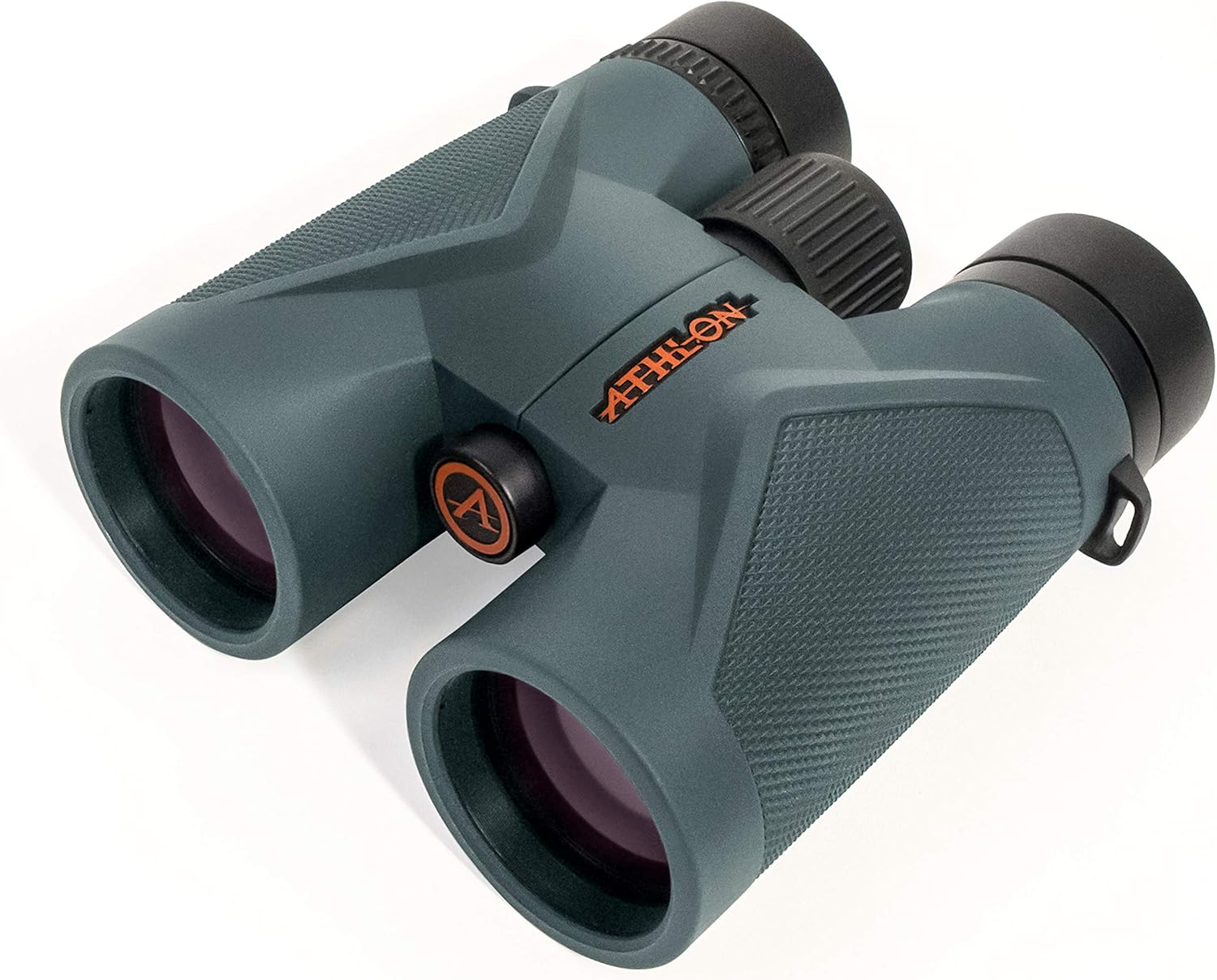
This Athlon Midas UHD is an 8x42 binocular built with ED glass and advanced fully multi-coated optics. The listing specifies dielectric prism coating, argon purging, and an 8.1-degree angular field of view. It provides a final 8x42 example that can be judged by its exact optical and fit specifications instead of magnification alone.
Check on AmazonIf you click this link and buy, we earn a commission at no additional cost to you.
FAQs
🔭 Is 8×42 or 10×42 better for general birding?
8×42 often suits general birding when fast acquisition, a wider field, and a steadier-looking handheld view matter most. Choose 10×42 when your normal viewing is farther away and the extra image scale remains comfortable and stable for you.
🌲 Is 8×42 always better in woods?
No. Woods often create short sightlines and fast target movement that can favor a wider field, but the real decision depends on your distance, movement, and exact model. A long, open sightline through woodland can still make 10x useful.
🦅 Is 10×42 only for raptors and shorebirds?
No. Those are useful examples of repeated long-distance viewing, not exclusive uses for 10×42. Any situation where distant image scale matters consistently can justify 10x if field of view and steadiness remain acceptable.
👓 Which power is better if I wear glasses?
Check the exact eye relief and then verify that you can see the full usable field with your normal glasses. Magnification alone does not determine eyeglass fit, and two powers in the same family can list different eye-relief values.
📏 Does 10×42 always have a narrower field of view than 8×42?
Comparable same-family pairs often show that pattern, but field of view is still an exact-model specification. Check the manufacturer figure for both variants you are considering rather than applying a generic number.
🌅 Is 8×42 always brighter than 10×42?
No. The exit-pupil geometry is larger for 8×42, at 5.25 mm versus 4.2 mm for 10×42, but perceived low-light performance also depends on the optical system, transmission, eye position, and viewing conditions.
References and Sources
- Cornell Lab binocular selection guidance: supports the birding context for 8x wide-field handling, 10x long-distance preference, field of view, and visible unsteadiness.
- Vortex Diamondback HD 8×42 specifications: verifies the 8×42 field of view, eye relief, close focus, dimensions, and weight used in the same-family comparison.
- Vortex Diamondback HD 10×42 specifications: verifies the 10×42 field of view, eye relief, close focus, dimensions, and weight used in the same-family comparison.
- Nikon MONARCH M5 specifications: provides a second same-family 8×42 and 10×42 check for field of view, eye relief, close focus, exit pupil, and weight.