Choosing between 8×25 and 10×25 binoculars is not a choice between a basic option and a free upgrade. When the objective diameter and body stay compact, 10x gives more image scale, while 8x usually preserves more viewing margin through a wider field and a larger exit pupil. A current same-family comparison makes that trade easier to see because size and weight no longer distract from the optical changes. The better choice depends on whether extra reach matters more than quick subject acquisition, eye placement tolerance, and handheld stability for the way you actually observe.
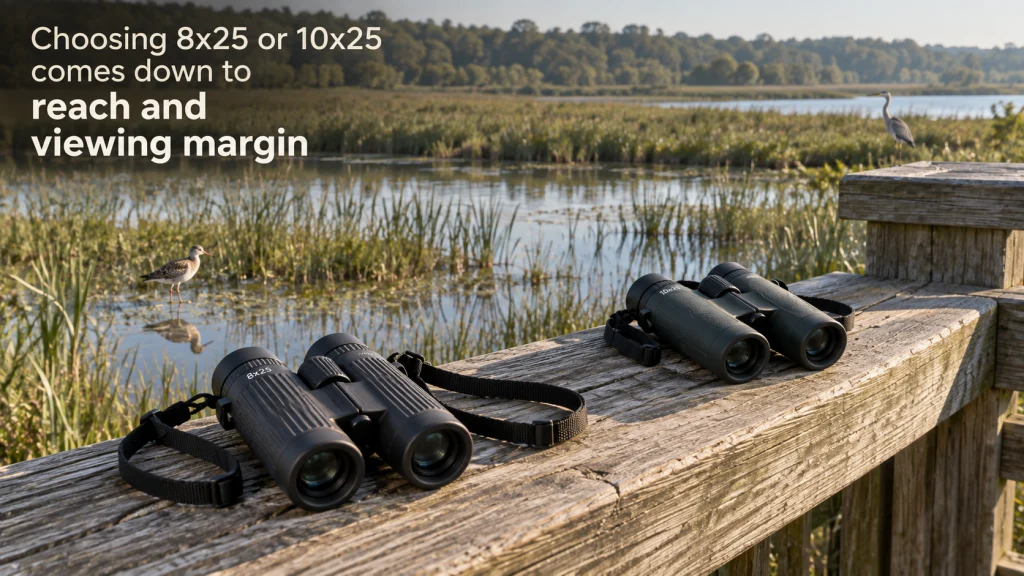
Same 25 mm body, same weight, different viewing margin
The useful way to approach 8×25 vs 10×25 binoculars is to hold the compact format steady and ask what the extra magnification changes. Nikon’s current TRAILBLAZER II pair is unusually clean evidence for that comparison because both versions use 25 mm objectives, weigh 10.9 oz, list the same 3.9 by 4.5 inch body size, and provide 10 mm of eye relief. The 10x model therefore does not gain its reach by becoming a visibly larger or heavier instrument in this pair. What changes is the view you have to work with once the binocular is at your eyes.
That is also why this comparison belongs inside the broader decision about how compact binoculars trade viewing ease for portability, not in a generic argument that higher magnification must be better. If you are still deciding whether a pocketable 25 mm format is right at all, the main binocular types and their practical tradeoffs provide the wider frame first. Here, the 25 mm objective is already accepted, so the decision is narrower: do you want more nominal reach, or more margin for finding, holding, and staying on the view? Keeping that boundary clear prevents the comparison from turning into a ranking of unrelated binoculars.

This 8x25 roof-prism compact uses BaK4 prisms and fully multi-coated lenses. Its 3.2 mm exit pupil and 357-foot field at 1,000 yards give the 8x configuration useful viewing margin. The IPX7, nitrogen-filled body weighs 11.85 ounces.
Check on AmazonIf you click this link and buy, we earn a commission at no additional cost to you.
Hold objective diameter and body size constant before comparing magnification
Comparing random 8×25 and 10×25 models across brands can hide the actual magnification trade behind different eyepieces, hinges, coatings, weights, and focus systems. A same-family pair removes much of that noise. In Nikon’s TRAILBLAZER II specifications, the 8×25 and 10×25 share the same listed weight, body dimensions, objective diameter, eye relief, interpupillary range, roof-prism layout, and waterproof or fogproof designation. That leaves magnification, field of view, exit pupil, apparent field, and close focus as some of the most relevant listed differences.
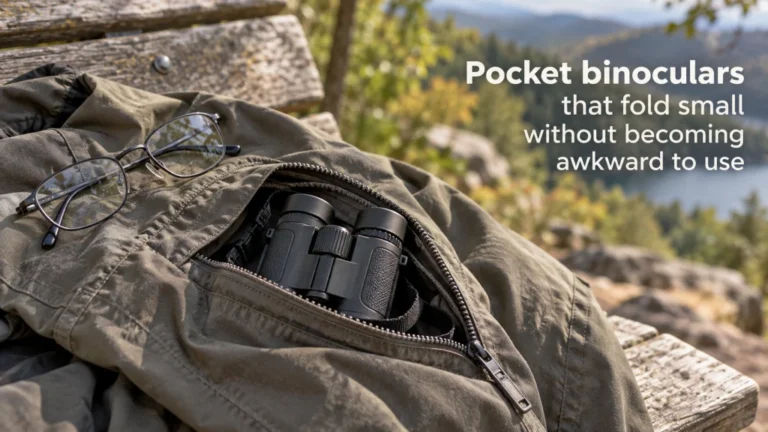
This does not prove that every same-family pair will behave exactly the same way, and it certainly does not make brand or optical quality irrelevant. It does make the decision more honest because you are not confusing a heavier chassis or different eyecup design with the effect of moving from 8x to 10x. When you shop another family, repeat the same control exercise by comparing the exact two variants rather than assuming the labels tell the whole story. If folded geometry and pocket fit are still uncertain, pocket binocular fit depends on the folded body, not only the 25 mm label, so settle that question before treating magnification as the final variable.
| Current same-family specification | 8×25 | 10×25 | Why it matters here |
|---|---|---|---|
| Objective diameter | 25 mm | 25 mm | Keeps the objective format constant |
| Weight | 10.9 oz | 10.9 oz | Removes weight as the reason to choose one magnification |
| Listed size | 3.9 x 4.5 in | 3.9 x 4.5 in | Removes body size as the main difference |
| Real angular field of view | 8.3 degrees | 6.5 degrees | Shows how much scene width changes |
| Exit pupil | 3.1 mm | 2.5 mm | Changes the physical margin for eye placement |
| Close focus | 8.2 ft | 11.5 ft | Shows why exact model pages still matter |
The table is useful because it separates shared packaging from optical consequences. It is not a product ranking, and it should not be reused as proof that every 8×25 has the same field or close-focus advantage. The practical takeaway is simpler: control the body variables first, then decide whether the remaining differences match the way you observe.

This 10x25 roof-prism compact uses BaK4 prisms and fully multi-coated lenses. Its 2.5 mm exit pupil and 315-foot field at 1,000 yards show the tighter viewing geometry of this version. The IPX7, nitrogen-filled body weighs 11.85 ounces.
Check on AmazonIf you click this link and buy, we earn a commission at no additional cost to you.
What 10x gains in image scale
The direct benefit of 10x is not mysterious: it provides more angular enlargement than 8x. Dividing 10 by 8 gives 1.25, so the nominal image scale is 25 percent higher before you consider optical quality, atmospheric conditions, focus accuracy, or hand movement. That does not mean you receive 25 percent more resolved detail in every real view. It means a distant subject is presented at a larger apparent scale, which can be useful when the subject is small, relatively stationary, and already easy to locate.
The mistake is treating that larger image scale as free information. Magnification enlarges the subject, but it also enlarges the apparent effect of motion in the view and often comes with a narrower real field in compact designs. The right question is therefore not whether 10x reaches farther on paper, because it does. The useful question is whether the additional scale survives your actual viewing conditions well enough to outweigh the reduced margin around the subject.
- Favor the extra image scale when distant detail is the limiting problem and you can acquire the subject reliably.
- Be more cautious when the subject moves unpredictably, appears only briefly, or is difficult to find in the first place.
- Do not use magnification alone as a proxy for sharpness, optical quality, or the amount of detail you will actually resolve.
That last distinction matters because two binoculars can show the same nominal magnification and still differ substantially in optical execution. The magnification number tells you how large the subject is presented, not how cleanly every detail will survive through the full optical system. In a 25 mm compact, reach is one benefit among several constraints rather than a standalone score.

This compact roof-prism binocular pairs 10x magnification with 25 mm objectives. Celestron lists a 6.2-degree field of view, a 2.5 mm exit pupil, and an 11.3-ounce weight. Its BaK-4 prisms, multi-coated optics, and nitrogen-filled waterproof body suit a reach-focused compact setup.
Check on AmazonIf you click this link and buy, we earn a commission at no additional cost to you.
Check the architecture tradeoffs before comparing finished products
The optical architecture changes even when the outside dimensions do not. In the Nikon pair, the 8×25 lists an 8.3 degree real field of view, while the 10×25 lists 6.5 degrees, so the higher-power version shows a narrower slice of the scene. The exit pupil also changes because the same 25 mm objective is divided by a different magnification. Those two differences create much of the reach-versus-viewing-margin decision before coatings, focus feel, or brand preference enter the discussion.
That does not make the 8×25 automatically superior. A wider field is most valuable when you need to find a subject quickly, follow motion, or maintain context around what you are watching, while extra image scale can matter more once a distant target is already centered. The job is to identify which limitation costs you more often. Once that is clear, exact model specifications become evidence for your use case instead of a list of numbers competing for attention.
What 8x keeps in real field of view
Real field of view describes how wide a scene the binocular shows, and it must be checked on the exact model rather than inferred from magnification alone. In this Nikon pair, 8.3 degrees at 8x is materially wider than 6.5 degrees at 10x. That extra scene width can make it easier to bring an object into view and keep surrounding context visible while the object moves. It is a handling advantage in the viewing geometry, not evidence that every 8×25 will beat every 10×25 on field of view.
A useful check is to ask whether you usually struggle more with finding the subject or with seeing enough scale after you find it. If acquisition is the recurring problem, the wider field deserves more weight than an abstract desire for higher power. If the target is usually stationary and obvious, a narrower field may be a reasonable cost. That is a cleaner decision than assuming a larger first number automatically represents the more capable compact.
The exit pupil falls from about 3.1 mm to 2.5 mm when the 25 mm objective stays fixed
Exit pupil is simple geometry in this comparison: divide objective diameter by magnification. A 25 mm objective divided by 8 gives 3.125 mm, which manufacturers commonly list as 3.1 mm, while 25 divided by 10 gives 2.5 mm. The calculation is useful because it shows that increasing magnification without enlarging the objective makes the beam leaving each eyepiece smaller. It does not, by itself, prove a universal brightness or comfort result.
A larger exit pupil gives more lateral margin before your eye moves partly outside the light beam, which is one reason small compacts can demand careful alignment. However, perceived brightness also depends on light level, transmission, coatings, optical quality, and your own pupil at that moment. Do not turn 3.1 mm into a promise that everyone will find an 8×25 comfortable, and do not turn 2.5 mm into a warning that a 10×25 causes eye strain. The exit pupil is a physical constraint to understand, not a diagnosis.
Why a small exit pupil makes eye placement less forgiving without becoming an eye relief rule
Exit pupil and eye relief describe different parts of the interface between binocular and eye. Exit pupil is the diameter of the outgoing light beam, while eye relief is the distance behind the eyepiece where the image is designed to be viewed. Nikon lists 10 mm of eye relief for both TRAILBLAZER II variants even though the exit pupils differ, which is a useful reminder not to merge the two specifications. A smaller exit pupil can reduce lateral placement margin, but it does not tell you whether eyeglasses will work well with a particular eyecup and eye-relief combination.
For eyeglass wearers, check the exact eye relief and eyecup geometry rather than choosing 8x or 10x by label. For anyone, set the interpupillary distance so the two image circles merge cleanly, then place the binocular consistently before judging whether the view feels fussy. If dark crescents or blackouts appear as your eyes shift, treat that as a fit and alignment signal, not evidence of a medical problem. The smaller 10×25 exit pupil gives you less geometric room, but the exact user experience still depends on the whole eyepiece interface.

This 8x25 roof-prism compact keeps the same 25 mm objective format while widening the view. Celestron lists an 8.2-degree field and a 3.1 mm exit pupil for this variant. BaK-4 prisms, multi-coated optics, and a nitrogen-filled waterproof body round out the design.
Check on AmazonIf you click this link and buy, we earn a commission at no additional cost to you.
Hand movement matters more when magnification rises
Magnification enlarges angular movement in the view along with the subject. If your hands rotate the binocular by the same small amount, a 10x view makes that movement appear larger than an 8x view, which can reduce how much of the extra image scale feels usable at a given moment. This is a product-use mechanic, not a statement that one person will always hold 10x less steadily than another. Grip, stance, support, fatigue, balance, and the exact body all affect what you can actually keep stable.
Compact binoculars make this worth thinking about because their light bodies do not provide much mass to damp small movement, yet portability is usually the reason you chose the format in the first place. Before choosing 10x for reach, imagine the conditions in which you will use it: standing, seated, leaning on a rail, following motion, or making a brief look from a trail. If you can brace naturally and the subject is distant and slow, the extra scale may be worth the narrower margin. If the view is often quick and handheld, 8x can preserve more usable control even though it presents the subject smaller.

The Vanquish 10x26 uses a compact reverse-Porro design with 10x magnification and 26 mm objectives. Vortex lists a 294-foot field at 1,000 yards, 7.6-foot close focus, and 12.7-ounce weight. Fully multi-coated lenses and a waterproof, fogproof body support handheld outdoor use.
Check on AmazonIf you click this link and buy, we earn a commission at no additional cost to you.
Close focus and other specifications still need the exact model page
Magnification does not determine every difference between an 8×25 and 10×25. Nikon lists the current 8×25 at an 8.2 ft close-focus distance and the 10×25 at 11.5 ft, even though the two models share the same listed body size and weight. That difference matters if you sometimes view nearby objects, but it is a property of this product family rather than a law of 8×25 versus 10×25 design. Another family may hold close focus equal while changing something else.
The same caution applies to eye relief, interpupillary range, waterproofing, focus mechanism, and included accessories. ZEISS, for example, lists both Victory Pocket versions with the same 16.5 mm exit-pupil distance and the same 1.9 m close focus while still showing the familiar 3.1 mm versus 2.5 mm exit-pupil difference. That is exactly why the magnification comparison should establish the optical trade first, then the exact model page should confirm the remaining fit details. Never assume that a 10×25 inherits every specification from its 8×25 sibling simply because the housings look alike.
The Vanquish 8x26 uses a compact reverse-Porro design with 8x magnification and 26 mm objectives. Vortex lists a 7.6-foot close focus, 352-foot field at 1,000 yards, and 12.7-ounce weight. Its fully multi-coated lenses and adjustable eyecups make it a useful exact-spec compact reference.
Check on AmazonIf you click this link and buy, we earn a commission at no additional cost to you.
Use current same-family evidence instead of assuming every pair differs identically
The strongest evidence for this decision is not a broad claim that all 8×25 binoculars behave one way and all 10×25 binoculars behave another. It is a current pair in which objective size and much of the physical architecture are controlled, followed by a second family that shows which patterns repeat. Nikon’s pair shows identical listed weight and size with a wider 8x field and larger 8x exit pupil. ZEISS also lists a 25 mm objective for both Victory Pocket versions, with a 3.1 mm exit pupil at 8x, 2.5 mm at 10x, and a wider field at 8x.
Those repeating patterns support the core geometry without pretending every finished product has the same specifications. Exact field of view can change with eyepiece design, close focus can be identical or different, and eye relief can be shared or not shared. Nocs also answers the basic buyer question in practical terms by distinguishing wider, steadier viewing at 8x from greater reach and more visible hand shake at 10x, while noting that sharpness depends on optical quality rather than magnification alone. Use those patterns as a framework, then verify the exact pair you are considering.

This H2O variant is an 8x25 folding-roof compact. Bushnell lists a 361-foot field at 1,000 yards, 3.0 mm exit pupil, 11 mm eye relief, and 10.3-ounce weight. The H2O line is tested to IPX7 water-resistance standards.
Check on AmazonIf you click this link and buy, we earn a commission at no additional cost to you.
Let activity-specific requirements decide only after the compact-format trade is understood
Use case matters, but it should come after you understand what the format itself is doing. A moving subject rewards field width and easy acquisition, while a small stationary subject at distance gives extra image scale more room to matter. Viewing duration matters too because a choice that feels acceptable for a ten-second look may be less pleasant when you repeatedly reacquire the image over a longer session. None of those conditions creates a universal winner, because the constraint that dominates can change from one outing to the next.
Keep the decision tied to the specific viewing problem rather than an activity label. Someone watching a fixed landmark from a stable overlook may value 10x reach, while another person at the same location may spend most of the time scanning for moving subjects and prefer 8x margin. That is more useful than declaring one configuration the birding, travel, sports, or wildlife winner. The binocular still has to fit your eyes, hands, carrying limit, and expected light conditions after the magnification choice is made.

This green 8x25 compact uses extra-low-dispersion glass and fully multi-coated optics. Hawke lists a 6.8-degree field, 13 mm eye relief, and a 6.6-foot close focus. Its twin-hinge body folds for pocket carry and uses phase-corrected BAK-4 roof prisms.
Check on AmazonIf you click this link and buy, we earn a commission at no additional cost to you.
A four-question 8×25 versus 10×25 decision check
By this point, the choice should be narrower than a general feature comparison. You already accepted the 25 mm compact format, so ask which limitation is more likely to cost you a usable view. The questions below keep the decision centered on reach, field width, exit-pupil margin, and the way you actually hold the binocular. They also keep exact model fit separate from the basic magnification trade.
Answer these questions based on repeated real situations, not the single most extreme distance you can imagine. If your answers split evenly, try the exact 8×25 and 10×25 pair if possible, because eye placement and grip are personal even when the geometry is known. If one side clearly dominates, the specification sheet becomes easier to interpret. You are no longer shopping for the largest number; you are choosing which constraint you can afford.
- Do I more often fail because the subject looks too small, or because I cannot find and hold it quickly?
- Will I usually observe from a braced, steady position, or make brief unsupported handheld views?
- Does the exact 10×25 keep enough field of view and eye-placement margin for my use?
- Do the exact pair’s eye relief, close focus, interpupillary range, and eyecups fit me, regardless of magnification?
If reach is the recurring limitation and the exact 10×25 still fits comfortably, choosing 10x can be rational. If acquisition, motion, alignment, or handheld steadiness are the recurring problems, the 8×25 trade is often easier to live with. Either way, make the final call from the exact model specifications and fit rather than from the first number alone.

The Pentax AD 8x25 WP pairs 8x magnification with 25 mm objectives in a compact body. Ricoh lists 21 mm eye relief, a 3.1 mm exit pupil, and a 3 m close-focus distance. Its waterproof construction and 300 g weight suit a final fit-and-use check.
Check on AmazonIf you click this link and buy, we earn a commission at no additional cost to you.
Final Thoughts: extra reach is not free inside a 25 mm body
An 8×25 and 10×25 can look nearly identical in your hand while giving you meaningfully different viewing margins. The 10x format increases nominal image scale, but the same 25 mm objective produces a smaller exit pupil, and current same-family examples also show a narrower real field at 10x. That trade can be worthwhile when distant scale is the real limit and your viewing setup is steady enough to use it. It is not an automatic upgrade simply because the housing stays small.
Choose 8x when wider acquisition space, more eye-placement margin, and lower sensitivity to visible hand movement solve the problems you actually encounter. Choose 10x when the extra scale solves a more important problem and the exact model still meets your field-of-view, eye-relief, close-focus, and fit requirements. Most importantly, compare the exact 8×25 and 10×25 siblings instead of relying on the format label alone. In compact optics, the better number is the one that leaves you with the more usable view.

The CL Pocket 10x25 is a foldable compact with 10x magnification and 25 mm objectives. Swarovski lists a 2.5 mm exit pupil, 294-foot field at 1,000 yards, and 17 mm eye relief. Its foldable body is designed for pocket carry and travel.
Check on AmazonIf you click this link and buy, we earn a commission at no additional cost to you.
FAQs
🔭 Is 10×25 more powerful than 8×25?
Yes. A 10×25 provides 10x magnification compared with 8x for an 8×25, so the nominal image scale is higher. That does not guarantee more usable detail because field of view, stability, focus, optical quality, and viewing conditions still matter.
🌲 Does every 8×25 have a wider field of view than every 10×25?
No. Lower magnification often comes with a wider real field in a same-family compact pair, but field of view depends on the exact optical design. Check the manufacturer specification for the two models you are actually comparing.
👁️ Why is the exit pupil larger on an 8×25?
Exit pupil equals objective diameter divided by magnification. With the objective fixed at 25 mm, 25 divided by 8 is about 3.1 mm, while 25 divided by 10 is 2.5 mm. The larger beam provides more geometric margin for eye placement, but comfort still depends on the complete eyepiece fit.
🖐️ Is 10×25 always harder to hold steady?
Higher magnification makes the apparent effect of the same angular hand movement larger, so 10x generally gives movement more visual consequence. Your actual steadiness still depends on grip, stance, support, fatigue, and the exact binocular body. Do not treat the magnification number as a personal stability test.
👓 Is 8×25 automatically better for glasses?
No. Glasses fit depends heavily on eye relief and eyecup geometry, which are separate from exit pupil. Compare the exact model’s eye relief and try the eyecups with your glasses if possible.
📏 Are 8×25 and 10×25 binoculars usually the same size?
Sometimes, but not always. Nikon’s current TRAILBLAZER II 8×25 and 10×25 list the same size and weight, which makes them useful for isolating magnification tradeoffs. Other product families may differ, so verify the exact specifications instead of assuming the housings match.
References and Sources
- Nikon TRAILBLAZER II 8×25 specifications: verifies the 8×25 field of view, exit pupil, close focus, eye relief, size, weight, and other current model details used in the comparison.
- Nikon TRAILBLAZER II 10×25 specifications: verifies the matching 10×25 body details and the magnification-specific field of view, exit pupil, and close-focus values.
- ZEISS Victory Pocket technical data: provides a second current 8×25 and 10×25 family for cross-checking objective size, exit pupil, field of view, eye relief, close focus, dimensions, and weight.
- Nocs Standard Issue product Q and A: supports the practical distinction between wider, steadier 8x viewing and greater 10x reach while separating magnification from optical sharpness.