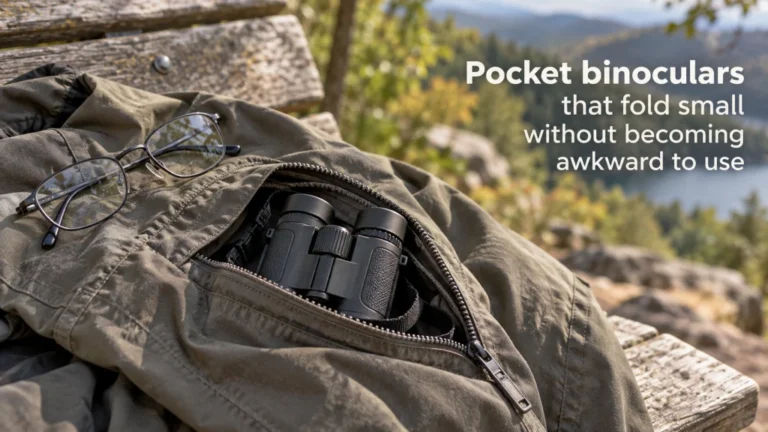
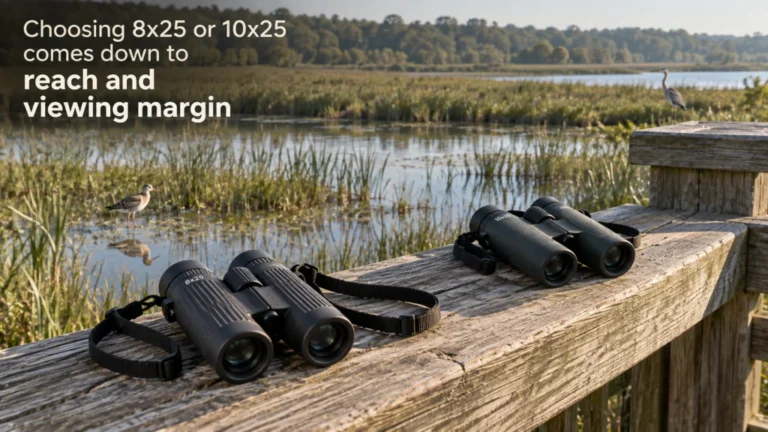
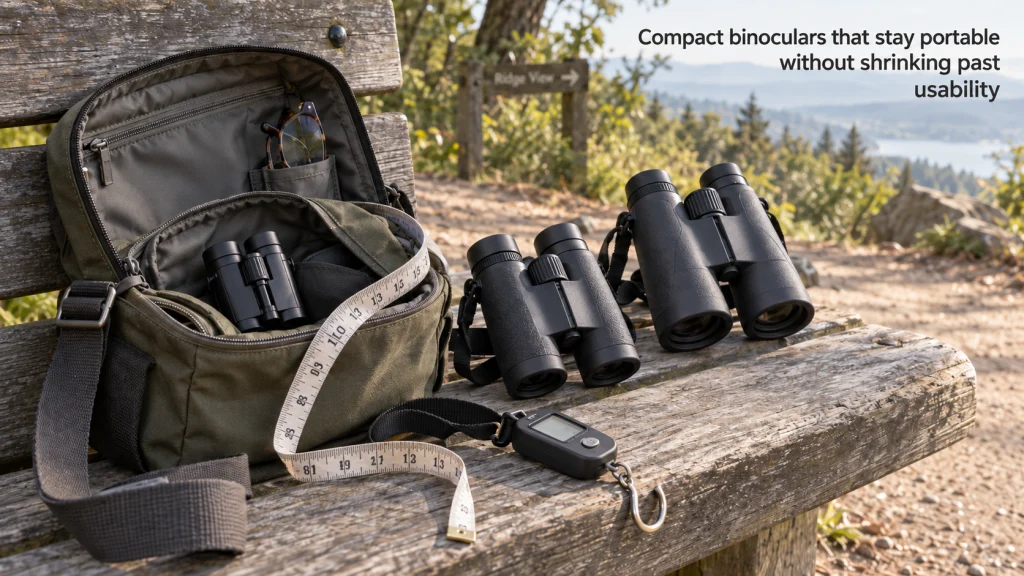
Compact binoculars are useful only when the smaller body solves a real carrying problem without making viewing difficult. Compact is not a universal size standard, so objective diameter alone cannot tell you whether a model is truly portable for your bag, pocket, hands, or viewing conditions. A better choice comes from checking packed dimensions, weight, hinge design, eye placement, eye relief, and the viewing ease you trade for a smaller package. The goal is not the smallest binoculars available, but the smallest size that still works well in use.
Compact is only useful when it solves a carry problem
Put a folding 8×25, a small 8×30 or 8×32, and a typical 42 mm binocular beside the same shoulder bag and the marketing labels become much less useful. The real question is which one fits the space and weight limit you actually have while still being easy enough to raise, align, focus, and look through. Compact binoculars can mean very different things in different product lines, so I would start with the carry constraint rather than the category name. If you first need the broader differences among binocular formats, the overview of common binocular types and their trade-offs gives that larger frame without turning size into the only decision.
For one person, compact may mean something that fits a jacket pocket with room to spare. For another, it may mean an 8×32 that slips into a small day bag and gets carried more often than a 42 mm pair. Neither definition is automatically wrong because compact and pocket are conventional labels rather than fixed industry boundaries. A useful compact binocular guide therefore starts with dimensions, folded geometry, weight, and viewing fit, then asks whether the saved space is worth the handling and optical compromises that follow.

This 8x25 model weighs 10.9 ounces and uses a compact fold-up roof-prism body. Nikon lists an 8.3-degree real field of view, a 3.1 mm exit pupil, and 10 mm eye relief. Its waterproof and fogproof construction suits a carry-first compact comparison without treating small size as the only criterion.
Check on AmazonIf you click this link and buy, we earn a commission at no additional cost to you.
Normalize objective size, weight, and folded dimensions before comparing models
Objective diameter is a useful first clue, but it does not show how much space a binocular occupies when packed. Similar objectives can sit in bodies with different hinges, eyecups, focus wheels, and folded widths. Weight also needs an exact manufacturer check because a small body can still be dense. Start with the configuration, then verify the measurements that affect carrying.
Manufacturer specifications show why this matters without making either example a recommendation. Nikon lists its folding TRAILBLAZER II 8×25 at 3.9 inches long and 10.9 ounces, while its PROSTAFF P3 8×30 is 4.9 inches long and 16.75 ounces. That is a meaningful change even though both are small binoculars. Compare not just 25 mm versus 30 mm, but what the extra bulk changes in exit pupil, eye relief, and viewing ease.
| Size class to inspect | What to verify before buying | Typical decision tension |
|---|---|---|
| About 20 to 25 mm | Folded width, hinge movement, eyecup size, eye relief, focus control | Maximum packability versus fussier eye placement and controls |
| About 28 to 32 mm | Actual bag fit, weight, grip, field of view, eye relief | More viewing ease versus more bulk than a true pocket format |
| About 42 mm | Carry method, total weight, case size, viewing duration | More physical size versus a generally roomier viewing package |
Use the table as a screening tool rather than a rigid classification system. The final decision still depends on the exact body and the way it fits your carry constraint.

This 8x30 model weighs 16.75 ounces and measures 4.9 inches long. Nikon lists a 3.8 mm exit pupil, 15.4 mm eye relief, and a 456-foot field of view at 1,000 yards. Its waterproof and fogproof roof-prism body gives a concrete 30 mm reference for comparing packed size, weight, and viewing ease.
Check on AmazonIf you click this link and buy, we earn a commission at no additional cost to you.
Separate pocket bodies from small 28 to 32 mm binoculars without inventing a universal boundary
Independent size comparisons commonly describe roughly 25 mm binoculars as pocket models and roughly 32 mm binoculars as compact models, but those labels are better treated as practical conventions than standards. A 25 mm body is usually trying to minimize packed volume more aggressively, often through a narrow body or folding hinge. A 30 or 32 mm model may still be very portable while giving the designer more room for eyecups, focus controls, and a larger exit pupil. That distinction is useful because the smaller category often changes the way the binocular is handled, not just the number printed on the objective.
If your requirement is genuinely pocket-first, go deeper into how pocket binoculars trade folding size against viewing ease before assuming every small model will fit the same role. If a small shoulder bag or day pack is acceptable, a 28 to 32 mm body may solve the carry problem without demanding such aggressive folding. This is where small binoculars and lightweight binoculars stop being interchangeable ideas: a model can be short but dense, light but awkwardly wide, or narrow but slow to deploy. Measure the actual storage space you need to use, then compare the exact folded dimensions instead of choosing from the category label alone.

These compact 8x25 binoculars use BaK4 roof prisms and fully multi-coated optics in a lightweight waterproof body designed for bird watching, hiking, travel, and general outdoor viewing. They feature a central focus system, multi-stop twist-up eyecups, an ergonomic textured grip, and nitrogen-filled construction to help resist internal fogging. This Cypress Green II version keeps the same Standard Issue 8x25 format and core specifications as the original Cobalt Blue II model.
Check on AmazonIf you click this link and buy, we earn a commission at no additional cost to you.
Small objectives change eye placement as well as light gathering
When objective diameter shrinks while magnification stays the same, the exit pupil becomes smaller, and that affects more than a simple bright-versus-dim description. An 8×25 has an exit pupil of about 3.1 mm, while an 8×32 is 4 mm and an 8×42 is 5.25 mm. A smaller exit pupil gives your eye less positional margin, so a compact model can demand more precise alignment to avoid dark crescents or partial blackouts. That does not make 8×25 binoculars unusable, but it does mean quick, forgiving eye placement should be tested rather than assumed.
Eyecup geometry and eye relief can either help or compound that problem, especially if you wear glasses or tend to reposition the binocular frequently. A small body with tiny eyecups may look impressively portable on a specification sheet but still be frustrating if you cannot settle behind the oculars quickly. Published eye relief is useful evidence, but the exact eyecup shape and available adjustment still matter to fit. If glasses are part of the decision, use the more detailed eye relief fit checks for binocular users rather than assuming a compact body will work because the magnification looks familiar.

This 8x26 reverse-Porro binocular weighs 12.7 ounces and provides a 3.3 mm exit pupil. Vortex lists 15 mm eye relief and a 352-foot field of view at 1,000 yards. Those specifications put eye placement and viewing margin in clear context when a small objective is part of the tradeoff.
Check on AmazonIf you click this link and buy, we earn a commission at no additional cost to you.
Folded size depends on hinge architecture as well as objective diameter
A small objective does not guarantee a small packed footprint because the hinge determines how the barrels move when stored. Double-hinge pocket designs can fold inward much more aggressively, which can reduce width enough to fit spaces that a single-hinge body cannot. The trade-off is that both sides may need to be positioned correctly again when you unfold the binocular, adding one more setup step before viewing. A compact that is technically smaller but slower to open and align may not solve the problem if your priority is fast deployment.
Single-hinge designs usually keep the barrels working as one unit, which can feel simpler when moving repeatedly between carrying and viewing. They may not collapse into the same narrow shape, but their ready-to-use geometry can be more predictable. This is also why you should keep prism architecture separate from size classification instead of assuming every roof-prism binocular is automatically compact. If you need to compare those optical body layouts directly, the guide to roof versus Porro binoculars handles that choice as a separate design decision.

This 8x25 pocket binocular uses a folding design and weighs about 10.9 ounces. ZEISS lists a waterproof body and hydrophobic multi-coating, with a focus system designed for fast adjustment. Its folding architecture is directly relevant when packed width and deployment matter as much as objective diameter.
Check on AmazonIf you click this link and buy, we earn a commission at no additional cost to you.
Eight power and ten power behave differently when the objective stays at 25 mm
Keeping the objective at 25 mm while moving from 8x to 10x reduces the exit pupil from about 3.1 mm to 2.5 mm. The higher magnification also commonly comes with a narrower field of view, though the exact amount depends on the model, so the manufacturer specification still needs to be checked. In a very small binocular, those changes matter because there is already less room for relaxed eye placement and large controls. The extra magnification may be useful for a specific viewing need, but it is not a free upgrade simply because both models have the same outer size.
The decision should start with what is wrong with 8x for your viewing distance, not with a general preference for a larger number. If you frequently struggle to keep the image centered, acquire a moving subject, or align a small eyecup quickly, 10x in a 25 mm package can push in the wrong direction. If you have a clear need for more detail at distance and can accept the smaller exit pupil and likely narrower view, the trade can make sense. The dedicated comparison of 8×25 versus 10×25 binoculars is the better place to make that magnification decision without mixing it with the broader question of compact size.
This 10x25 model keeps the same 25 mm objective size while raising magnification to 10x. Nikon lists a 6.5-degree real field of view, 10 mm eye relief, and a 10.9-ounce weight. Its fold-up waterproof body makes it a direct counterpart for evaluating what changes when 25 mm binoculars move from 8x to 10x.
Check on AmazonIf you click this link and buy, we earn a commission at no additional cost to you.
The step from 25 to 32 mm is often a portability versus usability decision
Moving from 25 mm toward 30 or 32 mm usually gives the designer more physical room for the oculars, eyecups, focus wheel, and hand placement. At 8x, the larger objective also increases exit pupil from about 3.1 mm at 25 mm to 4 mm at 32 mm, which can make alignment less demanding. The cost is obvious in the bag: the binocular becomes heavier, usually wider, and less likely to disappear into a small pocket. Whether that is an improvement depends on where your portability limit actually sits.
This is the point where I would stop talking about category labels and compare the two exact bodies side by side on dimensions, weight, eye relief, and field of view. If the 32 mm model still fits the space you intend to use and the extra ounces are acceptable, the larger body may offer a better balance of portability and viewing ease. If the 32 mm body is large enough that you begin leaving it behind, the 25 mm option may still solve the more important problem. The focused 8×25 versus 8×32 comparison is where that size step can be judged without turning either format into a universal winner.

This 8x32 model combines 32 mm objectives with phase-coated BaK-4 prisms and fully multi-coated optics. Celestron lists a 4 mm exit pupil, 17.5 mm eye relief, and waterproof nitrogen-purged construction. It provides a clear 32 mm reference for weighing extra viewing ease against the additional size of a larger compact format.
Check on AmazonIf you click this link and buy, we earn a commission at no additional cost to you.
A compact can complement a full-size pair without automatically replacing it
A smaller binocular does not have to beat a 42 mm model in every condition. It can earn its place when the larger pair is inconvenient to carry, too bulky for the bag, or unnecessary for a short session. That turns replacement into role separation, which is often more realistic for people who already own usable binoculars. A compact makes sense when it fills a carry gap the existing pair does not handle well.
If the current 42 mm binocular already fits your routine and gets carried consistently, downsizing may solve a problem you do not actually have. On the other hand, if the larger pair repeatedly stays at home because the case takes too much room or the weight does not fit the rest of your kit, a smaller second pair can be easier to justify. Compare what you would gain in carried size against what you might give up in eye placement, low-light margin, and handling. The full decision is covered in compact versus full-size binoculars, including when keeping both formats makes more sense than forcing one to do everything.

This 8x42 full-size model provides a 5.3 mm exit pupil and a 377-foot field of view at 1,000 yards. Nikon lists waterproof and fogproof construction with a rubber-armored body. Its 42 mm format gives a useful full-size reference when deciding whether a compact should replace an existing pair or simply fill a separate carry role.
Check on AmazonIf you click this link and buy, we earn a commission at no additional cost to you.
Eye relief, interpupillary fit, and low-light needs can disqualify an otherwise small body
Compact dimensions are irrelevant if the binocular cannot be adjusted to your eyes comfortably. Check the published interpupillary distance range, then verify that the barrels can actually center behind both pupils without forcing an awkward head position. If you wear glasses, eye relief and eyecup travel deserve the same level of attention because a small body does not excuse a clipped field of view. These are fit checks, not afterthoughts, and they should be resolved before you treat a model as a serious candidate.
Low-light use also deserves its own decision instead of a blanket claim that compact binoculars are always too dim. Objective size, magnification, coatings, transmission, exit pupil, ambient light, and your own viewing conditions all influence what you see. A 25 mm model that works well in bright conditions may be less forgiving as available light drops, while a 30 or 32 mm model can provide more margin without becoming full size. If low-light performance is a major requirement, use the separate framework for choosing binoculars for low-light viewing rather than forcing that entire question into the word compact.

This 8x30 binocular provides 15.4 mm eye relief, a 3.8 mm exit pupil, and a wide 8.7-degree real field of view. Nikon lists a waterproof, fogproof roof-prism body with a locking diopter. Those fit and optical specifications make it relevant when eye relief, alignment, and changing light can disqualify an otherwise compact body.
Check on AmazonIf you click this link and buy, we earn a commission at no additional cost to you.
Activity-specific choices depend on the viewing job, not the compact label
The same small binocular can be convenient in several activities without being the best fit for every viewing job. A short daytime look at a stationary subject places different demands on field of view, low-light performance, focusing speed, and viewing duration than tracking movement for a long session. That is why the activity should define the constraints before you decide how small the binocular should be. Portability is one variable in the decision, not permission to ignore distance, light, motion, glasses, or how long you expect to keep the binocular at your eyes.
Keep the activity question at the level of requirements instead of using it to create endless size permutations. Decide whether your situation needs fast target acquisition, a wider field, better low-light margin, very low carried weight, or a body that can stay in a small bag all day. Then bring those requirements back to the compact formats that can meet them. This keeps the purchase logic stable even when manufacturers use different labels for similar sizes or offer the same configuration in several body designs.
This 10x32 binocular uses 32 mm objectives, phase-coated BaK-4 prisms, and fully multi-coated optics. Celestron lists waterproof and fogproof construction in a compact field-ready body. The 10x32 configuration is useful for showing how an activity can change the preferred balance among reach, field of view, portability, and handling.
Check on AmazonIf you click this link and buy, we earn a commission at no additional cost to you.
Keep prism design and image stabilization as separate architecture decisions
It is easy to treat compact as if it describes the whole binocular, but size class and optical architecture answer different questions. Roof and Porro prism designs can package the optical path differently, which affects shape, handling, and sometimes how small a body can realistically become. That choice should be evaluated on its own rather than smuggled into a conclusion about objective diameter. A small roof model is not automatically superior to a small Porro model simply because its barrels look straighter or more modern.
Image stabilization also solves a different problem: reducing apparent hand movement in the view. Stabilized binoculars can involve added electronics, controls, batteries, weight, or body volume, so their value depends on whether steadiness is the real constraint you need to solve. If shake is the main reason you are dissatisfied with a conventional compact, compare the trade-offs in image-stabilized binoculars instead of assuming a smaller body or lower weight will automatically fix the view. Keeping these decisions separate prevents one attractive feature from hiding a new compromise somewhere else.

This 10x30 binocular uses Canon optical image stabilization to reduce apparent hand movement during viewing. Canon specifies 30 mm objectives, a 6-degree real field of view, and 14.5 mm eye relief. It is a direct example of why stabilization should be evaluated as a separate architecture decision rather than treated as a synonym for compact size.
Check on AmazonIf you click this link and buy, we earn a commission at no additional cost to you.
Build a compact-binocular shortlist from constraints instead of rankings
Start a shortlist by removing models that fail the carry requirement before comparing finer specifications. Set the maximum packed length, width, and weight that fit the bag, pocket, case, or carry method you will use. Then remove models that miss your eye relief, interpupillary distance, or handling needs. This stops a praised binocular from surviving only because other people like it.
After those hard constraints are set, compare field of view, exit pupil, focus behavior, weather protection, and price only where they change your use. Do not reward features you will rarely use or pay extra to solve a problem you do not have. The smallest candidate should win only when its portability advantage is meaningful and fit remains acceptable. If a slightly larger model still fits while making alignment easier, it may be the better stopping point.
Carry constraint, packed size, and handling
Measure the storage space and decide whether you need pocket carry, a small pouch, or simply less bulk than a 42 mm body. Verify exact closed dimensions and weight from the manufacturer instead of relying on a category label. Then check whether the hinge, focus wheel, and eyecups work without excessive fiddling after storage. A model that fits only after rearranging the bag may not meet the carry constraint as cleanly as the numbers suggest.
Optical fit, conditions, and price
Once the body fits, check eye relief, interpupillary range, field of view, exit pupil, and expected light. Compare price only after fit is acceptable because an awkward bargain solves nothing. If two candidates meet the same need, the simpler or cheaper one may be enough. If neither works cleanly, move up a size rather than forcing a pocket format into the wrong job.
- Measure the bag, pocket, or case space before comparing model names.
- Verify exact folded dimensions and weight from the manufacturer.
- Check eye relief and interpupillary fit before treating a body as suitable.
- Compare 8x and 10x only after deciding what the extra magnification must accomplish.
- Stop shrinking when portability gains become smaller than the usability losses.
This sequence also protects against buying by reputation alone. A compact model earns its place by fitting your constraint and remaining easy enough to use, not by being the smallest object on the shelf.

This 25-foot tape measure uses a retractable self-locking blade with fraction markings. Its rubber overmold is designed to improve grip while measuring. It gives you a simple way to record actual bag, pocket, or case limits before filtering a compact-binocular shortlist by published dimensions.
Check on AmazonIf you click this link and buy, we earn a commission at no additional cost to you.
Final Thoughts: buy the size you will carry without shrinking past usability
The useful question is not whether compact binoculars are better than larger binoculars. It is whether a smaller body removes a real carry obstacle while keeping eye placement, focus control, fit, and viewing conditions within an acceptable range. Pocket 20 to 25 mm designs make the strongest case when packed volume is the dominant constraint, while 28 to 32 mm bodies often trade a little more size for easier handling and a larger exit pupil. The right stopping point is the smallest format that still works comfortably for the job you actually need it to do.
Before buying, verify the exact dimensions, weight, eye relief, interpupillary range, and field of view of the specific model you are considering. If the compact choice adds friction every time you deploy it, the saved space may not be worth much. If it fits cleanly, aligns easily, and removes enough bulk that you are genuinely more likely to carry it, the format is doing its job. Keep the decision tied to your constraint, not to the word compact printed on a category page.

This 10x30 compact binocular is 4.9 inches long and weighs 16.4 ounces. Nikon lists waterproof and fogproof construction with a rubber-armored body. It represents the middle ground described here: still compact enough for lighter carry, but physically larger than a pocket 25 mm format.
Check on AmazonIf you click this link and buy, we earn a commission at no additional cost to you.
Explore related compact binocular decisions
These comparisons separate the decisions that become harder when every small binocular is placed under the same compact label. Start with the question that is actually blocking the purchase instead of opening several comparisons at once. A pocket-first problem is different from a magnification problem, and both are different from deciding whether a 32 mm body is still small enough. Keeping those questions separate makes the next comparison much easier to use.
| Topic | What you’ll find |
|---|---|
| Choosing a true pocket binocular | How to judge folding size, deployment, controls, and eye placement when minimum packed volume is the priority. |
| Choosing between 8×25 and 10×25 | How magnification changes exit pupil, field of view, steadiness, and viewing demands in the same 25 mm size class. |
| Choosing between 8×25 and 8×32 | How the move to a larger objective changes portability, eye placement, weight, and overall viewing ease. |
| Choosing compact or full-size binoculars | When a compact can replace a larger pair and when two different carry roles make more sense. |
Use the comparison that matches the decision you are actually stuck on instead of restarting from a generic list of small binoculars. Return to your measured carry limit after reading it, because the useful answer still has to fit the space and weight you can accept. If two formats both meet that limit, let eye fit and viewing conditions break the tie. If neither fits cleanly, change the size requirement rather than forcing a poor compromise.

The Nikon 7072 Lens Pen combines a retractable soft brush with a separate cleaning tip for optical surfaces. It is designed to remove dust, fingerprints, and other debris from lenses without liquid cleaner. The compact format is useful alongside small binoculars because routine lens care can stay in the same travel or field kit.
Check on AmazonIf you click this link and buy, we earn a commission at no additional cost to you.
FAQs
🔭 What size counts as compact binoculars?
There is no universal industry boundary. Roughly 32 mm is often called compact and roughly 25 mm pocket, so still compare actual size, folded shape, and weight.
🎒 Are 8×25 binoculars small enough for a pocket?
Some are, especially folding designs, but width and depth matter as much as the 25 mm objective. Check the closed dimensions against your actual pocket or pouch.
👓 Are compact binoculars harder to use with glasses?
They can be if eye relief is short or the eyecups hold your glasses too far away. Verify eye relief and test whether you can see the full field comfortably.
🌤️ Are 8×25 binoculars always too dim?
No. Their smaller exit pupil gives less margin, but the result still depends on available light, optical design, transmission, and viewing conditions.
📏 Is 8×32 still compact?
Many sources treat 30 to 32 mm models as compact, but the label matters less than actual fit. Some 8×32 models are far less pocketable than folding 8×25 binoculars.
🔍 Should I choose 8×25 or 10×25?
Choose 10x only if extra magnification solves a real distance problem and you accept the smaller exit pupil and field-of-view trade-off. For easier alignment, 8x is often the simpler starting point.
References and Sources
- Cornell Lab size class guidance: Supports approximate full-size, compact, and pocket size classes.
- Cornell Lab size and weight comparison: Supports comparing real size and weight instead of relying on category labels.
- Nikon TRAILBLAZER II 8×25 specifications: Verifies the 8×25 dimensions, weight, exit pupil, and eye relief used in the article.
- Nikon PROSTAFF P3 8×30 specifications: Verifies the 8×30 dimensions, weight, and exit pupil used in the article.