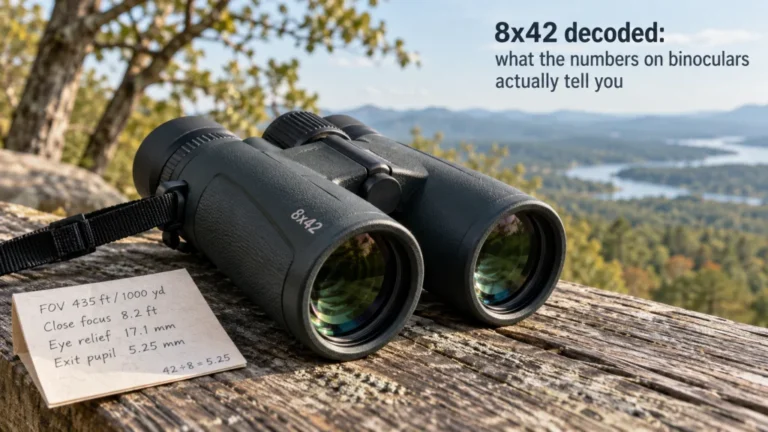
A binocular specification sheet can look precise while mixing direct facts, calculated values, construction claims, and qualities numbers cannot prove. Read binocular specifications by sorting each line by the decision it can support, then verify the exact model when fit, sealing, handling, or optical behavior matters. An 8×42 label is only a starting pair of inputs, not a quality grade. The goal is to narrow the sheet to the few questions that deserve closer comparison.
Why a binocular specification sheet needs an evidence hierarchy
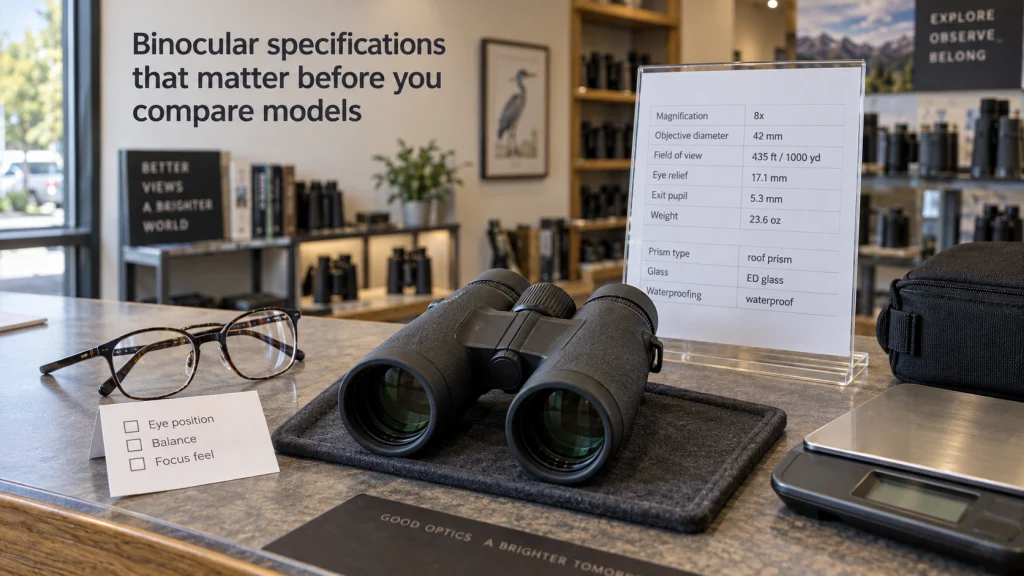
Open Nikon’s current MONARCH M7 8×42 product page and the 8×42 configuration is only the first layer of information. Farther down, the page lists field of view, eye relief, close focus, weight, coatings, prism type, and weather sealing as if every line belongs to one comparable scorecard. It does not. The page is useful precisely because it shows how published measurements, calculated values, construction claims, and unanswered fit or performance questions can sit side by side.
I would separate a published number from a quality claim before comparing models because the buying question changes with the evidence class. A field of view figure can support a width comparison, while a phrase about premium optics needs stronger evidence before it becomes a conclusion about image quality. Weight can support a carry comparison without settling balance or grip. The point of an evidence hierarchy is not to distrust the sheet, but to match each entry to the decision it can actually support.
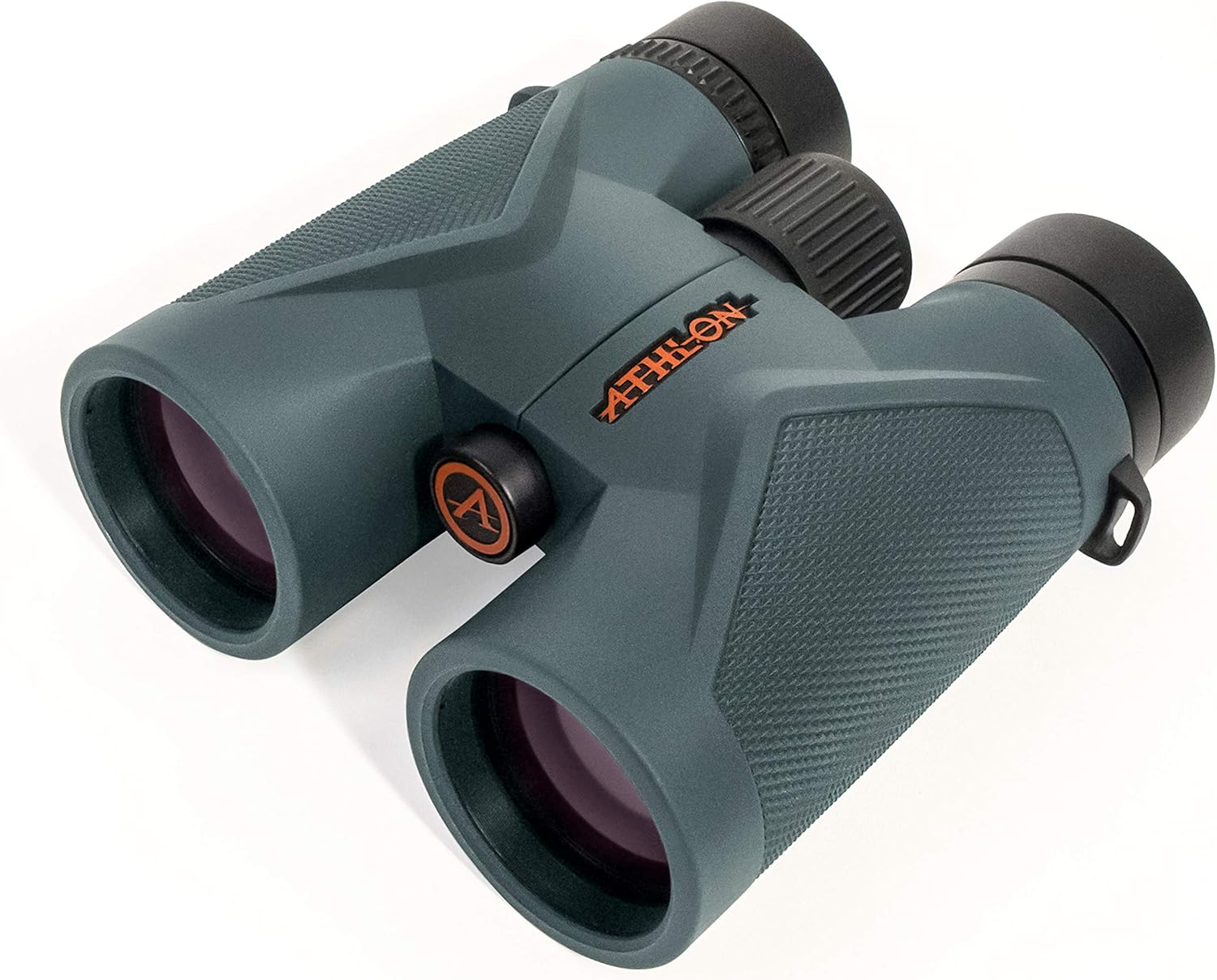
This 8x42 binocular uses ED glass and is built for waterproof and fogproof outdoor use. Its model page provides a concrete set of published features that can be separated from broader performance claims. That makes it useful for practicing an evidence hierarchy without treating one specification as a complete quality score.
Check on AmazonIf you click this link and buy, we earn a commission at no additional cost to you.
Four kinds of information can appear on the same product page
The cleanest way to read a spec sheet is to classify each line before deciding whether it matters to you. Some entries are published product specifications, some are values calculated from other specifications, some describe materials or features supplied by the manufacturer, and some important ownership qualities are not represented at all. Those categories can overlap, so a value may be both published and mathematically derived. What matters is knowing what kind of conclusion each item can support.
The Nikon MONARCH M7 8×42 makes those categories concrete. Nikon publishes the configuration, field of view, eye relief, close focus, weight, and several construction features, while exit pupil and relative brightness are derived from other specifications. That lets one page supply examples from more than one evidence class without turning the model into a recommendation. The remaining questions have to be handled with fit checks or model-specific performance evidence.
Directly published specifications
Published specifications are figures assigned to the exact model, such as magnification, field of view, eye relief, close focus, dimensions, and weight. They let you compare the same variable across products. Similar numbers can still hide differences in optical execution and handling. Treat them as decision inputs, not a scorecard where the largest number wins.
Derived values
Derived values come from other specifications through a defined relationship. Exit pupil is objective diameter divided by magnification, so 8×42 produces about 5.3 mm. Relative brightness is calculated from exit pupil rather than measured as total light transmission. These values explain relationships, but they do not prove that two binoculars with the same result will look equally bright.
Manufacturer claims
Construction labels range from checkable design details to broader performance language. A manufacturer can declare ED glass, phase correction, dielectric coating, or a roof prism on an exact model. Those labels do not quantify edge sharpness, glare resistance, contrast, or transmission. Use them to identify construction, then seek stronger evidence before making a performance conclusion.
Qualities documentation cannot prove
Some important ownership questions are not settled by a spec table. Balance, focus feel, eyecup behavior, glare control, and comfort depend on design execution and the user. Even eye relief remains partly a fit question because glasses, facial structure, and eyecup shape can change the result. When the sheet reaches that boundary, verify the exact model instead of forcing a numerical answer.

This 7x50 binocular combines a wide-field design with Porro prisms and multi-coated optics. Its page mixes a basic configuration with construction and usability descriptions, giving you several evidence types to classify. Use the listed details as inputs, then keep unmeasured handling or optical qualities in a separate evidence category.
Check on AmazonIf you click this link and buy, we earn a commission at no additional cost to you.
Use 8×42 as an input pair, not a quality grade
In an 8×42 binocular, the first number is magnification and the second is the objective lens diameter in millimeters. Those two inputs establish the basic configuration, but two 8×42 models can still have different fields of view, eye relief, close focus, weight, dimensions, coatings, and eyecup designs. That is enough variation to change which model fits a particular viewing situation. The shared label narrows the comparison, but it does not finish it.
Those two inputs also create trade-offs rather than a simple ladder of better and worse. Higher magnification can reveal more angular detail at distance, but it can also make hand movement more noticeable and often comes with a narrower field of view within a product family. A larger objective can gather more light at the same magnification, but it usually adds bulk and weight. If the basic number pair is still unclear, the fuller explanation of what the numbers on binoculars mean is the better place to resolve that question before comparing secondary specifications.

This exact 8x42 model pairs 8x magnification with 42 mm objective lenses. Its waterproof body, phase-coated BaK-4 prisms, and fully multi-coated optics show how models sharing the same number pair can still differ in construction. Compare the 8x42 configuration first, then treat the other features as separate decision inputs.
Check on AmazonIf you click this link and buy, we earn a commission at no additional cost to you.
Numerical viewing questions need their own specification path
Not every number answers the same viewing question. Magnification and objective diameter establish the configuration, exit pupil describes a calculated light relationship, field of view describes scene width, and close focus sets the nearest focusing distance. Combining them into one ranking creates poor comparisons because a gain in one area can cost something elsewhere. Decide what viewing problem you are solving, then compare the specification that addresses it.
For a moving subject in woods, field of view may matter more than another step in magnification because it changes how much of the scene stays visible. For a nearby insect or display, close focus can matter more than objective diameter because the nearest usable focusing distance becomes the constraint. In dim conditions, exit pupil helps describe the configuration and its light relationship, but it cannot replace measured transmission or complete optical evidence. The sheet becomes easier to use once every number has a specific job tied to a practical viewing question.
Magnification and objective diameter
Magnification describes how large the subject appears, while objective diameter describes the front lens diameter. More magnification can help with distant detail, but it also magnifies hand movement and can make moving targets harder to find. A larger objective can support more light gathering at the same magnification, but usually adds size. Compare both numbers against distance, movement, carrying needs, and viewing duration.
Exit pupil and relative brightness
Exit pupil is objective diameter divided by magnification, so 8×42 works out to about 5.3 mm. Relative brightness is calculated from exit pupil rather than measured directly. Nikon notes that equal exit pupils can still differ because optical design and coatings affect delivered light. For a deeper decision, use the guidance on choosing binoculars for low-light viewing rather than calculated brightness alone.
Real and apparent field of view
Real field of view describes the angular width visible without moving the binoculars and may also be expressed as feet at 1,000 yards. Apparent field of view describes how wide the magnified scene appears. A wider real field can help with moving subjects, but magnification alone does not determine field width across unrelated designs. Compare the exact published figure instead of assuming every 8x model is wider than every 10x model.
Close focus
Close focus is the nearest distance at which the binocular can focus a subject. A shorter figure matters for nearby subjects, exhibits, plants, or insects, but may be irrelevant for distant viewing. It is objectively useful without being universally important. Compare it only when your normal viewing distance makes the difference meaningful.

This 10x42 binocular provides a different magnification and objective pairing for numerical comparisons. Its HD optics, waterproof and fogproof construction, and tripod-adaptable design add other variables that should not be collapsed into one score. Use the exact model when comparing magnification, objective size, and the viewing questions those numbers address.
Check on AmazonIf you click this link and buy, we earn a commission at no additional cost to you.
Physical-fit numbers need a different decision path
Eye relief, interpupillary distance adjustment, eyecup positions, overall dimensions, and grip shape all affect whether a binocular can be positioned correctly for a particular person. Eye relief is especially important for eyeglass wearers because the glasses keep the eyes farther from the eyepiece, but the published millimeter figure is still only part of the fit. Eyecup shape, glasses thickness, facial structure, and the location of the usable eyepoint can change how much of the field you actually see. That is why a number that looks sufficient on paper should still be checked on the exact model when fit is critical.
The practical test is whether you can center both exit pupils, see the full field without dark cutoffs, and maintain that view without fighting the eyecups. None of those checks requires turning eye relief into a medical claim or assuming one figure is suitable for everyone. A model with more eye relief may offer more room, but it can still fit one person better than another for reasons the sheet does not show. If glasses are part of the decision, use the more focused explanation of eye relief in binoculars before treating a single millimeter value as a pass or fail rule.

This 8x42 model lists 18 mm eye relief, a 56 to 74 mm IPD range, and twist-up eyecups. Those published fit numbers provide a useful starting point without guaranteeing comfort for every user. Check eye placement, eyecup position, grip, and control reach on the exact binocular when physical fit matters.
Check on AmazonIf you click this link and buy, we earn a commission at no additional cost to you.
Weight and dimensions are measurable, but balance and handling are not the same thing
Weight and dimensions are among the easiest specifications to compare because they are published as straightforward physical quantities. They matter for carrying, packing, one-handed use, and how long you are willing to hold the binocular before support becomes attractive. Even so, two models at a similar weight can feel different because mass can be distributed differently around the bridge, barrels, and eyepieces. A spec sheet can tell you how much an instrument weighs, but not where that weight seems to sit in your hands.
Grip geometry adds the part the published ounce figure misses. Width, bridge design, armor texture, thumb position, focus-wheel location, and hand size can change how easily a binocular is held and adjusted. A lighter model is therefore not automatically easier for every person. Use weight and dimensions to rule out obvious portability mismatches, then check balance and control reach when long sessions or small hands make handling important.

This binocular harness uses adjustable straps and includes extra storage in the carrying system. It gives a binocular user a different carry setup than a basic neck strap. That makes it relevant when published binocular weight is only part of the real handling and carrying decision.
Check on AmazonIf you click this link and buy, we earn a commission at no additional cost to you.
Optical construction needs more evidence than headline numbers
Prism type, glass descriptions, phase correction, dielectric coatings, and lens coatings can all describe real construction choices. Those details matter because optical design influences transmission, contrast, color correction, stray light control, and other parts of the view. The mistake is turning a component label into a complete quality score. Two binoculars can list similar materials or coatings and still differ because optical performance depends on the entire system and on how well that system is executed.
Use those labels to form the next question rather than to declare a winner. ED glass may be relevant to color correction, and a dielectric coating may describe a real prism treatment, but neither label quantifies the complete view on its own. When image quality is the unresolved decision, move to model-specific testing or carefully controlled comparison. The broader framework for that step belongs in how to evaluate optical quality in binoculars.

This 8x42 binocular uses ED glass, fully multi-coated optics, and phase-coated BaK-4 prisms. Those labels describe real parts of the optical construction without proving the complete viewing performance by themselves. Use the model as a concrete example of separating component claims from evidence about the finished optical system.
Check on AmazonIf you click this link and buy, we earn a commission at no additional cost to you.
Low-light use, waterproofing, and price each need their own decision lens
Some buying questions are too broad to settle with one specification. Low-light use combines magnification, objective size, exit pupil, transmission, coatings, steadiness, and the actual lighting conditions. Waterproofing depends on the exact sealing statement and its limits, not on a vague impression that the body looks rugged. Price adds another layer because a higher cost can reflect materials, optical refinement, service, accessories, or brand positioning without guaranteeing that every buyer will notice the difference.
That is why the main spec sheet should route you toward the unresolved question instead of pretending to answer everything at once. A reader comparing 8×42 and 10×42 may need a number explanation first, while another reader wearing glasses may need a fit check before thinking about coatings. Someone who regularly encounters rain needs a sealing standard, and someone weighing a premium model needs to know which improvements are relevant to actual use. The table below keeps those questions separated so each one can be evaluated with the right evidence.
| Question the spec sheet raises | Where to take the decision next |
|---|---|
| What do 8×42 and the basic numbers actually mean? | Understand the numbers on binoculars |
| Do coatings, prisms, and glass labels prove better image quality? | Evaluate binocular optical quality |
| Will the eye position work with glasses? | Check binocular eye relief and fit |
| Which specifications matter when light is limited? | Compare binoculars for low-light viewing |
| What does a waterproof claim actually cover? | Check waterproof binocular features |
| Does a higher price buy an improvement I will use? | Decide when expensive binoculars are worth it |
Use the route that matches the uncertainty you still have, not the one with the most impressive terminology. A single product can look strong in one category and still be a poor fit in another. Separating the questions also prevents price, waterproofing, or one optical label from dominating the entire comparison. If a specification does not change the decision you are making, it probably does not deserve equal weight.

This 10x42 roof-prism binocular uses fully multi-coated lenses and an O-ring sealed IPX7 waterproof optical system. Its weather-focused construction makes it a practical example of evaluating sealing separately from magnification and other decision variables. Check the exact model details rather than treating a rugged appearance as proof of waterproof performance.
Check on AmazonIf you click this link and buy, we earn a commission at no additional cost to you.
Work through one current spec sheet without declaring a winner
Consider the official Nikon MONARCH M7 8×42 page as a reading exercise rather than a recommendation. It publishes field of view, close focus, exit pupil, relative brightness, eye relief, dimensions, weight, and the 8×42 configuration. It also declares phase coating, dielectric coating, roof prisms, ED glass, and waterproof and fogproof construction. The page is detailed, but those lines do not all answer the same kind of question.
The correct reading separates what can be compared directly from what needs a different kind of evidence. Field of view, eye relief, close focus, dimensions, and weight can sit beside the same figures from another exact model. Exit pupil and relative brightness are derived relationships, while coating and glass labels describe construction. Sorting the entries this way turns the page into a set of comparable inputs instead of a single quality score.
| Entry on the page | Evidence class | What it can support | What it cannot prove alone |
|---|---|---|---|
| 8x magnification and 42 mm objective | Published configuration | Basic magnification and aperture comparison | Overall image quality or comfort |
| 435 ft at 1,000 yd field of view | Published viewing specification | Width of the visible scene at the stated distance | Edge sharpness or ease of eye placement |
| 5.3 mm exit pupil and 28.1 relative brightness | Derived values | Mathematical relationships within the configuration | Measured transmission or real-world brightness by itself |
| ED glass and listed coatings | Manufacturer construction declaration | What optical components or treatments are claimed for the model | Complete optical performance |
| 23.6 oz weight and 5.6 by 5.1 in size | Published physical specification | Carry and packing comparison | Balance, grip, or long-session comfort |
This method deliberately avoids giving the example model a score. The same process works on a cheaper, lighter, more expensive, or differently configured binocular because the evidence categories do not depend on price. Once the sheet is sorted, you can compare only the variables that matter to your use and flag the rest for hands-on or independent verification. That is much more reliable than adding every line into an imaginary total.

This 10x42 binocular lists HD optics, tripod adaptability, and waterproof, fogproof, and shockproof construction. Those entries can be sorted into configuration, construction, and use-related categories instead of treated as one overall score. It is a useful second spec sheet for applying the same comparison method to an exact model.
Check on AmazonIf you click this link and buy, we earn a commission at no additional cost to you.
What to verify when the specification sheet runs out of evidence
The last step is to identify what the document cannot answer before you buy. If eyeglasses are involved, verify that you can see the full field at a comfortable eyecup position. If long viewing sessions matter, pay attention to balance, grip, focus-wheel reach, and whether the weight remains comfortable rather than stopping at the ounce figure. If weather exposure matters, read the exact waterproof statement and its limits instead of assuming that fogproof, water resistant, and waterproof are interchangeable.
For unresolved optical questions, look for model-specific testing with a clear method rather than extending a configuration label or coating list beyond what it supports. Fit questions are different and are often better answered by checking eye placement, eyecup positions, grip, and controls on the exact model. Keeping those two evidence needs separate prevents a spec comparison from turning into guesswork. The checklist below focuses only on the gaps that remain after the published numbers have done their job.
- Confirm the exact model and configuration before comparing any number.
- Compare field of view, eye relief, close focus, weight, and dimensions only when they matter to your use.
- Treat exit pupil and relative brightness as calculated relationships, not complete brightness tests.
- Read the exact waterproof or fogproof statement and note its stated limits.
- Verify eyecup position, eye placement, grip, focus reach, and balance when physical fit matters.
- Look for model-specific evidence before turning glass or coating labels into an image-quality conclusion.
A short verification list is more useful than collecting every available specification. It also makes comparison faster because each remaining question has a clear reason for being there. If the evidence still cannot answer a fit or optical-performance question, leave it unresolved until you can verify it properly. Unknown is a better category than a confident guess.

This exact 10x42 model combines HD optics with waterproof, fogproof, shockproof, and tripod-adaptable construction. The published feature list can narrow questions about configuration and intended outdoor use, but it does not settle personal fit or handling. Verify eye placement, controls, and comfort on the exact binocular when those questions matter.
Check on AmazonIf you click this link and buy, we earn a commission at no additional cost to you.
Final Thoughts: use specifications to narrow the question
Binocular specifications are most useful when they reduce uncertainty instead of creating a longer list to memorize. Start with the configuration, then separate direct published figures from derived values, construction declarations, and qualities that the document cannot prove. Compare only the variables connected to your viewing distance, light, movement, glasses, carrying needs, and tolerance for weight. That turns the sheet into a decision tool instead of a ranking system.
The stopping rule is simple: when a number no longer answers the real question, move to the evidence that can. A wider field, longer eye relief, lower weight, or stronger sealing statement matters only when the difference changes your use. At that point, verify the unresolved fit or performance question with evidence suited to it. The best outcome is not knowing every specification, but knowing which ones deserve your attention next.

This 15x70 binocular shows how a very different configuration can redirect the questions that matter. Its multi-coated BaK-4 optics, tripod adaptability, included tripod adapter, and carry case are model-specific details to evaluate separately. Use the 15x70 label to frame magnification and aperture first, then decide which remaining specifications actually affect your intended viewing.
Check on AmazonIf you click this link and buy, we earn a commission at no additional cost to you.
FAQs
🔭 What do the numbers 8×42 tell me?
The 8 is magnification and 42 is the objective lens diameter in millimeters. Those numbers define the basic configuration, but they do not prove image quality, comfort, field of view, eye relief, or handling.
👓 How much eye relief do I need with glasses?
Longer eye relief can give eyeglass wearers more room to reach the eyepoint, but the exact fit also depends on eyecups, glasses, and facial structure. Verify the exact model and check whether you can see the full field comfortably instead of relying on one universal cutoff.
🌅 Does a larger exit pupil always mean a brighter view?
A larger exit pupil describes a useful configuration relationship, especially in dim conditions, but it does not measure total optical transmission. Two binoculars with the same exit pupil can still differ because their optical design and coatings are different.
📏 Is field of view determined by magnification alone?
No. Higher magnification often narrows field of view within a related product design, but different binoculars can use different optical designs and eyepieces. Compare the published field of view on the exact models you are considering.
🌧️ Does waterproof mean I can use binoculars underwater?
Not automatically. Read the manufacturer’s exact waterproof statement, including any stated depth, duration, and limitations, because a waterproof binocular can still be explicitly unsuitable for underwater use.
🔍 Can a spec sheet tell me which binocular is sharper?
Not by itself. Magnification, glass labels, prism type, and coatings describe parts of the design, but sharpness across the field needs model-specific optical evidence rather than a simple specification ranking.
References and Sources
- Nikon MONARCH M7 8×42 specifications: verifies the current model example and its published specifications and construction claims.
- Nikon guide to choosing by specifications: supports the main specification definitions and trade-offs used in the article.
- Nikon relative brightness reference: explains relative brightness and the limits of comparing exit pupil alone.
- Nikon binocular terminology glossary: supports field of view, eye relief, exit pupil, and related terminology.