The second number in a binocular label such as 10×50 is the effective diameter of the objective lenses in millimeters. A larger objective can collect more light at the same magnification, but it also tends to increase the physical size and weight of the binocular. That number does not tell you how wide the scene will look, and it cannot by itself guarantee a brighter low-light view. The useful decision is to read objective diameter together with magnification, exit pupil, field of view, optical design, and the carrying constraints that matter to you.
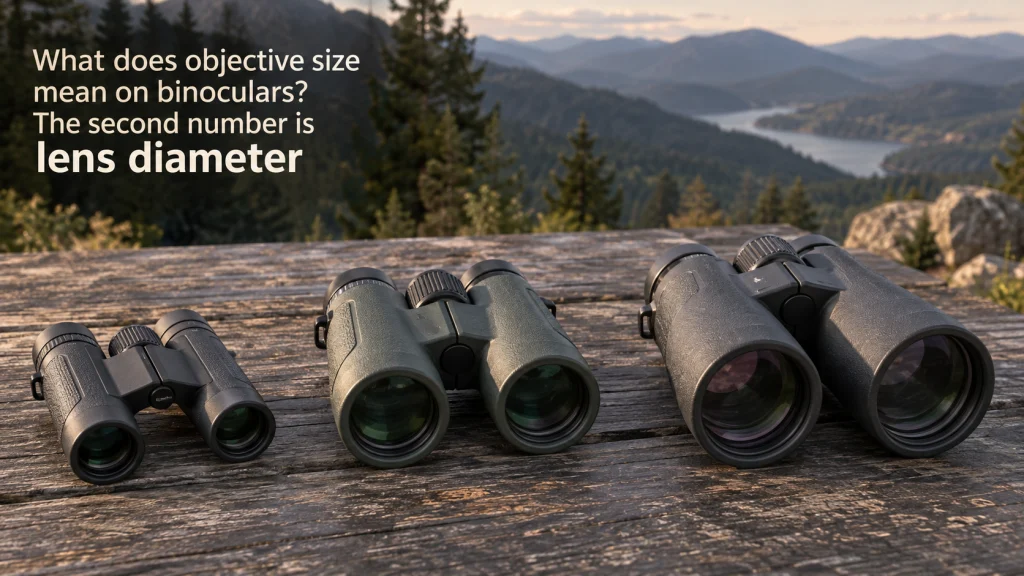
The 50 in 10×50 is lens diameter, not scene width
So, what does objective size mean on binoculars when you see labels such as 8×25, 8×42, or 10×50? The second number is the effective diameter of each objective lens, measured in millimeters, so the 50 in 10×50 refers to a 50 mm objective. It does not mean the binocular shows a 50-degree view, a 50-foot-wide scene, or a larger image circle simply because the number is bigger. If the two headline numbers still feel easy to mix up, how the numbers on binoculars work together is the better place to establish that basic reading order.
Once you know what the second number measures, the next move is to stop asking it to answer questions that belong to other specifications. Field of view has its own line on a specification sheet, exit pupil depends on both objective diameter and magnification, and physical fit involves more than the front lenses alone. The broader binocular specifications that affect real use can help you separate those measurements instead of treating one large number as a quality score. That separation matters because a buyer can correctly understand that a 50 mm objective is larger than a 42 mm objective and still make the wrong purchase if the real constraint is viewing width, hand stability, eyeglass fit, or carrying weight.

The PROSTAFF P3 8x42 pairs 8x magnification with 42 mm objective lenses, matching the two numbers discussed in this section. Nikon lists a 377-foot field of view at 1,000 yards and a 20.3-ounce weight. Its waterproof, fogproof roof-prism body makes it a concrete full-size example without treating objective diameter as a quality score.
Check on AmazonIf you click this link and buy, we earn a commission at no additional cost to you.
What the objective size number physically measures
The objective lenses are the large front lenses that face the subject, and the stated objective diameter refers to their effective clear aperture rather than the outside diameter of the barrels. Nikon describes effective objective diameter as the inside diameter of the objective lens frame, which is why a marking such as 8×42 uses 42 mm as the second headline number. That distinction is practical when you are comparing binoculars because the rubber armor, barrel housing, and lens frame can all make the outside body wider than the optical opening itself. The specification is therefore about the working aperture, not a tape measurement across the widest part of the front housing.
At a fixed magnification, increasing that effective diameter gives the optical system a larger opening through which light can enter. That is the useful part of the number, but it still does not tell you everything about the image that reaches your eyes. The eyepiece design, coatings, prisms, internal light control, and exact magnification remain separate parts of the optical system. Read objective diameter as one physical input to the system, not as a shortcut for overall optical quality.

The Bushnell Explorer 10x42 pairs 10x magnification with 42 mm objective lenses in a compact roof-prism body. Bushnell uses a lightweight aluminum chassis with rubber housing and a textured grip, so the outside body includes structure beyond the optical specification itself. Its fully multi-coated optics and BaK-4 prisms are separate parts of the optical system from the stated objective diameter.
Check on AmazonIf you click this link and buy, we earn a commission at no additional cost to you.
Aperture can collect more light, but exit pupil also depends on magnification
A larger objective has greater light-collecting potential when magnification is held constant, which is why comparing 8×25 with 8×42 is different from comparing 8×42 with 10×50. The first pair keeps magnification at 8x while changing the objective from 25 mm to 42 mm. The second pair changes both numbers, so the larger 50 mm objective does not automatically create a larger exit pupil. When two variables change at once, reading only the second number hides part of the optical relationship.
Exit pupil is calculated by dividing objective diameter by magnification. An 8×42 configuration has an exit pupil of about 5.25 mm, while a 10×50 configuration has a 5 mm exit pupil, so the physically larger objective does not produce the larger exit pupil in that comparison. An 8×25 configuration is about 3.1 mm, which shows how strongly the result changes when the same 8x magnification is paired with a smaller objective. These figures do not rank the binoculars by quality, but they do show why objective size and magnification have to be read together before making brightness assumptions.

The Outland X 10x50 pairs 10x magnification with 50 mm objective lenses, giving a concrete format for the exit-pupil calculation in this section. Dividing 50 by 10 gives a 5 mm theoretical exit pupil. Celestron also uses multi-coated optics and BaK-4 prisms, showing that the complete optical system includes more than aperture alone.
Check on AmazonIf you click this link and buy, we earn a commission at no additional cost to you.
Objective diameter does not set real or apparent field of view
Field of view answers a different question: how much of the scene is visible without moving the binocular. A specification sheet may express real field of view as an angle or as a width at a stated distance, and apparent field of view describes how wide the magnified field appears to the viewer. Neither measurement is simply the objective diameter converted into another unit. A 50 mm objective therefore gives you no reliable basis for assuming the view will be wider than through a 42 mm or 32 mm configuration.
This is one of the easiest buying errors to avoid because the relevant evidence is usually printed separately. If you care about finding a moving subject quickly or keeping more surrounding context in view, check the actual field of view specification rather than the second number in the binocular name. If you care about how expansive the magnified view feels, apparent field of view is the more relevant concept. Objective aperture can influence other parts of the design, but it is not the field-width specification itself.

The Diamondback HD 8x32 uses 32 mm objectives, while Vortex separately lists an 8.1-degree angular field and a 426-foot linear field at 1,000 yards. That separation shows why objective diameter and field of view belong to different specifications. The model also weighs 15.9 ounces and uses fully multi-coated optics.
Check on AmazonIf you click this link and buy, we earn a commission at no additional cost to you.
Larger objectives usually come with a size and weight cost
The extra aperture has to exist somewhere physically, so larger objectives generally require larger front barrels and more glass. Nikon notes that large-diameter objectives make binoculars bigger and heavier, which is the trade-off a spec-only comparison can hide. That extra bulk may be acceptable when the binocular spends most of its time near a fixed viewing position. It can matter much more when the binocular hangs from your neck or harness, shares space in a small bag, or stays in your hands for long sessions.
This does not mean a smaller objective is automatically easier to use, because body shape, balance, grip spacing, armor, and the rest of the optical design still affect handling. It does mean that moving from 25 mm to 42 mm or from 42 mm to 50 mm should solve a real viewing constraint rather than serve as an automatic upgrade. If portability is the limiting factor, extra aperture can create a cost you notice every time you carry the binocular. If light collection at a given magnification is the limiting factor, the added size may be a rational trade, but the decision still needs the rest of the specifications.

The Vortex GlassPak carries full-size binoculars in a chest-mounted harness rather than leaving their weight on a neck strap. Vortex lists the pack at 8 ounces and 6.75 by 6.25 by 3.75 inches, with adjustable straps, binocular tethers, side pockets, and a rear zippered pocket. It directly addresses the carrying tradeoff that becomes more important as binocular size and weight increase.
Check on AmazonIf you click this link and buy, we earn a commission at no additional cost to you.
Why 50 mm alone cannot promise a brighter low-light image
The phrase “bigger objective means brighter” is only safe when its conditions are clear. At the same magnification, a larger effective objective diameter has greater light-collecting power, but perceived brightness through a complete binocular depends on more than the entrance aperture. Magnification changes exit pupil, and the viewer can only use the light that the optical system actually delivers through that exit pupil. A 50 mm label by itself therefore leaves out too much information to promise what the image will look like in dim conditions.
Optical transmission adds another boundary. Nikon notes that binoculars with the same exit pupil can still differ in brightness because lens elements, prism design, and lens or prism coatings affect how much light reaches the viewer. That is why a theoretical relationship between objective size and exit pupil should not be turned into a universal claim about real low-light performance. Use the second number to understand aperture, then check magnification and exit pupil, and treat transmission quality as a separate evidence question rather than assuming more millimeters settle it.

The Falcon combines 10x magnification with 50 mm objectives and a 5 mm exit pupil. Bushnell lists fully coated optics and a Porro-prism design, so aperture is only one part of how the system handles light. Its 27-ounce weight also shows the physical tradeoff that can accompany a larger-objective format.
Check on AmazonIf you click this link and buy, we earn a commission at no additional cost to you.
Four checks before paying for a larger objective
A larger objective should earn its place by solving something you can name. Start with the viewing condition, then identify which specification actually addresses that condition instead of treating diameter as a general upgrade. This keeps a 42 mm or 50 mm choice tied to distance, light, movement, carrying time, and physical fit rather than to the assumption that the bigger number must be better. It also makes it easier to recognize when a smaller and lighter configuration already meets the job.
Use the following checks in order, because each one rules out a different kind of category error. None of them requires choosing a particular brand or model, and none assumes that one objective size is universally preferable. The goal is to find out whether the added aperture changes the problem you actually have. If it does not, paying for more glass may simply buy more bulk.
- Check magnification with objective diameter: calculate exit pupil instead of comparing the second number by itself.
- Check field of view separately: use the listed angle or width if scene coverage matters.
- Check carry and handling limits: consider total weight, body size, grip, storage space, and how long you expect to hold or carry the binocular.
- Check the next use-specific specification: if nearby subjects matter, read what close focus means in binoculars rather than expecting objective diameter to answer that question.
After those checks, the decision becomes much cleaner. A larger objective can be worthwhile when you have a reason to want more aperture at the magnification you intend to use and you accept the size and weight that come with it. A smaller objective can be the better fit when portability and handling dominate and its exit pupil is adequate for the conditions you actually expect. The second number is useful precisely because it is specific, so let it describe aperture and let the other specifications do their own jobs.

The H2O Xtreme 10x42 combines 42 mm objectives with fully multi-coated optics and BaK-4 prisms. Bushnell specifies IPX7 waterproofing and nitrogen purging, and the package includes a strap, carrying case, and lens covers. Those features let a buyer check optics, weather protection, and carrying needs alongside magnification and objective size.
Check on AmazonIf you click this link and buy, we earn a commission at no additional cost to you.
Final Thoughts: make the second number solve a real constraint
Objective diameter is easy to understand once it stops carrying jobs that belong to other specifications. The second number tells you the effective diameter of the front objective lenses in millimeters, and a larger diameter can collect more light when magnification is held constant. It does not tell you field of view, optical transmission, close focus, or whether the binocular will feel comfortable after a long carry. Those questions need their own evidence.
Before choosing a larger objective, identify the constraint you are trying to solve and then check the specification that actually governs it. If light is the concern, read objective diameter together with magnification and exit pupil, then consider the optical system rather than assuming the aperture number guarantees the final view. If scene width is the concern, check field of view directly, and if portability is the concern, check dimensions, weight, and fit. A bigger second number is useful when the extra aperture solves your problem, not when it merely looks more impressive on the label.

The Bantam HD uses 6.5x magnification with 32 mm objective lenses in a streamlined, lightweight body. Vortex lists a 400-foot linear field of view, 14.4-ounce weight, and 18.7 mm eye relief for this model. Its smaller format makes it a useful final example of choosing aperture together with handling and viewing requirements.
Check on AmazonIf you click this link and buy, we earn a commission at no additional cost to you.
FAQs
These questions focus on the mix-ups that happen when objective diameter gets used as a shortcut for other binocular specifications. The answers keep aperture, exit pupil, field of view, and physical size in separate lanes. That makes comparisons more predictable because each number is asked to describe only what it actually measures. Exact performance still depends on the complete optical design and the conditions in which the binocular is used.
The quickest way to use this section is to start with the question closest to your buying assumption. If you thought 50 mm meant a wider view, check the field of view answer first. If you thought 50 mm must always look brighter than 42 mm, start with exit pupil and transmission. If your real concern is carrying comfort, treat the objective number as one contributor to physical size rather than as a quality grade.
🔭 What does the 42 mean in 8×42 binoculars?
The 42 is the effective objective lens diameter in millimeters. It describes the front aperture, not field of view or magnification.
🌙 Are 10×50 binoculars always brighter than 8×42 binoculars?
No. A 10×50 configuration has a 5 mm exit pupil, while 8×42 is about 5.25 mm, and real brightness also depends on optical transmission and viewing conditions.
👀 Does a larger objective give a wider field of view?
Not by itself. Real and apparent field of view are separate specifications, so check the listed field of view rather than inferring it from objective diameter.
🎒 Is a 50 mm objective too large for general carrying?
That depends on the complete binocular, your carrying method, and how long you use it. Larger objectives generally add size and weight, so compare actual dimensions and total weight before deciding.
📐 How do I calculate exit pupil from binocular numbers?
Divide the objective diameter by the magnification. For example, 42 divided by 8 gives about 5.25 mm for an 8×42 configuration.
References and Sources
The technical claims in this article rely on manufacturer explanations of effective objective diameter, exit pupil, field of view, and relative brightness. These sources are used for definitions and optical relationships, not as product recommendations. They also make clear where a simple formula ends and complete optical performance begins. That boundary is important when a single specification is being used to predict a viewing result.
The objective-diameter reference supports what the second number physically measures and the general size and weight trade-off. The exit-pupil and field-of-view references separate aperture from two specifications that buyers often confuse with it. The relative-brightness reference explains why equal theoretical values do not guarantee equal real brightness. Together, they support the article without turning the source section into a general reading list.
- Nikon effective diameter of the objective lens: Defines effective objective diameter and explains its light-collecting, size, and weight implications.
- Nikon exit pupil: Gives the objective-diameter divided by magnification relationship and worked examples.
- Nikon field of view: Defines real field of view, apparent field of view, and field width as separate specifications.
- Nikon relative brightness: Explains why equal exit-pupil values do not necessarily produce equal real brightness.