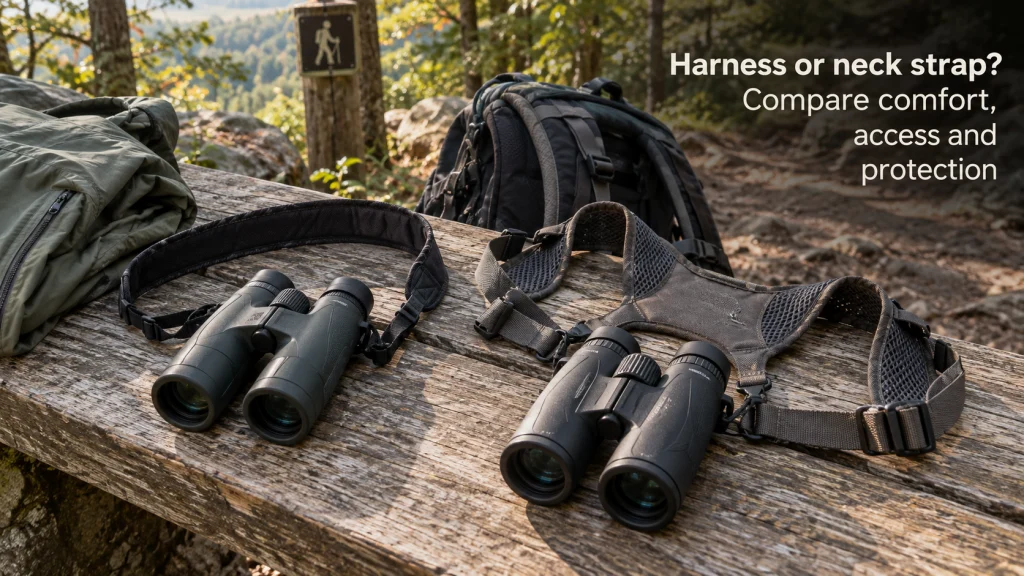
A binocular harness vs neck strap decision is less about finding a universal upgrade and more about deciding which carry tradeoffs fit the way you actually use your binoculars. A harness can spread the load across more of the upper body and limit some free swinging, while a neck strap stays simpler to put on, remove, share, and combine with other gear. Binocular weight, viewing frequency, clothing, backpacks, body fit, and the attachment system can all reverse the better choice. The useful comparison is therefore not which system looks more serious, but which one gets in the way less during your normal session.
A harness is not an automatic upgrade
The main binocular harness vs neck strap choice is a fork, not an upgrade ladder. Choose an open binocular harness when spreading the load and controlling movement matter more than simplicity, but keep a strap when fast removal, easy handoff, and minimal torso hardware matter more. That judgment changes with binocular weight, how often you raise them, and what else you wear across your shoulders or chest. A carry system that feels neat in isolation can become awkward once a backpack, camera strap, jacket, or hydration tube joins it.
It also helps to separate this decision from the wider accessory question. The broader binocular accessories guide covers when extra gear is useful at all, while this comparison stays focused on two ways to carry one binocular. Neither system guarantees comfort, stability, or protection for every person because fit and connector geometry still vary. Start with the session you actually have, then choose the simpler system that handles its main constraint.

This adjustable harness uses nylon and Lycra straps to keep binoculars close to the chest. The straps allow the binoculars to slide into viewing position while staying attached to the harness. Its one-size design is fully adjustable.
Check on AmazonIf you click this link and buy, we earn a commission at no additional cost to you.
Compare the two systems on the decisions that actually change
A useful comparison starts with load path, movement, access, and interference rather than marketing language. A conventional neck strap suspends the binocular from a relatively narrow route around the neck or shoulder area, while an open harness uses multiple straps to spread that load across the shoulders and upper torso. Published harness designs also show two attachment points running from the binocular to the worn system, which can help keep the instrument closer to the body than a long loose strap. That difference is meaningful, but the result still depends on strap adjustment, binocular mass, body shape, and how freely the connectors slide.
The table below is a decision matrix, not a promise that one side wins every row. A harness usually asks you to accept more worn hardware in exchange for a broader load path and more movement control. A neck strap usually asks you to accept a more concentrated load and more potential swing in exchange for fewer steps and fewer straps. After comparing the rows, focus on the two tradeoffs you notice most during actual use rather than trying to optimize everything at once.
| Decision | Open harness | Neck strap |
|---|---|---|
| Load path | Spreads support across shoulders and upper torso | Concentrates support through a simpler neck or shoulder route |
| Swing control | Can hold the binocular closer when adjusted well | Allows more free movement unless shortened or carried differently |
| Access | Fast once fitted, but the binocular stays connected to the worn system | Very direct, with fewer attachment points between storage and use |
| Handoff | Usually requires unclipping or removing more of the system | Usually easier to lift off and pass to another person |
| Other straps | May overlap a backpack, camera strap, or outer layers | Uses less torso space but may cross another shoulder strap |
Read the matrix as a way to identify friction, not as a scoring system. If your main complaint is movement while walking, connector placement and harness tension deserve more attention than padding alone. If your main need is to pick up, set down, or share the binocular quickly, the simpler strap route may remain the cleaner answer. That leads to the individual tradeoffs that matter most.
Load distribution
Harness makers commonly describe the design goal as moving support from the neck toward the shoulders and upper torso. That geometry can be useful with a heavier full-size binocular or during sessions where the instrument stays on your body for long stretches. It does not justify a medical claim, and it does not mean every harness fits every torso well. If a harness pulls unevenly, rides into the neck, or requires constant readjustment, the theoretical load advantage is not doing useful work for that wearer.
Swing and movement control
A long neck strap gives the binocular more room to move when you bend, step over an obstacle, or walk quickly. An open harness can reduce that range by keeping the attachment points under light tension and closer to the body, but it can still bounce if the straps are too loose or the geometry does not suit the wearer. Community reports are especially mixed here, which is a good reminder that bounce is partly a fit problem rather than a simple product category problem. Check how far the binocular moves during your normal walking motion before deciding that more restraint automatically means better carry.
Access and handoff
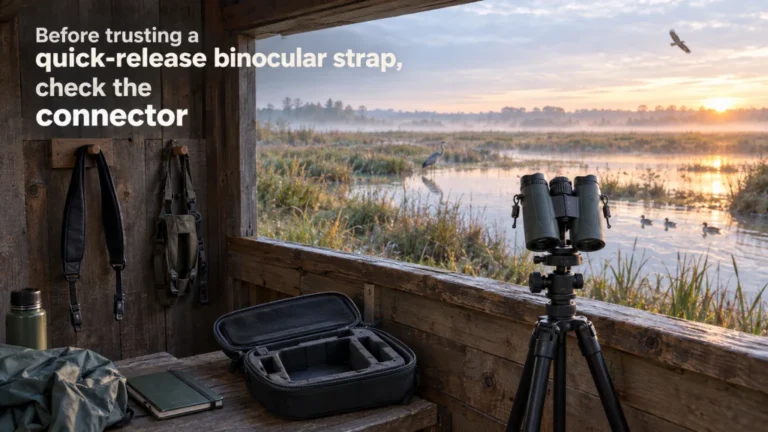
Both systems can keep binoculars immediately available, but they differ when another person needs to use them. A neck strap can usually be lifted off in one motion, while a harness often keeps the binocular tied to a system that the wearer is still wearing. Quick connectors can reduce that inconvenience, so attachment design matters as much as the main straps. If swapping between carry systems is frequent, compare the connector logic in a quick release binocular strap setup before choosing around the harness body alone.
Bulk, heat and other torso straps
A harness occupies more of the upper body than a basic strap, and that becomes noticeable when clothing or equipment is already layered there. Backpack shoulder straps can press over harness webbing, camera straps can cross the same space, and warmer weather can make extra contact area less appealing. A simple neck strap has less hardware to organize, although it can still interfere with a camera or bag strap if everything hangs from the same area. Lay out the whole carry system you use, not just the binocular, before deciding which option is cleaner.

This black elastic harness uses a two-shoulder layout with quick-release loop connectors for binoculars or cameras. The elastic version keeps gear close to the body while stretching as the binoculars are raised to the eyes. The harness is fully adjustable and designed as a one-size-fits-most system.
Check on AmazonIf you click this link and buy, we earn a commission at no additional cost to you.
Let binocular size and viewing frequency change the answer
Weight matters, but frequency matters with it. A compact binocular that comes up to your eyes a few times during a short stop places a different demand on its carry system than a full-size binocular that stays on your body through a long walk with repeated viewing. The heavier and more continuously carried the binocular becomes, the more useful it is to examine whether a broader load path improves the session. A lighter instrument used intermittently may never create enough carry friction to justify adding a harness.
Viewing rhythm can reverse the choice even when two people carry binoculars of similar size. Someone who repeatedly raises and lowers the binocular while walking may value keeping it centered and controlled, while someone who frequently removes it, sets it down, or lends it may value the simplicity of a strap. The point is not to set a weight cutoff that pretends every wearer is the same. Use weight as one variable, then judge it together with duration, movement, clothing, and access frequency.
| Reader situation | Start with | Reason to reconsider |
|---|---|---|
| Light binocular, short casual sessions | Neck strap | Move to a harness only if swinging or load concentration is actually bothersome |
| Heavier binocular carried for long walks | Open harness | Return to a strap if harness fit or torso interference creates more friction |
| Frequent sharing or quick removal | Neck strap | Consider quick connectors if load distribution becomes the bigger issue |
| Backpack and camera already in use | Test both as a complete system | Choose whichever produces fewer crossing straps and cleaner access |
This table is deliberately conditional because carry comfort is not a specification that transfers cleanly from one body to another. Try the intended setup over the clothing and backpack straps you normally use, with the exact binocular attached. Raise the binocular several times, walk, bend forward, and remove a layer if that is part of your routine. The better system is the one that stays predictable through those ordinary movements.

This black binocular harness uses shock cord and a swivel-hook fastener. The listed item weight is 2.24 ounces. The compact harness is designed for hunting, birding, and hiking.
Check on AmazonIf you click this link and buy, we earn a commission at no additional cost to you.
Decide whether you actually need an enclosed chest pack
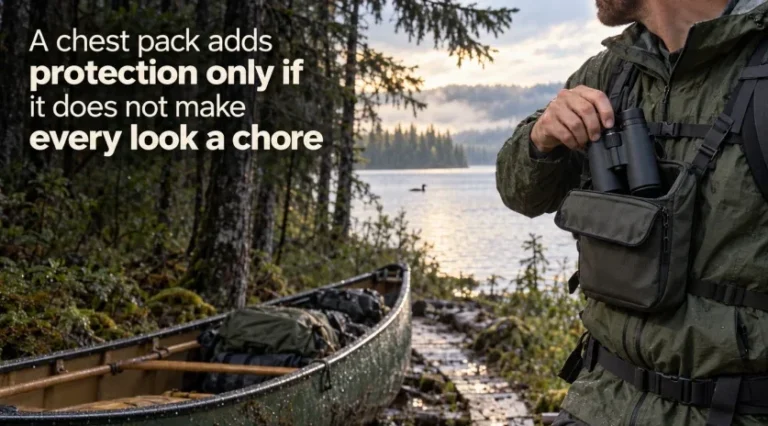
An open harness and an enclosed chest carrier solve different problems. The open design is mainly a support and retention system, leaving the binocular exposed and ready to lift, while an enclosed binocular chest pack adds a physical container around the instrument. That extra enclosure can matter when protection from brush, debris, or incidental contact is more important than having nothing between your hands and the binocular. It also adds bulk and introduces an opening step before viewing.
Do not let a need for better load distribution quietly turn into a much larger carrying system unless the protection problem is real. If the binocular mostly needs to stop swinging while you walk, an open harness may address that without adding a pouch. If the binocular is frequently exposed to rough vegetation or other contact, a chest pack may be the more relevant branch. Choose the enclosure question separately from the harness versus strap question so one decision does not smuggle in hardware you do not need.

This brown chest pack is made from 500D treated nylon and includes a removable rangefinder pouch. A rain cover adds another protective layer around the enclosed binocular compartment. The pack also uses MOLLE webbing and is designed for one-handed access.
Check on AmazonIf you click this link and buy, we earn a commission at no additional cost to you.
Keep the neck strap when a simpler replacement solves the problem
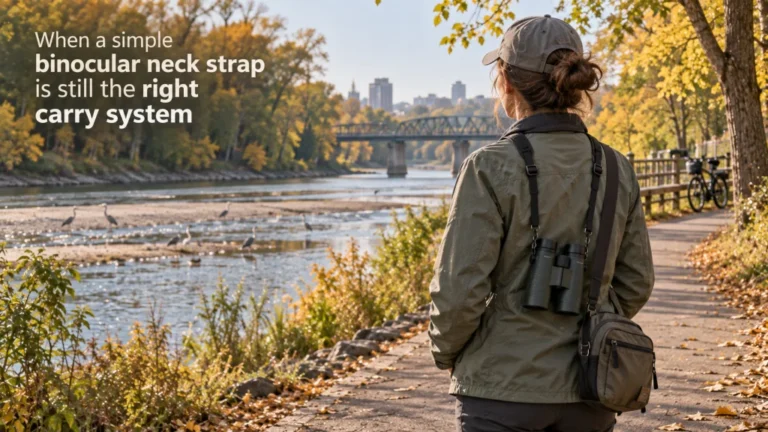
A neck strap is not automatically the inferior option just because it came with the binocular. Width, padding, length, surface grip, and connector placement can change how a strap behaves, and some systems allow quick changes between carrying methods. If the main problem is a narrow or awkward original strap, replacing only that part may solve the issue without putting another structure across the torso. The dedicated binocular neck strap guide covers those strap-specific choices in more depth.
Simplicity has practical value when binoculars move between users, bags, vehicles, and short viewing sessions. A single strap is easy to understand, easy to inspect, and usually quick to remove from the body. It can also work well when the binocular is light enough that load distribution is not the dominant constraint. Keep it when the system already behaves predictably, and change it only when a specific carry problem keeps showing up.

This black neoprene strap carries compact binoculars from two 1.5 mm loop connection points. Mini quick disconnects let the main strap detach from the binocular-side loops. The strap adjusts from 31.5 to 38 inches for neck or shoulder carry.
Check on AmazonIf you click this link and buy, we earn a commission at no additional cost to you.
Use harness sizing only after choosing the harness branch
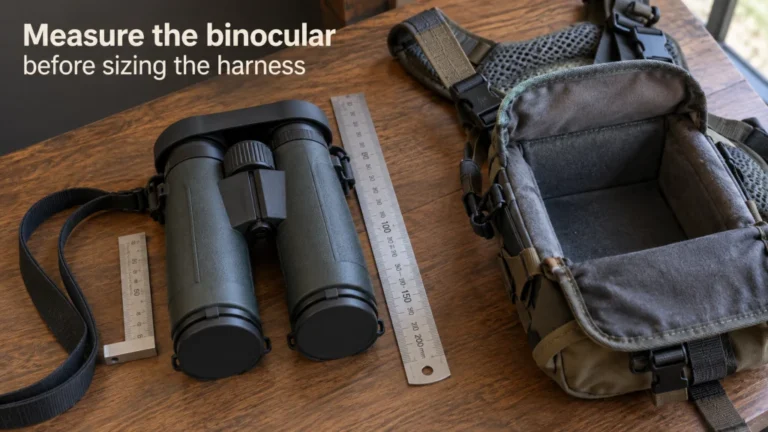
Harness fit deserves attention after you have decided that its basic carry geometry matches your needs. Adjustable straps are useful only if their range lets the binocular sit where you can raise it naturally without excess slack, binding, or constant repositioning. Clothing layers also change the effective fit, so a setup adjusted over a thin shirt may behave differently over a bulky jacket. This is why a broad claim such as one size fits all is not enough to establish compatibility.
Check the adjustment range across the clothing layers you normally wear, and verify that the binocular attachment points accept the harness connectors rather than assuming every loop is interchangeable. The binocular harness sizing guide is the next step once the carry style itself is settled. If the adjustment range or connector interface does not work cleanly, reject that setup even if the general idea of a harness still makes sense. Fit is part of function here, not a cosmetic detail.

This camo binocular harness uses an adjustable strap layout for hunting, hiking, and birding. The package includes a microfiber lens-cleaning cloth. The harness uses acrylic-fiber construction with snap fastening.
Check on AmazonIf you click this link and buy, we earn a commission at no additional cost to you.
Check the strap architecture before committing to an open harness
Open harnesses can look similar while using different paths, adjusters, clips, and connector tabs. Those details determine whether the binocular rises smoothly, whether the straps twist, and how easily the instrument can be detached from the worn system. They also determine how the harness shares space with a backpack or another shoulder strap. A visually minimal design is not automatically simpler if its connector path is awkward with your exact binocular.
Once you know you want an open harness, compare the actual strap path rather than treating every suspender-style system as interchangeable. The binocular harness strap guide focuses on that architecture and the attachment details that affect use. Inspect the binocular strap lugs, connector width, adjustment hardware, and the route the straps take across your body. Compatibility should be verified from the actual interface, not inferred from a product photo or the word universal.

This black hands-free strap uses quick-release buckles and a stabilizing cross-back design for cameras and binoculars. Its adjustable length reaches 230 centimeters. The device is secured by two fixing points, and the listed strap weight is 75 grams.
Check on AmazonIf you click this link and buy, we earn a commission at no additional cost to you.
Final Thoughts: pick the carry system whose tradeoffs match the actual session
Choose a harness when broader load distribution and tighter movement control solve problems you actually notice during longer or more active carrying. Keep a neck strap when the binocular is manageable, quick removal matters, sharing is common, or extra torso straps create more inconvenience than they remove. Neither answer needs to be permanent because some attachment systems make it practical to switch between carry methods. The useful goal is a predictable setup that lets you reach the binocular without reorganizing everything else you are wearing.
Before changing anything, identify the single carry problem you are trying to fix. Then test the candidate setup with the exact binocular, your normal outer layer, and any backpack or camera strap that shares the same space. If the new system solves that problem without creating a larger one, the change is justified. If it does not, the simpler setup is still the better choice.

This black X-shaped chest harness uses fast-release strap buckles for quick setup and removal. Adjustable sliding strap brackets let the harness fit a range of body sizes. The chest-strap layout distributes the carried load around the neck, back, and shoulders.
Check on AmazonIf you click this link and buy, we earn a commission at no additional cost to you.
FAQs
The questions below come up because harnesses and neck straps solve overlapping problems but create different kinds of friction. Most answers depend on binocular weight, fit, attachment style, clothing, and what else is already carried on the upper body. That means a good answer is usually conditional rather than universal. Use these checks to narrow the choice before buying more hardware.
Compatibility is especially important because a carry system can look suitable and still fail at the connector or adjustment range. Do not assume that a harness advertised broadly will fit every binocular without checking the exact strap lugs or attachment loops. Likewise, do not assume a heavier-looking system will automatically control movement better on your body. The right next step is a fit, connector, and access check before you commit to the change.
🎒 Is a binocular harness better than a neck strap for long walks?
It can be when the main problem is concentrated load or uncontrolled movement during extended carrying. A harness spreads support across more of the shoulders and upper torso, but poor fit or interference with a backpack can erase that advantage. Check whether the shoulder straps overlap or restrict access before switching.
🔭 Can any binocular use a harness?
Not safely by assumption. Many systems connect at the same strap lugs used by a neck strap, but connector shape, loop width, proprietary hardware, and adjustment range can vary. Verify the exact binocular and harness interface before relying on it.
🚶 Does a harness stop binoculars from bouncing?
It can reduce free swinging when the straps keep the binocular closer to the torso. Bounce can still happen when the harness is loose, the binocular is heavy, or the fit does not match the wearer. Treat reduced movement as a fit-dependent benefit, not a guarantee.
🧥 Can I wear a binocular harness with a backpack?
Often, but the two strap systems need to coexist without binding or blocking access. Put on the harness and backpack together, then raise the binocular several times and remove a layer if that is part of your normal routine. Choose the arrangement that stays predictable through those movements.
🤝 Which is easier if I share binoculars with another person?
A neck strap is usually simpler because the whole binocular can be lifted off and handed over in one motion. A harness may require unclipping the binocular or removing more of the worn system. Quick connectors can narrow that difference if they are compatible with the exact setup.
References and Sources
The comparison above uses manufacturer material for carry geometry, adjustment, and attachment details rather than treating user preference as technical proof. Celestron documents a harness design that distributes binocular weight across the shoulders and upper back, while Maven documents an adjustable padded neck strap and a quick-disconnect attachment system. Those sources establish how the two carry architectures are intended to work. They do not establish that either method will fit every wearer better.
Community discussion is useful for a different reason. It shows why people disagree about chest fit, bounce, backpack interference, and the effort required to hand binoculars to someone else. Those reports support the need for a condition-based decision, but they remain individual experiences rather than universal performance evidence. The article therefore keeps its verdict tied to fit, session length, movement, and access needs.
- Celestron binocular harness strap: supports the harness load path, adjustable strap design, and upper body weight distribution described in the comparison.
- Celestron harness setup instructions: supports the two-point attachment procedure and how the harness is worn around the shoulders and back.
- Maven binocular neck strap: supports the neck strap construction, adjustability, padding, and quick-disconnect attachment details used to explain strap simplicity and swapping.
- Birding community discussion on neck straps and harnesses: illustrates disagreement about fit, bounce, backpacks, and handoff without being used as technical proof.