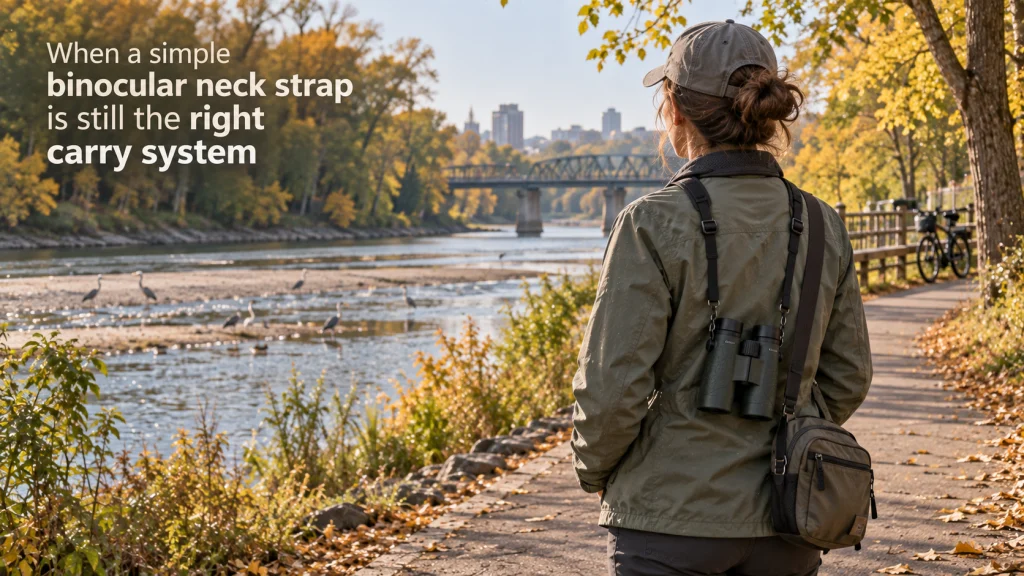
A binocular neck strap is still the right carry system when the real problem is limited to width, grip, padding, length, or attachment fit. A better conventional strap can improve how the binocular sits and moves without adding the bulk or setup of a harness. The useful buying test is not whether a strap looks more substantial, but whether its dimensions, material, adjustment range, and connectors solve the specific problem you already have. If the issue is load distribution across the torso or uncontrolled swing during active movement, a different carry system may make more sense.
Diagnose what the existing binocular neck strap gets wrong
If the supplied strap only fails on width, grip, length, or padding, replacing the strap may solve the problem without changing the whole carry system. Start by noticing what actually happens during a normal outing: where the binocular rests, whether the strap slides, whether the adjustment leaves enough range, and whether the attachment points sit cleanly against the body. If you have not decided whether a simple strap is enough, the binocular harness guide gives the broader carry context. For a wider look at cases, straps, harnesses, and other add-ons, use the binocular accessories guide rather than treating one carry style as the default.
The point of this first check is to separate a fixable strap problem from a system problem. A strap that is too narrow can feel very different from one that is too long, and neither problem proves that a harness is necessary. Likewise, a slippery surface can make the binocular wander even when the strap length is correct. Solve the failure you can describe, not the one implied by a thicker pad or a more complicated product page.
Pressure from narrow width
A narrow strap concentrates the binocular’s weight over a smaller contact area, so width is one of the first dimensions worth checking. That does not mean the widest strap is automatically the best choice, because extra width can bunch at the neck, catch on a collar, or feel bulky under a jacket. Compare the current strap with the replacement at the padded section and at the narrower tails, since both affect how it sits. The useful question is whether added width changes the pressure and stability problem you actually notice.
Slip or unwanted stretch
A strap that constantly migrates off the shoulder can be annoying even when it is adequately padded. Surface texture, backing material, clothing, and the amount of stretch all influence how a strap behaves while walking or raising the binocular. Some stretch can soften abrupt movement, while too much stretch can make the binocular bounce lower than expected. Judge grip and elasticity as separate traits instead of assuming a soft material will automatically stay put.
Length and carry position
Length determines where the binocular rests before you even think about padding. A strap that is too short can keep the binocular high against the chest, while one that is too long can place it where it swings more or collides with a belt, jacket zipper, or bag. Check the usable adjustment range, not only the advertised total length, because folds, buckles, and attachment tails consume part of that measurement. The goal is a carry height that lets you reach the binocular naturally without leaving excessive slack.
Connector mismatch
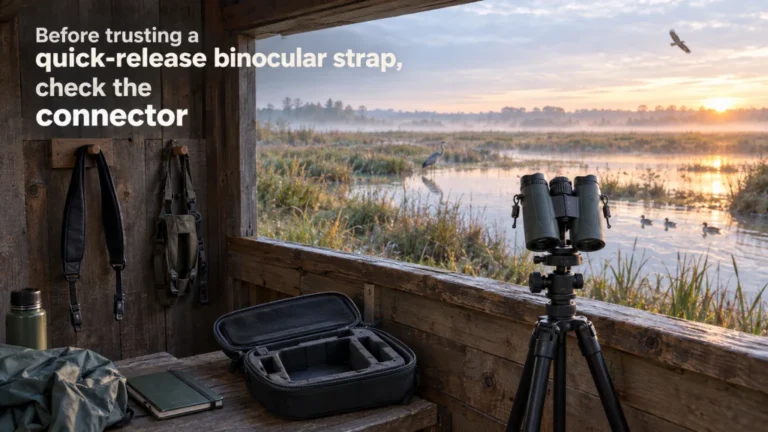
The strap can be perfectly sized and still be the wrong purchase if its attachment system does not match the binocular. Some designs thread directly through narrow lugs, while others use small loops, clips, rings, or proprietary quick disconnects. Manufacturer documentation matters here because a photo that looks compatible may hide a lug opening that is too small or a connector that needs an intermediate loop. Treat exact attachment fit as a pass or fail requirement before comparing padding or materials.

The BlueCabi strap uses neoprene construction for cameras and binoculars. Its anti-slip design directly addresses a strap that tends to move on clothing. It keeps the replacement in a conventional neck-strap format while changing the material and grip.
Check on AmazonIf you click this link and buy, we earn a commission at no additional cost to you.
Match material and padding to the actual problem
Padding should solve a contact problem without creating a new bulk problem. Foam and neoprene can spread pressure and may add some compliance, while woven webbing can stay comparatively thin and structured. Leather or fabric faced designs may feel different against clothing, but the material name alone does not tell you how much the strap stretches, grips, or dries after getting wet. Look at the construction of the padded zone, its backing, its width, and how the narrow ends transition toward the binocular.
It also helps to separate softness from support. A very soft strap can feel pleasant when first placed on the neck yet still stretch or roll in a way that changes carry height during movement. A firmer strap can hold its shape better but may feel less forgiving against bare skin, especially if the edges are stiff. The right choice is the one that addresses the failure you identified, not the one with the thickest pad or the longest materials list.
| What you notice now | What to check in a replacement | What not to assume |
|---|---|---|
| Narrow pressure point | Wider load area and a smooth transition into the strap tails | More thickness is always better |
| Strap slides off clothing | Backing texture, surface grip, and stretch behavior | Soft material automatically has good grip |
| Binocular bounces while walking | Elasticity, carry height, and remaining slack after adjustment | Extra padding will control movement |
| Strap feels bulky under outerwear | Overall width, edge thickness, and shoulder profile | A premium strap must be physically larger |
Use the table as a diagnostic filter, then check the actual dimensions and construction of any strap you are considering. The label on the material is less useful than knowing where the padding sits, how wide it is, and what happens when the strap is adjusted to your normal carry position. That keeps the decision tied to the binocular and the way you carry it. It also prevents a simple replacement from turning into an unnecessary equipment upgrade.

The E-Z Comfort uses padded neoprene in a lightweight neck strap. Amazon lists the black model as adjustable and compatible with binoculars as well as DSLR and mirrorless cameras. It changes the contact material and padding while keeping the carry system in a simple strap format.
Check on AmazonIf you click this link and buy, we earn a commission at no additional cost to you.
Check neck, shoulder, and cross-body length options
A conventional strap can serve more than one carry position, but only if its adjustment range supports the position you intend to use. Neck carry usually needs less total length than shoulder carry, and cross-body use generally needs more room to pass across the torso without pulling the binocular awkwardly upward. Clothing matters too, because a length that works over a T-shirt can feel completely different over a thick coat. Measure the path you want the strap to follow instead of buying by a generic short, regular, or long label.
Before shopping, set the current strap as close as possible to the carry height you want and note what is missing. If you need several more inches, estimate that extra length at the actual route around your body rather than simply adding it to one tail. If the strap already reaches the desired position but leaves large loose ends, a model with a better adjustment range may be more useful than a longer one. This is also where you can decide whether a true binocular shoulder strap is enough or whether you are really trying to turn a neck strap into a different carry system.
- Check where the binocular rests while standing, walking, and raising it to your eyes.
- Repeat the fit check over the thickest clothing you expect to wear.
- Confirm that buckles or adjusters do not land directly on a pressure point.
- Leave enough adjustment range for small changes instead of setting the strap at its absolute limit.
A strap that only works at the end of its adjustment range gives you little flexibility when clothing or carry position changes. A useful fit leaves some room in both directions, especially if the same binocular moves between warm weather and layered conditions. Cross-body carry also increases the importance of the strap path because the binocular may rest closer to the hip and move differently during a stride. Choose the length for the position you will actually use most often.

The TIMISM padded shoulder strap adjusts from 39 to 63 inches. Amazon lists this black variant for binoculars as well as cameras and several other carried devices. Its long adjustment range supports neck, shoulder, or cross-body routing without relying on a generic short or regular label.
Check on AmazonIf you click this link and buy, we earn a commission at no additional cost to you.
Verify the binocular attachment system before buying
Connector compatibility is the part of strap shopping that deserves a hard stop rather than a hopeful guess. The binocular may have narrow molded lugs, wider slots, metal rings, cord loops, or a maker-specific interface, and those details control what can be attached safely. A replacement strap can also add hardware between the strap and the binocular, which may change how the connection folds against the body. Check the binocular maker’s instructions or accessory information and compare them with the strap maker’s stated connector method.
Do not treat the word universal as proof of fit. The useful evidence is a stated lug size, a documented loop or clip system, an exact compatibility list, or clear installation instructions for the attachment style on your binocular. If the strap relies on an adapter loop, make sure that loop can pass through the binocular lug without forcing it and that the finished connection does not interfere with caps, eyecups, or the way the binocular enters its case. When any part of that path is unclear, keep the existing strap until the interface can be verified.
Key point: Fit the connector first, then evaluate width, padding, and material. A comfortable strap that cannot attach correctly is not a viable upgrade.
Published examples show why this check matters. Some makers list separate strap sizes and pair them with their own loop or quick disconnect system, while other accessory catalogs separate neck straps, harnesses, and related carry hardware into distinct products. That is evidence that attachment details are not interchangeable by default. Use the exact model and exact interface as the final compatibility check.

The OP/TECH USA Uni-Loop set is made for binocular and camera strap connections. Each connector uses a 1/4-inch tubular nylon webbing loop for tight connection areas. The pair provides a defined attachment interface that can be checked against the binocular lug before choosing the strap.
Check on AmazonIf you click this link and buy, we earn a commission at no additional cost to you.
Add quick release only when frequent detachment matters
Quick release hardware is useful when you regularly remove the padded strap to place the binocular in a case, mount it on another carry system, or reduce dangling material during storage. If the strap stays attached almost all the time, extra clips can solve a problem you do not actually have. They also add another interface that needs to be checked for fit, orientation, and security. Treat quick release as a workflow feature rather than a marker of a better strap.
The important questions are simple: how often do you detach the strap, what remains attached to the binocular, and does that remaining hardware interfere with normal use? A short loop or connector tail can be convenient when it stays out of the way, but an oversized clip can rub against the housing or make a compact binocular feel cluttered. If detachment is a real part of your routine, the quick release binocular strap guide goes deeper into connector choices. If it is not, a straightforward threaded strap may be the cleaner solution.
Quick release should also be judged as a complete system rather than a single buckle. Check both sides, make sure the connectors are installed in the intended direction, and confirm that the strap cannot be released accidentally during normal handling. Avoid mixing small attachment parts from unrelated systems unless both makers explicitly support that combination. A simple, correctly fitted connection is usually more useful than extra hardware that adds uncertainty.
The same logic applies when moving between a strap and a case or harness. A shared connector system can make swapping easier, but only when the connector family is documented for those components. Otherwise, frequent changes can create more opportunities for incorrect routing or incomplete engagement. Buy quick release for a repeated need, not because it looks more advanced.

This OP/TECH USA 3/8-Inch Utility Strap is a padded quick-release strap listed for binoculars and cameras. The black model combines the padded strap with detachable connector hardware. Its quick-release design fits routines where the main strap is removed for storage or switching carry setups.
Check on AmazonIf you click this link and buy, we earn a commission at no additional cost to you.
Move to a harness when load distribution or swing control is the real constraint
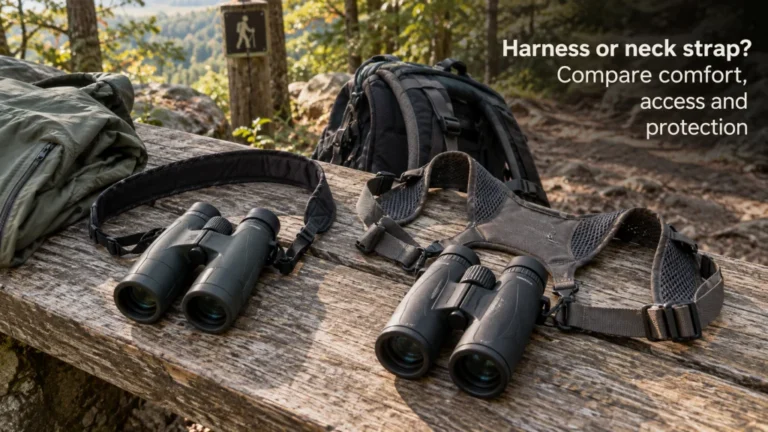
A better strap cannot solve every carry problem. If the binocular still feels poorly supported because its weight is concentrated at the neck, or if it swings excessively during repeated bending and active walking, changing width or padding may only soften the symptom. A harness changes the routing of the load and can hold the binocular closer to the torso, so it belongs in a different decision category. That distinction matters more than whether the harness looks more technical or costs more.
The threshold is functional: switch systems when the thing you want to change is no longer the strap itself. If your complaint is simply that the stock strap is slick, too short, or poorly padded, stay with a conventional replacement. If you want the load shared across the shoulders and torso or you need more control over movement, compare the tradeoffs in binocular harness versus neck strap. A harness adds more straps, more adjustment, and often more bulk, so it should earn that complexity by solving a problem the simple strap cannot.
There is also a middle ground where a different simple strap is still worth trying before moving to a harness. A wider shoulder section, a grippier backing, or a better length range can materially change carry behavior without changing how quickly you pick up and put down the binocular. That is especially relevant when the binocular is not unusually heavy and the main problem appears only with the supplied strap. Keep the upgrade proportional to the actual constraint.
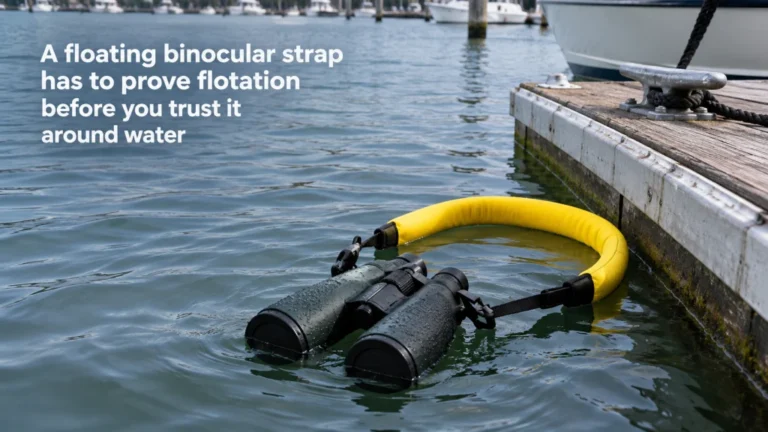
For water-focused use, the carry decision can change for a different reason. Buoyancy and water visibility are separate requirements from padding or load distribution, so a floating binocular strap belongs to that specific use case rather than this general neck strap decision. This article stays with conventional carry on land. Use the specialized system when the environment creates the specialized requirement.

The OP/TECH USA Bino/Cam Harness is a webbing harness made for binocular and camera carry. Its webbing layout routes the binocular through a harness instead of a single neck strap. The black model includes quick-release connections for attaching and removing the carried optic.
Check on AmazonIf you click this link and buy, we earn a commission at no additional cost to you.
Use a broader carry guide if you have not chosen the system yet
A binocular neck strap is easiest to choose when you already know you want a simple two-point carry system. If you are still deciding between a neck strap, shoulder carry, elastic harness, or chest pack style system, comparing strap materials too early narrows the decision before the main constraint is clear. Start with how long you carry the binocular, how active you are while carrying it, how quickly you need to raise it, and how much extra hardware you are willing to wear. Those answers tell you which family of carry systems deserves attention.
The binocular harness overview is the better next stop when your decision is still at that broader level. Once you decide that a conventional strap fits your use, come back to width, material, length, and connector geometry rather than restarting the entire comparison. That sequence keeps the purchase practical and reduces the chance of overbuying. A simple strap remains a strong solution when the problem is simple.
Think of the choice as a boundary rather than a ladder. A harness is not automatically an upgrade from a strap, and a padded strap is not automatically an upgrade from a plain one. Each system changes where the load sits, how the binocular moves, and how much setup surrounds a basic viewing tool. Pick the least complicated system that controls the problem you can actually describe.
That approach also makes future changes easier. If your use changes from short walks to long outings, from light clothing to bulky outerwear, or from relaxed standing to active movement, you can reassess the carry system without pretending the earlier choice was wrong. The best fit is conditional on how you carry the binocular now. Keep the decision tied to that reality.

The Rick Young Outdoors model is an adjustable binocular chest strap built around compact shock cord. Amazon positions it for hunting, birding, and hiking. The black harness is designed for all-day carry and tangle-free storage.
Check on AmazonIf you click this link and buy, we earn a commission at no additional cost to you.
Final Thoughts: upgrade the strap only as far as the carry problem requires
A conventional strap is still the right answer when its basic carry pattern works and only the details need improvement. Identify whether the real failure is width, grip, stretch, length, or connector fit, then choose a replacement that corrects that specific issue. Verify the attachment system before buying, and add quick release only when repeated detachment is part of your routine. Move to a harness only when load distribution or swing control has become the problem, not because a more complex system looks like the next step.
Keep the purchase proportional to the problem you can actually describe. A simpler strap can remain the better carry system when it reaches the right height, stays where you expect, and connects correctly to the binocular. If those conditions are already met, there is little reason to add more hardware. Recheck the system only when your binocular, clothing, activity level, or carrying needs change.

The OP/TECH USA Pro Loop is a black neck-and-shoulder strap listed for binoculars as well as DSLR and mirrorless cameras. It includes quick-release hardware while retaining a conventional strap format. That combination supports a modest strap upgrade without moving to a full harness.
Check on AmazonIf you click this link and buy, we earn a commission at no additional cost to you.
FAQs
🔭 How wide should a binocular neck strap be?
There is no single width that fits every binocular or person. Compare the current strap with the replacement and look for enough width to spread the load without bunching against your neck, collar, or jacket.
📏 How long should a binocular strap be?
It should adjust to the carry height you actually use while leaving some range in both directions. Check the fit over your normal outerwear and confirm that the binocular does not hang so low that it swings into other gear.
🎒 Can I wear a binocular neck strap over one shoulder?
Yes, if the strap has enough usable length and stays secure on the clothing you wear. If it repeatedly slips or the binocular swings excessively, check grip and carry height before assuming you need a more complex system.
🔗 Are binocular neck straps universal?
No. Lug size, loop style, clips, rings, and proprietary connectors can differ, so verify the exact attachment method for your binocular and the replacement strap before buying.
✂️ Is a quick release binocular strap worth it?
It is useful when you frequently remove the main strap for storage, cases, or another carry system. If the strap normally stays attached, quick release hardware may add complexity without solving a recurring problem.
🧭 When should I choose a harness instead of a neck strap?
Consider a harness when the main issue is how the load is distributed across your body or how much the binocular swings during active movement. If the problem is only strap width, grip, length, or padding, a better conventional strap may be enough.
References and Sources
- Maven binocular neck strap specifications: Documents separate strap widths, total lengths, and a maker specific loop and quick disconnect attachment system.
- Celestron binocular harness strap: Documents a harness design that routes binocular weight across the shoulders and upper back rather than relying on a conventional neck strap.