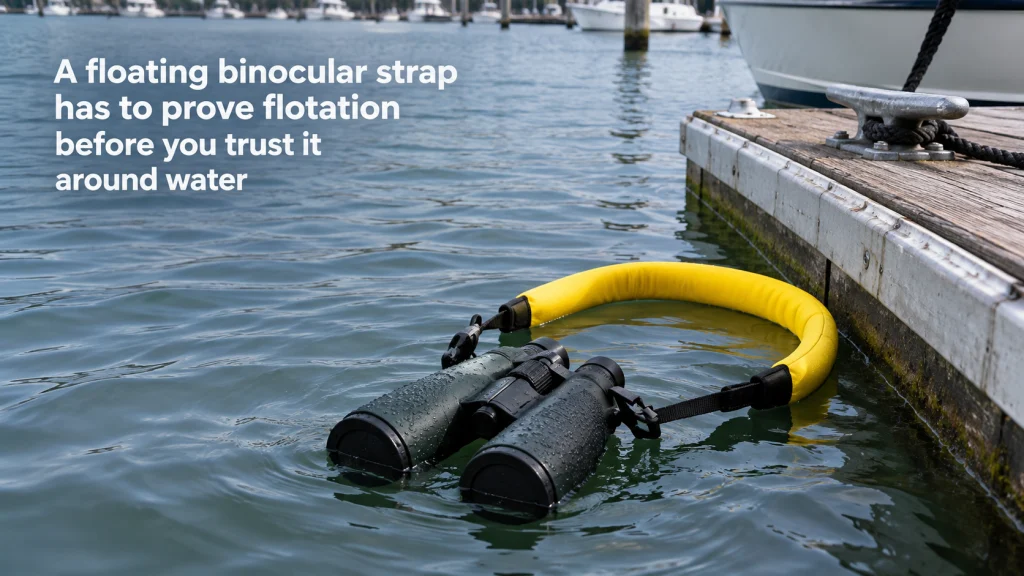
A floating binocular strap should be treated as a flotation device for the binocular setup only when the maker actually says it is designed to float that load. Padding, bright color, and thick foam can help with carry or visibility, but none of those features proves buoyancy by itself. The useful checks are the stated flotation function, the binocular weight or compatible-model range, the attachment interface, and how the strap behaves after getting wet. Keep that decision separate from whether the binocular itself is waterproof or suitable for prolonged water exposure.
Start with proof of flotation, not the look of the strap
A floating binocular strap earns that description through a documented flotation function, not because it looks thick, soft, or marine-colored. A broad neoprene pad can resemble a buoyant strap while being sold only for comfort, and a bright strap can be designed mainly to make the binocular easier to see. The first useful step is therefore to read the exact product description and compatibility notes before judging the strap by appearance. If the maker never states that the strap floats binoculars, treat flotation as unverified.
This matters because the accessory has to solve the problem you actually have. If the main problem is carrying weight over longer walks, a binocular harness for load distribution may address a different need than flotation. If you are still deciding which carry or protection category makes sense, the guide to practical binocular accessories helps separate those jobs before you buy anything. Around water, the decision becomes narrower: verify that the exact strap is intended to provide buoyancy for the binocular setup attached to it.
Read the manufacturer wording literally
Look for direct terms such as floating, flotation, buoyant, or swim strap in the maker’s own description. Wording such as padded, waterproof jacket, marine style, high visibility, or neoprene describes materials or use context, but it does not establish how much weight the strap can keep at the surface. One manufacturer, for example, lists a Float Strap separately from its ordinary Binocular Strap, which is a useful reminder that the two categories are not interchangeable. When the wording is vague, do not upgrade a comfort claim into a flotation claim on your own.
Use published limits when they exist
A manufacturer may publish a weight limit, name compatible binocular models, or tie the strap to a specific attachment system. Any of those boundaries is more useful than guessing from strap width because buoyancy has to support the actual binocular and whatever remains attached to it. If your binocular falls outside the stated range, the honest conclusion is that the maker has not confirmed that combination. A binocular flotation strap without a clear load or compatibility statement deserves a more cautious reading, not a more optimistic one.

This ClicLoc strap is a dedicated floating accessory for Steiner marine binoculars. Steiner specifies item 76804 for Navigator Pro 7x30 models only. Its visible yellow waterproof jacket is part of a documented float-strap design rather than evidence inferred from color or padding alone.
Check on AmazonIf you click this link and buy, we earn a commission at no additional cost to you.
Match the flotation claim to the binocular setup you will actually carry
The strap does not float an abstract specification sheet; it has to support the binocular that is hanging from it. Start with the binocular’s actual weight for the exact configuration, then account for meaningful attached items such as fixed covers or adapters when the maker’s limit is close. You do not need to invent a safety margin that the manufacturer never published, but you also should not assume a claim for one model automatically covers a heavier one. When the fit is not documented, ask the manufacturer or choose a setup with clearly stated compatibility.
Weight is only one side of the setup. The attachment points have to match the strap’s hardware, and the hardware has to be installed the way the strap maker specifies. A floating neck strap for binoculars is not useful if a quick-release fitting, narrow eyelet, or improvised adapter separates before the strap can do its job. Check the complete connection path from strap to fitting to binocular body, then check whether the attachment still allows normal eyepiece covers and case use.
Check binocular weight against the stated boundary
Use the exact binocular weight from the maker’s specification rather than a remembered class such as compact, 42 mm, or marine. Two binoculars with the same objective size can differ enough in chassis, prism design, stabilization hardware, or accessories to change the load on the strap. If the strap page names compatible models instead of a numerical capacity, stay inside that named compatibility unless the manufacturer confirms otherwise. The practical goal is not to calculate buoyancy from foam dimensions; it is to respect the boundary the maker has actually documented.
Treat connector fit as part of flotation performance
Check whether the strap uses conventional webbing loops, proprietary quick-release fittings, or model-specific clips. A connector that looks close enough can still seat poorly, twist under load, or interfere with the binocular’s own attachment hardware. Do not substitute zip ties, unverified clips, or improvised knots for a connection the manufacturer has not approved when the whole point is reliable retention around water. If an adapter is required, verify that the exact strap, adapter, and binocular combination is supported as a system.
Keep visibility separate from buoyancy
Bright yellow, orange, or another high-contrast color can make a dropped strap easier to spot, especially when the surface is dark or cluttered. That is useful, but visibility only helps after the flotation function has already done its job. A vivid nonfloating strap can still disappear below the surface with the binocular, while a verified floating strap in a muted color may remain recoverable but harder to locate. Treat color as a recovery aid, not as evidence that the strap can support the load.

This Elastic Black Bino/Cam Harness uses quick-release connections and is designed for binocular and camera carry. Its harness layout carries the attached gear across the shoulders instead of relying on a conventional neck strap. The selected Amazon child ASIN is the Elastic version in Black.
Check on AmazonIf you click this link and buy, we earn a commission at no additional cost to you.
Separate buoyancy from ordinary padding and carry comfort
Thick straps often feel more substantial because they spread pressure over a larger area, and foam can make a strap look purpose-built for water. Neither observation tells you whether the complete binocular setup will float. Comfort is about how the strap carries on your body, while flotation is about whether the strap can provide enough buoyant support in water. Those jobs can coexist in one accessory, but they should be verified independently.
The distinction also prevents a common buying mistake: paying for a marine-looking strap when the real need is simply a better everyday carry strap. If you rarely work near water, a bulky flotation design may add wet material, storage volume, and drying time without solving a recurring problem. If water exposure is a real part of use, then comfort still matters, but it comes after the flotation claim and connector fit. The table below keeps those decisions separate without assuming one strap style is universally better.
| What you are checking | Ordinary padded strap | Verified flotation strap |
|---|---|---|
| Primary job | Carry comfort and simple retention | Carry plus documented buoyancy for a stated setup |
| Proof to look for | Material, width, attachment, and adjustment details | Explicit floating or buoyancy claim plus load or model compatibility when available |
| Bright color | May improve visibility | May improve recovery visibility, but does not prove flotation |
| Connector check | Must fit the binocular securely | Must fit securely because retention is part of the flotation setup |
| Best fit for the problem | Dry-land carry when flotation is not required | Use around water when the exact flotation claim matches the binocular |
Use the table as a filtering tool rather than as a shopping scorecard. A strap can be excellent at one job and wrong for another, which is why a binocular swim strap should not win simply because it looks more specialized. Once you know the job, verify the claim that matters for that job. That keeps a comfort decision from masquerading as a flotation decision.

This Black E-Z Comfort strap uses neoprene padding and is designed for binoculars as well as cameras. Its adjustable neck-strap layout focuses on lightweight padded carry. The selected Amazon variant is the Black strap made in the USA.
Check on AmazonIf you click this link and buy, we earn a commission at no additional cost to you.
Run a short claim check before trusting the strap around water
A useful product page should let you answer a few concrete questions without filling gaps with assumptions. You want to know what the strap is claimed to do, which binoculars or loads that claim covers, and how the attachment system connects. You also want to know whether bright color is presented as visibility rather than as proof of buoyancy. If those basics are missing, the evidence is not strong enough to treat the strap as flotation protection.
Keep the check simple because the goal is to reject weak claims quickly, not to reverse-engineer foam density at home. The list below is enough for most owner-level decisions and stays within information a buyer can realistically verify. It also makes uncertainty visible instead of hiding it behind a generic marine label. If one of the load-bearing or flotation questions remains unanswered, treat that as a reason to verify further before relying on the strap.
- Confirm that the exact strap is explicitly described as floating, buoyant, flotation, or a swim strap.
- Check for a published weight limit or an exact list of compatible binocular models.
- Verify that the connector style matches the binocular without an improvised attachment.
- Treat high-visibility color as a recovery feature, not as evidence of buoyancy.
- Check the maker’s wet-care instructions before rinsing, washing, drying, or storing the strap.
After the checklist, the decision should be fairly binary. Either the maker documents a flotation role for a setup close enough to yours, or the product page leaves you with a gap that needs confirmation. Do not let a persuasive photograph close that gap for you. The practical conclusion is often simply that flotation has not been established for that combination.

Steiner lists item 7699 as a float strap for Navigator Open Hinge binoculars. The strap uses a visible yellow waterproof jacket and is sold specifically for flotation rather than ordinary padded carry. Steiner lists 7699 separately from the ClicLoc variants made for Navigator Pro and Commander models.
Check on AmazonIf you click this link and buy, we earn a commission at no additional cost to you.
Treat wet-material care as part of normal ownership
A flotation strap is expected to get wet, which makes drying and storage more important than with a strap that stays indoors or on dry trails. Follow the strap maker’s cleaning instructions because foam, neoprene, fabric covers, stitching, adhesives, and quick-release hardware do not all tolerate the same treatment. If the manufacturer permits fresh-water rinsing after salt exposure, rinse as directed and let the strap dry fully before putting it into a closed case. If no cleaning method is stated, use conservative surface cleaning and ask the maker before soaking or machine washing the strap.
Inspect the attachment points while the strap is drying rather than waiting for the next trip. Look for frayed webbing, cracked plastic, corrosion, pulled stitching, deformation, or a fitting that no longer locks positively. Those are retention problems even before flotation enters the discussion, and a damaged connector can defeat a buoyant strap. Replace or service damaged parts according to the manufacturer rather than improvising a repair to a load-bearing connection.

This Amazon bundle combines a Celestron lens cleaning kit with a LensPen optics cleaning tool. The kit includes 10 lens wipes, cleaning fluid, a lens cloth, and a retractable lens brush. The LensPen adds a soft retractable brush and a separate cleaning element for smudges and fingerprints.
Check on AmazonIf you click this link and buy, we earn a commission at no additional cost to you.
Check whether your binocular intended for use around water already includes the right strap
Some binoculars intended for use around water are sold with a floating strap as part of the supplied accessory set. If yours already includes one, start by verifying that supplied strap before assuming an aftermarket replacement is necessary. The included accessory has one practical advantage: the manufacturer can specify it for the exact binocular rather than asking you to infer compatibility from generic dimensions. That does not make every included strap ideal for every user, but it can remove uncertainty about the intended connection system.
Read the binocular package contents and support information together, because the strap and the binocular can have different limits. A binocular described as waterproof does not automatically float, and a floating strap does not upgrade the binocular’s sealing or immersion rating. Keep those claims separate even when both appear on the same product page. If the supplied strap is missing or damaged, replace it only with a strap whose attachment and flotation role are documented for the binocular.

The Steiner Military Marine MM1050 delivers ten times magnification and 50mm objectives in a rugged binocular format intended for outdoor and marine style viewing. Its individual eyepiece focusing system and substantial housing distinguish it from compact birding binoculars, making it relevant for distant landscape or vessel observation. This is a comparable Steiner binocular replacement for the original packaged set, not a promise that the same floating strap or camouflage case is bundled. Review the current box contents and carrying requirements separately before buying.
Check on AmazonIf you click this link and buy, we earn a commission at no additional cost to you.
Keep a standard neck strap when flotation is not a real requirement
Not every binocular needs a flotation accessory. If your normal use is backyard viewing, travel, sports, dry trails, or short walks away from open water, a conventional strap may be lighter, less bulky, and easier to pack. The right question is whether dropping the binocular into water is a realistic recurring risk, not whether a flotation strap sounds more protective. Buying extra buoyancy for a problem you do not have can make the carry system less convenient without changing your actual risk.
For dry-land carry, focus instead on width, adjustment range, attachment security, and how the strap sits with your clothing and case. The separate guide to choosing a binocular neck strap for everyday carry covers that decision without treating flotation as a default requirement. If your use changes and regular water exposure becomes part of the setup, return to the flotation claim and compatibility checks rather than assuming the old strap is enough. Matching the accessory to the recurring situation is more useful than choosing the most specialized-looking option.

This Black Bin/Op strap uses neoprene and a quick-release design for binoculars and small cameras. Its adjustable configuration supports conventional neck or shoulder carry. The selected Amazon child ASIN is the QD Black version made in the USA.
Check on AmazonIf you click this link and buy, we earn a commission at no additional cost to you.
Keep binocular water resistance separate from the flotation-strap decision
A strap and a binocular answer different questions. The strap may help keep the attached binocular at the surface when its documented flotation capacity is adequate, while the binocular’s own construction determines what water exposure it is designed to tolerate. Do not read a floating-strap claim as proof that the optic can be submerged, left wet, or used beyond the manufacturer’s water-resistance limits. Likewise, a waterproof binocular can still sink if neither the binocular nor its attached strap is designed to float.
This boundary also keeps the article away from navigation and life-safety claims. A flotation strap is an equipment-retention accessory, not personal flotation equipment and not a substitute for safe practices around water. Its job is narrow: support the binocular setup within the stated flotation and compatibility limits. Once that is clear, you can judge the strap without asking it to prove anything about the binocular’s optical performance, water sealing, or suitability for a particular marine activity.

The Vortex Triumph HD 10x42 is designed with waterproof, fogproof, and shockproof protection. It is tripod adaptable and includes a GlassPak binocular harness and case. Vortex specifies nitrogen gas purging and O-ring sealing as part of its weather-protection design.
Check on AmazonIf you click this link and buy, we earn a commission at no additional cost to you.
Final Thoughts: trust documented flotation, not thickness or bright color
The cleanest way to choose a floating strap is to start with evidence that is hard to misread. Look for an explicit flotation claim, then match the stated load or compatible models to the binocular you actually own and verify every connector in the attachment path. Treat bright color as a visibility benefit and padding as a comfort feature, not as substitutes for buoyancy information. If the maker leaves the flotation boundary unclear, the correct conclusion is that the combination still needs verification.
After that, keep the ownership side simple. Dry and inspect the strap according to the maker’s instructions, replace damaged load-bearing parts, and keep the binocular’s own water-resistance limits separate from the strap’s job. Use a normal carry strap when water risk is not part of your real use, and use a verified flotation strap when it is. That approach avoids both extremes: underestimating a genuine water risk and buying specialized gear that solves a problem you do not actually have.

This Webbing Black Bino/Cam Harness uses quick-release connections for binocular and camera carry. It is the webbing variant rather than the elastic version used elsewhere in these placements. The selected Amazon child ASIN is the Webbing version in Black and is made in the USA.
Check on AmazonIf you click this link and buy, we earn a commission at no additional cost to you.
Frequently asked questions
Most questions about flotation straps come down to proof, fit, and what the accessory can actually be expected to do. A thick strap may look buoyant, but the decisive information is still the manufacturer’s stated function and compatibility. Connector fit matters because flotation cannot help if the binocular separates from the strap. Water resistance of the binocular remains a separate specification throughout the decision.
The answers below stay at owner level and avoid treating any strap as life-safety equipment. Where a maker publishes a weight limit or compatible-model list, use that information instead of a visual guess. Where the claim is unclear, verify it with the manufacturer before relying on the strap around water. That is more useful than trying to create a universal rule from strap material alone.
🌊 How do I know whether a binocular strap really floats?
Look for an explicit floating, flotation, buoyant, or swim-strap claim from the manufacturer. Then check any stated weight limit or compatible-model list because appearance alone does not establish how much load the strap can support.
⚖️ Does binocular weight matter with a flotation strap?
Yes, because the strap has to support the actual binocular setup attached to it. Use the maker’s stated capacity or exact model compatibility when available, and do not assume a claim for a lighter binocular automatically covers a heavier one.
🟡 Does a bright yellow or orange strap automatically float?
No. High-visibility color can make a floating setup easier to spot, but color is a visibility feature rather than proof of buoyancy.
🔗 Can I use any connector or adapter with a floating strap?
Only when the strap, connector, and binocular interface are compatible. Avoid improvised load-bearing connections when the maker has not confirmed that combination.
💧 Does a floating strap make nonwaterproof binoculars safe in water?
No. The strap’s flotation function and the binocular’s water-resistance rating are separate, so follow the binocular maker’s limits for water exposure even when a floating strap is attached.
🎒 Do I need a flotation strap if I rarely use binoculars near water?
Probably not if water exposure is not a realistic recurring risk. A standard neck strap or another carry system may be simpler and less bulky when flotation does not solve a problem you actually have.
References and Sources
These sources are included because the article depends on model-specific flotation wording, attachment compatibility, and the distinction between a floating strap and an ordinary carrying strap. They are evidence for how manufacturers describe those functions, not a list of recommended products. The article does not infer buoyancy from color, thickness, or padding when the source does not make that claim. Product-specific purchasing advice is intentionally outside the scope here.
The sources also show why strap flotation and binocular water resistance should be treated as separate claims. One page describes a dedicated float strap and lists compatibility by model or attachment system, while another manufacturer page lists floating and ordinary straps as different accessories. A binocular product page separately describes its water-resistance features and included floating strap, which supports keeping those functions distinct. Only sources that directly support those points are listed below.
- Steiner floating strap: Describes the accessory as a marine binocular float strap and lists different versions for specific binocular attachment systems and models.
- Steiner binocular accessories: Lists a floating strap and a standard binocular strap as separate accessory categories.
- Steiner Commander 7×50: Separately identifies binocular water resistance and an included floating strap, supporting the distinction between optic sealing and strap flotation.