
Binocular apparent field of view describes how broad the magnified viewing window appears at the eyepiece, not how much landscape fits inside it. A binocular can show adequate real scene width and still present a view that feels visually confined. The useful comparison is to read real FOV and AFOV as separate measurements, then check the exact manufacturer’s method before treating any calculated number as equivalent to the published specification. A larger AFOV can make the apparent window broader, but it does not prove better edge sharpness, distortion control, or comfortable access to the whole field.
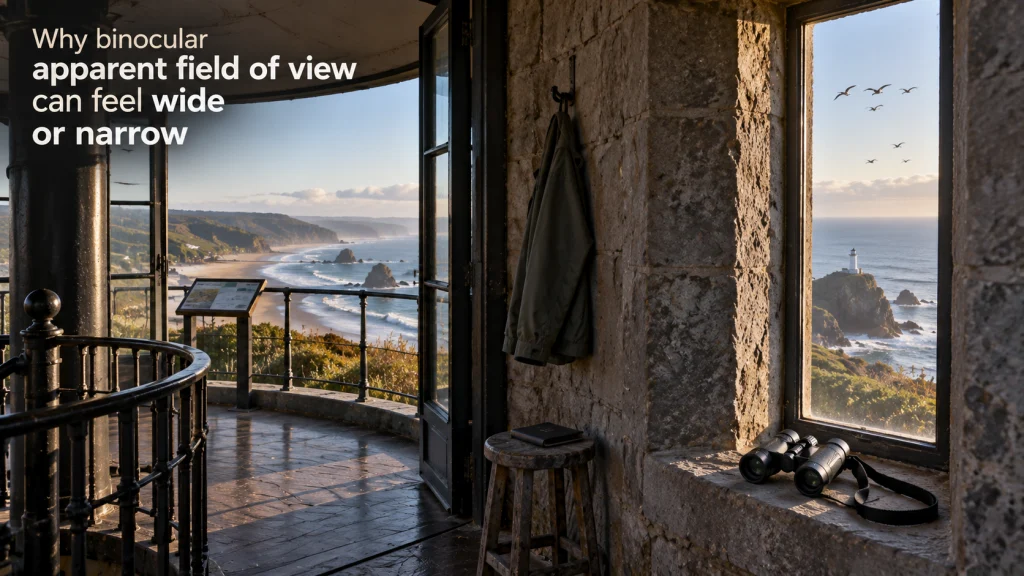
Enough landscape can be visible while the viewing circle still feels narrow
A binocular apparent field of view problem often sounds like this: the landscape width is fine, yet the viewing circle still feels narrow. That is not the same complaint as wanting to see more feet of shoreline, more sky, or more of a moving bird’s path without panning. The first complaint concerns how broad the magnified field appears at your eye, while the second concerns how much of the real scene fits inside the field. Separating those two jobs prevents a buyer from chasing the wrong number.
If the rest of the specification language is still getting mixed together, the guide to what the numbers on binoculars mean provides the broader framework, while the binocular specifications that affect real use puts field of view beside eye relief, weight, close focus, and other variables. For this decision, focus on the viewing window itself before comparing optical quality or comfort. I would check AFOV separately from real FOV whenever a buyer says the scene coverage seems adequate but the eyepiece view still feels confined. That keeps a subjective description tied to a specification without pretending the number can describe the whole viewing experience.
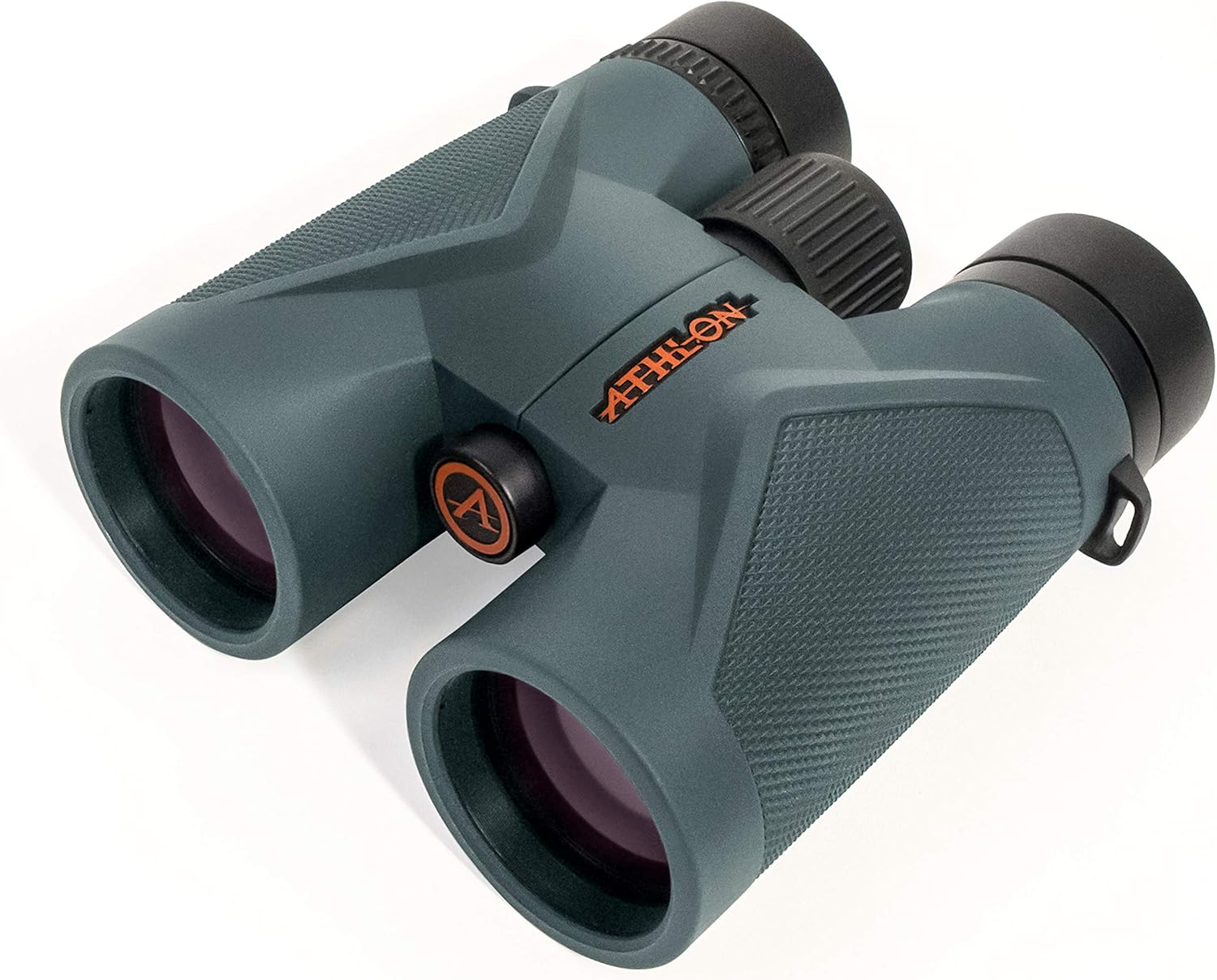
This 8x42 binocular provides an 8.1-degree angular field of view and 17.2 mm of eye relief. ED glass, dielectric prism coatings, and advanced fully multi-coated lenses support bright, detailed viewing. Twist-up eyecups and an argon-purged waterproof chassis suit regular outdoor observation.
Check on AmazonIf you click this link and buy, we earn a commission at no additional cost to you.
Apparent FOV answers a different question from real scene width
Real field of view describes the angular width of the scene that the binocular shows without moving it. Manufacturers may also express that real coverage as a linear width at a stated distance, which is useful when you want to know how much ground or sky fits into the frame. AFOV instead describes the angular size of the magnified field as it appears through the eyepiece. In practical terms, real FOV tells you how much of the outside scene is included, while AFOV helps describe how broad that framed view appears to your eye.
That distinction matters because magnification changes the apparent scale of what is already inside the real field. Two binoculars can therefore require different questions even when a single field of view label makes them look easy to compare. If your concern is tracking a moving subject or fitting more of a nearby scene into one view, start with real field of view in binoculars. If the scene width is acceptable but the eyepiece window feels restricted, AFOV is the more relevant specification to investigate next.
| What you are trying to judge | Specification to read first | What the number describes |
|---|---|---|
| How much of the real scene fits into one view | Real FOV | Angular or linear scene coverage |
| How broad the magnified viewing window appears | AFOV | Apparent angular width at the eyepiece |
Use the table as a question sorter, not as a quality ranking. A binocular can perform well for one field of view job and still be less satisfying for the other. Once the problem is named correctly, the next step is understanding what an AFOV number is actually describing.

This 8x42 binocular provides a 7.4-degree angular field of view and focuses as close as 6.5 feet. Fully multi-coated optics and phase-coated BaK-4 prisms support bright, high-contrast views. Twist-up eyecups and a waterproof, nitrogen-purged body support outdoor use.
Check on AmazonIf you click this link and buy, we earn a commission at no additional cost to you.
How AFOV describes the angular size of the magnified field
When you look through binoculars, you are not simply seeing a patch of the world cropped to a certain width. The eyepiece presents a magnified field that occupies an apparent angle in your view, and AFOV is a way to describe that angular size. A larger value generally means the visible field appears to span a broader angle at the eye. That is why two views with usable real scene coverage can still feel different in how open or confined the viewing window appears.
The number should still be read as a specification, not a promise about how a particular person will describe the experience. Eyecup position, eye relief, eye placement, and whether you can actually access the full field can change how much of the published field you see. Optical behavior near the edge can also affect whether a broad field is useful, even though edge quality is not what AFOV measures. For a buyer, AFOV is most useful when it answers a specific viewing-window question rather than becoming a stand-in for overall optical quality.

This 10x50 Porro binocular provides a 6.8-degree angular field of view and 12 mm of eye relief. Multi-coated optics pair with 50 mm objectives for general daytime and low-light viewing. The water-resistant body is tripod adaptable and includes soft folding eyecups.
Check on AmazonIf you click this link and buy, we earn a commission at no additional cost to you.
Why magnification times real FOV is only an approximation
A common shortcut is to multiply magnification by real angular field of view. The arithmetic is convenient, and it can give a rough sense of whether one configuration has a narrower or broader apparent field than another. The problem begins when that shortcut is treated as identical to every manufacturer’s published AFOV value. Nikon’s field of view guidance and Fujifilm’s binocular knowledge page both present an angular calculation that accounts for the geometry rather than using simple multiplication as a universal final answer.
Consider a simple official example in which an 8x binocular has a 7.0 degree real field. Straight multiplication produces 56 degrees, while Nikon’s angular method produces 52.1 degrees. The difference is large enough to matter if you are comparing a calculated value with a manufacturer’s published specification and assuming they were produced by the same method. Use magnification times real FOV as a quick estimate only when you clearly label it as an estimate, then prefer the manufacturer’s stated AFOV and calculation note for exact comparison.

This 10x42 roof-prism binocular provides a 7.0-degree real field and a 62.9-degree apparent field. Nikon lists 15.7 mm of eye relief and a 367-foot field of view at 1,000 yards. Multilayer-coated lenses, adjustable eyecups, and a waterproof, fogproof body support regular outdoor use.
Check on AmazonIf you click this link and buy, we earn a commission at no additional cost to you.
Read the exact manufacturer’s calculation note or ISO reference
Do not assume every AFOV number on a current specification page was generated under the same revision or labeling convention. Nikon’s own material demonstrates why that check matters: its general field of view guidance names one ISO based method, while the current 4x10D CF product page names a different ISO revision for the published AFOV figure. On that product page, the binocular is listed at 4x magnification, a 10.0 degree real field, and a 38.6 degree apparent field. Simple multiplication would give 40 degrees, so replacing the published figure with your own shortcut would erase the method stated by the manufacturer.
I would therefore read the exact product or specification page before recalculating anything. The goal is not to memorize a standards history; it is to keep unlike numbers from being treated as if they were created the same way. If a manufacturer supplies AFOV and identifies its method, use that published figure for model-level comparison and keep any homemade estimate separate. If the method is not stated, treat the comparison with more caution instead of pretending an estimate has the same status as a documented specification.
- Record the binocular’s magnification and real angular field.
- Look for a published apparent field of view on the exact specification page.
- Read the footnote or calculation note attached to that AFOV value.
- Keep a simple magnification times real FOV result labeled as an estimate if you use it at all.
This check is especially important when comparing information copied from different manufacturer pages, retailer tables, or older specification lists. A small numerical disagreement may reflect the calculation method rather than a change in the physical viewing field. Once the source and method are clear, the number becomes much more useful.

This 8x42 roof-prism binocular has a 7.2-degree real field and a 53.4-degree apparent field. Nikon states that its apparent field figure is calculated under ISO 14132-1:2002. It also provides 20.2 mm of eye relief and a 377-foot field of view at 1,000 yards.
Check on AmazonIf you click this link and buy, we earn a commission at no additional cost to you.
Wider AFOV does not guarantee better edges, distortion control, or field access
A larger AFOV can describe a broader apparent window, but it does not tell you whether the outer field stays sharp. It also does not tell you how distortion is managed, how easy the binocular is to align with your eyes, or whether the eyecups let you reach the full published field. Those are separate design and fit questions. Treating AFOV as a one-number optical score hides the tradeoffs that actually decide whether a view works for a particular user.
Eyeglass wearers have an especially good reason to keep these measurements separate. A generous AFOV on paper is not much help if the combination of eye relief, eyecup geometry, and the user’s glasses prevents access to the outer field. Likewise, a broad apparent field can contain edge softness or visible distortion that AFOV itself does not evaluate. Compare AFOV for apparent window width, then evaluate eye relief, usable field access, and edge behavior with their own evidence rather than awarding the wider number an automatic win.

This 10x42 binocular provides a 305-foot field of view at 1,000 yards. Fully multi-coated optics and BaK-4 prisms support bright, high-contrast viewing. IPX7 waterproofing, nitrogen-purged fog resistance, and twist-up eyecups add separate durability and fit features beyond field width.
Check on AmazonIf you click this link and buy, we earn a commission at no additional cost to you.
Use real FOV for scene width and AFOV for apparent window width
The cleanest buying method is to start with the problem you are actually trying to solve. If you keep losing moving subjects because too little of the real scene fits into view, compare real FOV first. If the scene coverage is already sufficient but the eyepiece view feels visually boxed in, compare AFOV and verify how each manufacturer states it. If both issues matter, keep both columns in your comparison instead of trying to make one number do two jobs.
This also keeps magnification from confusing the decision. A higher magnification can change the relationship between real field and apparent field, so two binoculars should not be judged only by which one has the larger scene width or the larger AFOV in isolation. Read the measurements alongside eye relief and the fit variables that determine whether you can see the whole field. The practical goal is not the widest possible number; it is a field that is wide in the way your viewing situation actually requires and usable from your normal eye position.

This 8x42 binocular provides a 394-foot field of view at 1,000 yards and 17.2 mm of eye relief. ED glass, BaK-4 prisms, and fully multi-coated optics support clear field observation. IPX7 waterproofing and twist-up eyecups add weather protection and adjustable eye positioning.
Check on AmazonIf you click this link and buy, we earn a commission at no additional cost to you.
Final Thoughts: Name the field of view problem before comparing the number
Start by deciding whether the problem is scene coverage or the apparent size of the eyepiece window. Real FOV answers the first question, while AFOV helps answer the second. Once that distinction is clear, check the exact manufacturer’s published AFOV and the note attached to it rather than assuming a quick multiplication result is equivalent. That simple sequence prevents a lot of false comparisons.
Then keep AFOV in its proper lane. A wider apparent field can be useful when you want a broader viewing window, but it does not certify edge sharpness, distortion control, or comfortable access through the eyecup. Those qualities need their own evidence and fit checks. Choose the number that matches the problem, then verify whether the rest of the binocular lets you use that field in practice.
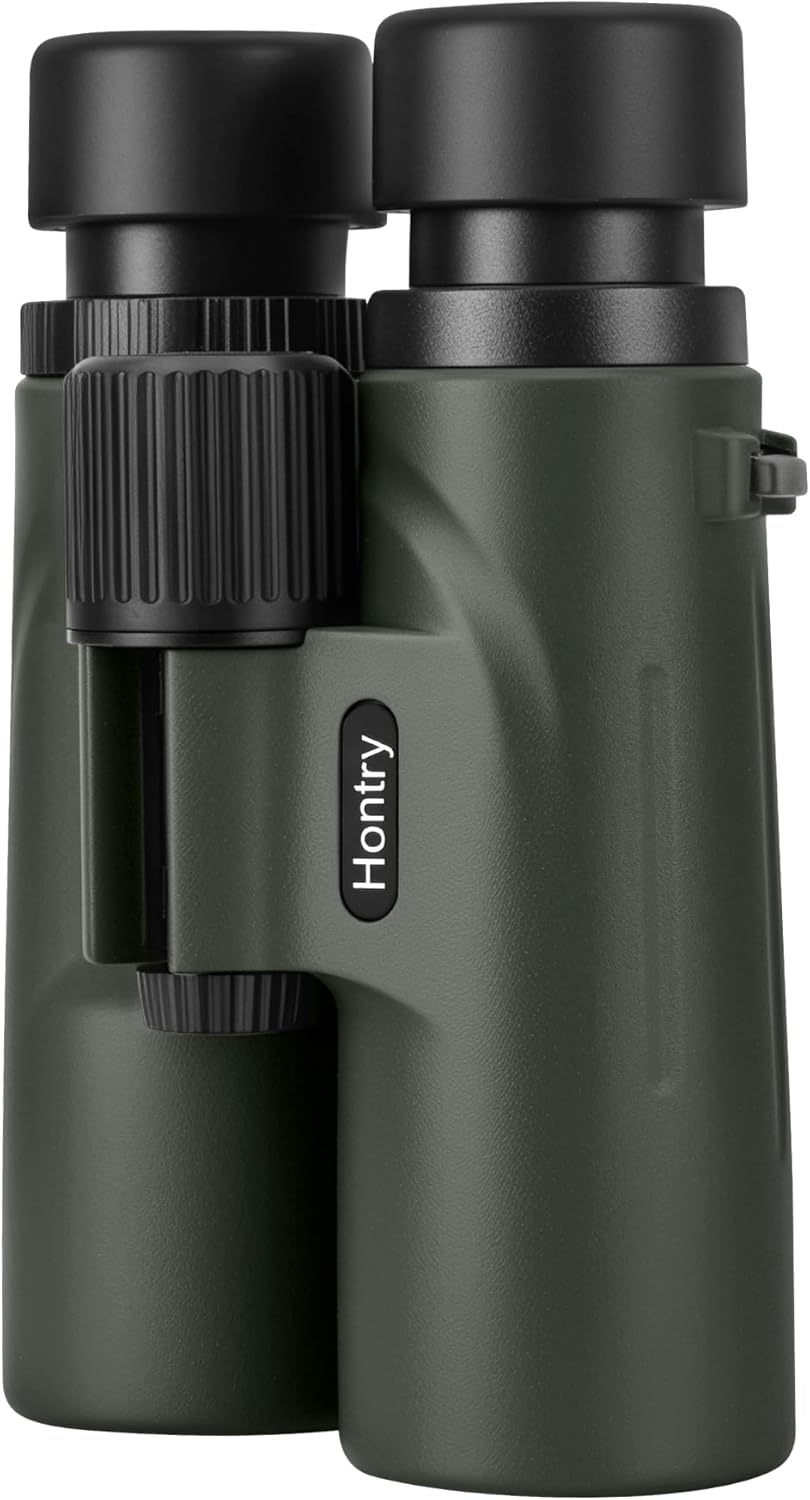
This 8x42 binocular combines 8x magnification with 42 mm objectives in a roof-prism design. The IPX6-rated body is built for outdoor use, including birding and travel. Twist-up eyecups and tripod compatibility provide practical options for adjusting viewing comfort and stability.
Check on AmazonIf you click this link and buy, we earn a commission at no additional cost to you.
FAQs
🔭 What does apparent field of view mean in binoculars?
AFOV describes the angular width of the magnified field as it appears through the eyepiece. It is different from real FOV, which describes how much of the outside scene fits into the view.
📐 Can I calculate AFOV by multiplying magnification by real FOV?
You can use that multiplication as a rough estimate, but do not assume it will match every published manufacturer value. For an exact comparison, use the AFOV and calculation note on the exact specification page when the manufacturer provides them.
👓 Does a wider AFOV mean I will see the whole field with glasses?
No. Full field access with glasses also depends on eye relief, eyecup geometry, your glasses, and your eye position. Treat AFOV and eyeglass fit as separate checks.
🌲 Is a larger AFOV always better for binoculars?
No. A larger AFOV describes a broader apparent window, but it does not guarantee sharper edges, better distortion control, or easier eye placement. Compare it only when a broader apparent field solves a real viewing need.
🧭 Should I compare real FOV or AFOV first?
Compare real FOV first when you care about how much of the scene fits into one view. Compare AFOV when the real scene width is already adequate but you want to understand why the viewing window appears broader or more confined.
References and Sources
- Nikon field of view guide: Defines real and apparent field of view and provides Nikon’s angular AFOV calculation example.
- Fujifilm binocular basic knowledge: Provides Fujifilm’s apparent field of view formula and field of view terminology.
- Nikon 4x10D CF specifications: Provides a current manufacturer example with magnification, real FOV, published AFOV, and the calculation standard note.