A specification of 7.2 degrees and one of 435 feet at 1,000 yards cannot be compared directly, even though both may describe binocular field of view. That is the practical starting point for understanding what field of view in binoculars means: it is the width of the real scene visible without moving the binoculars. Manufacturers commonly express that width either as an angle in degrees or as a linear width at a stated distance, so useful comparison starts by putting both specifications into the same unit. Magnification influences field of view, but it does not determine it by itself, and objective diameter is not a reliable shortcut for predicting view width. The practical goal is to compare like with like before deciding whether a wider published field matters for the way you observe.

Degrees and feet at 1,000 yards must speak the same language
Imagine two specification sheets for binoculars you are comparing. One lists a real field of view of 7.2 degrees, while the other lists 435 feet at 1,000 yards. Neither number is more informative simply because it looks larger, and comparing 7.2 with 435 directly is meaningless because they use different units. The first step is to normalize the specifications, which is also a useful habit when working through the broader numbers printed and published for binoculars.
The same discipline matters when you move from one specification to another. A field listed in degrees is an angular measurement, while feet at 1,000 yards or meters at 1,000 meters describe the width that angle covers at a fixed distance. If you want the larger framework for reading magnification, objective diameter, exit pupil, eye relief, and related figures, use the binocular specifications guide as the reference point. Here, the narrower task is to make real field of view comparable without mixing it with a different metric.

This 8x42 binocular provides a concrete exact-model specification sheet for practicing field-of-view comparisons. The Amazon listing identifies HD optics plus a waterproof, fogproof, and shockproof build. It is tripod adaptable and includes the GlassPak harness.
Check on AmazonIf you click this link and buy, we earn a commission at no additional cost to you.
Angular and linear field of view describe the same real scene width
Real angular field of view tells you the angle of the scene visible through the binoculars without panning. Linear field of view takes that same angle and expresses how wide the visible scene is at a stated distance, such as feet at 1,000 yards or meters at 1,000 meters. Nikon gives the relationship as a simple trigonometric conversion: linear width equals twice the viewing distance multiplied by the tangent of half the real angular field. That is why a specification in degrees can be converted into a width rather than treated as a separate optical property.
For a practical approximation, one degree spans about 52.4 feet at 1,000 yards and about 17.5 meters at 1,000 meters. That shortcut is close enough for quick comparison across ordinary binocular fields, while the tangent formula is the cleaner choice when you want to reproduce a manufacturer’s figure more precisely. A 7.0 degree real field, for example, works out to roughly 367 feet at 1,000 yards or 122 meters at 1,000 meters. The important point is not memorizing those numbers, but recognizing that angular and linear field of view are two expressions of the same real viewing width.
| Published format | What it describes | Best comparison move |
|---|---|---|
| Degrees | Angular width of the real scene | Compare with another real angular FOV, or convert both listings |
| Feet at 1,000 yards | Linear width of the real scene at 1,000 yards | Compare with another listing at the same distance |
| Meters at 1,000 meters | Linear width of the real scene at 1,000 meters | Compare with another listing at the same distance |
Once the units match, the larger real FOV number represents a wider slice of the scene at that distance. It does not yet tell you whether the edges are sharp, whether distortion is well controlled, or whether the view will feel spacious through the eyepieces. A wider figure can therefore settle the scene-width question while leaving several optical and fit questions unanswered. Those are separate judgments, so unit normalization should be treated as the beginning of the comparison rather than the verdict.
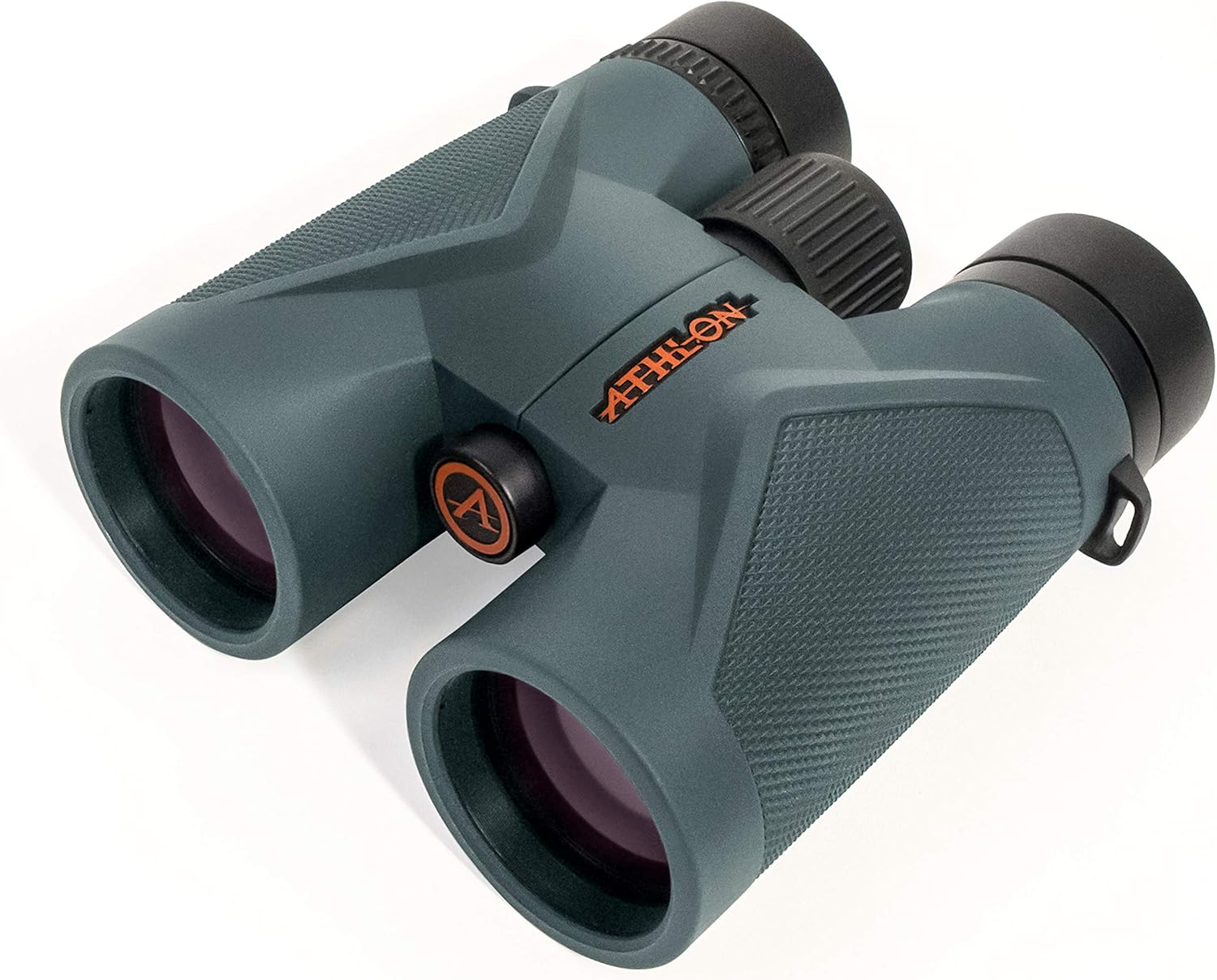
This 8x42 Midas UHD uses ED glass and is listed as waterproof and fogproof. Its fixed 8x configuration makes it useful for comparing field width against other 8x models. The listing also highlights eye relief, which should remain a separate check from real field of view.
Check on AmazonIf you click this link and buy, we earn a commission at no additional cost to you.
Normalize unlike units before comparing products
If one specification uses degrees and another uses feet at 1,000 yards, choose one format and convert the other into it. For quick work in the United States, multiplying degrees by about 52.4 gives an approximate width in feet at 1,000 yards. Going the other direction, divide feet at 1,000 yards by about 52.4 to estimate degrees. These shortcuts are useful for screening specifications, while the full tangent formula avoids the small approximation error when precision matters.
Do not mix distances either. A figure of 400 feet at 1,000 yards is not directly comparable with a width stated at 500 yards, because the same angular field covers a different linear width as distance changes. Also check that the degree figure is labeled as real field of view rather than apparent field of view. If the listing only discusses the apparent viewing window, move that question to the separate explanation of apparent field of view in binoculars instead of forcing the numbers into a real FOV comparison.
- Confirm that both values describe real field of view.
- Convert both values to degrees, feet at 1,000 yards, or meters at 1,000 meters.
- Keep the reference distance identical when comparing linear widths.
- Use the wider number only as evidence of more real scene width, not better overall optics.
This process is deliberately simple because it prevents a common specification-sheet mistake. A clean comparison does not require a special preference for degrees or feet. Either format works when both listings describe the same type of field at an equivalent reference distance. It requires matching units, matching reference distance, and matching the kind of field being measured.

This 8x42 Nature DX listing specifies a 7.4-degree field of view, giving you a real angular value to normalize against linear FOV listings. It uses phase-coated BaK-4 prisms and fully multi-coated optics. The nitrogen-purged housing is designed for outdoor use.
Check on AmazonIf you click this link and buy, we earn a commission at no additional cost to you.
The same magnification can still produce different real field of view
Magnification creates a broad tendency, not a one-number rule for field width. Higher magnification often comes with a narrower real field because the optical system is showing a smaller angular portion of the scene at greater scale, but binocular design still determines the actual published value. Eyepiece design, prism layout, internal stops, and the optical system as a whole can change the usable angular field. That is why two 8x binoculars can differ meaningfully even though the magnification number is identical.
A concrete manufacturer example makes the point without turning it into a product recommendation. Nikon lists the PROSTAFF P7 8×42 at 7.2 degrees, or 377 feet at 1,000 yards, while the MONARCH M7 8×42 is listed at 8.3 degrees, or 435 feet at 1,000 yards. Both are 8×42 configurations, yet the second specification covers 58 more feet of scene width at the stated distance. The lesson is that binocular magnification helps set expectations, but the exact model specification still has to be checked.
That difference can matter when locating or following something that moves across the scene, because more real width gives you more surrounding area before you need to pan. It can also preserve more context around a stationary subject when you want to see where it sits in the surrounding scene. It does not automatically make the wider model preferable for every observer, since eye relief, weight, focus behavior, physical fit, and other properties can matter just as much. Read real FOV as one constraint in a larger decision, not as a ranking score.

This MONARCH M7 keeps magnification at 8x while pairing it with 42mm objectives, ED glass, and multilayer coatings. Amazon lists a wide-view design along with smooth focus and long eye relief. It is a useful same-magnification comparison model without treating 8x as a guarantee of one field width.
Check on AmazonIf you click this link and buy, we earn a commission at no additional cost to you.
Objective diameter is not a shortcut to view width
The objective number tells you the effective diameter of the front lens, not the width of the scene. A larger objective can affect light gathering, exit pupil when magnification is held constant, body size, and weight, but it does not prescribe a particular real field of view. Treating a 42 mm binocular as automatically wider than a 30 mm binocular confuses two different specifications. The published real FOV still has to come from the exact optical design.
Nikon’s own PROSTAFF P7 line provides a useful counterexample. The 8×30 version is listed at 8.7 degrees and 456 feet at 1,000 yards, while the 8×42 version is listed at 7.2 degrees and 377 feet at 1,000 yards. The smaller objective does not prevent the 8×30 from having the wider real field in this case. If objective diameter itself is the number you are trying to interpret, keep that question separate and use the explanation of what objective size means on binoculars.
This separation keeps the buying logic clean. Use objective diameter to understand what that front-lens size changes, then use the real FOV specification to understand how much scene is included. Two binoculars can therefore reverse the simple expectation that the larger front lens must show the wider view. When one number is asked to stand in for another, the comparison becomes faster but less accurate.

This 8x32 Diamondback HD gives the section a smaller-objective configuration to compare against 8x42 binoculars. Amazon identifies HD optics plus waterproof, fogproof, and shockproof construction. It is tripod adaptable and includes a carry case.
Check on AmazonIf you click this link and buy, we earn a commission at no additional cost to you.
A wider real field does not prove better edges, distortion control, or apparent window size
Real FOV answers a narrow question: how much of the actual scene fits within the binocular’s field at once. It does not tell you how sharp the outer part of that field remains, how straight lines behave near the edge, how much eye relief you get, or whether your eyes can easily take in the full published width. Those qualities depend on other parts of the optical and mechanical design. A wider number therefore proves more scene width, not superior image quality across that entire scene.
Apparent field of view is also a different metric. It describes how wide the magnified viewing window appears to the observer, and its calculation involves both real field and magnification rather than simply restating the real field in another unit. This article intentionally stops before teaching that calculation because mixing the two metrics is one of the easiest ways to make a clean FOV comparison confusing. If the concern is whether the view looks expansive or tunnel-like through the eyepieces, use the apparent-FOV discussion rather than trying to infer the answer from feet at 1,000 yards alone.
There is also a fit boundary worth keeping in mind. A published field can only help if the observer can actually see it comfortably with the chosen eyecup position, eye relief, and eyeglasses if worn. Someone who cannot reach the full viewing position may lose part of the visible edge even though the specification itself remains unchanged. That does not change the manufacturer’s real FOV specification, but it can change how much of the specified field the individual observer can use.

This 10x42 Triumph HD combines a stated HD optical system with a weather-resistant binocular body. Amazon lists it as waterproof, fogproof, and shockproof, while also noting tripod adaptability. Those attributes illustrate why field width should be judged separately from the rest of a binocular design.
Check on AmazonIf you click this link and buy, we earn a commission at no additional cost to you.
A clean two-spec-sheet field of view workflow
Start by locating the exact real field specification for each binocular, not a family-level marketing statement. Check whether the value is given in degrees, feet at 1,000 yards, meters at 1,000 meters, or more than one of those formats. If the units differ, normalize them before making any judgment about which field is wider. Then confirm that you are comparing the exact magnification and variant shown on each product page.
After the numbers match, ask what the difference changes in the observation itself. A modestly wider real field can make it easier to locate a moving subject or keep more surrounding context in view, while a very small difference may matter little compared with eye relief, weight, focus feel, or fit. Do not award a winner from FOV alone. The useful output of the comparison is simply a reliable statement about which binocular includes more real scene and by how much.
- Verify the exact model and magnification.
- Find the real FOV, not only a marketing phrase such as wide view.
- Put both specifications in the same unit and at the same reference distance.
- Calculate or read the difference in real scene width.
- Keep edge quality, apparent field, eye relief, weight, and fit as separate checks.
This workflow is also useful when a retailer and a manufacturer display the same model differently. If one page gives degrees and another gives feet at 1,000 yards, converting one figure should bring them into roughly the same relationship. A large mismatch can indicate a variant mix-up, a copied listing error, or a field value that is not describing the same metric. If they do not agree after normalization, go back to the exact variant and manufacturer specification before assuming the binocular itself has changed.
This Diamondback HD uses a clearly identified 10x42 configuration, making exact-variant checking straightforward before comparing specifications. Amazon lists HD optics along with waterproof, fogproof, and shockproof construction. It is tripod adaptable and includes the GlassPak harness.
Check on AmazonIf you click this link and buy, we earn a commission at no additional cost to you.
Final thoughts: compare the field in the same units
Field of view becomes much easier to read once degrees and linear width are treated as two descriptions of the same real scene. Normalize the units first, then compare exact variants rather than assuming magnification or objective diameter dictates the answer. A wider real FOV can be useful when scene coverage matters, but it does not certify sharper edges, better distortion control, better fit, or a larger apparent viewing window. Keeping those claims separate makes the specification useful instead of turning it into another marketing score.
When two listings seem inconsistent, check the type of field, the reference distance, and the exact model before drawing a conclusion. If the question is simply which binocular shows more real scene, the normalized FOV numbers can answer it directly. If the question is how wide the magnified window appears, move to apparent field of view rather than stretching real FOV beyond what it measures. That boundary is what keeps a simple spec comparison accurate.
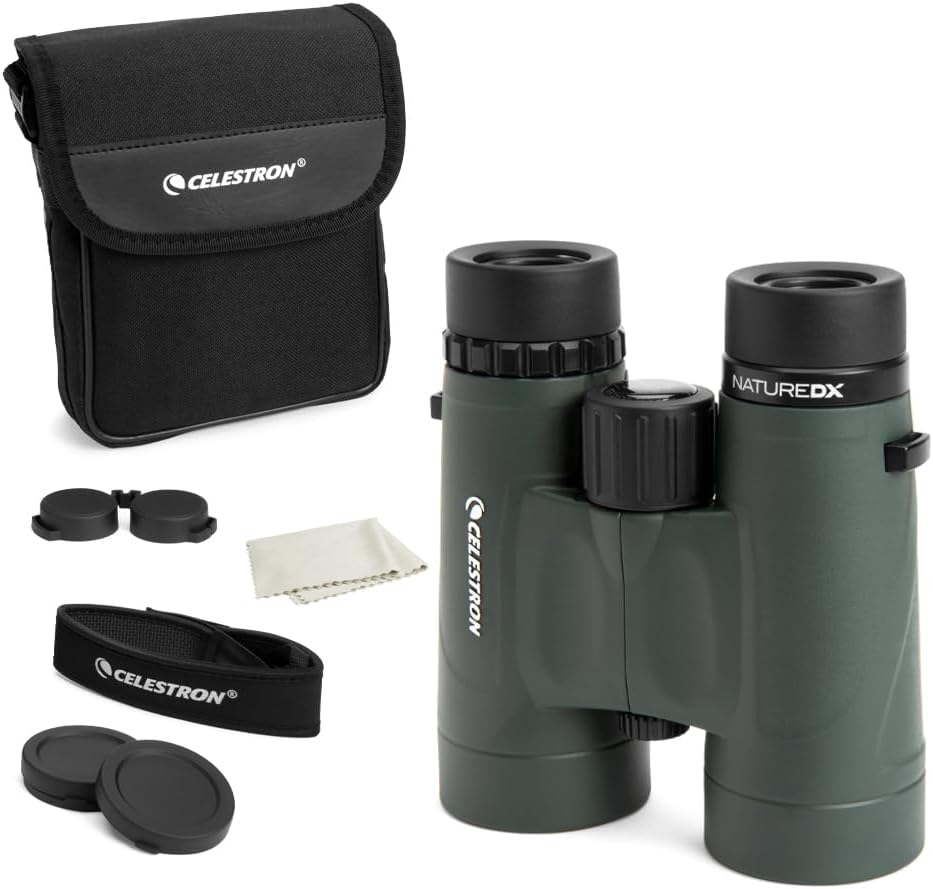
This Nature DX uses 10x magnification with 42mm objectives, giving you another exact configuration for like-for-like specification checks. Amazon lists a phase-coated roof prism, nitrogen-purged housing, and twist-up eyecups. Its feature set reinforces the need to keep real FOV separate from fit and other optical characteristics.
Check on AmazonIf you click this link and buy, we earn a commission at no additional cost to you.
Frequently asked questions
🔭 What is a good field of view for binoculars?
There is no single good number for every binocular because magnification, design, eye relief, and use case vary. Compare exact models at the same magnification when you want to know whether one gives meaningfully more real scene width.
📐 How do I convert binocular field of view from degrees to feet at 1,000 yards?
For a quick estimate, multiply the real field in degrees by about 52.4. For a more exact conversion, use the tangent relationship based on half the angular field and a distance of 1,000 yards.
👀 Is a wider field of view always better?
No. A wider real field shows more scene at once, but it does not by itself prove better edge sharpness, distortion control, eye relief, comfort, or overall optical quality.
🎯 Do all 8x binoculars have the same field of view?
No. Magnification influences field of view, but exact optical designs at the same 8x magnification can publish substantially different real FOV values.
📏 Does a larger objective lens give a wider field of view?
Not necessarily. Objective diameter and real field of view are separate specifications, so the exact model’s published FOV should be checked instead of inferred from the front-lens size.
🪟 Is real field of view the same as apparent field of view?
No. Real FOV describes how much of the actual scene is included, while apparent FOV describes how wide the magnified viewing window appears to the observer.
References and sources
- Nikon field of view guide: Defines real angular field of view, linear field of view at a stated distance, and the conversion relationship used in this article.
- Nikon PROSTAFF P7 8×42 specifications: Supports the 8×42 real FOV example and its published degree and linear-width figures.
- Nikon MONARCH M7 8×42 specifications: Supports the same-magnification comparison showing a different real FOV for another 8×42 design.
- Nikon PROSTAFF P7 8×30 specifications: Supports the example showing that a smaller objective diameter can still have a wider published real field.