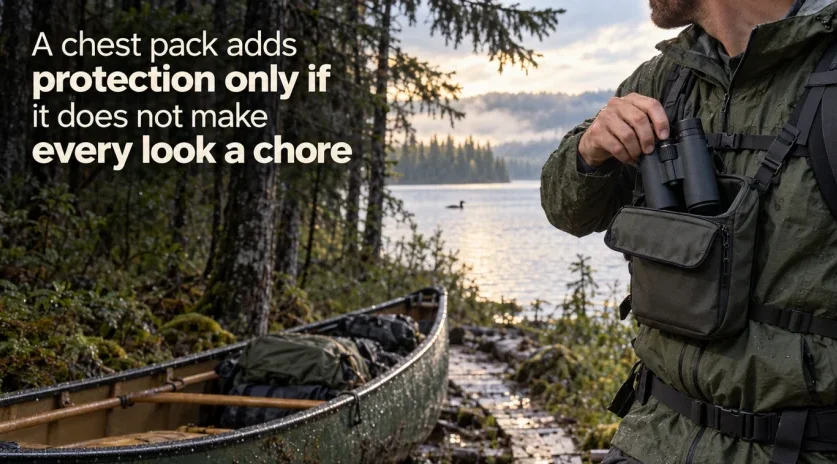
A binocular chest pack is useful when it adds real protection without making the binocular awkward to retrieve. The first decision is physical fit: usable internal height, width, depth, eyecup position, covers, and any fixed connectors all matter before pockets or closure style. After fit passes, compare how the lid opens, how the binocular clears the compartment, how much structure sits on the torso, and what the maker actually claims about magnets and weather protection. An open harness or simpler pouch can still be the better carry system when full enclosure adds more bulk than the situation needs.
Fit the binocular before comparing chest pack features
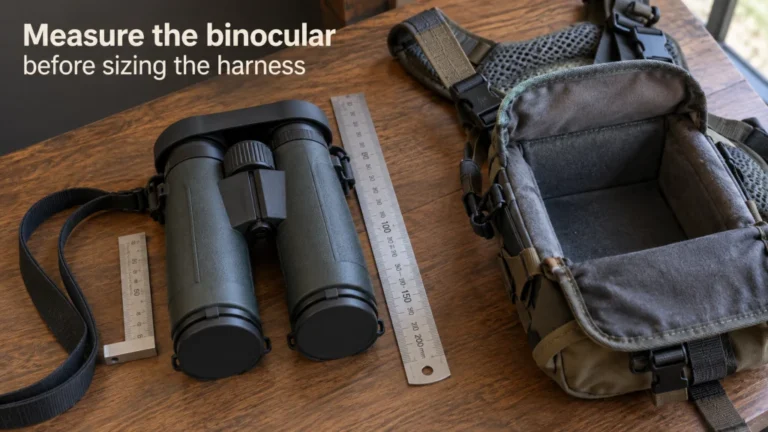
A binocular chest pack can be protective and still be the wrong choice if the binocular jams under the lid or needs two hands to come out. Start with the optic you already own, not the pocket count, and compare its working dimensions with the pack’s published internal dimensions. If you are still deciding whether enclosed carry is the right format, compare it first with a broader binocular harness setup and the binocular accessories that change everyday carry. Those two decisions should happen before storage extras start looking important.
Published sizing systems show why a simple label such as small, medium, or large is not enough, so a bino chest pack should be treated as a measured container rather than a generic size class. Some makers publish interior height, width, and depth, while others also publish model compatibility or a maximum binocular height, so the useful comparison is the geometry that matches your binocular. Measure the binocular in the configuration you normally carry, then leave enough clearance for a normal draw rather than planning to compress the eyecups or force the barrels through the opening. A pack that barely closes on paper is already a poor candidate for fast, repeatable use.
| What to check | How to measure it | Why it matters |
|---|---|---|
| Working height | Measure from the objective end to the top of the eyecups in the position you normally use. | The lid must close without pressing the eyecups down or catching the ocular end. |
| Maximum width | Measure the widest barrel or hinge position used for your interpupillary setting. | The binocular needs to enter and leave the compartment without binding at the sides. |
| Maximum depth | Measure the thickest front-to-back section, including fixed armor shapes that project outward. | A shallow compartment can grip the binocular even when height and width look adequate. |
| Carry extras | Repeat the check with the rainguard, objective caps, and fixed connectors you actually keep attached. | Small additions can change the retrieval path or stop the lid from closing normally. |
Write these four measurements down before shopping so every candidate is judged against the same working setup. If a maker lists only outside dimensions, do not assume they equal usable interior space.
Length with eyecups in normal position
Measure height with the eyecups where you normally leave them, especially if you do not fully retract them between looks. A pack that fits only when the eyecups are screwed down changes your normal setup every time the binocular goes away. That adds a small task to every viewing cycle and can also make the published fit look more generous than it feels in use. The practical target is enough vertical room for the binocular to rest naturally without the lid using the eyecups as a compression point.
Width and depth
Width and depth need separate checks because two binoculars with the same objective diameter can have different barrel spacing, bridge shapes, armor contours, and overall thickness. Measure at the interpupillary setting you actually use rather than squeezing the barrels together to win a few millimeters. If either dimension is close to the compartment limit, look for a published size guide or compatibility chart instead of assuming the fabric will stretch enough. For a more systematic fit process, the binocular harness sizing guide explains how to separate binocular fit from body fit.
Caps, rainguard and fixed connectors
Carry accessories can be the difference between a clean draw and a binocular that catches on the pouch. A rainguard may add height at the ocular end, tethered objective caps can flare outward, and fixed strap connectors can snag on the sidewall or lid seam. Check the pack with the exact pieces you intend to leave attached rather than measuring a stripped binocular that you never carry that way. If the fit works only after removing useful protection or disconnecting hardware each time, the compartment is too restrictive for that setup.

This quick-release attachment hardware secures a binocular lens cover with a cord loop and clip. The clip lets the cover detach quickly when the optic needs to come out of a chest pack. It is useful when caps and attached hardware are part of the binocular configuration being checked for fit.
Check on AmazonIf you click this link and buy, we earn a commission at no additional cost to you.
Choose the closure architecture from access and retention needs
Closure style matters only after the binocular fits, and the useful question is what the closure asks your hand to do. A secure lid can still slow access if it needs a long zipper path, a second hand, or a motion that conflicts with the direction the binocular must travel. A quick opening can also be a poor match if the compartment does not retain the binocular the way you expect during normal walking, bending, or removing a backpack. Judge the whole sequence from closed pack to binocular at the eyes and back again.
Do not reduce this choice to a slogan such as magnetic is fast or zippered is secure. Real designs vary in lid direction, sidewall height, zipper placement, retention tethers, stiffness, and whether the lid stays out of the retrieval path after opening. The best architecture is the one that lets you reach the binocular with the same simple motion repeatedly while still giving the level of enclosure you actually need. If the closure solves a problem you rarely have but adds friction to every look, the trade is backwards.
| Closure approach | What to verify | Likely tradeoff |
|---|---|---|
| Zippered | Pull direction, opening width, slider position, and whether the zipper must travel around corners before the draw. | Positive closure can require more hand movement and may be slower if the path is long. |
| Flap | Where the flap moves, how it stays open, and whether sidewalls still guide or obstruct the binocular. | Simple access can depend heavily on flap geometry and the stiffness of the opening. |
| Magnetic | Opening direction, retention design, maker warnings, and whether the lid remains clear during retrieval. | Fast closure behavior does not by itself prove retention, silence, weather sealing, or compatibility with other gear. |
Use the table as a test list rather than a ranking. The closure should disappear into the routine instead of becoming the routine.
Zippered
A zippered design makes sense when you value a clearly closed compartment and accept an extra opening motion. Check whether the zipper can be reached with the same hand that will retrieve the binocular and whether the opening becomes wide enough before the binocular starts moving upward. A short straight pull is a different experience from tracing a longer path around a structured lid, so the word zippered tells you less than the actual layout. If you expect frequent short looks, rehearse the full motion mentally from closed to viewing position before treating the closure as a good fit.
Flap or magnetic
A flap can reduce the number of steps, but its direction and resting position matter more than the presence of magnets. Some published designs use magnets to hold a lid closed, open, or both, which changes how the hand approaches the compartment. Verify that the lid clears the eyecups and bridge as the binocular leaves the pack and that any listed retention system matches how you plan to carry it. Treat magnetic operation as one design feature, not as proof of quietness, security, or universal compatibility.

This TIDEWE binocular chest pack keeps field binoculars close to the body while distributing their weight across adjustable shoulder and back straps. The camouflage pack uses a quiet closure system and modular MOLLE storage, including detachable utility and rangefinder pouches. An integrated rain cover and lens cloth support use during changing outdoor conditions. It is a practical alternative for users who need a protected binocular carrying system rather than a simple neck strap. Measure your binoculars against the advertised internal dimensions before ordering.
Check on AmazonIf you click this link and buy, we earn a commission at no additional cost to you.
Check one-hand access and the retrieval path
One-hand access is useful only when one hand can complete the entire important part of the draw. Imagine the binocular resting in the compartment with the lid fully closed, then trace where your fingers land, what must move first, and whether the barrels can rise without scraping a sidewall or catching a tether. The binocular should come out along a natural path toward your eyes rather than requiring a sideways wiggle followed by a second grip. This is especially important when the fit is close, because a compartment can look correct in a dimension table yet still have a narrow mouth.
Also check the return path, because storing the binocular is part of the same cycle. A pouch that is easy to open but collapses when empty can make one-hand replacement slower than one-hand removal. Stiff sidewalls can help guide the binocular, but extra structure can also add bulk, so the advantage needs to show up in the motion you actually use. The useful test is not how dramatic the opening looks in a product photo, but whether retrieval and replacement both remain simple with your normal caps, rainguard, and tether arrangement.
- Can one hand open the compartment without searching for a small tab or slider?
- Does the lid stay out of the way while the binocular moves upward?
- Can the binocular clear the opening at your normal interpupillary setting?
- Can you return it without folding caps, tethers, or sidewalls into the compartment?
- Can you close the pack again without looking down for several seconds?
If several answers are no, the problem is not a lack of practice alone. The pack geometry may simply be fighting the way you want to use the binocular.

This chest pack uses an adjustable buckle closure and a zipperless main binocular pouch. The listing says the pouch fits most mid-size 10x42 binoculars and allows easy one-handed access. Those features make it a useful example for tracing the full retrieval path from closed pouch to viewing position.
Check on AmazonIf you click this link and buy, we earn a commission at no additional cost to you.
Evaluate torso bulk, heat and backpack interaction
An enclosed pack adds structure in front of the torso, and that structure has to coexist with clothing, pack straps, jacket zippers, and the way you move. A larger compartment can solve binocular clearance while creating a new problem if it projects far enough to catch a backpack sternum strap or makes the binocular sit lower than you prefer. Harness adjustment can change height, but it cannot make a deep box physically thinner. Think about the whole cross section on your chest, not just whether the shoulder straps are long enough.
Heat and pressure are also individual, so treat comfort claims cautiously unless they come from your own try-on. Mesh, wider straps, or a shaped back panel can change how the system contacts the body, but no material description proves all-day comfort for every torso and clothing layer. Community discussions are useful here because they repeatedly surface issues such as interference with backpacks, jacket changes, chest shape, and handoff to another viewer. Use those reports to build your test list, then verify fit on your own body instead of treating another person’s comfort as a specification.
Key point: compartment size and harness fit are separate checks. A pack can fit the binocular perfectly and still sit poorly on the person wearing it.
When possible, load the pack with the binocular you actually use and wear the backpack or outer layer that normally joins it. That simple fit check is more valuable than comparing pocket counts.
Treat magnets and weather claims as exact product evidence
A magnetic lid should be evaluated from the maker’s actual closure description, not from assumptions about all magnetic packs. Confirm where the magnets act, whether the lid is intended to stay open as well as closed, what other retention is present, and whether the manufacturer publishes any warnings for magnet-sensitive equipment. Do not convert a magnetic closure into a claim that the pack is automatically silent, more secure, or easier to use in every position. Those outcomes depend on the complete design and the way it fits the binocular.
Weather language needs the same discipline. Waterproof material, water-resistant treatment, a weatherproof design, and a fully waterproof enclosure are different claims, so keep the wording at the exact level the manufacturer documents. A tall sidewall or overlapping lid can add protection from dust and light moisture without proving immersion resistance or sealed construction. If the maker does not publish a stronger protection rating or test, do not invent one from fabric names, coating language, or the fact that the binocular is fully enclosed.
Warning: follow the manufacturer’s published warnings and compatibility instructions for magnetic closures and other hardware. Do not override a listed restriction because a closure seems weak, distant, or harmless.
The practical takeaway is simple: protection claims should narrow your choice only after physical fit and retrieval already work. A stronger sounding label cannot rescue a pack that is awkward every time you reach for the binocular.
Compare an open harness when enclosure is unnecessary
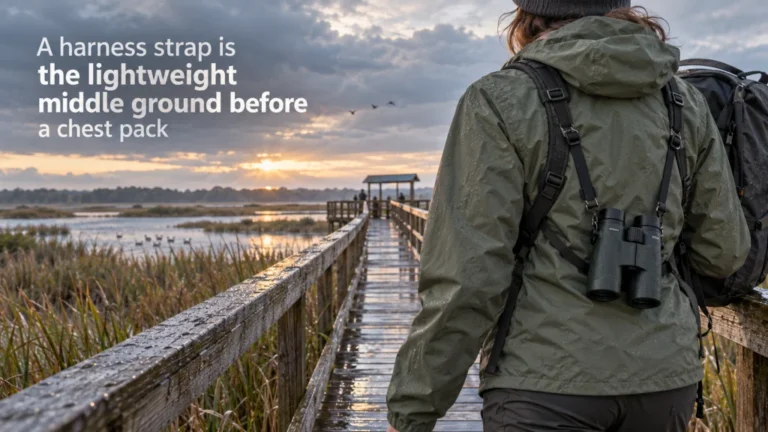
An enclosed pack earns its extra structure when you actually need the binocular shielded from routine contact, dust, brush, or other everyday exposure. If the binocular mostly needs weight distributed away from a neck strap and you value the fastest possible transition to viewing, an open harness can be the simpler answer. It removes the lid and compartment from the access sequence, which also removes a fit problem around the binocular body. The tradeoff is that the optic remains more exposed when you are not looking through it.
This is where the decision should return to your actual use rather than the number of features. A casual walk on a clean trail, repeated short observations, or frequent sharing may favor less enclosure, while rougher carry conditions can make a protective compartment worth the added step. If you want to understand the lighter format in more detail, compare how a binocular harness strap carries the optic without a full box. Do not pay a bulk penalty for protection you rarely need just because the enclosed system looks more complete.
| Carry style | Best reason to choose it | Main compromise to accept |
|---|---|---|
| Enclosed chest pack | You want on-body protection and controlled storage around the binocular. | More structure, more fit variables, and at least one extra access step. |
| Simple chest pouch | You want some containment with less structure than a full pack system. | Protection and retention depend heavily on the exact pouch shape and closure. |
| Open harness | You prioritize immediate access and weight distribution over enclosure. | The binocular remains more exposed during carry. |
None of the three is a universal upgrade over the others. The best format is the least complicated one that still solves the carry problem you actually have.

This adjustable binocular harness carries the optic without a full enclosing pouch. Its chest-strap layout distributes the binocular on the torso while leaving the optic exposed for direct access. That open format makes it a clear comparison point when enclosure is unnecessary.
Check on AmazonIf you click this link and buy, we earn a commission at no additional cost to you.
Compare a pouch when you want less structure
A binocular chest pouch sits between a fully structured pack and an open harness. It can give the binocular a defined home on the torso without surrounding it with as much paneling, pocketing, or rigid shape. That can be useful when your main concern is keeping the optic contained and easy to find rather than building a larger carry system around it. The key is to verify whether the pouch keeps its opening usable when empty and whether the sidewalls still clear your caps, bridge, and connectors.
Do not assume a softer or smaller pouch automatically means easier access. Less structure can let fabric fold inward, while a tighter mouth can still catch on armor or objective caps, so the same fit and retrieval tests apply. An enclosed binocular pack makes more sense when you need greater coverage and the larger shape does not interfere with your torso or backpack. A pouch makes more sense when it passes the same fit test with less bulk and you do not need the extra enclosure.
Note: the label on the product category is less important than the actual internal shape. Compare the opening, usable interior space, and retrieval path instead of assuming every pouch is smaller or every pack is more protective.
That distinction keeps the decision focused on what your binocular and carry routine require. It also prevents extra pockets and modular panels from becoming a substitute for a good basic fit.
Final Thoughts: buy the chest pack only after compartment fit and access both pass
Start with the binocular, including the eyecup position, rainguard, caps, and connectors you actually carry. Match those working dimensions to published internal dimensions, then check whether the opening gives the binocular a clean path out and back in. Only after those two tests pass should closure style, torso profile, pockets, and weather language influence the choice. This order prevents a feature-rich pack from hiding a basic fit problem.
If enclosure solves a real protection problem and access stays simple, the added structure can be worthwhile. If the pack needs repeated adjustment, forces you to change the binocular’s normal setup, or interferes with the backpack you already wear, choose a simpler carry format instead. The right answer is not the chest pack with the most features, but the system that protects the binocular without making you hesitate before every look. Fit first, access second, and extra features last is the useful buying rule.
Frequently asked questions
📏 How do I know what size chest pack fits my binoculars?
Measure working height, maximum width, and maximum depth with the eyecups and carry accessories in their normal positions. Compare those numbers with published internal dimensions or an official compatibility chart, and allow enough clearance for an easy draw rather than a force fit.
🖐️ Is one-hand access worth prioritizing?
Yes if you make frequent short observations or often have the other hand occupied with ordinary outdoor gear. Verify the full motion from closed pack to viewing position and back, because a lid can open with one hand while the binocular still binds in the compartment.
🧲 Are magnetic closures always faster than zippers?
No. Speed depends on lid direction, opening size, retention, and whether the binocular clears the compartment cleanly. Compare the exact design rather than treating the closure label as a performance rating.
🌧️ Does a fully enclosed pack mean it is waterproof?
Not automatically. Use the manufacturer’s exact protection claim for that specific pack, and do not turn terms such as enclosed, weather resistant, or waterproof material into a stronger claim than the maker documents.
🎒 Can I wear a binocular chest pack with a backpack?
Often, but the result depends on pack depth, harness position, backpack shoulder straps, sternum strap placement, and your torso. Try the two systems together with the binocular loaded, because a chest pack that fits well by itself can still interfere with a backpack.
🔭 When is an open harness better than a chest pack?
An open harness is often the simpler choice when you mainly want weight distribution and immediate access rather than enclosure. Choose the chest pack when added protection solves a real carry problem and the extra bulk does not slow your normal viewing routine.
References and Sources
- Badlands binocular harness size charts: Publishes interior height, width, and depth by pack size plus binocular compatibility examples, supporting the need to verify usable compartment dimensions.
- FHF Gear FOB bino pouch specifications: Publishes size limits, dimensions, enclosure details, materials, and magnetic lid construction used to check fit and closure claims.
- FHF Gear setup instructions: Documents harness position, pouch height adjustment, and closure construction, supporting the distinction between binocular fit and body fit.
- Birding community discussion on straps and harnesses: Provides owner-reported examples of backpack interaction, torso fit, access friction, and sharing inconvenience used only to identify practical fit questions.