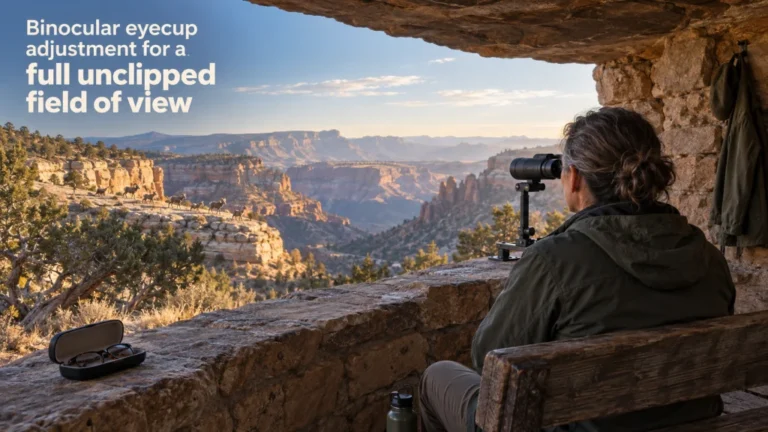
Interpupillary distance controls how far apart the two eyepieces sit relative to your eyes, and the useful setup goal is simple: both optical fields should overlap into one clean circular view. If you still see two circles, crescent shadows, or uneven black edges, adjust barrel spacing before blaming focus or internal alignment. Eyecup position can create similar edge shading, so recheck it after the fields merge. If two distinct images remain after a correct field merge, stop treating the hinge as the solution and move to a different troubleshooting path.


This 8x42 roof-prism binocular provides 20.2 mm of eye relief and a 377-foot field of view at 1,000 yards. Adjustable eyecups and a large center focus knob support a repeatable fit and focus sequence. The nitrogen-filled body is waterproof and fogproof for outdoor viewing.
Check on AmazonIf you click this link and buy, we earn a commission at no additional cost to you.
What you are adjusting when you change binocular IPD
Binocular IPD adjustment changes the spacing between the eyepieces by moving the two barrels around the hinge or other manufacturer provided spacing mechanism. The goal is not to alter magnification, focus, or diopter compensation. You are placing the two exit beams and two visible fields where both eyes can receive them at the same time. Nikon’s user guidance describes the correct result as left and right fields aligned into a single circle, which is a useful owner level check because it depends on what you can actually see rather than on guessing a number.
That distinction matters because several controls sit close together on many binoculars, yet they solve different problems. The center focus changes target sharpness, the diopter balances focus between the two optical channels, and the hinge changes the separation between those channels. If you keep turning focus while the spacing is wrong, you can spend time improving sharpness inside two badly positioned fields. Treat barrel spacing as geometry first, then use the other controls for the jobs they actually own.

This 8x42 binocular combines multi-coated optics with BaK-4 prisms and twist-up eyecups. Its 5.2 mm exit pupil and 17.8 mm eye relief provide clear fit variables to check after barrel spacing is set. The waterproof, fogproof body also includes tripod adapter threads for supported viewing.
Check on AmazonIf you click this link and buy, we earn a commission at no additional cost to you.
Use a distant simple target before touching focus again
A distant, uncomplicated target makes spacing errors easier to see because your attention is not being pulled toward fine detail at close range. A roofline, sign, tree trunk, or other stationary object with a clear outline works better than a bird moving through branches while you are still setting the binoculars to your face. Bring the target roughly into focus if necessary, then leave the focus wheel alone while you adjust barrel spacing. The task here is to judge the shape and overlap of the visible field, not to chase perfect detail.
Keep your normal viewing posture while you make the adjustment. Do not squeeze your face toward the eyepieces, tilt one side dramatically, or shift your head sideways just to force the circles to overlap. Those compensations can hide a poor hinge setting and make the position hard to repeat later. A simple target gives you a stable reference, while a natural head position tells you whether the binocular geometry actually fits.

This 8x42 binocular has a 388-foot field of view at 1,000 yards and a manual center focus. Twist-up eyecups and 17.5 mm eye relief let the viewer set eye position independently of focus. Fully multi-coated optics, phase-coated BaK-4 prisms, and a waterproof body round out the design.
Check on AmazonIf you click this link and buy, we earn a commission at no additional cost to you.
Move the hinge until the two fields merge into one circle
Hold the binoculars with both hands and move the barrels slowly closer together or farther apart around the hinge. Watch the two circular fields rather than the target detail, and stop when they overlap into one clean circle. Fujifilm’s current setup instructions use the same basic endpoint: move the hinge until the image circles align and merge into one image circle. If the hinge feels abnormally stiff, reaches a hard stop, or seems damaged, stop and check the exact manual rather than trying to gain extra travel by forcing it.
Make small changes near the point where the fields begin to merge because a large swing can move you from too wide to too narrow without showing the usable middle position clearly. Once you have one circle, hold the binoculars in your normal viewing position for several seconds and confirm that the field stays centered without deliberate head correction. Then lower the binoculars and raise them again to see whether the same hinge position still works. A repeatable position is more useful than a setting that only looks right while you are carefully posing your eyes for it.
| What you see | What it usually means during setup | What to do next |
|---|---|---|
| Two circles remain separated | The eyepiece spacing is not yet matched to your viewing position | Move the barrels gradually and watch for the fields to overlap |
| One field with a dark central intrusion or uneven overlap | The spacing may still be too wide or too narrow | Make a small hinge correction and recheck from a natural head position |
| One clean circle but edge shading remains | IPD may be close while eyecup position or eye placement still needs attention | Leave the hinge alone briefly and recheck eyecup position |
The table is a setup guide, not a diagnosis of internal optical condition. Field shape can also change with eyecup position, eye relief, and how consistently you bring the binoculars to your face. Use the hinge to solve spacing first, then isolate the remaining variable instead of changing several controls at once. That sequence makes it much easier to tell whether the adjustment actually helped.
What too wide looks like
When the barrels are too far apart for your viewing position, the two fields may resist merging even though each side looks individually clear. You may also see a central dark intrusion, uneven overlap, or feel tempted to spread your eyes or shift your head to make the view work. Move the barrels slightly closer together and recheck the circle from a relaxed position. Stop when the fields merge naturally rather than continuing until the hinge is as narrow as it can go.
What too narrow looks like
When the barrels are too close together, the fields can again become uneven or separate, but the correction is in the opposite direction. Spread the barrels gradually while keeping the binoculars square to your face. Avoid using a memorized millimeter value from another person as the answer, because the useful setting is tied to the current viewer and the exact binocular geometry. The visual endpoint is still one stable circle, not a particular number copied from elsewhere.
Save the repeatable hinge position if the binocular has a scale
Some binoculars provide an IPD scale near the hinge, and that scale can be useful after you have found the working position visually. Note the value only after the fields merge, not before, so the number records a successful fit instead of dictating one. A marked scale can help a regular user return quickly to a previously verified position. If your binoculars have no readable scale, a consistent visual check is enough and you do not need to invent one.
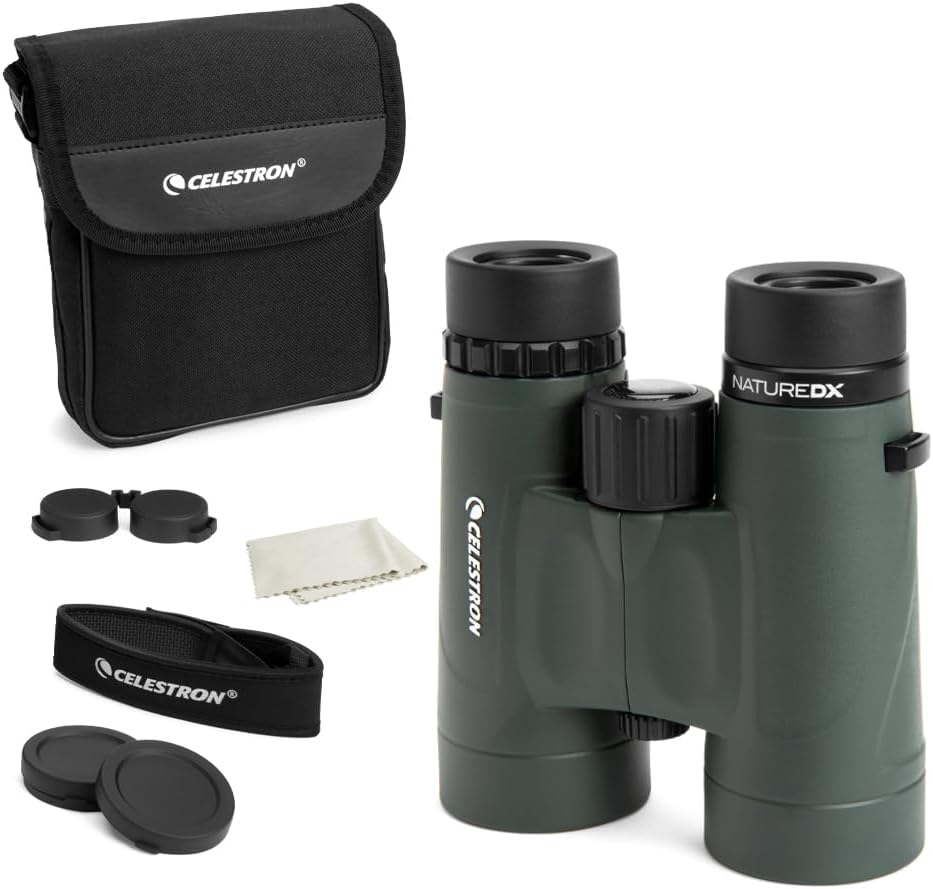
This 10x42 binocular uses fully multi-coated optics and phase-coated BaK-4 prisms. Twist-up eyecups let the viewer refine eye position while working toward a stable merged field. The waterproof, fogproof rubber-armored body is built for regular outdoor use.
Check on AmazonIf you click this link and buy, we earn a commission at no additional cost to you.
Recheck eyecups when edge shading remains after the field merges
A single merged circle does not guarantee that eye position is finished. If the central split has disappeared but you still see black crescents or shading near the edge, eyecup position and eye relief become the next variables to check. Cornell’s binocular guidance separates barrel spacing from eyecup adjustment for this reason, and it notes that poor setup can leave blacked out areas in the view. Keep the hinge at the position that produced one field while you adjust how far your eyes sit from the eyepieces.
Eyeglass wearers usually need the eyecups retracted farther because the lenses of the glasses already hold the eyes away from the binocular eyepieces. Users without glasses often need more eyecup extension, although the exact useful position depends on the eyecup design and the person’s facial geometry. If edge shading changes as you move the binoculars slightly closer to or farther from your eyes, that is a strong clue to work on eyecup position rather than restarting the IPD adjustment. For a fuller setup sequence, use the site’s binocular eyecup adjustment guidance after the field itself is properly merged.

This 10x42 binocular uses twist-up eyecups and provides 17 mm of eye relief. Fully multi-coated optics and a center focus system support normal viewing adjustments after the fields are aligned. The O-ring-sealed body is waterproof and fogproof with a rugged rubber exterior.
Check on AmazonIf you click this link and buy, we earn a commission at no additional cost to you.
Why smaller exit pupils can make alignment feel less forgiving
Exit pupil is the diameter of the light beam leaving each eyepiece, calculated from objective diameter divided by magnification. A smaller exit pupil gives the eye less lateral room before a positioning error starts to clip the usable beam, so precise eye placement can feel more demanding. Fujifilm’s setup guidance notes the practical counterpart: with a smaller exit pupil, even slight misalignment between the optical axis and the user’s pupils can cause blackout. That does not mean exit pupil replaces IPD, but it helps explain why two binocular configurations can feel different even after their hinges are correctly set.
For example, an 8×25 configuration has an exit pupil of about 3.1 mm, while an 8×42 configuration is about 5.3 mm. Those numbers do not prove that one binocular will fit a particular face better, because eyecup shape, eye relief, field design, and physical handling still matter. They do explain why a compact configuration can demand more careful centering for some users. If a small exit pupil binocular keeps showing edge loss after the fields merge, check eyecup height and eye placement before assuming the hinge is wrong.

This compact 8x25 binocular has a 3.1 mm exit pupil, directly matching the smaller-exit-pupil example in this section. Multi-coated optics and BaK-4 prisms support clear daylight viewing in a compact roof-prism design. The waterproof, nitrogen-purged body is built to resist internal fogging.
Check on AmazonIf you click this link and buy, we earn a commission at no additional cost to you.
When persistent double images are no longer an IPD setup problem
Stop treating the hinge as the answer once the visible fields have merged into one circle and normal eyecup position has been checked. If you still see two distinct versions of the same target inside that merged field, continuing to squeeze or spread the barrels can destroy a correct IPD setting without solving the remaining problem. Do not jump from that symptom to an eyesight diagnosis, and do not assume that every double image proves a specific internal fault. The owner level conclusion is narrower: the basic spacing adjustment has reached its endpoint, so the next step belongs to troubleshooting rather than more IPD movement.
First verify that the binoculars are being held squarely, that the diopter has not been moved far from your normal setting, and that the symptom persists on a simple distant target. If the binoculars were dropped, the hinge is damaged, the body is loose, water has entered the optic, or the two images remain clearly separated after correct external setup, stop at the owner service boundary. Do not open the housing or attempt internal prism or collimation adjustments. Use the manufacturer’s support path or qualified optical service for an internal alignment problem that external controls cannot resolve.
Check IPD range before purchase, not during this setup procedure
This procedure assumes the binoculars can physically reach a spacing that works for the viewer. Published minimum and maximum IPD range matter before purchase because a model whose hinge cannot reach your needed spacing may never produce a comfortable field merge. That is a specification fit question, not something you should solve by forcing the hinge past its designed travel. If the barrels reach a hard mechanical limit before the fields can merge, stop and verify the exact model’s stated range.
Do not copy eyeglass prescription pupil distance blindly into a binocular setting or assume one adult value covers most users. A prescription measurement and a binocular’s mechanical IPD range are related to different fitting tasks, and the practical binocular check remains the actual merged view through the instrument. If you are comparing models before buying, verify the published IPD range alongside eye relief, eyecup design, field of view, weight, and how the binocular sits in your hands. Once the binocular is in use, return to the simpler test: adjust barrel spacing until both fields become one stable circle.
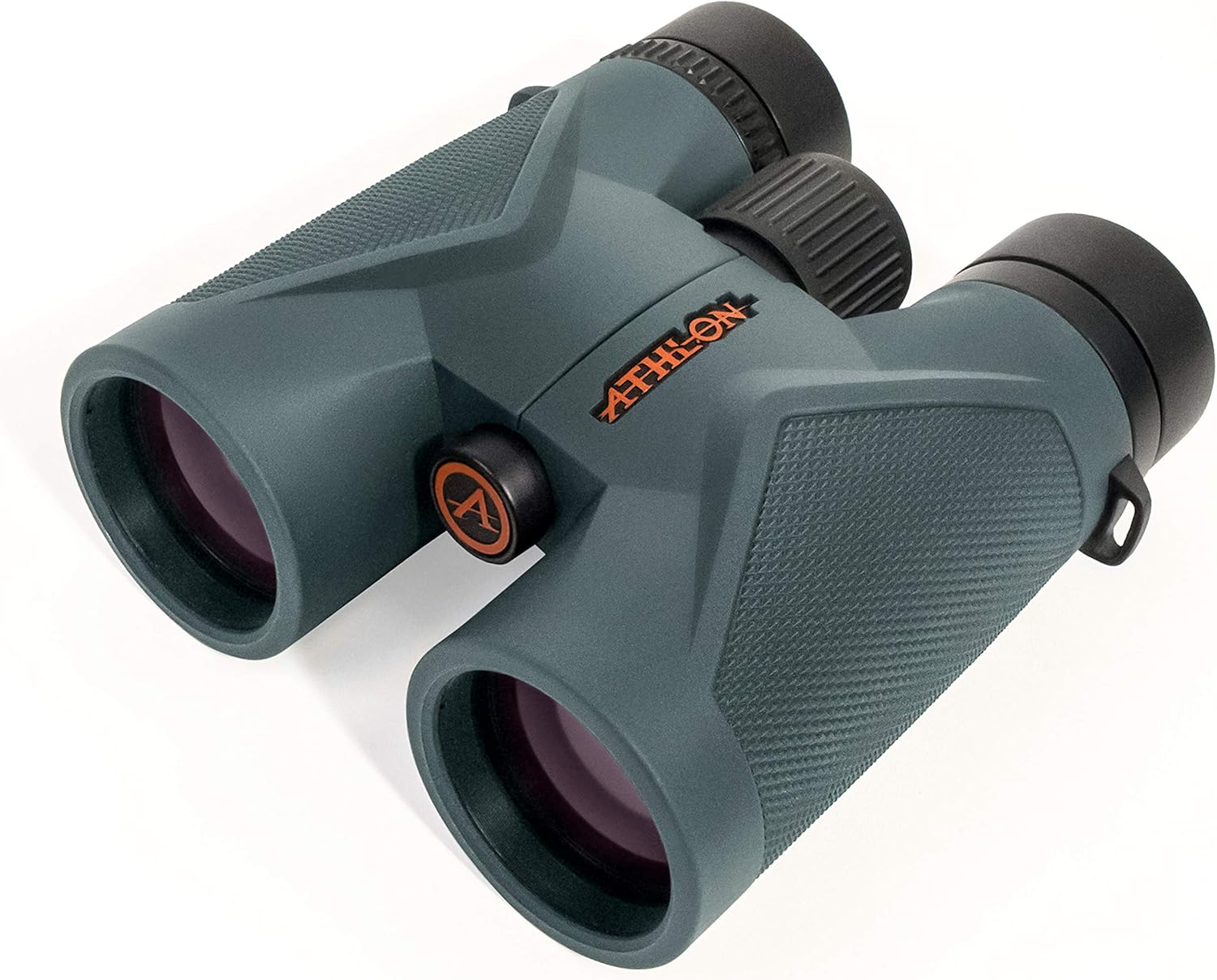
This 8x42 binocular has a published interpupillary adjustment range of 57 to 74 mm and 17.2 mm of eye relief. Twist-up eyecups help refine eye position after hinge spacing is established. ED glass, fully multi-coated optics, and an argon-purged chassis complete the model.
Check on AmazonIf you click this link and buy, we earn a commission at no additional cost to you.
Final Thoughts: merge the fields before judging the optics
A good IPD setting is not a mysterious number. It is the repeatable hinge position where both barrels work together as one viewing system, producing one clean field from a natural head position. Set that geometry before fine tuning focus or judging whether the binoculars feel sharp and comfortable. If you share the binoculars, expect to reset the spacing for each person rather than preserving one universal position.
When the field has merged but dark edge shading remains, move to eyecup and eye position checks instead of endlessly changing barrel spacing. When two distinct target images remain after the external setup is correct, stop at the owner level boundary and treat the issue as a separate troubleshooting problem. Do not force the hinge and do not attempt internal alignment work. The useful sequence is simple: merge the fields, confirm eye position, then judge what problem is actually left.
FAQs
🔭 Why do I see two circles through my binoculars?
The barrel spacing is often not matched to your eyes yet. Move the hinge slowly until the two visible fields overlap into one circle, then recheck from a natural head position.
👀 Should I focus before adjusting binocular IPD?
Get a distant target roughly clear if needed, then leave focus alone while setting IPD. The spacing step is about merging the two fields, not about perfecting target sharpness.
👓 Why do I still see black edges after the circles merge?
Eyecup position or eye relief may still be wrong even when IPD is correct. Keep the hinge at the merged position and adjust how far your eyes sit from the eyepieces, especially if you wear glasses.
📏 Should I set binocular IPD to a specific millimeter number?
No universal number works for every viewer or binocular. Use a scale only to record a position that has already produced one stable field for you.
🧭 Do shared binoculars need to be readjusted for each person?
Yes, check IPD whenever the binoculars change users. Eyecup position may also need to change when one user wears glasses and another does not.
🛠️ What if I still see two target images after the field is one circle?
Stop changing IPD if the field itself is already merged. Recheck normal external setup, and if two distinct images persist, use manufacturer support or qualified service rather than attempting internal alignment.
References and Sources
- Nikon binocular use guide: supports the one-circle endpoint for interpupillary adjustment and separates IPD from focus and diopter adjustment.
- Fujifilm binocular instructions: supports hinge based IPD adjustment, the single image circle check, and the greater blackout sensitivity of smaller exit pupils.
- Cornell Lab binocular adjustment guidance: supports separating barrel spacing from eyecup setup when blacked out areas remain.