Diamondback HD and Viper HD can look close enough on a basic spec sheet to make the price jump feel like the main difference. In the current 8×42 pair, Viper HD gives you a wider field of view and a little more eye relief, while Diamondback HD is lighter and focuses closer. Those are useful differences, but none makes Viper HD an automatic upgrade for every buyer. The right choice is the one that clears your own field, eyeglass fit, close-focus, weight, and viewing requirements without paying for a label you cannot use.
Define the one job Viper HD is supposed to do better than Diamondback HD
The Vortex Diamondback HD vs Viper HD binoculars choice is not really about which name sits higher in the lineup. It starts with two similar-looking spec sheets and one practical question: what limitation would the Viper HD actually remove for you? In the matched 8×42 configuration, field of view is the first clean separator because Vortex lists 409 feet at 1,000 yards for Viper HD and 393 feet for Diamondback HD. That wider window can matter when keeping a moving subject in view or reacquiring it after it slips toward the edge.
Before paying for that difference, place it inside the larger decision instead of treating it as a trophy specification. The Vortex binoculars guide gives the family context, while the best binocular brands guide is the better place for brand-level trade-offs outside this comparison. Here, the job is narrower: decide whether Viper HD fixes a field, fit, or focus constraint that Diamondback HD leaves unresolved. If Diamondback HD already clears those thresholds, the higher family name does not create a new viewing need.

The Viper HD 8x42 uses 8x magnification with 42 mm objective lenses. Vortex lists a 409-foot field of view at 1,000 yards and 18 mm of eye relief for this configuration. Its feature set includes XR Plus lens coatings, a locking diopter, and tripod adaptability.
Check on AmazonIf you click this link and buy, we earn a commission at no additional cost to you.
Normalize magnification and objective size before reading the suffixes
A fair Diamondback HD versus Viper HD comparison has to begin with the same magnification and objective diameter. Comparing an 8×42 from one family with a 10×42 or 10×50 from the other mixes family differences with changes caused by magnification or objective size. That makes a wider or narrower field, different eye relief, weight, and handling much harder to interpret. The 8×42 pair is useful because both binoculars begin at the same 8x magnification and 42 mm objective size, so the remaining specification gaps are easier to assign to the model family.
This also prevents a common first-time buying mistake: assuming that a more expensive model with a different configuration proves the more expensive family is better. An 8x binocular normally presents a different stability and field relationship than a 10x model, regardless of badge. Likewise, moving to a larger objective can change weight and bulk before any family-level optical differences enter the discussion. Match the configuration first, then judge what the family change actually buys you.
- Match magnification before comparing field of view.
- Match objective diameter before comparing size, weight, and low-light expectations.
- Use the exact current model page rather than borrowing a specification from a sibling configuration.
- Treat family names as labels until a measurable or well-supported viewing difference appears.
Once the configuration is normalized, the useful comparison becomes much less dramatic and much more specific. You are no longer asking whether Viper HD is the more premium family in the abstract. You are asking whether its documented differences matter in the way you actually look through binoculars. That is the point where the spec sheet becomes a decision tool instead of marketing shorthand.
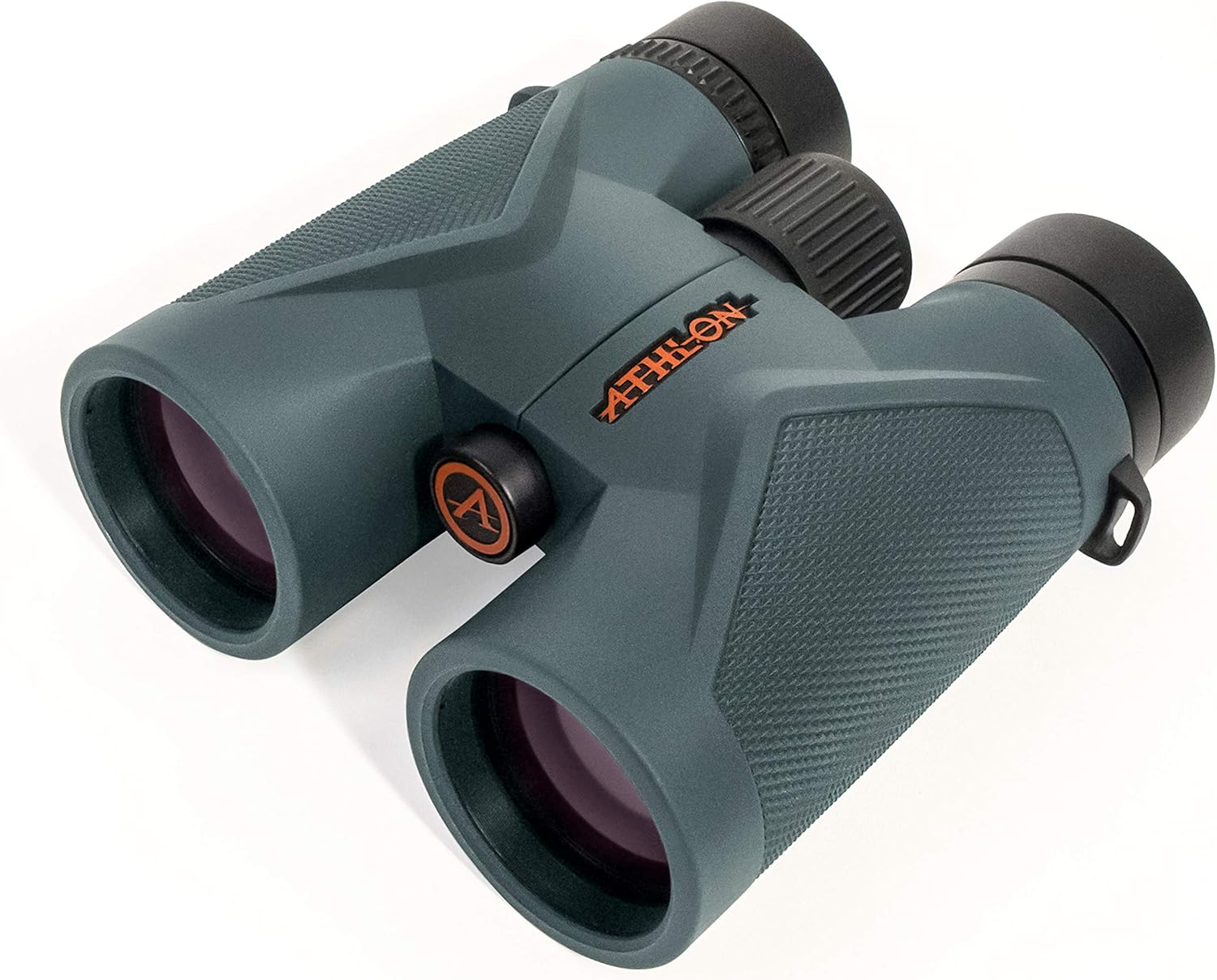
The Midas UHD pairs 8x magnification with 42 mm objective lenses. Athlon specifies extra-low dispersion glass, advanced fully multi-coated optics, and BaK-4 prisms with dielectric and phase coatings. Its magnesium chassis is waterproof and argon purged.
Check on AmazonIf you click this link and buy, we earn a commission at no additional cost to you.

The FANAUE S1 is a CNC aluminum binocular tripod adapter with a 1/4-20 interface. It is compatible with Arca-style ball heads and tripod heads that use a 1/4-inch thread. The adapter is designed to connect compatible binoculars to a stable tripod support.
Check on AmazonIf you click this link and buy, we earn a commission at no additional cost to you.
Do not turn an optical material label into an automatic visible-performance claim
Vortex describes both models with an HD optical system, but the coating language is not identical. Diamondback HD lists fully multi-coated lenses, while Viper HD lists XR Plus lens coatings and presents them as its higher-level anti-reflective treatment. That is a documented feature difference, not a complete measurement of how much brighter, sharper, or more color-accurate one exact binocular will look to you. A coating name can support the existence of a design difference without proving the size of the visible benefit under every light condition.
The same caution applies to claims such as better edge sharpness, stronger low-light detail, easier focus behavior, or a more relaxed image. Those are behaviors that deserve controlled comparative testing, clearly described methods, or a careful side-by-side fit check rather than an inference from price alone. Vortex’s product pages establish what the manufacturer says is built into each model, but they do not turn that language into an independent performance test. When the spec sheet stops proving the claim, the article should stop pretending the claim is settled.
That distinction protects both sides of the decision. It prevents Diamondback HD from being dismissed just because its price and position are lower, and it prevents Viper HD from being denied real credit for differences that can matter. The upgrade case becomes stronger only when the documented difference intersects with a limitation you actually notice. That is a much higher standard than reading the word HD twice and assuming the rest is obvious.

The Vortex Lens Cleaning Pen combines a retractable brush with a non-liquid cleaning compound. It is designed to remove dust, smudges, and fingerprints from optical lenses. The compact pen format is intended for portable lens care.
Check on AmazonIf you click this link and buy, we earn a commission at no additional cost to you.
Where Diamondback HD remains the rational stopping point
Diamondback HD remains the sensible stopping point when its 393-foot field already feels wide enough, 17 mm of eye relief gives you a full usable view, and the 5-foot close-focus specification covers the distances you care about. Its lighter 21.8-ounce body is also a real advantage if long carry time or hand fatigue matters more than gaining a little extra field width. In that situation, moving up the family does not fix a failed requirement. It mostly adds features and a higher price to a setup that was already doing the required job.
This is especially important for a buyer who is tempted to treat the lower-priced model as temporary. If the fit is correct and the viewing window is comfortable, there is no rule saying you must buy past the point where the problem is solved. A lower weight can even be the better functional choice when you carry the binocular for hours or prefer less front-heavy movement on a strap or harness. If you are still deciding whether the step into Diamondback HD itself is necessary, the Crossfire HD versus Diamondback HD comparison owns that adjacent decision instead of this page.
| Decision | Use this threshold |
|---|---|
| Keep Diamondback HD | Its field, eye relief, close focus, and fit already clear your requirements, and lower weight is useful. |
| Move to Viper HD | The wider field or extra eye relief clears a real limitation, or a separately verified optical difference matters in your viewing conditions. |
| Skip both for now | Neither model fits your eyes, hands, required field, close-focus need, or carry tolerance well enough to justify the purchase. |
The third row matters because a two-model comparison does not require one of the two to win for every person. If both fail a non-negotiable fit or handling threshold, choosing between them is the wrong problem. A brand family should not trap you into accepting a poor fit just because the shortlist began there. The stopping point is the first configuration that satisfies the real constraint, not the most expensive name you can afford.

The OP/TECH USA Bino/Cam Harness uses non-stretch webbing for carrying binoculars or cameras. OP/TECH states that it fits most binoculars and uses a self-adjusting design to stabilize gear against the body. Uni-Loop quick disconnects are included for attaching and removing the carried optic.
Check on AmazonIf you click this link and buy, we earn a commission at no additional cost to you.
Where Viper HD changes enough to justify its tier
Viper HD earns a stronger case when the Diamondback’s viewing window is the specific thing holding you back. The published jump from 393 to 409 feet at 1,000 yards is modest, but it is measurable and points in a useful direction for motion and scanning. The additional millimeter of eye relief can also matter for a glasses wearer who sits right on the edge of seeing the full field with Diamondback HD. If either difference changes a pass into a fail for your fit, the upgrade has a reason that survives beyond the badge.
Viper HD also adds a locking diopter and Vortex’s XR Plus coating system, but those features should be valued according to how you use the binocular. A locking diopter is useful if you want the setting to resist accidental movement, while coating language alone still does not quantify the visible gain. The Viper is also heavier, so the upgrade is not free in physical terms even before price enters the decision. If you are already asking whether the next family above Viper is warranted, the Viper HD versus Razor HD comparison is the appropriate next comparison rather than stretching this one beyond its scope.
Key point: Pay more only when the wider field, extra eye relief, locking diopter, or separately verified viewing performance solves a problem you can name. If you cannot name the problem, the upgrade case is still incomplete.

The Vortex Binocular Harness Strap spreads binocular weight across the shoulders instead of concentrating it at the neck. Its nylon and Lycra straps keep binoculars close to the chest while allowing them to slide into viewing position. The one-size harness is adjustable and designed to fit binoculars, rangefinders, and many cameras.
Check on AmazonIf you click this link and buy, we earn a commission at no additional cost to you.
Check close focus before using price as the tiebreaker
Close focus is a useful reminder that a higher-positioned family does not improve every specification in the same direction. Vortex lists the Diamondback HD 8×42 at 5 feet and the Viper HD 8×42 at 6 feet, so the less expensive model focuses closer on the official numbers. That one-foot gap will not matter for every viewing situation, but it can matter if you regularly observe subjects at short distances. It also breaks the lazy assumption that every line on the Viper sheet must be numerically superior.
Use close focus as a threshold rather than a bragging right. If your nearest realistic subject is comfortably beyond both limits, the difference should carry little weight in the purchase. If you specifically need reliable focus around the five-foot range, Diamondback HD has the stronger documented specification and the Viper upgrade does not solve that need. Price should enter only after the field, fit, focus, and weight questions have already told you which compromises are acceptable.
- If both models focus close enough for your use, move on to field, fit, and weight.
- If five-foot focus matters, Diamondback HD has the published advantage in this matched pair.
- If six feet is already comfortably inside your requirement, do not overvalue a one-foot difference.
The same logic keeps price in its proper place. A higher price can be justified by a useful difference, but it cannot create one. A lower price is not automatically better either if the model fails your eye relief or field requirement. First decide which specification crosses your threshold, then ask what that solved problem is worth.

The Pentax Papilio II 6.5x21 uses 6.5x magnification with 21 mm objective lenses. Pentax specifies a minimum focusing distance of about 0.5 meter, or 1.6 feet. Its compact design is intended for viewing subjects from close range through longer-distance observation.
Check on AmazonIf you click this link and buy, we earn a commission at no additional cost to you.
State the evidence that could still reverse the verdict
The current product pages are enough to establish the basic geometry and feature differences, but they are not enough to settle every visible-performance question. A carefully controlled comparison could show a meaningful Viper advantage in contrast, edge behavior, stray-light control, or low-light detail that matters to a particular observer. It could also show that the improvement is too small to matter in the buyer’s normal conditions. Until the method and result are clear, those claims belong in the unresolved column rather than being smuggled in through the word premium.
Personal fit can reverse the paper verdict too. A buyer wearing glasses may find that 18 mm of listed eye relief finally exposes the full field, while another person may see no practical difference from 17 mm because both eyecup systems already fit well. Hand size, focus-wheel preference, balance, and tolerance for the 2.7-ounce weight increase can also change which model feels easier to use. The spec sheet narrows the choice, but the last step is still to verify the constraint that matters to you.
Evidence boundary: The official specifications can prove that the current 8×42 Viper HD is wider in field, slightly longer in eye relief, heavier, and farther in close focus than the current 8×42 Diamondback HD. They cannot by themselves prove how large a visible optical advantage you will perceive in your normal viewing conditions.
A good verdict therefore stays conditional. Keep Diamondback HD when it already meets your field, fit, close-focus, and carry requirements. Move to Viper HD when a documented difference fixes one of those requirements, or when trustworthy comparative evidence demonstrates a visible gain that you know you need. That is a stricter standard than choosing by family rank, and it is also a much more useful one.

This 72-inch tripod includes a binocular adapter and two quick-release plates. The listing specifies compatibility with binoculars, spotting scopes, cameras, and phones. A phone holder and carry bag are included with the tripod kit.
Check on AmazonIf you click this link and buy, we earn a commission at no additional cost to you.
Final Thoughts: choose the solved constraint, not the higher label
Diamondback HD and Viper HD are close enough in basic configuration that the upgrade decision should stay narrow. Viper HD gives you the wider published field and slightly more eye relief, while Diamondback HD is lighter and focuses closer. Those are not cosmetic differences, but they point to different buyer needs rather than a universal winner. The model that clears your actual threshold is the model that has done its job.
Start with field of view, then confirm eyeglass fit, close focus, and weight before allowing price or family position to decide anything. If Diamondback HD passes those checks, stopping there is rational. If Viper HD changes a failed check into a pass, the extra tier has a concrete purpose. If neither fits, do not force a winner just because both names were on the original shortlist.

ZEISS Lens Wipes are pre-moistened, individually wrapped, and supplied in a 200-count package. ZEISS states that the wipes are non-abrasive and safe for prescription lenses and anti-reflective coatings. The product description also lists binoculars among the optical surfaces the wipes are designed to clean.
Check on AmazonIf you click this link and buy, we earn a commission at no additional cost to you.
Frequently asked questions
🔭 Is Viper HD automatically better than Diamondback HD?
No. The current 8×42 Viper HD has a wider field and slightly more eye relief, but Diamondback HD is lighter and focuses closer. Viper is the better choice only when its differences solve a requirement that matters to you.
👓 Is Viper HD better for eyeglass wearers?
It has a small paper advantage because Vortex lists 18 mm of eye relief for Viper HD and 17 mm for Diamondback HD. That does not guarantee better fit with every pair of glasses, so verify that you can see the full field comfortably with the eyecups positioned correctly.
🌲 Which 8×42 has the wider field of view?
Vortex lists 409 feet at 1,000 yards for the Viper HD 8×42 and 393 feet for the Diamondback HD 8×42. That gives Viper HD the wider published viewing window in this matched configuration.
📏 Which one focuses closer?
Diamondback HD 8×42 has the closer published specification at 5 feet, compared with 6 feet for Viper HD 8×42. If your normal subjects are farther away than both limits, this difference may not deserve much weight.
🎒 Is Viper HD lighter than Diamondback HD?
No. In the current 8×42 pair, Vortex lists Diamondback HD at 21.8 ounces and Viper HD at 24.5 ounces, so Diamondback HD is lighter by 2.7 ounces. That can matter during long carry periods even if it does not change optical performance.
💡 Do XR Plus coatings prove Viper HD will look much brighter?
No. The coating system is a documented design difference, but the name alone does not quantify how much brighter the view will look to you. Use side-by-side viewing under the light conditions you actually care about before treating that claim as decisive.
References and Sources
- Vortex Diamondback HD 8×42 product page: verifies the current 8×42 field of view, eye relief, close focus, weight, dimensions, interpupillary range, coatings, weather sealing, and listed features.
- Vortex Viper HD 8×42 product page: verifies the current 8×42 field of view, eye relief, close focus, weight, dimensions, interpupillary range, XR Plus coating language, locking diopter, and listed features.