Vortex binoculars make more sense when the lineup is treated as a set of different stopping points, not a straight quality ladder. The useful question is whether moving to another family solves a remaining constraint such as close focus, eye relief, field of view, weight, configuration choice, or a performance difference that has actually been demonstrated. Current family names also need to be separated from older or transitional stock before price comparisons mean much. The goal is to leave with the lowest family that already fits the job, then open a narrower comparison only when a specific unresolved trade-off remains.
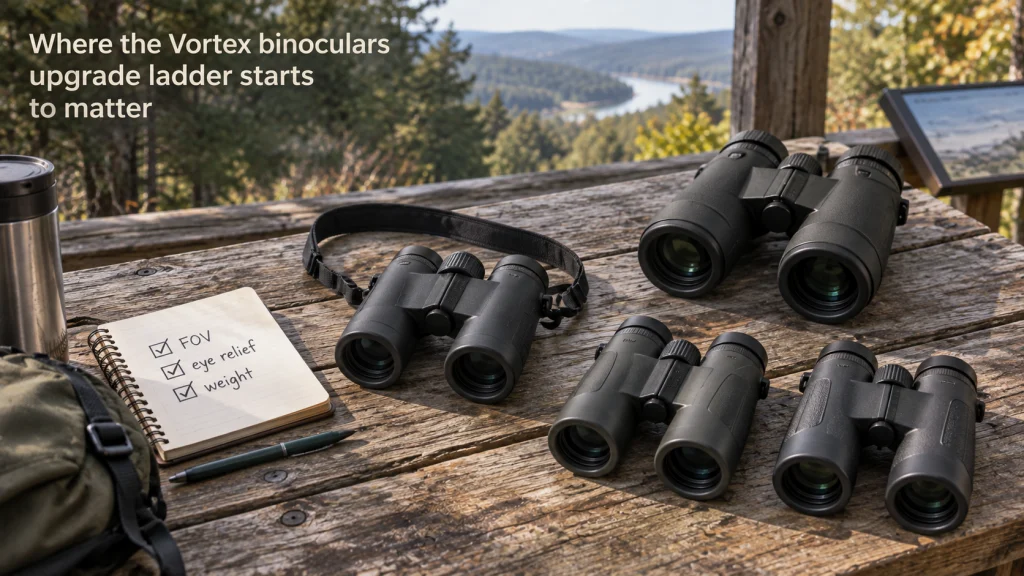
Where the Vortex upgrade ladder starts to matter
A shelf full of Vortex binoculars can look like a simple climb from inexpensive to premium, but that is not a reliable way to choose. Two families can overlap in magnification and objective size while differing in close focus, eye relief, field of view, weight, body dimensions, included carrying gear, or the range of configurations offered. That means the next price step matters only when one of those differences addresses something you can name before buying. If the lower family already fits your eyes, hands, viewing distance, carrying tolerance, and usual light, stopping there is a rational decision rather than a compromise.
The first check is therefore not which family sits higher on a retailer page. It is what is still wrong with the option you are already considering, and whether the next family documents a change that could fix it. A buyer who has not yet decided whether Vortex is the right brand at all should first use the broader binocular brand comparison framework, because family level decisions come later. Once Vortex is already the working brand choice, the lineup can be reduced to a smaller set of role changes instead of a march toward the most expensive badge.

This 10x42 Triumph HD gives the entry point a concrete configuration for checking whether the lowest family already fits. Its 17.0 mm eye relief and 334-foot field of view are useful fit references. The 15.3-foot close focus also shows why another family may matter for nearer subjects.
Check on AmazonIf you click this link and buy, we earn a commission at no additional cost to you.
Map the current Vortex lineup by buyer role, not MSRP
The current mainstream checkpoints are Triumph HD, Crossfire HD, Diamondback HD, Viper HD, Razor HD, and Razor UHD. They are not six mandatory steps. Lower families often settle basic fit, configuration, close focus, and cost, while higher families matter only when a narrower optical or ergonomic demand remains. A useful lineup map therefore asks what changes at each transition instead of assuming every step is worth paying for.
Specifications do not rise in a perfectly ordered pattern. A higher family can be heavier, while a lower family can already provide suitable field of view or eye relief. Premium families can add coatings, construction details, or optical design claims, but those matter only when they address the actual use case. The family label tells you where to investigate, while the exact configuration and remaining constraint decide whether to continue.
| Family checkpoint | What should justify moving farther | Reason to stop instead |
|---|---|---|
| Triumph HD | A documented fit, focus, configuration, or ownership difference in Crossfire HD matters to you. | The available configuration already fits your viewing distance, eyes, carrying tolerance, and budget. |
| Crossfire HD | Diamondback HD changes the exact specification or body choice that is limiting your shortlist. | The difference is mostly a family name or price change rather than a solved constraint. |
| Diamondback HD | Viper HD adds a verified fit, field, handling, or tested optical benefit that you will use often. | Your current requirements are already met and the premium evidence is not relevant to your use. |
| Viper HD | Razor HD solves a premium level issue you can identify and verify. | You cannot name the remaining limitation beyond wanting a higher tier. |
| Razor HD | Razor UHD changes a fit, size, close focus, configuration, or independently demonstrated optical behavior that matters enough to accept its trade-offs. | Razor HD already fits the job, or the UHD change adds bulk or cost without solving a real problem. |
The table is a stopping map, not a ranking. Eye relief, field of view, close focus, weight, and balance can push two people toward different endpoints. Street price also moves faster than the physical specifications that determine fit. Verify current price only after the family role is narrow.

This 10x42 Crossfire HD provides a matched checkpoint for the lineup map. Vortex lists 15 mm eye relief, a 325-foot field of view, and a 6-foot close focus. Those specifications make it easier to judge whether this family solves a real constraint before moving higher.
Check on AmazonIf you click this link and buy, we earn a commission at no additional cost to you.
Separate current Vortex families from transitional or legacy stock
The comparison path used here is Triumph HD, Crossfire HD, Diamondback HD, Viper HD, Razor HD, and Razor UHD. That sequence is a practical mainstream path for deciding when another family step changes the buyer’s constraints, not a claim that those six names make up the entire current Vortex binocular lineup. Vortex’s current binocular navigation also includes families such as Bantam, Kaibab, Ranger, Raptor, Talon, and Vanquish. Those families should enter the shortlist only when their exact configuration or role matches the viewing job, rather than being inserted automatically between the six checkpoints used on this page.
A family name alone is also not enough to prove that a specific retail listing represents the current version. Retailers can continue showing older stock, old comparison pages can remain indexed, and a familiar family can receive a revised configuration without every older page disappearing from search. Check the exact product page on Vortex first, then match the configuration, specification set, and included items against the retailer listing. If an exact variant is inactive, mismatched, or described differently across pages, compare identifiers and specifications before treating a lower price as evidence that one family is the better value.
Status check: Verify the exact Vortex page first, then compare the retailer listing line by line. If the product identity, configuration, or specification set does not match, do not use the price difference as evidence that one family is the better value. A lower price can reflect stock age, a different configuration, a package difference, or a promotion rather than a meaningful family step. Current status has to be established before value can be judged.

This Diamondback HD uses the selected 10x42 Amazon variant, giving the status check a specific retail identity to match. Amazon lists HD optics, tripod adaptability, waterproofing, fogproofing, shockproofing, and an included GlassPak. Checking the exact variant helps keep current-family comparisons from drifting into a different configuration.
Check on AmazonIf you click this link and buy, we earn a commission at no additional cost to you.
Let evidence change the comparison, not the family name
A useful family comparison starts with differences that can change the verdict. Field of view, eye relief, close focus, weight, interpupillary range, dimensions, and included gear can usually be checked directly. Claims about contrast, edge performance, color control, glare, or low light detail need stronger evidence because a manufacturer description does not measure what a viewer will see. Higher in the lineup, separating documented specifications from test-dependent optical judgments becomes more important.
This distinction prevents paying for a premium feature before proving that it fixes the actual limitation. An eyeglass wearer may care more about usable eye relief, while someone viewing nearby wildlife may care more about close focus and field of view. A long carry can also make added weight a reason to reject an upgrade. The right family is the first one that clears the important constraints, not the last one the budget can reach.
When the shortlist reaches Triumph HD and Crossfire HD, test the next constraint
Matched 10×42 listings show why this first step is not a generic upgrade. Triumph HD and Crossfire HD are close in size and weight, while their documented close focus and eye relief differ. Someone viewing closer subjects may care about Crossfire HD’s shorter close focus, while an eyeglass wearer may care about the eye relief trade. If neither difference matters, moving up only because Crossfire HD sits higher has not been justified.
The Crossfire HD to Diamondback HD step only matters when it changes the decision
Crossfire HD and Diamondback HD can overlap heavily, so compare the exact versions rather than the family names alone. In matched configurations, field of view can be very close or identical on paper, so another difference has to matter. Body design, weight, close focus, eye relief, configuration range, coatings, or tested optical behavior may become the real decision point. If none is relevant, the higher family name is weak evidence for spending more.
Route Diamondback HD versus Viper HD by the trade-off that survives verification
The Diamondback HD to Viper HD jump still requires interpretation. In 10×42 form, Viper HD documents more eye relief and a somewhat wider field of view than Diamondback HD, but it is also heavier. Those facts support fit and handling decisions, yet they do not prove that every viewer will value the optical difference enough to pay more. If the remaining reason is optical rather than physical, use independent comparison under conditions that resemble the intended viewing.

This Viper HD uses the 10x42 configuration discussed in the comparison path. Vortex lists 17 mm eye relief, a 341-foot field of view, and a 6-foot close focus. Those documented specifications give the section concrete evidence to separate fit and handling from subjective optical claims.
Check on AmazonIf you click this link and buy, we earn a commission at no additional cost to you.
Viper HD versus Razor HD needs a premium boundary, not a prestige rule
By the time a shortlist reaches Viper HD and Razor HD, generic statements about being clearer or more premium are not enough. The buyer should already know the preferred magnification and objective size, whether glasses are used, how much weight is acceptable, and whether the binoculars will be carried for long periods. From there, documented fit and field changes can be checked directly, while optical gains should be judged with evidence that actually compares the relevant configurations. This is the point where paying more without a named remaining problem becomes especially easy.
A premium step is easier to defend when it solves something that repeatedly interferes with viewing, such as field width, focus behavior, edge usability, glare handling, color error, or low light detail that has been demonstrated in a credible comparison. It is much harder to defend when the only argument is that Razor HD is positioned above Viper HD. Even a real optical improvement can be a poor trade if the buyer rarely encounters the condition where it appears. The stopping point should therefore be based on frequency and consequence, not on whether a more expensive family exists.
- Move forward when a documented or properly tested difference solves a recurring limitation.
- Stop when the lower family already fits your eyes, hands, carrying tolerance, and viewing conditions.
- Reject a premium step when the claimed benefit cannot be tied to a condition you actually encounter.
- Try the exact configuration when eye relief, eyecup position, balance, focus feel, or hand fit could decide the result.
The practical test is simple: write down the remaining limitation before opening the premium comparison. If the next family cannot be shown to address that limitation, the upgrade has no decision logic yet. That does not make the higher family bad; it means the evidence has not made it necessary for this buyer. A rational stopping point is specific to the use case.

This Razor HD is the 10x42 configuration used at the premium boundary. Vortex lists 16.5 mm eye relief, a 6-foot close focus, and a 362-foot field of view. Those measurable details help test whether the premium step solves a named fit or viewing limitation.
Check on AmazonIf you click this link and buy, we earn a commission at no additional cost to you.
Razor HD and Razor UHD can change the body role as well as the optics
The Razor HD to Razor UHD decision is a good example of why premium families should not be reduced to image quality claims. Matched magnification and objective size can still differ in dimensions, weight, close focus, field of view, and other physical details that change how the binoculars carry and handle. A UHD option may provide a feature or optical design that interests the buyer while also introducing more size or weight than the lower family. That makes the comparison a trade rather than a one-way upgrade.
This is also where skip-a-rung logic can be more sensible than climbing every family. A buyer who already knows that the unresolved problem is at the premium end does not gain anything by treating each intermediate family as a required purchase or trial. Conversely, someone who is satisfied at Diamondback HD or Viper HD has no obligation to continue simply because Razor HD and Razor UHD exist. The useful question remains whether the next family changes the viewing result enough, often enough, to justify its physical and financial cost.

This current Razor UHD 10x42 uses Vortex SKU RZB-1042 and includes the GlassPak Pro harness. Vortex lists a 346-foot field of view, 4.5-foot close focus, and 32.2-ounce weight. Those figures expose the section's central trade between premium capability and added body size or weight.
Check on AmazonIf you click this link and buy, we earn a commission at no additional cost to you.
Use independent evidence when a family step depends on visible optical performance
Manufacturer specifications are strong evidence for dimensions, weight, eye relief, field of view, close focus, included accessories, and stated construction features. They are not a substitute for a controlled comparison of resolution, color error, flare, edge sharpness, focus behavior, or low light detail. If the entire case for moving from one Vortex family to another depends on one of those visible behaviors, look for an independent comparison that identifies the exact models, magnification, objective size, viewing conditions, and method. A vague claim that one family has better glass does not tell you how large the difference is or whether it appears in the conditions you care about.
Community reports can help reveal which differences owners notice and which questions repeatedly cause uncertainty, but they should be treated as prompts rather than measurements. Two people can look through the same pair and value field edge, color, brightness, focus tension, or hand fit differently, and sample variation can complicate casual comparisons. Use owner discussion to identify what deserves closer testing, then return to traceable specifications or a method that can support the claim. When the evidence remains mixed, narrow the verdict instead of pretending the family ladder has a universal answer.
This 8x42 Viper HD gives independent testing a precisely identified configuration instead of a family-level label. Vortex lists 18.0 mm eye relief and a 409-foot field of view for this 8x42 model. Matching the exact magnification and objective size keeps observed optical differences from being mixed with configuration changes.
Check on AmazonIf you click this link and buy, we earn a commission at no additional cost to you.
Keep Vortex family choice separate from the decisions that belong elsewhere
Family selection should not be forced to answer every binocular question at once. If the real uncertainty is whether 8x or 10x suits moving subjects, whether 32 mm or 42 mm fits a carrying need, or whether a particular activity calls for a different configuration, solve that question before treating a Vortex family as the answer. The same applies to general buying process questions such as budget ceilings, return policies, or how to test eye relief with glasses. Mixing those decisions into the family ladder makes price look more informative than it really is.
Cross-brand questions also belong outside a Vortex-only stopping map. If the remaining choice is Vortex versus another manufacturer rather than Diamondback HD versus Viper HD, use the brand to brand binocular comparison route and match equivalent roles instead of comparing random prices. That keeps the Vortex lineup useful for what it actually answers: where to stop inside one brand once the use case is already clear. It also prevents a family hierarchy from being mistaken for proof that Vortex is the right answer for everyone.
This Diamondback HD is the selected 8x42 Amazon variant, making magnification a concrete decision instead of a family-level assumption. Amazon lists it as tripod adaptable, waterproof, fogproof, and shockproof, with an included GlassPak. Resolving the 8x configuration first keeps the later Vortex family comparison focused on the family difference.
Check on AmazonIf you click this link and buy, we earn a commission at no additional cost to you.
Final Thoughts: stop when the remaining problem is solved
The Vortex lineup becomes much easier to navigate once each family step has to earn its place in the shortlist. Start with the lowest family that appears to fit the viewing job, then name the exact problem that remains before moving higher. Check specifications for fit and configuration changes, verify current product status on the manufacturer site, and use independent evidence when the claimed benefit is optical behavior rather than a documented dimension or feature. If the next family does not solve a real limitation, stopping is the correct outcome.
The most useful upgrade is therefore not the biggest jump in price or the family with the strongest marketing language. It is the first change that improves something the buyer will notice often enough to matter, without creating a worse trade in weight, bulk, fit, or cost. That can mean moving one step, skipping a step, or staying exactly where the shortlist already works. The narrower comparison pages below are for the moments when that remaining decision is specific enough to deserve its own test.

This small GlassPak Sport harness is sized for most 42 mm and smaller binoculars. Amazon lists an adjustable harness, quick-release buckles, and extra pockets on the selected small variant. It gives the final carrying and bulk trade-off a practical accessory option without requiring another binocular family step.
Check on AmazonIf you click this link and buy, we earn a commission at no additional cost to you.
Compare the Vortex families that remain on your shortlist
Use these comparisons only after the broader family map has left you with a specific fork. Each page narrows the evidence to one pair or one deliberate skip, so the decision can focus on the trade that actually remains. That is more useful than reading every comparison in sequence because many buyers will already have a clear stopping point. Start with the pair that matches your shortlist and ignore the rest unless a new constraint appears.
The final row is intentionally a skip comparison rather than another rung. It is for buyers who already know the middle step does not answer their problem and want to test whether jumping farther changes the decision. Keep the exact configuration consistent whenever possible so magnification and objective size do not become hidden variables. If the comparison produces no meaningful gain for your conditions, return to the lower family and stop there.
| Comparison | Use it when |
|---|---|
| Vortex Triumph HD vs Crossfire HD | You are deciding whether the first family step fixes a close focus, fit, configuration, or ownership constraint. |
| Vortex Crossfire HD vs Diamondback HD | You need to know whether the next mainstream family changes the decision enough to justify moving up. |
| Vortex Diamondback HD vs Viper HD | Your shortlist has reached the point where fit, field, weight, and premium optical evidence need to be separated. |
| Vortex Viper HD vs Razor HD | You are testing whether a premium step solves a recurring limitation rather than simply raising the tier. |
| Vortex Razor HD vs Razor UHD | You need to weigh premium optical claims against physical differences such as size, weight, field, and close focus. |
| Vortex Diamondback HD vs Razor HD | You are considering a deliberate skip and want to know whether the larger jump changes the actual viewing decision. |
Do not treat the table as a required reading order. Its job is to send a narrowed shortlist to the comparison that can finish it. If your unresolved question is still generic, settle that first instead of opening a family comparison too early. The fewer unnecessary rungs you examine, the clearer the final choice becomes.
This 8x42 Razor HD gives the comparison route another exact family-and-configuration endpoint. Vortex lists 17.5 mm eye relief, a 388-foot field of view, and a 6-foot close focus for SKU RZB-2101. Using the exact 8x42 model helps keep pairwise comparisons consistent when the shortlist reaches Razor HD.
Check on AmazonIf you click this link and buy, we earn a commission at no additional cost to you.
FAQs
Most lineup questions are really about where a buyer can stop without leaving an important constraint unresolved. The answers below focus on fit, configuration, evidence, and role rather than assuming the highest family is right. Specifications can change with magnification and objective size, so compare like with like. Eye relief, hand fit, and focus feel still need to be checked on the exact binocular.
Price should stay separate from family role because discounts can temporarily change the gap between two models. A sale changes value, not field of view, close focus, weight, or physical fit. Start with the viewing job, then use current pricing as the last filter. That keeps a temporary deal from becoming the entire reason for an upgrade.
🔭 Which Vortex binocular family should I start with?
Start with the lowest current family that offers the configuration you need, then check fit, eye relief, field of view, close focus, weight, and carrying needs. Move higher only when a documented or properly tested difference solves a remaining problem.
👓 Is a higher Vortex family always better for eyeglass wearers?
No. Eye relief varies by exact configuration, and a higher family name does not guarantee a better fit for every pair of glasses or face shape. Check the exact eye relief and eyecup behavior, then verify that you can see the full field comfortably.
🌲 Is Diamondback HD automatically a better choice than Crossfire HD?
Not automatically. Compare the exact matched configuration and identify which difference matters to your use, such as weight, close focus, eye relief, body design, or a tested optical behavior. If the Crossfire HD already clears those constraints, there may be no practical reason to move up.
👀 Do I need independent testing to compare Razor HD and Razor UHD?
You need independent evidence when the verdict depends on visible optical behavior that specifications cannot prove. Dimensions, weight, field of view, eye relief, and close focus can come from official specifications, but claims about resolution, glare, color error, or edge performance need an appropriate comparison.
🎒 Can a more expensive Vortex binocular be a worse fit for carrying?
Yes. Premium families can differ in weight and dimensions, and those changes can matter during long carries even when optical performance improves. Treat size and weight as real trade-offs rather than assuming a higher family improves every part of ownership.
References and Sources
These sources support current family status, exact specifications, and retailer cross-checks. Vortex first-party pages carry the most weight for active product identity and documented specifications. B&H is used only as a secondary check on matched configurations and retail positioning. No retailer page is treated as proof of optical superiority.
Family names and retailer listings can outlive a specific variant, so the exact product page matters. Prices can change without altering the fit or physical specification that drives the decision. This article therefore does not use temporary price as the backbone of the family ladder. Recheck the exact manufacturer page before acting on model-specific details.
- Vortex binoculars: first-party lineup navigation used to establish current family context.
- Vortex Triumph HD 10×42: first-party specifications used for the entry-family fit comparison.
- Vortex Crossfire HD 10×42: first-party specifications used for close focus, eye relief, field of view, and body comparison.
- Vortex Diamondback HD 10×42: first-party specifications used for the middle-family comparison.
- Vortex Viper HD 10×42: first-party specifications used to compare the premium-midrange step with Diamondback HD.
- Vortex Razor binoculars: first-party family page used to confirm current Razor HD and Razor UHD positioning and configurations.
- B&H Triumph HD vs Crossfire HD comparison: retailer cross-check for matched 10×42 specifications and retail positioning.
- B&H Razor HD vs Razor UHD comparison: retailer cross-check for matched 10×42 size, weight, field of view, and close focus differences.