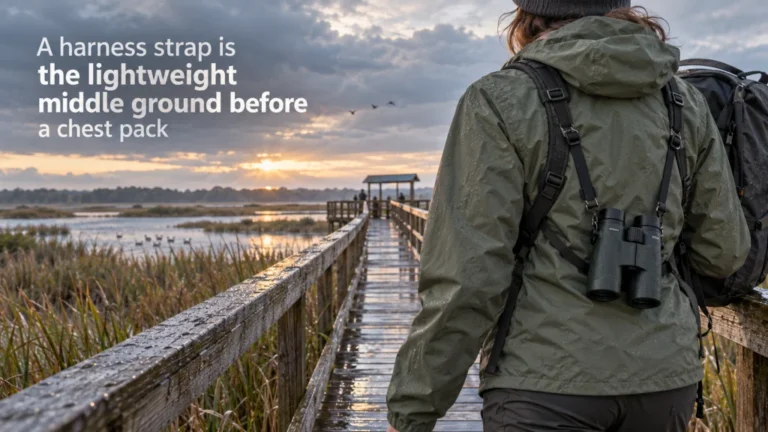
A quick-release strap is only as useful as the connection it leaves on the binocular. Before choosing one, check the binocular-side attachment, the way the connector locks, and whether the remaining hardware interferes with a case, harness, or normal handling. Detachability is most valuable when you regularly switch carry systems or want the strap out of the way for storage or supported viewing. The safest decision comes from verifying the exact attachment system rather than assuming a clip, loop, or post is universally compatible.
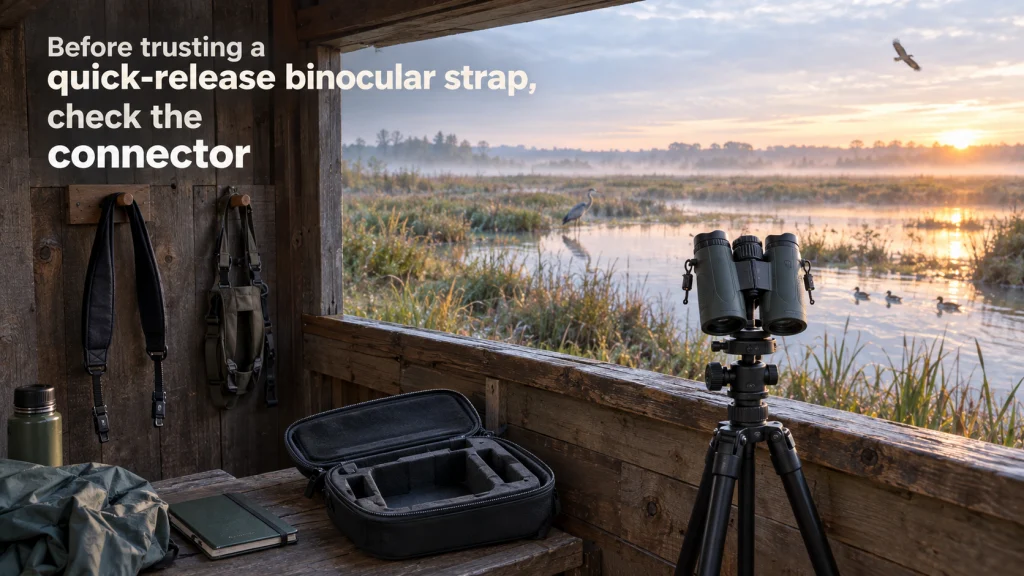
Identify the binocular-side attachment before comparing connectors
A quick release binocular strap should be judged from the binocular outward, not from the padded section inward. Start by finding the actual strap lug, slot, loop, or dedicated mounting point on the binocular and noting what can pass through it without forcing the fit. If you are still deciding whether a detachable system belongs in your carry setup, the broader binocular harness guide helps separate carry-system choices from connector choices. For a wider view of cases, straps, adapters, and other add-ons, the binocular accessories guide provides the larger ownership context.
The practical problem is that two connectors can look similar while depending on very different interfaces. One may use a narrow cord loop through a conventional lug, another may use webbing, and another may require a dedicated post or receiver built into the binocular. The connector also changes what remains attached after the strap is removed, which matters when the binocular has to fit into a close case or connect to another carry system. Treat the attachment point as a fit problem with several parts rather than a simple question of whether the clip opens quickly.
| Connector arrangement | What to verify | What may remain after release | Common fit concern |
|---|---|---|---|
| Thin loop through a standard lug | Loop thickness, lug opening, and how the loop closes back on itself | Short loop or small connector tail | Loop may fit the lug but leave bulky hardware against the binocular body |
| Webbing through a strap slot | Webbing width, slot width, and the intended threading path | Webbing tail, buckle half, or both | Webbing can be too wide or too stiff for a narrow slot |
| Dedicated post or receiver | Exact system compatibility and full locking position | Post, receiver, or proprietary fitting | A visually similar connector may not share the same locking geometry |
Check the loop or lug width as a physical fit
A narrow-looking attachment is not automatically compatible with every thin cord or strap end. The loop must pass through the lug without scraping, bunching, or needing enough force to make removal difficult later. If the system uses a doubled loop, remember that the return pass can require more room than the first pass suggests. A clean fit should also let the binocular hang naturally instead of pulling the connector sideways against the body.
Treat a proprietary post or clip as its own system
A proprietary post or clip can make attachment and release very fast, but that convenience depends on the intended receiver and locking action. A similar shape is not evidence that two systems are interchangeable, and a loose fit is not something to solve with an improvised clip. Manufacturer instructions are the right place to confirm how the connector reaches its locked position and how it is released. If that documentation is model-specific, keep the conclusion model-specific too.
Inspect the hardware that stays behind after release
The part left on the binocular can matter more than the strap you remove. A short loop may disappear beside the barrel, while a buckle half, ring, or rigid fitting may press against the case lining or knock against another accessory. That residual hardware can also catch on a harness attachment if you switch systems without removing it. The right question is not only how quickly the strap detaches, but whether the binocular remains cleanly usable after detachment.
- Confirm the attachment type on both sides of the binocular.
- Check that the connector passes through the intended lug or slot without force.
- Lock and unlock the system exactly as its documentation describes.
- Look at what remains attached after the strap is removed.
- Test the binocular in its case with that residual hardware still in place.
This sequence also keeps marketing language in proportion. A detachable binocular strap can be convenient without being the right fit for every binocular or every case. The useful evidence is the exact interface, the correct locked position, and the space the remaining parts occupy. Once those points are clear, quick release becomes a feature you can evaluate instead of a promise you have to trust.

This neoprene strap is designed for binoculars and small cameras and uses Mini Quick Disconnects at the ends. Its 1.5 mm cord loops suit compact attachment points where lug clearance needs to be checked carefully. OP/TECH lists an adjustable length of 31.5 to 38 inches with a 1-inch-wide neoprene pad.
Check on AmazonIf you click this link and buy, we earn a commission at no additional cost to you.
Decide where quick release actually adds value
Detachability matters most when removing the strap is part of your normal routine rather than an occasional novelty. A quick disconnect binocular strap can save repeated rethreading when the same binocular moves between a neck strap, a harness, a case, and a supported viewing setup. That benefit is strongest when the connector halves are designed to stay with the binocular and reconnect predictably. If you rarely remove the strap, an extra release mechanism may add hardware without solving a real problem.
Think through the sequence you actually use before giving quick release much weight. A strap that detaches in seconds is useful only if the remaining connector does not then block the next step, twist against the lug, or make storage awkward. Convenience should reduce transitions, not create a second compatibility problem after the strap comes off. That is why the best use cases are repeated, easy to describe, and easy to test with the exact binocular in hand.
Switching between a neck strap and a harness
Frequent switching is one of the clearest reasons to want a detachable binocular strap. The advantage is not simply speed, but avoiding repeated threading through small lugs that were never meant to be adjusted every outing. The connector is more useful when both carry systems are intentionally designed around the same binocular-side interface. If separate adapters are required, check whether stacking them creates more bulk than the switching convenience is worth.
Removing the strap for storage or supported viewing
A loose neck strap can be inconvenient when the binocular is packed tightly or positioned on a support, so quick removal can make setup cleaner. This article stops at the strap connection and does not treat tripod quick-release hardware as the same problem. After removing the strap, check that no dangling buckle half can strike the support, rub the binocular body, or prevent the case from closing normally. If the residual hardware still gets in the way, the release point may be in the wrong place for your routine.

This padded black shoulder strap uses quick-release buckles and is listed for binoculars as well as cameras and other carried gear. The selected package includes both thin and thick connector sets so the attachment interface can be matched more deliberately. The strap adjusts from 39 to 63 inches for different carry setups.
Check on AmazonIf you click this link and buy, we earn a commission at no additional cost to you.
Check accidental-release and retention evidence on the exact system
A connector should not be called secure just because it makes a satisfying click. What matters is how the documented locking mechanism reaches its intended position, what movement releases it, and whether there is a secondary feature that prevents an unintended release. Some systems use a button or paired release surfaces, while others use a hook, buckle, pin, or loop that depends on a specific assembly sequence. Those designs cannot be reduced to one universal rule, so retention claims should stay tied to the exact mechanism.
Before carrying the binocular by a new connector, assemble it according to the manufacturer’s instructions and inspect both sides under good light. Pull on the strap in the same direction it will be loaded during normal carry, then confirm that the locking part has not shifted out of position. Repeat the check after packing and unpacking the binocular because case contact can reveal interference that is not obvious on a table. If a connector does not seat, lock, or release as documented, stop using that connection until the fit issue is resolved.
- Use the documented attachment path rather than inventing a shortcut.
- Confirm the connector reaches its full locked position on both sides.
- Check for cracked loops, distorted webbing, bent rings, damaged buckles, or loose receiver parts.
- Recheck the connection after storage if the case presses against the hardware.
- Do not substitute an unverified clip or make up a load rating for an attachment that has no published support.
Owner reports can be useful for showing where confusion occurs, but they are not a substitute for technical documentation. A report that a connector came loose can prompt you to inspect the locking sequence, yet it does not prove that every connector of that type is unsafe. Likewise, a system that has worked for one owner does not establish universal compatibility. The defensible conclusion is narrower: verify the exact connection, use the intended locking method, and treat unexplained looseness as a reason to stop and investigate.

The Nikon 6121 PROSTAFF uses elastic shoulder straps with quick-release connections for binocular carry. Its harness layout shifts the binocular load across the shoulders while keeping the optic accessible in the field. Nikon positions the black harness for activities including bird watching, hiking, hunting, and camping.
Check on AmazonIf you click this link and buy, we earn a commission at no additional cost to you.
Verify case and harness compatibility with the residual hardware
The connection is not fully evaluated until the binocular goes back into its normal case. Close the case gently and watch where any buckle half, loop, ring, or rigid post contacts the lining and the binocular body. Hardware that fits in open air can become a pressure point when a close-fitting case compresses it against an eyepiece housing or barrel. If you have to force the zipper or reposition the binocular around the connector, the quick-release setup has created a storage problem.
Harness compatibility needs the same physical check because two systems may compete for the same lug. A small retained loop can sometimes coexist with another attachment, but a larger fitting may twist, stack, or hold the new connector at an awkward angle. Avoid assuming that a free lug opening means the combined hardware is supported, especially when the systems were not designed to work together. The cleaner solution is the one with an attachment path you can verify and inspect without improvised layers of clips and rings.
Key point: Check the binocular in the same case and carry setup you actually use. A connector that works on a bare binocular can still fail the ownership test if the retained hardware presses, rattles, tangles, or blocks another intended attachment.
A useful fit check is simple enough to repeat whenever you change carry hardware. Attach the connector, remove the strap, place the binocular in the case, close it without force, then take it back out and inspect the retained parts. Next, connect the carry system you plan to use and make sure both sides hang evenly without hardware rubbing against the barrels. That short routine exposes most practical conflicts before they become an annoyance in the field.

The Maven Mid Size binocular case combines molded foam with a ballistic nylon outer shell. It is sized for 38 to 44 mm optics, with listed internal dimensions of 7 by 6 by 2.5 inches. A zip closure and female buckle attachments support secure storage and an optional shoulder strap.
Check on AmazonIf you click this link and buy, we earn a commission at no additional cost to you.
Compare an ordinary neck strap when detachability is not necessary
Quick release is a feature, not a requirement for a good carry setup. If the strap normally stays on the binocular, a conventional threaded connection may be simpler, lower profile, and easier to inspect at a glance. It also avoids leaving extra buckle halves or clip bodies beside the binocular when nothing needs to detach. The more useful comparison is therefore between your actual routines, not between an ordinary strap and a detachable one on feature count alone.
Start with the problem you are trying to solve: strap width, length, padding, grip, or attachment convenience. If the first four are the real issue, the binocular neck strap guide is the better next step because changing the connector will not fix an uncomfortable strap body. If the problem is only that you occasionally want the strap out of the way, decide whether occasional rethreading is actually burdensome enough to justify extra hardware. A simpler strap can be the better choice when the binocular spends most of its time in one carry configuration.
| Your routine | Quick release adds meaningful value | Ordinary attachment may be enough |
|---|---|---|
| Frequent switching between compatible carry systems | Yes, if the same binocular-side interface is verified | Less convenient if rethreading is required often |
| Strap stays attached almost all the time | Limited benefit | Often simpler and lower profile |
| Tight storage case | Only if the retained hardware clears the case | May create less residual bulk |
| Uncertain lug or connector compatibility | Wait until the interface is verified | Use the documented original attachment path |
That comparison keeps the purchase decision proportional to the problem. A detachable mechanism is worthwhile when it repeatedly saves a real step and still preserves a clean, verified connection. It is less persuasive when the release feature is used once or twice a year while its hardware remains on the binocular every day. Choose the mechanism that simplifies ownership rather than the one with the longer feature list.

The OP/TECH USA E-Z Comfort is a padded neoprene neck strap for binoculars and cameras. The black version adjusts from 22 to 44 inches and uses 3/8-inch webbing at the ends. It does not use quick disconnects, keeping the attachment layout simple when the strap normally stays installed.
Check on AmazonIf you click this link and buy, we earn a commission at no additional cost to you.
Keep open harness architecture separate from connector choice
A quick-release connector and an open harness solve different problems. The connector determines how the binocular joins and leaves the carry system, while the harness architecture determines how the load is routed around your body and how freely the binocular moves when raised. A fast connector does not prove that the harness will fit your torso, control movement, or suit the way you observe. Keeping those decisions separate prevents a convenient clip from carrying more weight in the buying decision than it deserves.
If your actual question is how an open strap arrangement carries the binocular, compare that architecture on its own terms in the binocular harness strap guide. Then return to the connector and ask whether the specific attachment is compatible with the binocular and with any other system you intend to use. This order matters because a connector can be mechanically sound while the carry layout is wrong for your routine, or the reverse can be true. Solve the body-side carry problem and the binocular-side attachment problem as two linked but separate decisions.
That distinction also makes replacements easier to reason about later. If a strap body wears out, you can identify whether the binocular-side connector is reusable, replaceable, or tied to that exact system. If a connector is damaged, you can search for the documented replacement without assuming the whole carry layout must change. Clear separation between those parts makes the setup easier to inspect, maintain, and change without improvisation.
Do not use appearance alone to mix components from different systems. A clip that closes around a ring or slides onto a post may still use different dimensions, release geometry, or retention features than the original. Unless the manufacturer documents cross-compatibility, treat the parts as unrelated systems. That small discipline is more useful than any broad claim that a connector works with nearly everything.

This black binocular harness uses a compact shock-cord layout that distributes the optic across the chest and shoulders. Its minimalist design is adjustable and stores tangle-free around the binocular when not in use. Rick Young Outdoors lists it for hunting, birding, and hiking with quick-release functionality.
Check on AmazonIf you click this link and buy, we earn a commission at no additional cost to you.
Final Thoughts: trust the connector only after the whole fit makes sense
The best reason to choose quick release is a repeatable need to detach the strap, not the appeal of one more feature. Verify the binocular-side attachment first, then confirm the lock, the release action, and the hardware left behind. Put the binocular in its real case and connect it to the other carry system you expect to use. If those steps are clean and documented, detachability can remove friction from the way you carry and store the binocular.
If any part of that chain depends on forcing a loop, stacking unverified clips, or assuming two proprietary fittings are equivalent, stop before carrying the binocular by it. A simpler threaded strap is preferable to a clever connector with uncertain fit. The decision should end with a connection you can explain, inspect, and repeat without improvisation. That is a much stronger basis for trust than the words quick release on a product page.
FAQs
🔗 Will any quick-release strap fit any binocular?
No. Compatibility depends on the binocular’s lug, slot, loop, post, or receiver and on the dimensions and locking method of the connector. Verify the exact attachment system instead of relying on a universal label.
🧷 What should stay attached to the binocular after I remove the strap?
That depends on the system. It may leave a short loop, buckle half, ring, post, or other fitting, and that part should not interfere with the case, the binocular body, or the next carry system you use.
🎒 Can I leave quick-release connectors on the binocular in its case?
Only if the case closes normally without pressing the retained hardware into the binocular. Test the actual case gently, then inspect for pressure, rubbing, or a connector that gets shifted while packing.
🛠️ Can I replace a proprietary connector with a similar clip?
Do not assume a similar-looking part has the same geometry or retention. Use a replacement documented for the exact system, and avoid improvised clips or unsupported load claims.
👀 When is a detachable strap worth having?
It is most useful when you regularly switch between compatible carry systems or remove the strap for storage or supported viewing. If the strap stays attached almost all the time, a simpler conventional connection may be enough.
References and Sources
- Maven binocular neck strap: Documents a loop attachment system with quick disconnects and interchangeability with a binocular case.
- Maven binocular neck strap extension: Confirms the same loop-based quick-disconnect architecture across a related carry accessory.
- Steiner Commander 7×50: Documents a dedicated push-button ClicLoc strap interface, illustrating why proprietary connector behavior should remain system-specific.