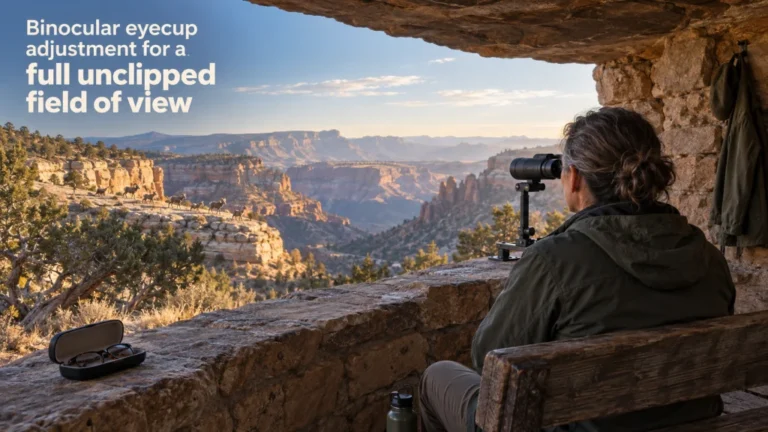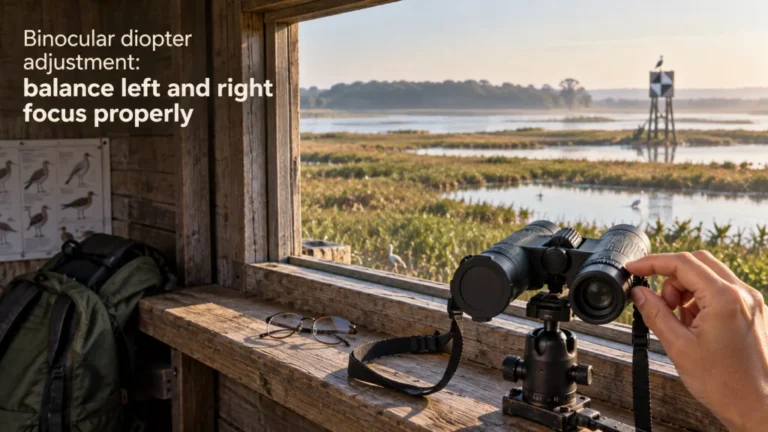
Using binoculars with glasses works best when you treat the eyewear as part of the setup rather than something to work around. Start with the eyecups retracted or folded, reset the interpupillary distance while your glasses are on, and then set the diopter for left-right focus balance. If the field still looks clipped after those adjustments, the limiting factor may be usable eye relief, eyecup geometry, frame position, or the way the binocular meets your face. The goal is a complete, stable view without pressing the eyepieces hard into your lenses.
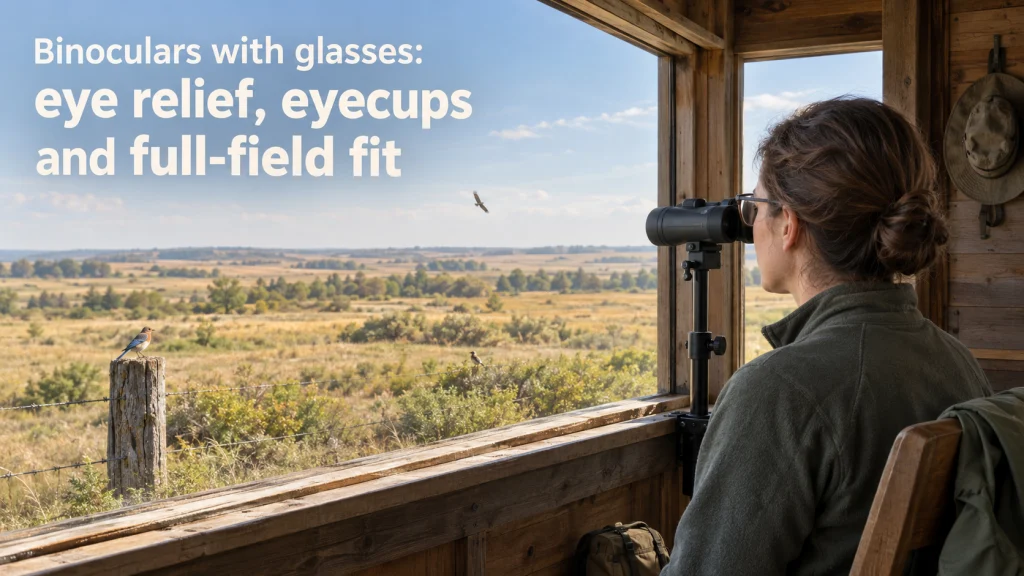
The real choice is not simply glasses on or off
If you are using binoculars with glasses, the first useful question is whether the binocular can be fitted around the eyewear you already depend on. A reliable binocular setup process starts with the controls that change eye position, barrel spacing, and focus before blaming the optics. The broader principles in how to use binoculars still apply, but glasses add physical distance between your eyes and the eyepieces. That distance can change how much of the available field you actually see.
Do not make taking prescription glasses off the default fix for black rings or a narrow-looking image. If you need the glasses to locate the subject, switch between nearby and distant viewing, or simply function comfortably in the viewing situation, the binocular should be adjusted around that reality. The practical sequence is eyecups first, IPD second, diopter third, then a fit judgment about the remaining field. That sequence separates a correctable setup problem from a physical limitation that the controls cannot solve.

This 8x42 binocular uses ED glass optics with dielectric prism coatings. Nikon specifies 19.5 mm of eye relief and a central focusing system. The body is waterproof and fogproof for outdoor viewing.
Check on AmazonIf you click this link and buy, we earn a commission at no additional cost to you.
Start with what your glasses are correcting
A binocular focus mechanism can move the optical image into focus, but that does not mean the binocular replaces every function of prescription eyewear. For an owner-level setup, the useful distinction is simpler: decide whether you normally need your glasses in place to see and relocate the subject outside the binocular. If the answer is yes, keep the glasses on while making every setup adjustment. That gives you a setup that works in the actual viewing sequence instead of only while your eyes are behind the eyepieces.
Frame shape, lens position, nose bridge fit, and the distance between your eyes and the glasses can all change where the binocular sits. Those are fit variables, not reasons to infer anything about your eyesight or prescription. Progressive or multifocal lenses can also make head and eye position more sensitive, so there is no single binocular setting that can be promised to work for every wearer. If you have persistent visual symptoms outside binocular use, that falls outside binocular setup and should be handled by an eye-care professional.

This pack contains six black and green Japanese microfiber cleaning cloths. The cloths are made for eyeglasses, camera lenses, VR or AR headsets, and screens. Their microfiber surface is designed to remove dirt, grime, and oils from lens surfaces.
Check on AmazonIf you click this link and buy, we earn a commission at no additional cost to you.
Retract or fold the eyecups, then verify the full field
For many center-focus binoculars, the first glasses-on adjustment is to retract twist-up eyecups or fold down flexible rubber eyecups. Nikon and Fujifilm both describe this basic position for eyeglass wearers because the glasses already hold the eyes farther from the eyepiece. The important part is not merely reaching the lowest click stop. The important part is checking whether that position lets you see one complete circular field without dark crescents or a noticeably cropped edge.
Some eyecups have several click positions, while others fold or slide with less precision, so the exact control depends on the model. If your eyecups have intermediate stops, begin fully retracted and then move outward only if the view becomes easier to hold without losing the field. For a deeper look at that control alone, use the binocular eyecup adjustment guide rather than assuming every design behaves the same way. The working position is the one that places your eyes near the intended eye point with your glasses still in their normal position.
- Put on the glasses you actually use for the viewing situation.
- Retract twist-up eyecups or fold down flexible eyecups according to the binocular’s instructions.
- Bring the binocular up gently without forcing it into the lenses.
- Check for one complete circular field, not merely a sharp center.
- Only test another eyecup stop if it improves stability without clipping the field.
This checklist is intentionally simple because eyecup position is only the first variable. A full-looking field with poor binocular width still needs the IPD corrected, while a clipped field after correct IPD points you toward eye position or usable eye relief. Treat each adjustment as one test rather than changing several controls at once. That makes the source of the problem much easier to identify.

This 8x42 Bushnell Engage uses twist-up eyecups and center focusing. The BEN842 variant has 19 mm of eye relief and an interpupillary adjustment range of 53 to 72 mm. Its roof-prism body is waterproof and nitrogen filled.
Check on AmazonIf you click this link and buy, we earn a commission at no additional cost to you.
Reset IPD while wearing the glasses
Interpupillary distance, or IPD, is the spacing between your pupils, and the binocular hinge changes the spacing between the two optical paths. Glasses can alter how the binocular rests against your face, so an IPD setting that felt right without them may not produce the same alignment with them on. While looking at a distant, easy-to-recognize subject, move the barrels closer together or farther apart until the two views merge into one clean circle. Nikon and Fujifilm both use this single-circle result as the practical check for correct alignment.
Do not use black edges alone as proof that the binocular lacks enough eye relief. An IPD that is too wide or too narrow can also create dark areas, partial overlap, or a view that never feels settled. Make small hinge adjustments while keeping your glasses in their normal wearing position, and stop when the image is comfortably merged rather than forcing a familiar hinge position. Once the IPD is right, any remaining field loss becomes more informative because one major alignment variable has been removed.

This 10x42 Triumph HD has a 55 to 75 mm interpupillary-distance range. Vortex specifies 17.0 mm of eye relief and a 334-foot field of view at 1,000 yards. Its HD optical system is housed in a waterproof, fogproof, and shockproof body.
Check on AmazonIf you click this link and buy, we earn a commission at no additional cost to you.
Use the diopter only for left-right focus balance
The diopter is not an eye-relief control and it will not recover field that is physically blocked by distance from the eyepiece. Its job is to balance focus between the left and right optical paths after the binocular is positioned correctly. On many center-focus designs, one eye is focused with the main focus wheel and the other is matched with the diopter, but the control location and sequence can vary by model. Check the manual before assuming the ring is always on the same eyepiece or that the procedure is identical.
Set the diopter while wearing the glasses you intend to use with the binocular, because the goal is to tune the actual glasses-on setup. After that, return to the center focus wheel for normal changes in viewing distance rather than repeatedly chasing the diopter. The separate binocular diopter adjustment guide covers the setup sequence in more detail. If one side remains visibly unclear after a correct model-specific adjustment, do not keep forcing controls past their limits or treat the diopter as a medical correction.

This 8x42 Viper HD uses an HD optical system with XR Plus lens coatings. Its locking diopter sits on the right eyepiece for left-right focus compensation. Vortex specifies 18.0 mm of eye relief and a 55 to 74 mm interpupillary-distance range.
Check on AmazonIf you click this link and buy, we earn a commission at no additional cost to you.
Avoid pressing the eyecups hard into your lenses
Glasses-on viewing should not require using the binocular as a clamp against your frames. Hard pressure can shift the glasses on your face, change the eye-to-eyepiece distance you just set, and make the view less repeatable every time you raise the binocular. It can also put unnecessary contact on eyeglass lenses or coatings if hard eyecup edges, grit, or exposed hardware are present. Bring the eyecups to the glasses lightly enough that the position is repeatable without relying on force.
If a stable view only appears when you push hard, treat that as a fit clue rather than a technique to practice. First confirm that the eyecups are fully retracted or correctly folded and that the IPD still produces one circle. Then check whether your frame shape is preventing the eyepieces from getting close enough to the needed eye point. A setup that works only under pressure may be telling you that the remaining distance is structural, not something the focus controls can fix.

The LensPen NLP-1 combines a retractable dust-removal brush with a non-liquid cleaning element. Its round cleaning tip measures 12 mm, and the tool is 11 cm long. LensPen lists it for camera lenses, binocular lenses, spotting scopes, telescopes, and eyepieces.
Check on AmazonIf you click this link and buy, we earn a commission at no additional cost to you.
What a clipped field tells you about usable eye relief
Eye relief is the distance from the eyepiece to the point where the full image can be viewed, but the published number is not a universal promise of glasses-on fit. Eyecup depth, eyepiece recess, frame position, lens thickness, and face geometry can change how much of that nominal distance is actually usable. If the center is sharp yet the outer field stays cut off after the eyecups and IPD are correctly set, the binocular may not let your eyes get close enough to the intended eye point. That is a physical fit limitation, not a reason to keep turning the focus wheel.
A single eye-relief threshold is tempting because it turns a fit problem into one easy number, but that shortcut is unreliable across different designs and different wearers. Published eye relief is still useful as a comparison spec, especially when two models are otherwise similar, but the final glasses-on result must be checked at the eyepiece. The symptom table below helps separate likely setup causes before you conclude that eye relief is the limiting factor. Use it as a sequence of checks, not as a diagnosis.
| What you see or feel | Likely constraint to check first | Next owner-level check |
|---|---|---|
| Two overlapping circles | IPD is not matched to your eyes | Adjust the hinge until the views merge into one circle |
| Dark crescents that change as you move the binocular | Eye position, eyecup position, or IPD | Reset eyecups, center your eyes, then recheck IPD |
| Sharp center but persistently cropped outer field | Usable eye relief or physical glasses fit | Confirm setup, then judge whether the eyepieces can sit close enough without pressure |
| One side is less sharp than the other | Diopter balance or model-specific focus setup | Repeat the manual’s diopter procedure with your glasses on |
| View is only stable when you press hard into the glasses | Eyecup geometry or face and frame fit | Stop using pressure as the fix and reassess the physical fit |
The most useful distinction is between a view that changes when you adjust a control and a view that remains clipped after the controls are correctly set. The first points toward setup. The second increasingly points toward usable eye relief or physical fit. That boundary keeps you from treating every blackout as the same problem.

This 8x42 Carson TD-842ED uses ED glass and a BAK-4 roof-prism system. Carson specifies 19.5 mm of eye relief and a 341-foot field of view at 1,000 yards. The model is O-ring sealed, waterproof, and fogproof.
Check on AmazonIf you click this link and buy, we earn a commission at no additional cost to you.
When removing glasses may help, and when it does not
Removing glasses can sometimes change the view because your eyes can move physically closer to the eyepieces. If a clipped outer field becomes noticeably wider with the glasses off, that is useful evidence that eyewear position, frame geometry, or eye-to-eyepiece distance is part of the fit problem. It does not show that the prescription is the problem, and it does not mean the binocular has been fully set up for the way you normally use it. Treat the glasses-off comparison as a positioning check, not as the default solution.
The comparison only becomes practical if you can already use the viewing situation comfortably without those glasses. If you need them to locate the subject, move between nearby and distant viewing, or function normally before and after raising the binocular, taking them off each time can solve one field-of-view problem while creating a less workable routine. The binocular focus and diopter should not be treated as substitutes for prescription or medical guidance. If the field improves without glasses but your real viewing routine still requires them, the useful conclusion is that the binocular and eyewear combination has reached a physical fit limit.

This 8x42 Nature DX uses twist-up eyecups with multiple stops for eye positioning. Celestron specifies 17.5 mm of eye relief and an interpupillary-distance range of 56 to 74 mm. Its fully multi-coated optics use phase-coated BaK-4 roof prisms.
Check on AmazonIf you click this link and buy, we earn a commission at no additional cost to you.
When setup cannot overcome the binocular’s physical fit
There is a point where more adjustment stops being useful. If the eyecups are in the correct glasses position, the IPD is centered, the diopter is set according to the manual, and the outer field is still consistently clipped, the remaining problem may be the binocular’s usable eye relief or the way its eyepieces meet your frames and face. Repeating the same adjustments will not create extra physical clearance. At that point, the correct owner-level conclusion is that the current binocular and eyewear combination may not provide full-field fit.
The same boundary applies if the hinge cannot reach a comfortable IPD, an eyecup is damaged, an eyepiece is loose, or the image remains severely doubled despite normal external setup. Do not disassemble the binocular, adjust prisms, or attempt internal collimation to solve a glasses-fit problem. Check the model manual and manufacturer support, and use qualified service for internal damage, broken hinge parts, loose optical components, severe double image, or water ingress. Setup should solve setup problems, not become an excuse to turn an owner adjustment into a repair job.

This 10x42 Crossfire HD has a 58 to 75 mm interpupillary-distance range. Vortex specifies 15.0 mm of eye relief and a 325-foot field of view at 1,000 yards. The waterproof, fogproof, and shockproof body is tripod adaptable and includes a GlassPak harness.
Check on AmazonIf you click this link and buy, we earn a commission at no additional cost to you.
Final Thoughts: fit the binocular around the eyewear you actually use
The cleanest glasses-on setup is a sequence: retract or fold the eyecups, set IPD for one merged circle, balance the diopter according to the model’s instructions, and then judge the remaining field. If the view becomes complete and stable, stop adjusting and use that setup. If the outer field is still clipped, treat usable eye relief and physical fit as the next constraint rather than blaming focus or pressing harder into the lenses. That approach makes the binocular fit your real viewing routine instead of forcing your routine around the binocular.
Keep the conclusion conditional because glasses frames, face geometry, eyecup design, and published eye relief do not combine the same way for every wearer. A specification can narrow the search, but the eyepiece view decides whether you actually get the full field. When normal controls cannot solve the fit, recognize that boundary instead of improvising internal adjustments. The right endpoint is a comfortable, repeatable view with the glasses you actually wear.

This 8x42 Diamondback HD uses adjustable eyecups for viewing with or without eyeglasses. Vortex specifies 17.0 mm of eye relief and a 55 to 73 mm interpupillary-distance range. The waterproof, fogproof body uses an HD optical system and fully multi-coated lenses.
Check on AmazonIf you click this link and buy, we earn a commission at no additional cost to you.
FAQs
👓 Should eyecups be up or down when using binoculars with glasses?
Start with twist-up eyecups fully retracted or flexible rubber eyecups folded down, following the model’s instructions. Then verify that you can see one complete circular field without pressing hard into your glasses.
🔭 Why do I still see black edges with the eyecups down?
Check IPD before assuming the binocular lacks enough eye relief. If the IPD is correct and the field still stays cropped, usable eye relief, eyecup geometry, frame position, or face fit may be the limiting factor.
📏 Is there one minimum eye relief number that works for everyone with glasses?
No single number guarantees full-field fit for every wearer. Published eye relief is useful for comparison, but eyepiece recess, eyecup shape, glasses position, and face geometry affect how much of that distance is actually usable.
🎯 Do I need to reset IPD when I put my glasses on?
It is worth checking because glasses can change how the binocular rests against your face. Adjust the hinge while wearing the glasses until the left and right views merge into one clean circle.
⚙️ Can the diopter fix a field that looks cropped?
No. The diopter balances focus between the two optical paths, while field clipping is more likely related to eye position, eyecups, IPD, or usable eye relief.
🕶️ Should I take off prescription glasses to make binoculars easier to use?
Do not treat that as the default solution. If you normally need your glasses in the viewing situation, set up the binocular with them on and judge whether the eyecups, IPD, diopter, and physical fit provide a stable full field.
References and Sources
- Fujifilm binocular instructions: Supports the glasses-on eyecup position, IPD adjustment, and focus and diopter setup sequence.
- Nikon guide to center-focus binoculars: Supports retracted or folded eyecups for eyeglass wearers, one-circle IPD alignment, and model-dependent diopter setup.
- Cornell Lab guide to binocular blackouts: Supports checking eyecups, barrel spacing, and diopter when blacked-out areas appear.