Binoculars with glasses: eye relief, eyecups and full-field fit
Using Binoculars With Glasses

Using binoculars with glasses works best when you treat the eyewear as part of the setup rather than something to work around. Start with the eyecups retracted or folded, reset the interpupillary distance while your glasses are on, and then set the diopter for left-right focus balance. If the field still looks clipped after those
Binocular eyecup adjustment for a full unclipped field of view

Binocular Eyecup Adjustment

Binocular eyecup adjustment is about placing your eyes at a usable distance behind the eyepieces, not changing focus. A good setting lets you see a complete, stable field without black rings, kidney-shaped shadows, or a clipped edge appearing whenever your head moves slightly. Fully extended and fully retracted positions are useful starting points, but twist-up

Eyeglass wearers need a full birding field before they need better specs

Birding Binoculars For Eyeglass Wearers

Birding binoculars for eyeglass wearers should pass one test before optical prestige, price, or magnification gets much attention: you should be able to see the complete usable field while wearing the glasses you actually bird in. Published eye relief helps narrow the field, but it cannot guarantee that a particular eyecup, frame shape, lens position,

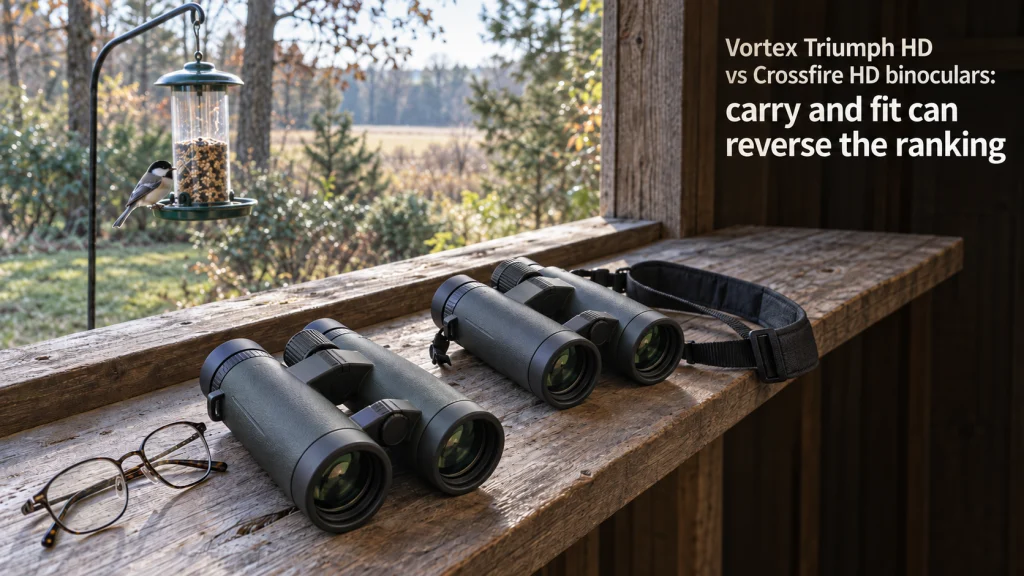
Vortex Triumph HD vs Crossfire HD binoculars: carry and fit can reverse the ranking

Vortex Triumph Hd Vs Crossfire Hd Binoculars

Triumph HD and Crossfire HD do not form a simple lower and higher rung once fit enters the decision. In the matched 10×42 configuration, Triumph HD gives you more published eye relief and a slightly wider field of view, while Crossfire HD focuses much closer and costs more in the retailer comparison checked for this