Birding binoculars for eyeglass wearers should pass one test before optical prestige, price, or magnification gets much attention: you should be able to see the complete usable field while wearing the glasses you actually bird in. Published eye relief helps narrow the field, but it cannot guarantee that a particular eyecup, frame shape, lens position, and face geometry will work together. A wide published field of view can lose much of its practical value if your eyes sit too far behind the intended viewing position. Treat full-field viewing through your own glasses as the purchase gate, then compare the other specifications that matter for birding.
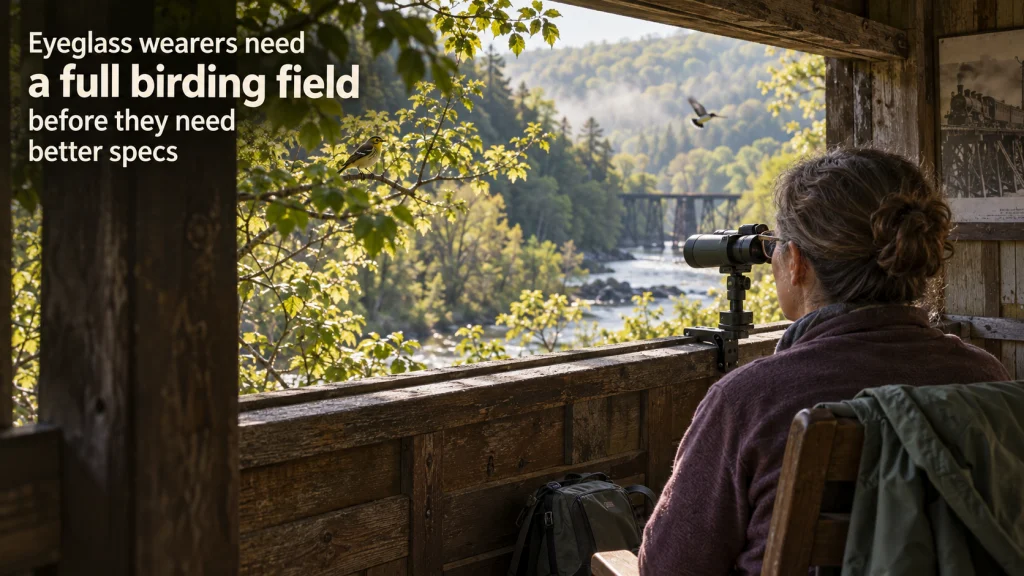
Make full-field viewing with your actual glasses the first pass-fail test
A binocular can look excellent on paper and still be a poor fit once eyeglasses sit between your eyes and the eyepieces. That is why the first useful test is not whether the image looks sharp in the center, but whether the full circular field is visible without moving your head around to inspect the edges. For the broader activity decision, start with the practical tradeoffs in choosing binoculars for birding, because field width, movement, carrying weight, and viewing distance still matter after the glasses fit works. If the visible field is clipped from the start, the rest of the specification sheet is trying to rescue a fit problem it cannot fix.
The same logic should guide the wider buying decision, not just this one fit check. Our binocular buying framework treats physical fit as a constraint that can reject an otherwise attractive configuration, and eyeglasses make that especially obvious. A model with high-end glass, a broad published field, or a premium coating package is not automatically the better purchase if your eyewear prevents you from using the intended image circle. Once a binocular gives you a complete, stable field through your normal glasses, the more familiar optical and handling comparisons become worth making.

Nikon PROSTAFF P3 8x42 provides 20.2 mm of eye relief and a 377-foot field of view at 1,000 yards. Its turn-and-slide eyecups let the user set eye position with or without glasses. The waterproof, nitrogen-filled body gives eyeglass wearers a practical full-size model for checking whether the complete field remains visible.
Check on AmazonIf you click this link and buy, we earn a commission at no additional cost to you.
Eye relief is a screening specification, not a universal comfort guarantee
Eye relief tells you how far behind the eyepiece the intended viewing position sits, so it is highly relevant when eyeglass lenses add physical spacing. The number is useful because a very short specification can warn you that a model deserves extra scrutiny before purchase. It is not a universal promise that everyone wearing glasses will see the same field, because frame depth, lens position, eyecup shape, and face geometry change how close the eye can actually get. Use the published number to build a shortlist, then make the full visible field the final test.
Current specifications show why that distinction matters. Vortex lists 17.0 mm of eye relief and a 393 ft field at 1,000 yards for the Diamondback HD 8×42, while the 10×42 version is listed at 15.0 mm and 330 ft at 1,000 yards. Celestron lists 17.5 mm of eye relief and a 388 ft field at 1,000 yards for the Nature DX 8×42. Those figures are useful comparison points, not product endorsements and not universal thresholds, because the wearer still has to confirm that the usable field survives the spacing created by the actual eyeglasses.

Vortex Diamondback HD 8x42 lists 17 mm of eye relief and a 393-foot field of view at 1,000 yards. Adjustable eyecups support viewing with or without eyeglasses. The exact 8x42 configuration makes it useful for treating eye relief as a screening number while still checking the usable field in person.
Check on AmazonIf you click this link and buy, we earn a commission at no additional cost to you.
Match the binocular to the viewing conditions that change this use case
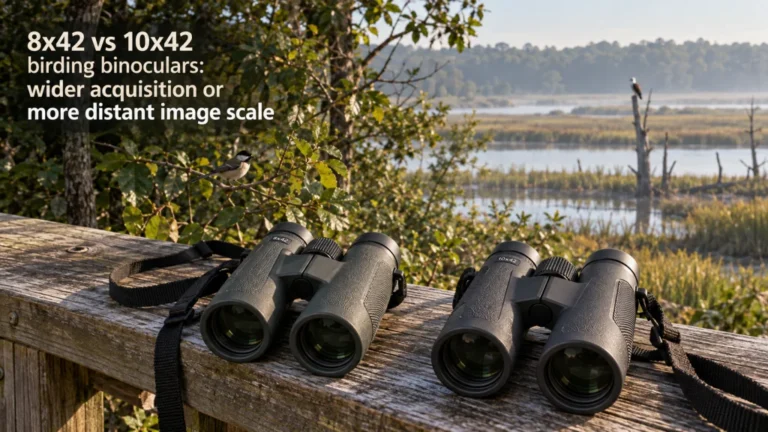
Once the glasses fit passes, return to the birding conditions that determine whether one configuration makes more sense than another. Fast birds, tangled branches, mixed viewing distances, and frequent target reacquisition all reward a field that feels easy to enter and easy to keep centered. Higher magnification can help with distant detail, but it often brings a narrower published field and more visible hand movement, so it should not be treated as a free upgrade. For a direct comparison of those tradeoffs, see our guide to 8×42 versus 10×42 binoculars for birding.
Eyeglasses add another layer because the field you can actually see may be smaller than the field printed in the specifications. Cornell notes that viewing through eyeglasses can reduce effective field of view, which is especially relevant when a bird moves quickly or appears only briefly between branches. A wide published field still has value, but only if the eye can reach a position where that width is available. This is why magnification, field of view, and glasses fit need to be judged together rather than as separate scorecard items.
Eyecup travel and intermediate stops can change the usable eye position
Eyecups are the mechanical part of the fit equation because they set the spacing between the eyepiece and the face. A design with several stable positions may make it easier to find a placement that avoids both a clipped outer field and unstable blackouts. With glasses, the lowest position is often the starting point, but the exact useful position depends on the eyecup shape and how the frames sit on the face. Check that the eyecups remain where you set them instead of treating the number of advertised positions as a benefit by itself.
A reduced effective field matters most when the bird is moving
Field of view is not only about enjoying a broad scene. It gives you more room to acquire a bird quickly, recover after a small hand movement, and keep a moving subject inside the image. Cornell specifically notes that eyeglasses can reduce the effective field seen through binoculars, so a wearer may not receive the full practical benefit suggested by the published figure. If the edges disappear through your glasses, judge the binocular by the field you can actually use rather than the larger number in the specification table.
Compare exact 8×42 and 10×42 variants instead of assuming the fit is the same
Two versions from the same product family can share objective diameter, styling, and many features while differing in eye relief and field of view. The current Diamondback HD specifications are a clear example: the 8×42 lists 17.0 mm of eye relief, while the 10×42 lists 15.0 mm. That does not make either number a universal pass or fail, but it does mean a glasses wearer should not assume that a comfortable 8×42 experience automatically carries over to the 10×42 version. Verify the exact configuration you intend to buy, then test that exact version with your normal eyewear.
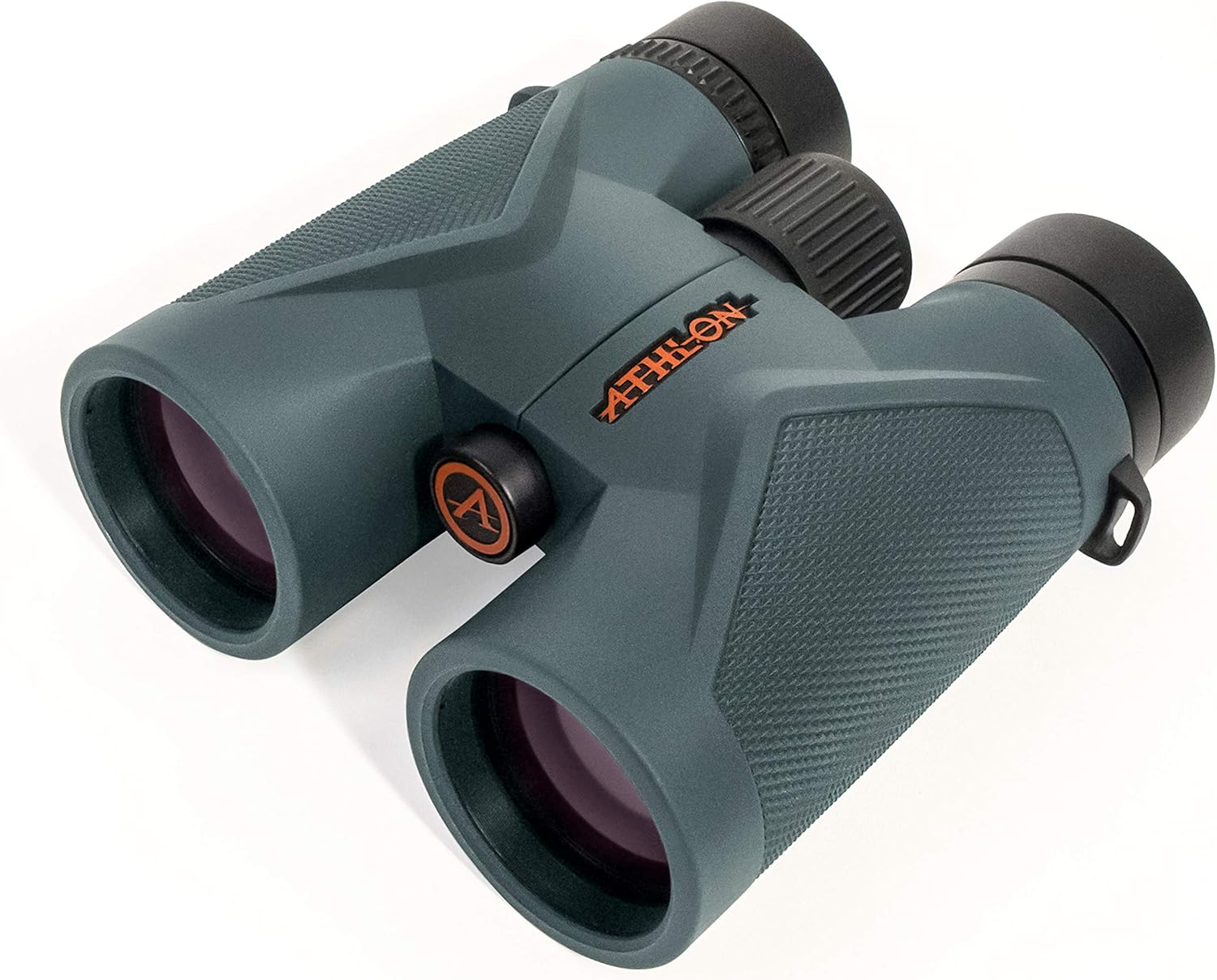
Athlon Midas UHD 8x42 uses ED glass and an 8.1-degree field of view. Twist-up eyecups and a 6.5-foot close focus support repeatable eye position and quick subject acquisition. Its argon-purged waterproof body suits birding conditions where field width, changing distance, and weather all matter after glasses fit is confirmed.
Check on AmazonIf you click this link and buy, we earn a commission at no additional cost to you.
Do not use one universal millimeter minimum for every eyeglass wearer
A fixed eye-relief cutoff sounds convenient because it turns a fit problem into a single number, but it ignores the spacing created by real eyewear. Thick frames, thin frames, lens curvature, nose-pad position, and how the binocular rests against the glasses can all change the effective eye position. Even two people using the same binocular can reach different conclusions about whether the outer field is easy to see. The safer buying rule is to treat longer published eye relief as potentially helpful while refusing to call one value a guarantee for everyone.
This also prevents the common mistake of assuming that more eye relief is automatically better without qualification. Too much spacing for a particular face and eyecup position can make eye placement less forgiving, especially if the user floats behind the eyecup instead of getting a repeatable reference point. The useful target is not the largest number on the shelf, but a stable position that gives a complete field without strain or edge blackouts. That practical result is what the specification is trying to help you predict.

Bushnell H2O 8x42 uses twist-up eyecups in a waterproof, fogproof roof-prism body. Fully multi-coated optics and BaK-4 prisms are paired with an 8x42 configuration rather than a fixed eyeglass-fit promise. It gives this section a concrete model for checking eyecup position and full-field visibility instead of relying on one universal millimeter cutoff.
Check on AmazonIf you click this link and buy, we earn a commission at no additional cost to you.
Test for a complete field without pressing the glasses unnaturally into the eyecups
A good fit should not require you to force the eyecups hard against your glasses just to recover the outer edge of the view. Bring the binocular to your normal viewing position, settle it naturally, and check whether the image forms a complete circle without obvious clipping. Then move your gaze through the field while keeping the binocular position stable rather than sliding the frame around to chase missing edges. If the field becomes usable only when the glasses are pushed into an unnatural position, treat that as a fit warning rather than a technique you should accept.
Blackouts are another useful clue because they can reveal that the eye is not staying in a forgiving position behind the eyepiece. A small adjustment of eyecup position may improve stability on some models, but the goal is still a repeatable view that appears quickly when you raise the binocular. Birding often gives you only a short window to find and follow a moving subject, so a fussy eye position becomes more costly in practice than it might seem during a slow indoor test. If possible, test the binocular with the exact pair of glasses you normally wear outside instead of a different frame that sits closer to the face.

Bushnell H2O 8x42 Porro lists 18 mm of eye relief and a 390-foot field of view at 1,000 yards. Twist-up eyecups help establish a repeatable eye position without forcing glasses into the eyepieces. Its IPX7 waterproof construction makes it suitable for a real outdoor fit test with the eyewear normally used for birding.
Check on AmazonIf you click this link and buy, we earn a commission at no additional cost to you.
Check focus, weight, close focus, and weather protection only after the full-field fit passes
Once the full field is visible through your glasses, move on to the features that shape everyday birding use. The focus wheel should be easy to reach and control without shifting your grip enough to disturb eye position, especially when a bird moves between near branches and a more distant perch. Close focus matters if you regularly watch nearby birds, feeders, butterflies, or insects, while weight matters more as viewing sessions and walking time increase. Weather protection can also matter for field use, but none of these strengths compensates for a viewing window that is already clipped by poor eye placement.
A useful order keeps the decision simple and prevents a long specification sheet from distracting you. First confirm that the binocular works with your eyewear, then decide whether its optical and handling traits match the places where you actually watch birds. That order also makes it easier to reject an expensive model early when the fit is wrong, rather than rationalizing the purchase because another feature looks impressive. The aim is a binocular you can raise, focus, and use immediately without negotiating with your glasses every time.
- Confirm the complete field through your normal eyeglasses.
- Check that the eyecup position is stable and repeatable.
- Make sure the focus control is easy to reach without disturbing eye placement.
- Compare close focus if nearby subjects are part of your normal birding.
- Judge weight and balance for the amount of time you expect to carry and hold the binocular.
- Verify weather protection for the conditions in which you actually use the binocular.
That sequence keeps fit at the front while still respecting the rest of the birding decision. It also gives you a practical reason to stop evaluating a model as soon as it fails a non-negotiable constraint. Better glass is useful only when the binocular first lets you see the image it was designed to deliver. That keeps the final comparison focused on usable advantages rather than attractive specifications that cannot overcome a poor fit.

Nikon PROSTAFF P3 8x30 weighs 16.8 ounces and provides a 456-foot field of view at 1,000 yards. Its center focus, turn-and-slide eyecups, waterproof construction, and 15.4 mm eye relief add handling and fit variables beyond magnification alone. It is useful after the full-field test passes because weight, focus access, and carry burden can then be judged.
Check on AmazonIf you click this link and buy, we earn a commission at no additional cost to you.
Keep prescription and eyesight questions outside the binocular selection decision
Binocular fit can answer a physical question: can your eyes, glasses, eyecups, and eyepieces line up well enough to give you the intended field? It cannot determine whether a prescription is correct, whether a progressive lens design is appropriate, or whether a particular eyesight condition should change medical care. Those questions belong with an eye-care professional, not a binocular specification sheet. The buying decision should stay focused on what the binocular and eyewear physically allow you to see together.
This boundary also prevents misleading claims about particular types of lenses. Progressive, bifocal, and single-vision glasses can come in many frame and lens configurations, so assigning one required eye-relief number to an entire eyewear category is too broad. Instead, test the actual glasses you use for birding and observe whether the full field appears comfortably and consistently. If it does, continue evaluating the binocular; if it does not, reject the fit without trying to turn the result into an eyesight diagnosis.

Nikon PROSTAFF P3 10x42 provides 15.7 mm of eye relief and a 367-foot field of view at 1,000 yards. Adjustable eyecups and a center focus system address physical viewing setup without making any claim about a prescription. The waterproof, fogproof body keeps the product example focused on binocular fit and field use rather than eyesight diagnosis.
Check on AmazonIf you click this link and buy, we earn a commission at no additional cost to you.
Use a glasses-fit audit before you compare the rest of the specifications
A short audit makes the purchase decision more repeatable than relying on one eye-relief number. Start with the published specification, but immediately connect it to what you see through your own glasses and how easily you can reproduce that view. The goal is to catch a poor physical match before price, brand familiarity, magnification, or optical marketing changes your judgment. A model that passes this audit has earned the right to be compared on the rest of its birding strengths.
Use the checks below in order, because each one answers a different part of the fit question. None requires pressing the glasses into the binocular or accepting a narrow tunnel as normal. If one item fails badly, especially full-field visibility or stable eye placement, the sensible next step is usually to try a different model or configuration. That is faster and more reliable than trying to force a specification to work because it looked good on paper.
| Check | What to verify with your glasses on | Reason it matters |
|---|---|---|
| Published eye relief | Use it to screen candidates, not as a guaranteed fit threshold. | It estimates available spacing but does not include your frame and face geometry. |
| Eyecup travel | Confirm that at least one position gives a stable, repeatable eye position. | A useful setting can reduce clipping and blackouts. |
| Full field | Look for a complete circular image without moving your head to inspect the edges. | The usable field is the field that matters for finding and following birds. |
| Blackouts | Raise and settle the binocular several times to see whether dark areas appear unpredictably. | Frequent blackouts make quick bird acquisition harder. |
| Focus access | Turn the focus wheel while maintaining the same comfortable eye position. | Birds change distance quickly, so focus control should not disrupt the fit. |
| Weight and balance | Hold the binocular long enough to notice whether your grip starts changing. | Fatigue can alter how consistently the eyepieces meet your glasses. |
After the audit, compare the models that remain instead of trying to rehabilitate the ones that failed. This keeps the decision tied to the image you can actually use in the field. A technically impressive binocular that hides part of its field behind your glasses is still the wrong fit for that job. Passing the fit test first makes every later comparison more meaningful.
Vortex Diamondback HD 10x42 lists 15 mm of eye relief and a 330-foot field of view at 1,000 yards. Adjustable eyecups and the center focus wheel give the wearer several concrete fit and control checks. Comparing this exact 10x42 variant against other configurations reinforces why the audit should use the model being purchased, not family-level assumptions.
Check on AmazonIf you click this link and buy, we earn a commission at no additional cost to you.
Final Thoughts: reject the binocular if the birding field disappears behind the glasses
For an eyeglass wearer, the most important early buying question is whether the binocular delivers its usable field through the glasses you actually wear. Eye relief, eyecup travel, and published field of view can help you screen candidates, but none replaces a direct fit check. A candidate should let you see the field comfortably without forcing the frames into the eyecups or making you hunt for one narrow eye position. If that basic fit fails, stronger specifications elsewhere do not recover the viewing area you have already lost.
Once the full field appears comfortably and repeatably, compare magnification, focus behavior, close focus, weight, weather protection, and price. That order keeps optical and handling differences in perspective because every remaining binocular has already passed the fit requirement that matters most with glasses. If the outer field remains clipped or the view demands an unnatural glasses position, move on rather than paying for specifications you cannot fully use. The better choice is the binocular that preserves a stable birding view through your own eyewear and still meets the rest of your viewing needs.

Vortex Triumph HD 10x42 uses adjustable eyecups, an adjustable diopter, and a 10x42 roof-prism design. The body is waterproof, fogproof, shockproof, and tripod adaptable. It gives the final section a concrete model to reject or keep only after full-field viewing through the user's normal glasses is comfortable and repeatable.
Check on AmazonIf you click this link and buy, we earn a commission at no additional cost to you.
FAQs
👓 How much eye relief do I need for birding with glasses?
There is no single number that guarantees a fit for every glasses wearer. Use published eye relief to screen models, then confirm that you can see the complete field with your actual glasses without pressing them unnaturally into the eyecups.
🔭 Is 8x better than 10x for eyeglass wearers?
Not automatically, but exact 8x and 10x versions can differ in eye relief and field of view. Compare the specifications for the exact configuration, then test which one gives you a complete, stable field through your glasses.
🌲 Why do I lose part of the field of view when I wear glasses?
Eyeglasses add distance between your eye and the eyepiece. If that extra spacing keeps your eye behind the intended viewing position, the outer part of the field can become clipped even though the binocular has a wider published field.
⚫ Why do I see black areas when I move the binocular slightly?
Blackouts often indicate that your eye position is not staying within the binocular’s forgiving viewing zone. Try a stable eyecup position and natural placement with your glasses; if the problem remains frequent, the physical fit may be poor for you.
🪶 Should I choose the widest published field of view?
A wider field is useful for finding and following moving birds, but only the field you can actually see through your glasses counts. Do not pay for a wider specification if your eye position clips much of that width.
🧭 Should I remove my prescription glasses to use binoculars?
Do not make that a general buying rule. Evaluate the binocular with the eyewear you normally use for birding, and keep prescription decisions separate from binocular selection.
References and Sources
- Cornell Lab binocular testing tips: Supports in-person fit testing and the point that eyeglasses can reduce effective field of view.
- Cornell Lab field of view guidance: Supports why field width matters for finding and following moving birds and why eyeglasses can reduce the field a viewer actually sees.
- Vortex Diamondback HD 8×42 specifications: Verifies the current published eye relief and field of view used as an exact-model example.
- Vortex Diamondback HD 10×42 specifications: Verifies the current published eye relief and field of view used to compare exact 8×42 and 10×42 variants.
- Celestron Nature DX 8×42 specifications: Verifies the current published eye relief, field of view, close focus, and multi-stop eyecup details used as a specification example.