A first birding binocular should make a brief sighting easier to acquire, focus, and hold before adding magnification. For many beginners, 8x is a forgiving starting point, but 8×42 is not a universal rule. Field of view, focus control, close focus, eyeglass fit, carrying burden, weather protection, and viewing distance still decide fit. The goal is a first pair that removes friction instead of maximizing specifications.
Build the first pair around the first five seconds of a bird sighting
The best binoculars for birding beginners are not defined by the largest magnification or the longest feature list. A bird can appear in foliage, move twice, and disappear while a new user is still trying to place it inside the view. That is why a useful first pair should be judged by how quickly it helps you raise the binocular, find the bird, focus, and keep the subject in frame. The broader birding binoculars guide covers the category, while choosing binoculars for the wider viewing job helps when birding is only one of several uses.
Work backward from that short sequence instead of starting with a model name or a price. A wide enough view gives you more room to acquire a moving subject, a controllable focus wheel reduces the time spent hunting for sharpness, and a comfortable eye position helps the full image appear quickly. Weight and balance matter because a pair that feels fine for thirty seconds in a store can become annoying when carried for a long walk. A beginner needs the viewing process to feel predictable before extra magnification or premium features become meaningful.
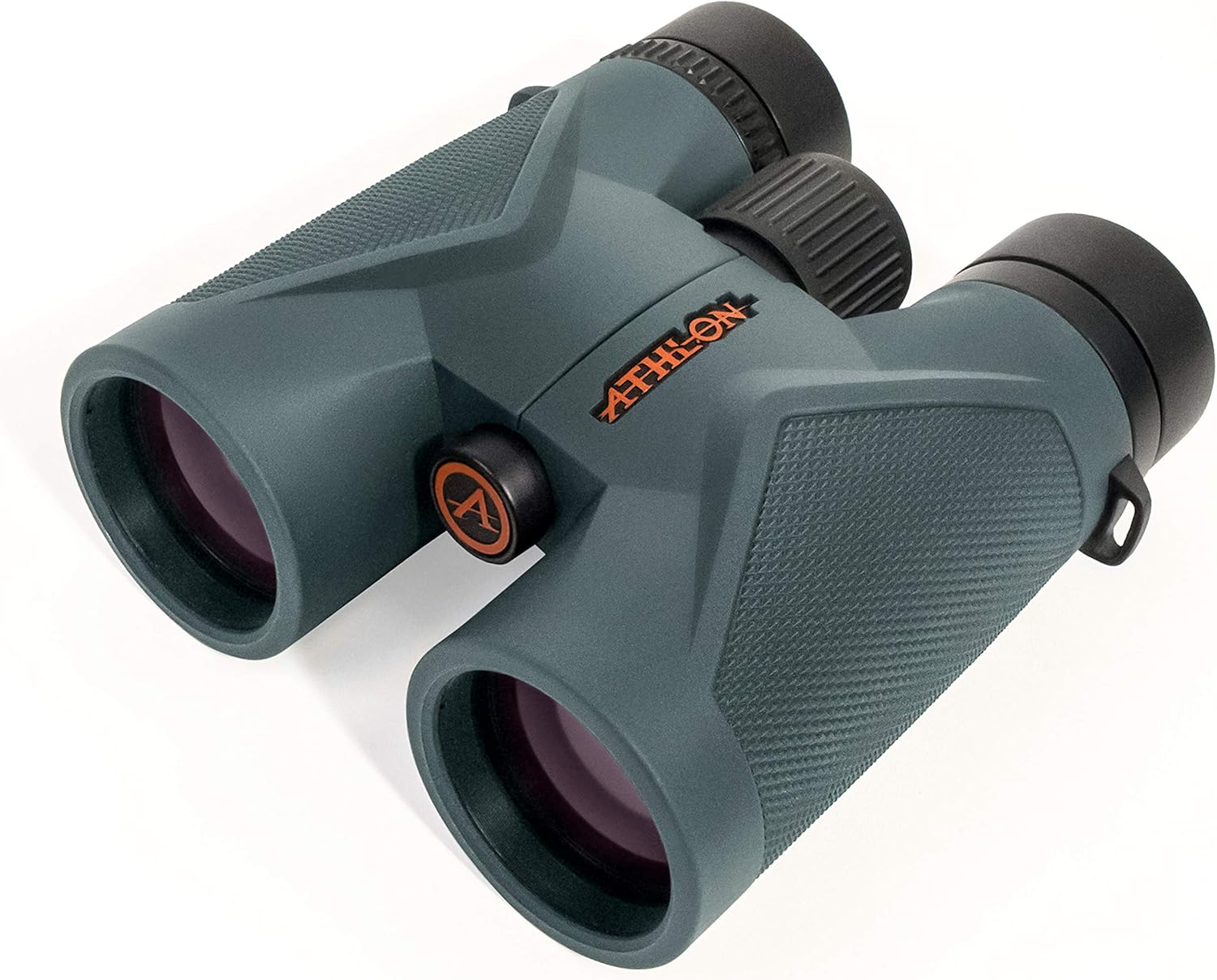
This 8x42 roof-prism binocular provides a 426 ft field of view at 1,000 yd and 17.2 mm eye relief. ED glass and phase-corrected prisms support detailed viewing. Its magnesium chassis and waterproof construction suit regular field use.
Check on AmazonIf you click this link and buy, we earn a commission at no additional cost to you.
A beginner needs an easy view before a more powerful view
Magnification only helps after the bird is actually inside the image. When the field is narrow, every small aiming error occupies a larger share of what you can see, so a quick raise to the eyes can land beside the bird instead of on it. Higher magnification also makes normal hand movement more visible, which can make fine detail harder to use even though the subject appears larger. For a first pair, usable detail matters more than the number printed before the x.
Think about common birding distances and movement instead of treating magnification as a score. Birds that hop through shrubs, cross an open branch, or fly through the edge of the frame reward a view that is easy to reacquire. A more powerful configuration can make sense when most observations are consistently distant and the subject does not move through dense cover as often. The practical question is whether added image scale improves the sighting often enough to justify the smaller, more movement-sensitive window.

This 8x42 model provides a 377 ft field of view at 1,000 yd with 20.2 mm eye relief. Its central focus system keeps routine focusing straightforward. The body is waterproof and nitrogen filled for fogproof performance.
Check on AmazonIf you click this link and buy, we earn a commission at no additional cost to you.
Why many birders find 8x a forgiving starting magnification
An 8x binocular often lands in a useful middle ground for birding because it can provide meaningful magnification without making acquisition unnecessarily demanding. Cornell’s birding guidance describes 8x as a common sweet spot because many users get a steadier, wider field that helps with finding and following birds. That does not make every 8x binocular equally easy to use, because field of view, eyecup design, focus behavior, balance, and eye relief still vary by model. It simply explains why 8x deserves to be the starting comparison rather than an automatic final answer.
The strongest reason to begin there is not that beginners are incapable of using more power. It is that a first pair should leave enough tolerance for imperfect aiming, quick changes in distance, and normal hand movement while the user is still building a consistent viewing routine. If an 8x pair gives a wide, comfortable view and the focus control is easy to place under a finger, the first sighting often becomes simpler. From there, you can decide whether your actual birding repeatedly exposes a reason to move away from 8x.

This 8x42 model uses ED glass with phase and dielectric prism coatings. It provides 19.5 mm eye relief and a 335 ft field of view at 1,000 yd. The body is waterproof and nitrogen filled for fogproof use.
Check on AmazonIf you click this link and buy, we earn a commission at no additional cost to you.
Do not turn the common 8×42 starting point into a universal rule
8×42 is popular because it combines moderate magnification with a full-size objective, but the label does not tell you how the binocular will fit your face, hands, bag, or viewing style. Two 8×42 models can differ in field of view, close focus, eye relief, weight, focus feel, and eyecup positions. Those differences can change acquisition and carrying comfort. The format is a useful reference point, not a guarantee of fit.
Manufacturer specifications show this without turning the comparison into a ranking. The Celestron Nature DX 8×42 lists a 388-foot field at 1,000 yards, 6.5-foot close focus, 17.5 mm eye relief, and 22.2 ounces, while the Vortex Diamondback HD 8×42 lists 393 feet, 5 feet, 17 mm, and 21.8 ounces. Both share the same configuration, yet important fit numbers differ. Read the full specification set before assuming 8×42 settles the decision.
| Verified 8×42 example | Field of view | Close focus | Eye relief | Weight |
|---|---|---|---|---|
| Celestron Nature DX 8×42 | 388 ft at 1,000 yd | 6.5 ft | 17.5 mm | 22.2 oz |
| Vortex Diamondback HD 8×42 | 393 ft at 1,000 yd | 5.0 ft | 17.0 mm | 21.8 oz |
The table shows that configuration alone is not enough and is not a recommendation. Use the same fields when comparing other models. If a pair fits your eyes or hands poorly, a paper match does not rescue it. The decision stays tied to actual viewing and fit.

This 8x42 model provides a 426 ft field of view at 1,000 yd and a 6.5 ft close focus. Its BaK-4 prisms use phase and dielectric coatings. Multi-stop twist-up eyecups and a magnesium alloy body support model-specific fit and handling checks.
Check on AmazonIf you click this link and buy, we earn a commission at no additional cost to you.
Choose 8×42 when full-size handling and varied light fit the actual use
An 8×42 format makes the most sense when you are comfortable carrying a full-size binocular and expect to bird across mixed conditions rather than only on short, bright outings. The 42 mm objectives allow a 5.25 mm exit pupil at 8x, which gives a forgiving geometric relationship between the light leaving the eyepiece and your eye position. That does not guarantee a brighter or better image by itself because coatings, optical design, light level, and your eyes still matter. It does mean the format has useful physical tolerance for general handheld birding.
Full-size bodies can also provide more surface area for grip and controls, which some people find easier to manage than a very compact chassis. The trade-off is bulk and carrying weight, especially if the binocular hangs from the neck or shares space with water, layers, and other field gear. If the pair is comfortable enough that you will bring it routinely, the extra size may be inconsequential. If the weight already feels like something you plan around, a smaller 8x format deserves equal consideration.

This full-size 8x42 Porro model provides a 390 ft field of view at 1,000 yd and 18 mm eye relief. Its H2O construction is tested to the IPX7 waterproof standard. The rubber-armored body and twist-up eyecups support outdoor handling.
Check on AmazonIf you click this link and buy, we earn a commission at no additional cost to you.
Consider 8×30 or 8×32 when carrying burden may keep the binocular at home
A smaller 8x binocular can preserve the same magnification while reducing the size and weight you carry, which can matter more than another feature on the spec sheet. That is especially relevant for casual neighborhood walks, travel, or birding mixed into another activity where a full-size pair competes for bag space. The smaller objective reduces the exit pupil compared with 8×42, so the trade becomes more noticeable as light falls or eye placement becomes less forgiving. In good daylight, however, the portability advantage can be the factor that gets the binocular used more often.
Do not assume every 8×32 is automatically lighter enough to justify the change. Compare actual weight, body dimensions, field of view, eye relief, and the way the barrels fit your hands, because compactness is not a single number. Some people also prefer the steadier grip of a larger body even when the smaller pair is easier to carry. The right routing decision is simple: choose the smaller format when reduced burden solves a real carrying problem without creating a fit or viewing problem that matters more.

This 8x30 model weighs about 16.8 oz and measures 4.9 inches long. It provides a 456 ft field of view at 1,000 yd. The waterproof nitrogen-filled body keeps the compact format ready for outdoor use.
Check on AmazonIf you click this link and buy, we earn a commission at no additional cost to you.
Consider 10x only when repeated longer-distance birding justifies the trade
Ten-power binoculars are not off-limits to beginners, and saying otherwise oversimplifies the decision. They can be useful when a large share of your birding happens across open water, broad fields, mudflats, or other situations where birds remain farther away and extra image scale is repeatedly useful. The cost is usually a narrower field than a comparable 8x model, plus more visible movement from the same handheld motion. A beginner should choose 10x because the viewing distance calls for it, not because 10 is assumed to be an upgrade from 8.
Make that choice only after comparing how quickly you can acquire a target and how stable the image remains during a normal viewing period. If a 10x pair repeatedly makes the bird larger but harder to find or hold in frame, the extra magnification is not improving the whole viewing task. If distant subjects dominate and you can use the view comfortably, the trade may be worthwhile. The dedicated comparison of 8×42 and 10×42 for birding goes deeper into that specific choice.

This 10x42 model provides a 367 ft field of view at 1,000 yd and 15.7 mm eye relief. Its central focus system and roof-prism body keep the controls conventional. The binocular is waterproof and nitrogen filled for fogproof performance.
Check on AmazonIf you click this link and buy, we earn a commission at no additional cost to you.
Wide field of view can make locating and following birds easier
Field of view describes how much scene you can see through the binocular at once, and in birding it directly affects acquisition. Cornell notes that a wider field gives more room for error when the binocular reaches your eyes and helps when a bird is flying, moving through foliage, or shifting along a branch. That is exactly the kind of advantage a new user can feel before learning any optics terminology. A narrow field can still be usable, but it places more demand on precise pointing and reacquisition.
Compare field of view within the magnification you are actually considering instead of chasing one universal threshold. Manufacturers may list it in feet at 1,000 yards or as an angular value, so make sure you compare like with like. Also remember that eyeglasses and eye position can reduce how much of the stated field you actually see, which is why the paper number should be paired with a fit check. A wide specification is valuable only if your eyes can access the view comfortably.

This 8x30 model provides a 435 ft field of view at 1,000 yd. It weighs 16.4 oz and uses ED glass with phase and dielectric prism coatings. The compact waterproof body pairs a broad viewing window with lower carrying weight.
Check on AmazonIf you click this link and buy, we earn a commission at no additional cost to you.
Focus-wheel control matters because bird distance changes quickly
Birds do not stay at one distance simply because the binocular has been adjusted for the last sighting. A bird may move from a nearby shrub to a farther tree, or your next subject may appear at a completely different distance before you have time to think about settings. The focus wheel therefore needs to be easy to find, move smoothly, and stop precisely enough that sharp focus does not become a second search problem. Cornell specifically recommends paying attention to focus-wheel feel because birding demands frequent focusing.
This is one reason trying a binocular in person can reveal something a specification table cannot. Focus travel may be described only loosely, while wheel resistance, finger placement, and the amount of correction you tend to overshoot are physical interactions. A wheel that feels controlled to one person may feel too loose or too stiff to another. For a first pair, predictable focusing is more useful than a premium-sounding focus feature that does not improve your own control.

This 8x42 model uses a central focus mechanism with multi-stop twist-up eyecups. It provides a 426 ft field of view at 1,000 yd and a 6.5 ft close focus. ED objective lenses and phase-corrected BaK-4 prisms support detailed field viewing.
Check on AmazonIf you click this link and buy, we earn a commission at no additional cost to you.
Close focus should match the nearest birds you realistically watch
Close focus is the minimum distance at which a binocular can produce a focused image, and it matters when birds appear near feeders, garden edges, boardwalks, or close branches. The right number depends on your actual viewing environment, not on a contest to find the shortest specification. If your nearest common subjects are well beyond a model’s close-focus limit, shaving another foot from the specification may never change a real sighting. If nearby birds are common, the limit can decide whether you can focus at all.
Use a simple check before buying: estimate or measure the shortest distance you expect to observe often, then compare that with the manufacturer’s stated close focus. Leave some margin because real use involves body position, where you stand, and where the bird lands. A short close-focus specification can also be useful for other nearby wildlife, but this article stays focused on birding needs rather than turning the feature into a general nature-viewing claim. The correct specification is the one that clears your real minimum distance without forcing unnecessary trade-offs elsewhere.

This 8.5x21 Porro binocular focuses from about 0.5 m to infinity. Its close-range convergence system is designed for comfortable observation at short distances. The compact body weighs about 290 g and provides 15 mm eye relief.
Check on AmazonIf you click this link and buy, we earn a commission at no additional cost to you.
Eyeglass users should make full-field fit a purchase gate
Eye relief is especially important when glasses keep your eyes farther from the eyepieces. A published eye-relief number can help narrow choices, but it cannot guarantee that a specific face shape, frame, eyecup design, and eye position will reveal the full field. The practical test is whether you can see a complete, stable circular image without pressing the glasses unnaturally into the eyecups. If the outer field disappears or blackouts appear with normal positioning, the fit is not solved by the magnification label.
Test the eyecups in their intended glasses position and check the view while looking naturally, not while forcing your head into one exact spot. Also verify that the binocular reaches your interpupillary distance so both images merge comfortably. The article on birding binoculars for eyeglass wearers covers this fit problem in more depth. For a first pair, full-field access should be a pass or fail condition rather than a feature to tolerate after purchase.

8x42 roof-prism binocular designed for birdwatching and nature observation, with ED objective glass for improved color control and detail. Fully multi-coated optics and phase-coated BaK-4 prisms support bright, high-contrast views, while the waterproof nitrogen-purged body is suitable for outdoor use.
Check on AmazonIf you click this link and buy, we earn a commission at no additional cost to you.
Try before buying when possible because fit is not captured by one specification
Specs are excellent for rejecting obvious mismatches, but they cannot fully describe balance, eyecup comfort, focus feel, grip, or how quickly the view snaps into place for you. Cornell recommends trying multiple binoculars when possible for exactly this reason. A short in-person comparison can expose whether the focus wheel falls naturally under your finger and whether the image appears without repeated repositioning. Those details matter every time a bird gives you only a brief look.
When trying a pair, do more than stare at a fixed sign across the room. Raise it from a relaxed carry position, acquire several targets at different distances, refocus between them, and check whether you can find the view again without adjusting your face each time. If you wear glasses, keep them on for the test because removing them hides the fit condition you actually need to solve. A return policy can provide a second chance, but it is better to identify obvious ergonomic problems before they become ownership annoyances.

This 8x42 model combines twist-up eyecups with 18 mm eye relief and an ergonomic roof-prism body. It provides a 394 ft field of view at 1,000 yd. A magnesium housing and rubber armor make grip and physical fit worth checking in hand.
Check on AmazonIf you click this link and buy, we earn a commission at no additional cost to you.
Use a beginner shortlist that rejects friction before it rewards features
A useful shortlist should remove pairs that make common birding harder before it compares extra features. Start with acquisition, field of view, focus control, and physical fit. Then check close focus, eyeglass compatibility, and carrying burden against the places you actually bird. Weather protection, warranty, and price should not rescue a binocular that already fails the viewing task.
The checklist is configuration-first. Use it only after verifying the exact model. Reject any candidate that creates a predictable repeated problem. A simpler pair that clears the practical gates is stronger than a spec sheet that adds friction.
Acquisition, field of view, and focus
Raise the binocular several times and see whether you can place a target near center without searching. Compare field of view at the same magnification, then refocus between near and far targets. Pay attention to control rather than speed. Reject a pair if you repeatedly lose the target or overshoot focus.
Close focus, eyewear, and weight
Check that close focus covers the nearest distance you use often. If you wear glasses, confirm the full image remains visible with the eyecups set correctly. Hold the binocular long enough to judge weight and balance. These fit variables are model-specific, so verify the exact pair.
Weather, warranty, and price
Check stated weather sealing instead of assuming rubber armor means waterproof construction. Read what the warranty covers and excludes. Treat price as a ceiling, not proof of fit or optical quality. If two options pass the viewing checks, warranty, carry gear, and cost can break the tie.
- Can you acquire a moving target quickly and keep it in view?
- Does the focus wheel feel controlled across useful distances?
- Can you see the full field with your normal eye position or glasses?
- Does close focus cover nearby birds you actually watch?
- Will the size and weight make you carry the binocular regularly?
- Are weather protection and warranty terms clear?
Use the list as a rejection tool, not a score. One serious fit failure can outweigh several minor advantages. If the remaining candidates pass the practical gates, preference can decide. That is more reliable than starting from a leaderboard.

This 8x42 model uses BaK-4 prisms, multi-coated optics, and twist-up eyecups. It is waterproof, nitrogen filled, and provides 17.8 mm eye relief. A large focus knob and rubber-armored body cover several practical checks in a beginner shortlist.
Check on AmazonIf you click this link and buy, we earn a commission at no additional cost to you.
Route the configuration to the condition that matters most
The common choices become clearer when each configuration is tied to a problem instead of ranked. An 8×42 fits full-size handling and mixed light, while an 8×30 or 8×32 deserves attention when carrying burden matters. A 10×42 makes sense when longer-distance birding is frequent enough that extra image scale repeatedly helps. None of these labels replaces model-specific checks for field of view, eye relief, close focus, and weight.
Use the table as routing logic, then verify exact specifications and fit. The same trade can help in one environment and annoy in another. If unsure, start with the configuration that creates the fewest constraints in your common birding situation. Your first pair should make more sightings usable, not maximize every number.
| Configuration | Reason to consider it | Reason to reject it |
|---|---|---|
| 8×42 | General birding, forgiving handling, mixed light, full-size grip | Too bulky or heavy for how you carry gear |
| 8×30 or 8×32 | Lower carrying burden while keeping 8x magnification | Smaller body or reduced exit pupil creates a trade you dislike |
| 10×42 | Repeated longer-distance viewing where added image scale helps | Narrower or more movement-sensitive view makes tracking harder |
After choosing a route, compare exact models rather than assuming the configuration settled everything. Keep the comparison tied to the same few specifications. Test controls and eye position if you can. That keeps the decision grounded in real use.

This 10x42 model provides a 334 ft field of view at 1,000 yd and 17 mm eye relief. Its roof-prism body is waterproof, fogproof, and tripod adaptable. The included GlassPak harness gives the full-size 10x configuration a practical carrying option.
Check on AmazonIf you click this link and buy, we earn a commission at no additional cost to you.
Final Thoughts: the first pair should reduce friction, not maximize specifications
A beginner’s birding binocular succeeds when the first few seconds of a sighting feel easier, not when the spec sheet looks more ambitious. Start with the ability to acquire a bird, keep it in the field, reach focus quickly, and see the full image comfortably. Let 8x be a strong starting comparison, but reject 8×42 if size, weight, eyewear fit, or another real constraint points elsewhere. Choose 10x only when your repeated viewing distance gives the extra magnification a clear job.
Before buying, verify the exact model’s field of view, close focus, eye relief, weight, weather protection, and warranty, then test the physical fit whenever possible. That keeps the decision specific enough to be useful without pretending one configuration fits every beginner. A first pair does not need to anticipate every future birding situation. It needs to be easy enough to carry and use that brief sightings stop being lost to the binocular itself.

This harness carries full-size binoculars in a protective case with adjustable shoulder straps. It includes two binocular tether straps plus side and rear storage pockets. The pack weighs 8 oz and measures 6.75 by 6.25 by 3.75 inches.
Check on AmazonIf you click this link and buy, we earn a commission at no additional cost to you.
FAQs
Most first-pair questions ask how much magnification remains easy to acquire, focus, and hold. The answer changes with distance, motion, eyeglasses, carrying tolerance, and the exact model. Configuration advice should narrow the search. The questions below cover the common decision points.
Use these answers as filters. Verify fit with your normal viewing setup. Verify specifications on the exact product page or manual. If two options pass the checks, comfort can decide.
🔭 Is 8x or 10x better for a beginner birder?
8x is often more forgiving because it commonly provides a wider, steadier view. Choose 10x when longer distances dominate and the narrower view still works for you.
🌲 Is 8×42 always the best first birding configuration?
No. An 8×32 may fit better when carrying burden matters, while 10×42 may suit repeated distant viewing. Exact fit and specifications still need checking.
👓 What should I check if I bird while wearing glasses?
Check whether you can see the full field with your glasses on and the eyecups set correctly. Eye relief helps narrow choices, but fit remains model-specific.
🎯 Why does field of view matter so much for beginners?
A wider field gives you more scene when the binocular reaches your eyes, helping with moving birds. Compare models at the same magnification.
🌿 How close should birding binoculars be able to focus?
Close focus should cover the nearest birds you realistically watch. If feeders or shrubs are close, verify the stated limit.
👐 Does focus-wheel feel really matter?
Yes. Bird distance can change quickly, so a wheel that is easy to find, smooth, and precise can make the pair easier to use.
References and Sources
These sources support the selection guidance and exact specifications used above. Cornell supports 8x, field of view, focus feel, and in-person trials. Manufacturer pages support the numerical examples. No retailer ranking sets the beginner standard.
The model examples are evidence anchors, not purchase recommendations. They show how specifications can differ inside one configuration. Verify the exact variant because specifications can change. Check physical fit when possible.
- Cornell Lab binocular testing tips: supports 8x starting logic, field of view, focus feel, and trying binoculars in person.
- Cornell Lab field of view guidance: explains why a wider field helps locate and follow moving birds.
- Celestron Nature DX 8×42 specifications: verifies the comparison values used in the article.
- Vortex Diamondback HD 8×42 specifications: verifies the comparison values used in the article.