Binoculars under 100 dollars can be useful, but the price ceiling is a shopping filter rather than a quality label. The strongest current candidates combine a verifiable manufacturer identity, coherent specifications, a usable configuration, and a support path that can be checked before purchase. Sale pricing can pull an otherwise more expensive binocular below the ceiling without changing its optics, weight, eye relief, sealing, or handling. The practical goal is to reject weak listings first, compare the credible survivors, and keep the ceiling only when one of them actually fits your viewing needs.
Under $100 is a moving retail filter, not a permanent product class
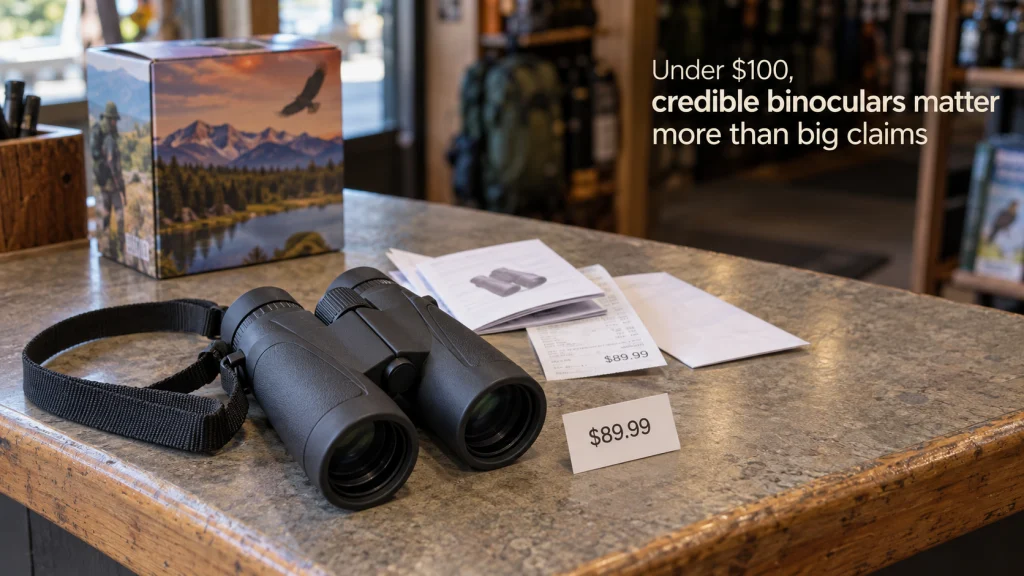
Two current binocular listings can both fall below $100 and still deserve very different treatment. Sportsman’s Warehouse lists the Vortex Triumph HD 10×42 at a sale price of $89, while Walmart lists a VAMOUT 20×50 at $35.89. The Triumph can be traced to a manufacturer page with an exact model number, 17.0 mm of eye relief, a 334-foot field of view at 1,000 yards, a published weight of 22.9 ounces, and stated waterproof and fogproof construction. The VAMOUT retailer page makes much larger headline claims, including 20x magnification, 99.8 percent light transmission, and waterproof construction, but the evidence path is much weaker because those claims are not backed here by a comparable manufacturer specification and support page.
This is why a hard budget works better when it sits inside a broader binocular budget decision instead of acting as the entire decision. It also helps to use the same fit logic explained in the binocular buying guide, because magnification, objective size, field of view, eye relief, weight, grip, and viewing duration still matter when the price is low. A sale does not widen a narrow field of view or make short eye relief more comfortable with glasses. Price tells you what can be considered, not what will work.

Bushnell H2O 8x42 combines fully multi-coated optics with BaK-4 prisms for outdoor viewing. Its IPX7 waterproof construction and nitrogen-purged fogproof design are built for wet conditions. A lightweight aluminum chassis, non-slip rubber armor, twist-up eyecups, carrying case, neck strap, and lens covers support regular field use.
Check on AmazonIf you click this link and buy, we earn a commission at no additional cost to you.
Define what a sub-$100 ceiling can realistically buy
A strict ceiling can still include ordinary full-size and compact binoculars from established manufacturers, especially when retailers discount older or entry-level lines. What changes most quickly is eligibility, not the physical design of the binocular. A model that sits above the ceiling at regular price can drop below it during a sale, while another product may stay below the limit all the time. That difference matters because a sale-only purchase should be judged as a temporary opportunity, not proof that the whole product family belongs in the same price class.
The safest way to shop this range is to separate price questions from product questions. First ask whether the actual checkout price stays within your limit without relying on an uncertain rebate or a condition you cannot meet. Then check whether the exact configuration has believable specifications and fits the viewing job. This keeps the budget firm without rewarding listings that use price theater to distract from missing information.
Confirm the actual checkout price before comparing specs
A binocular qualifies for the ceiling only at the price you can actually obtain from a seller you are willing to use. A headline price that depends on an unclear coupon, membership condition, rebate, or unavailable variant should not be treated as the same thing as a straightforward checkout price. Check the exact configuration and seller first, because a different color, package, or third-party seller can change the number you actually pay. Once the purchase path is clear, move on to the product evidence instead of letting the discount dominate the decision.
Separate regular price, sale price, and manufacturer MSRP
Retail pages often show a current selling price beside a higher reference price, while the manufacturer may publish a different MSRP again. The Triumph HD 10×42 is a useful example: the retailer price is currently below the ceiling, but Vortex lists a $149.99 MSRP for the same base model. That does not make the sale price less real, and it does not make MSRP a quality score. It simply tells you that this model enters the under-$100 set because of current retail pricing, so the price must be rechecked before purchase while the stable specifications can be evaluated separately.
Reject listings that do not give you a reliable evidence path
A low price is not enough when the seller page cannot be matched to a manufacturer specification, manual, warranty, or support path that lets you verify the important claims. The VAMOUT 20×50 listing is a useful example because the page supplies an impressive stack of numbers and features, yet those claims do not give the same traceable model-level evidence available for the Vortex and Celestron candidates below. That does not prove the binocular is unusable, and unfamiliar brands should not be rejected merely for being unfamiliar. It does mean the listing stops at the evidence gate before fit, magnification, or discount size gets a chance to persuade you.
Reject example: A retailer-only 20×50 listing with very high transmission claims, waterproof language, and no comparable manufacturer specification or support page should not make the shortlist on marketing copy alone. The price may be attractive, but the missing evidence makes fit and durability claims harder to judge. The correct response is not to declare the binocular bad from a distance. It is to reject the purchase decision until the claims can be independently tied to the exact model.
Do not treat a bigger magnification number as free value
High magnification can make a listing look generous because the number is easy to compare and easy to market. In real handheld viewing, more magnification can also make movement more obvious and can narrow the usable field, while small objectives can make the combination less forgiving in dimmer conditions. That does not make every 12x or higher binocular wrong, but it means the larger number needs a viewing reason behind it. For general handheld use, a more moderate configuration can be the better value even when its box looks less impressive.

Vortex Bantam HD 6.5x32 provides a 400-foot field of view at 1,000 yards with 18.7 mm of eye relief. Its 51 to 69 mm interpupillary range and 14.4-ounce weight emphasize fit and easy handling. The waterproof and fogproof body includes a soft carry case, neck strap, lens covers, rainguard, and lens cloth.
Check on AmazonIf you click this link and buy, we earn a commission at no additional cost to you.
Screen the surviving choices for fit, function, and support
Once a listing survives the credibility check, the next question is whether the binocular suits the person who will actually use it. Two products can share the same magnification and objective size yet differ meaningfully in field of view, eye relief, weight, focus behavior, and physical balance. Those differences become more important when you wear glasses, follow moving subjects, carry the binocular for long periods, or use it in changing weather. At this stage, the price ceiling should stay in the background while fit moves to the front.
Manufacturer specifications are most useful when they change a decision rather than when they merely fill a table. Field of view helps you judge how easy it may be to find and follow a subject, while eye relief can matter greatly for eyeglass wearers. Weight affects both carrying and steadiness, and weather claims should be checked on the exact model rather than assumed from the brand name. Warranty and return support deserve attention because a low purchase price does not make a frustrating sample cheap to own.
The three choices below survive the evidence screen for different reasons, not because they form a universal ranking. One is a full-size 10×42 that currently enters the budget only through a retailer discount, one is a lighter 6.5×32 built around a wide field and smaller fit range, and one is a compact 8×25 sold below the ceiling directly by its manufacturer. Their published compromises are different enough that the right choice depends on how you observe, whether you wear glasses, and how much size and magnification you actually want. Treat the table as a set of qualified candidates, then eliminate any option whose fit or configuration conflicts with your own use.
| Current candidate | Verified price status | Useful published facts | Reason to consider | Reason to skip |
|---|---|---|---|---|
| Vortex Triumph HD 10×42 | $89 retailer sale; $149.99 manufacturer MSRP | 17.0 mm eye relief, 334 ft at 1,000 yd, 22.9 oz, waterproof and fogproof | A traceable full-size 10×42 with clear manufacturer specs and included carrying support | Skip if 10x is harder for you to hold steadily, or if the sale price has moved back above the ceiling |
| Vortex Bantam HD 6.5×32 | $69.99 retailer price; $99.99 manufacturer MSRP | 18.7 mm eye relief, 400 ft at 1,000 yd, 14.4 oz, 51 to 69 mm interpupillary range | A lighter, lower-magnification option with a wide published field and dimensions aimed at smaller hands and faces | Skip if the 51 to 69 mm fit range does not suit you or if 6.5x does not provide enough image scale for your use |
| Celestron Outland X 8×25 | $69.95 manufacturer price | 432.3 ft at 1,000 yd, 11.5 oz, 9.3 mm eye relief, waterproof and nitrogen filled | A compact, lightweight 8x option with a wide published field and a direct manufacturer specification page | The 9.3 mm published eye relief makes it a cautious choice for many eyeglass wearers, so verify fit before buying |
The useful distinction is not which row looks most impressive, but which compromise matches the intended use. The Triumph is the clearest example of sale-only eligibility, the Bantam shows why lower magnification and physical fit can be a feature rather than a downgrade, and the Outland X shows why a credible low price can still carry a fit compromise. None of the three should be selected from price alone, and each should be rechecked against the exact seller, configuration, and current checkout price before purchase. If one fails the fit check, remove it even if its price or feature list looks stronger on paper.
| What the listing says | What to verify | Why it matters |
|---|---|---|
| Wide field of view | Published field of view for the exact configuration | A wider view can make moving subjects easier to locate and follow |
| Comfortable with glasses | Published eye relief plus the actual eyecup design | Eyeglass wearers may lose part of the visible field when eye relief is too short |
| Waterproof or fogproof | Exact manufacturer statement for that model | Weather protection should not be inferred from appearance or a family name |
| Lightweight | Published weight and dimensions | Carry comfort and steadiness depend on more than objective diameter |
| Strong warranty | Coverage, exclusions, and service process | Support can reduce the cost of dealing with a defective or damaged unit |
The table is a screening tool, not a scorecard. A product does not become the right choice merely because it checks every marketing box, and some buyers may reasonably accept a compromise that another buyer should reject. The useful question is whether the verified facts support your actual viewing conditions. If they do not, the low price has not solved the problem.
Check the configuration against the actual use
An 8x or 10x configuration can make sense for many handheld situations, but the label alone does not settle the choice. Someone following moving wildlife may care more about field of view and quick target acquisition, while a person watching a fixed distant scene may tolerate a narrower view. A compact body may be easier to carry but can also change grip and eye placement. The useful comparison is therefore not cheap versus expensive, but fit versus mismatch within the amount you can spend.
Verify weather protection and support on the exact model
Budget pages often mix products with very different levels of sealing and support, even when the prices look close. If you expect rain, humidity, or rapid temperature changes, confirm the manufacturer’s exact waterproof or fogproof language rather than relying on a retailer shorthand. Do the same with warranty coverage and exclusions, because a broad slogan can hide important boundaries. When the risk of sample variation matters, a clear return path may be more valuable than one more feature on the box.
Cheap binocular adequacy is a separate question
A binocular does not have to rival a much more expensive model to be useful. It only needs to meet the viewing task well enough without creating a problem that defeats the purpose of buying it. Community discussions repeatedly show that some beginners simply want a usable first pair, while others are already frustrated by poor clarity, awkward weight, or weak ergonomics. That difference is why a fixed minimum spending rule is less helpful than checking what the buyer actually needs from the view.

Celestron Outland X 8x25 uses BaK-4 prisms and multi-coated optics in a compact roof-prism design. Its waterproof, nitrogen-filled body provides a 432.3-foot field of view at 1,000 yards with 9.3 mm of eye relief. The binocular includes a neck strap, carrying case, lens cloth, and instruction manual.
Check on AmazonIf you click this link and buy, we earn a commission at no additional cost to you.
Decide whether the ceiling should hold or move
A hard $100 limit is reasonable when the surviving options meet your fit, viewing, and support needs. There is no benefit in spending more simply because another price tier exists. The limit should move only when a requirement you actually care about cannot be met inside it, such as comfortable eye relief, a particular size, dependable sealing, a wider usable field, or a configuration you can hold steadily. In that case, the extra money is buying a specific solution rather than a vague promise of better quality.
The opposite is also true. If the binocular will be used casually in good light for short sessions, a simpler option may be entirely adequate and leave money for something more useful. Waiting for a credible sale can also make more sense than settling for a listing that fails the evidence check. The budget is doing its job when it prevents unnecessary spending without forcing you into a product that is wrong for the task.
Use regular-price choices as the baseline and sale entries as opportunities
A model that normally sells below the ceiling is easier to treat as a stable budget option because it does not depend on a temporary markdown to qualify. A sale-only entry can still be the better purchase, but its eligibility has to be rechecked immediately before buying. That distinction is useful when comparing the current shortlist: the Celestron compact sits below the limit at the manufacturer’s listed price, while the Triumph depends on a retailer discount to enter the same set. Keep both in consideration when they fit, but do not build a permanent price-tier conclusion from a temporary sale.
Raise the ceiling only for a specific missing requirement
If nothing under the limit provides the fit or configuration you need, compare the next tier rather than buying the least bad option. The separate guide to binoculars under 200 dollars is useful when the higher ceiling is justified by a concrete requirement rather than general upgrade pressure. Moving up makes sense when you can name what must improve and verify that the additional money actually buys it. If you cannot name that improvement, keeping the original ceiling is usually the cleaner decision.
Consider used binoculars only when condition risk is acceptable
Used binoculars can stretch a fixed budget, but they replace some price pressure with condition risk. External wear is easy to see, while alignment problems, internal haze, fungus, moisture damage, stiff mechanisms, or damaged coatings may be harder to judge from a listing. A used purchase makes more sense when the seller provides clear condition information and the return process gives you a realistic way to reject a bad sample. If condition is uncertain and returns are weak, the lower price may not be enough compensation.
- Hold the ceiling when a verified option fits your eyes, hands, carrying needs, and viewing conditions.
- Wait when the only attractive choices depend on vague claims or weak seller support.
- Move the ceiling when a specific requirement is unavailable below it and the next tier verifiably solves that problem.
- Consider used only when you can evaluate condition risk and still have a reasonable exit if the sample is poor.
This decision path protects the budget without turning it into a rule that ignores fit. It also prevents the common mistake of buying a higher magnification, larger objective, or longer feature list simply because it appears to offer more for the money. The right stopping point is where the binocular becomes credible and suitable, not where the specification sheet becomes crowded. If the current market cannot reach that point below $100, waiting or moving the ceiling is cleaner than forcing a purchase.

Nikon PROSTAFF P3 8x42 provides a 377-foot field of view at 1,000 yards with 20.2 mm of eye relief. Its nitrogen-filled, waterproof and fogproof body uses rubber armor and a fiberglass-reinforced polycarbonate chassis. The 20.3-ounce binocular includes adjustable eyecups, a case, neck strap, eyepiece cap, and objective caps.
Check on AmazonIf you click this link and buy, we earn a commission at no additional cost to you.
Final Thoughts: a bargain is a credible binocular that fits the ceiling
The useful way to shop below $100 is to make the price limit the first filter and the evidence check the second. Verify what the product actually is, separate temporary pricing from stable specifications, and reject listings that ask you to trust claims you cannot confirm. Then judge field of view, eye relief, weight, sealing, handling, seller support, and warranty against the way you plan to use the binocular. A lower price is valuable only when the product still fits the job.
There is no universal rule that every inexpensive binocular is inadequate, and there is no reason to assume that a bigger number on the box is a better bargain. Keep the ceiling when a credible option meets your needs, wait when the market is forcing a bad compromise, and spend more only when the extra money solves a specific verified problem. Before buying, recheck the exact configuration, current checkout price, eye relief, field of view, and support terms that matter to you. That keeps the decision practical, repeatable, and much harder for marketing claims to hijack.

Nikon 7072 Lens Pen uses a soft retractable brush plus a non-liquid cleaning tip for optical surfaces. It removes fingerprints, dust, and other debris that can compromise an image. Nikon specifies the tool for cameras, binoculars, telescopes, and other optical products.
Check on AmazonIf you click this link and buy, we earn a commission at no additional cost to you.
FAQs
🔭 Can you get good binoculars for under 100 dollars?
Yes, depending on the use and the exact model. Look for coherent specifications, a configuration that fits your viewing conditions, and a clear seller or manufacturer support path rather than assuming price alone predicts quality.
👓 What should eyeglass wearers check first?
Check the published eye relief and the eyecup design on the exact binocular. Short eye relief can prevent some eyeglass wearers from seeing the full field, so this is a fit issue that should be checked before small feature differences.
🌲 Is 10x better than 8x at this price?
Not automatically. More magnification increases image scale but can make hand movement more visible and may come with a narrower field, so the better choice depends on distance, movement, steadiness, and the exact design.
💧 Is waterproofing worth prioritizing on a budget binocular?
It is worth prioritizing when you expect rain, humidity, or large temperature changes. Verify the exact manufacturer’s sealing claim because similarly priced binoculars can differ significantly in weather protection.
💵 Should I wait for a sale instead of buying immediately?
Waiting can make sense when a credible product is normally just above your ceiling and you do not need it immediately. A sale is useful when it lowers the price of a suitable binocular, not when it pressures you to accept poor fit or unverifiable claims.
🧭 When should I consider spending more than $100?
Spend more when you can identify a specific requirement that credible sub-$100 choices do not meet. That might be eye relief, size, sealing, field of view, weight, or another verified fit issue, not simply a desire for a more expensive label.
References and Sources
- Sportsman’s Warehouse Triumph HD 10×42 listing: verifies the retailer sale price used for the full-size candidate.
- Vortex Triumph HD 10×42 specifications: verifies manufacturer MSRP, eye relief, field of view, weight, sealing, and included accessories.
- Sportsman’s Warehouse Bantam HD 6.5×32 listing: verifies the current retailer price and basic configuration.
- Vortex Bantam HD 6.5×32 specifications: verifies MSRP, eye relief, field of view, weight, interpupillary range, and weather protection.
- Celestron Outland X 8×25 specifications: verifies manufacturer price, field of view, eye relief, weight, dimensions, and waterproof construction.
- Walmart VAMOUT 20×50 listing: provides the retailer-only high-magnification and optical claims used in the rejection example.