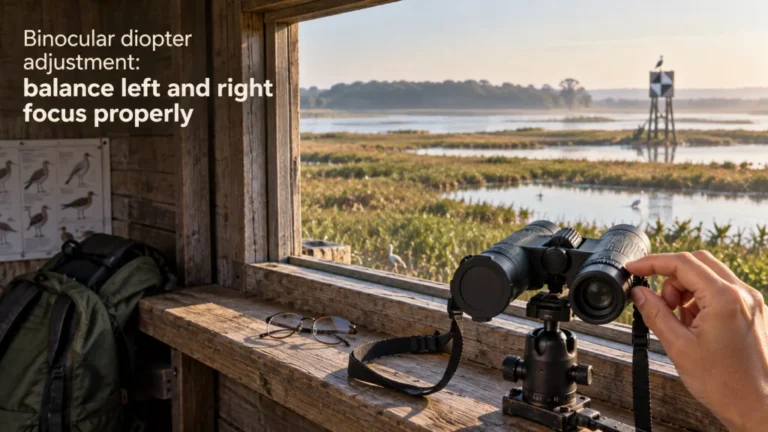
Getting a sharp view through center-focus binoculars requires two different adjustments to do two different jobs. The center focus sets the viewing distance, while the diopter balances the optical channels for the viewer using the binoculars. A brief eyecup and interpupillary-distance check should come first, because poor eye position can look like a focus problem. Once the two channels are calibrated correctly, normal viewing should rely mostly on the center focus wheel.
Separate calibration from everyday focusing
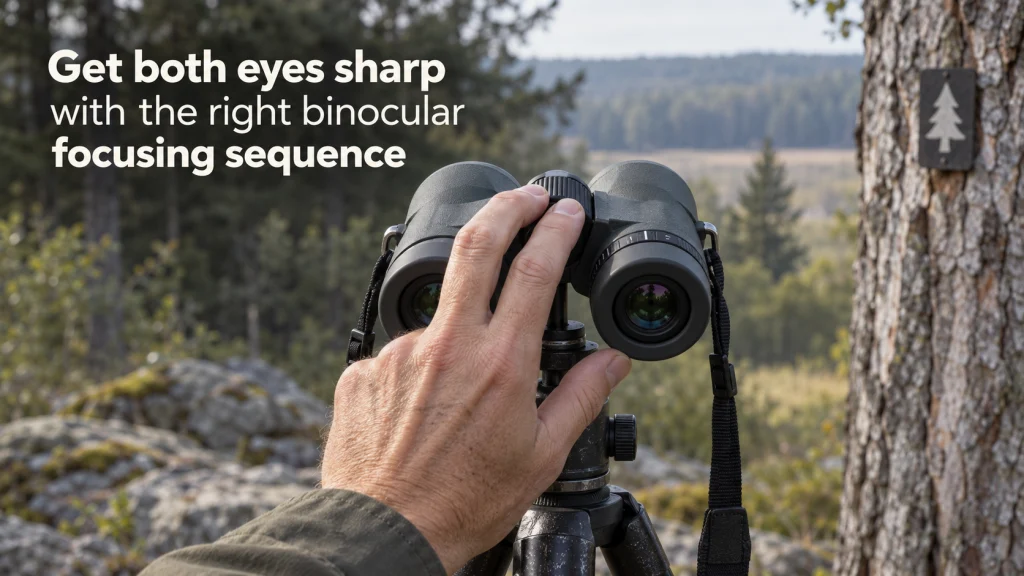
If both eyes are fighting for sharpness, learning how to focus binoculars is less about turning the center wheel again and more about separating calibration from everyday focusing. On common center-focus designs, the center wheel changes focus for normal target-distance changes, while the diopter compensates for a difference between the two viewing channels for one user. Turning both controls back and forth at the same time makes it difficult to tell which adjustment fixed the image and which one merely moved the problem. The practical goal is to establish the relationship between the two channels first, then leave that relationship alone during ordinary viewing.
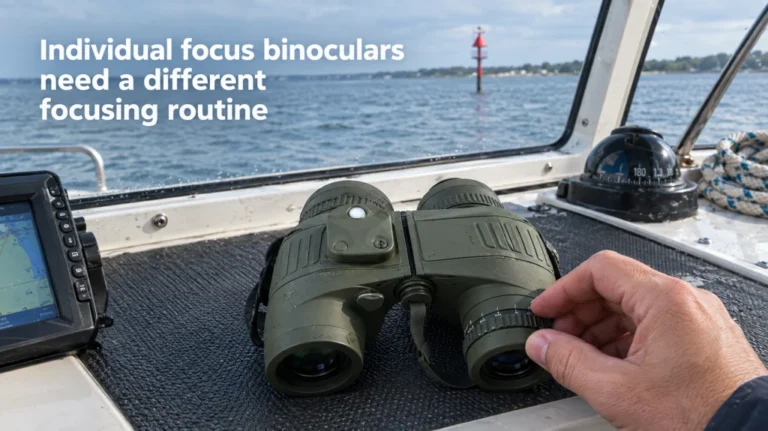
Before working through the sequence, make sure the binoculars are physically set up well enough to judge sharpness. The broader binocular setup process covers eye position and fit in more detail, while the larger guide to using binoculars correctly puts focusing in the context of normal viewing. This page stays on the focus procedure for center-focus binoculars rather than treating every control as part of one universal routine. Individual-focus binoculars use a different method and should not be forced into the steps below.

The Diamondback HD 8x32 uses adjustable eyecups, a center focus wheel that moves both barrels together, and a right-eyepiece diopter. Fully multi-coated lenses and dielectric prism coating support bright, color-accurate views. Argon purging and O-ring seals provide waterproof and fogproof performance.
Check on AmazonIf you click this link and buy, we earn a commission at no additional cost to you.
Check eyecups and IPD before judging focus
A soft image is not always a focusing error. If the eyecups place your eyes too far from or too close to the eyepieces, you can lose part of the field or struggle to hold the view in a stable position. Eyeglass wearers commonly need the eyecups retracted, while users without glasses often need more extension, but the exact position still depends on the binocular and the user’s face. Set the eyecups so the view is easy to hold before deciding that the focus mechanism is the problem.
Next, adjust the hinge until the two circular views merge comfortably into one image instead of appearing as overlapping circles or a narrow figure-eight shape. This interpupillary-distance setting is a fit adjustment, not a sharpness control, but a poor setting can make the eyes work harder and make fine focusing feel uncertain. Keep your normal viewing posture while making the adjustment rather than forcing your eyes inward or outward to meet the binoculars. Once the view is centered naturally for both eyes, the focus sequence becomes much easier to evaluate.

The PROSTAFF P3 8x42 has turn-and-slide eyecups and long eye relief for comfortable viewing with or without glasses. Its large central focus wheel is designed for quick, precise adjustment. O-ring seals and nitrogen gas purging provide waterproof and fogproof construction.
Check on AmazonIf you click this link and buy, we earn a commission at no additional cost to you.
Find the center focus and diopter controls
Identify the controls before turning anything. The center focus is usually the large wheel that changes focus for both channels together, while the diopter is a separate adjustment that offsets one channel relative to the other. Do not assume the diopter is always on the right eyepiece, because manufacturers use different layouts and some designs place the adjustment elsewhere. If the control is not obvious, the exact binocular manual should settle the question before you start calibration.
The point of this check is to know which control you will use for calibration and which one you will use repeatedly during normal viewing. Do this before you choose a target so you are not identifying controls while also trying to judge sharpness. A brief inspection can also reveal a locking diopter or a center-mounted control that changes the expected sequence. Use the following checks to establish the layout before making any focus correction:
- Confirm that the binoculars use a center-focus system rather than separate focusing at each eyepiece.
- Locate the center focus wheel and the model’s diopter adjustment.
- Check whether the diopter has a lock, index mark, scale, or unusual placement.
- Use the manual when the control layout differs from the familiar right-eyepiece arrangement.
After that identification step, avoid treating every ring near an eyepiece as an everyday focusing control. A center-focus binocular should not require constant diopter changes every time you move from a nearby target to a more distant one. The center wheel handles those routine distance changes after calibration. That distinction is the key to a repeatable binocular focus adjustment instead of a cycle of random corrections.

The Diamondback HD 10x42 combines adjustable eyecups with a center focus wheel and a right-eyepiece diopter. The 10x42 optical system uses fully multi-coated lenses and dielectric prism coating. Rubber armor, argon purging, and O-ring seals add grip plus waterproof and fogproof protection.
Check on AmazonIf you click this link and buy, we earn a commission at no additional cost to you.
Calibrate the first optical channel
Choose a stationary target with enough fine detail to make sharpness easy to judge, such as lettering on a sign, bark texture, or a high-contrast edge. Use a target far enough away that tiny body movement does not dominate what you are seeing, and keep the binoculars in a steady normal viewing position. Isolate the optical channel controlled by the center focus according to the manufacturer’s procedure, rather than trying to compare two changing images at once. On many center-focus instructions, this means viewing through the first channel and using only the center wheel until the target looks as crisp as you can make it.
Make small corrections as you approach sharp focus instead of sweeping past it repeatedly. Your aim is not to memorize a wheel position, because the center focus will move later as target distance changes. You are establishing a clean reference for the first channel so the second channel can be matched to it. Once that first channel is sharp, leave the center wheel alone during the next calibration step.

The H2O Xtreme pairs 10x magnification with 42mm objectives, BaK-4 prisms, and fully multi-coated optics. Its waterproof construction uses O-ring sealing and nitrogen purging to resist internal fogging. The rubber-armored body is built for outdoor handling while the 10x view provides fine target detail for deliberate focusing.
Check on AmazonIf you click this link and buy, we earn a commission at no additional cost to you.
Match the second channel with the diopter
Now isolate the second optical channel while keeping the same target and the same basic viewing position. Do not touch the center focus wheel that established the first-channel reference. Use only the diopter control assigned to the second channel and turn it slowly until the target reaches its best sharpness. This is the step that matches the two channels for the current viewer instead of changing the viewing distance for both sides.
When the second channel is sharp, note the diopter position if the scale makes that practical, but do not assume another person’s setting should match yours. Some binoculars provide a clear numbered or marked scale, while others give only a center mark or a smooth ring. A lockable diopter should be returned to its locked state if the manual specifies one. For a deeper explanation of what this adjustment is doing, the separate guide to binocular diopter adjustment covers the calibration control without turning this article into a control-design lesson.

The Crossfire HD 10x42 has adjustable eyecups, a center focus wheel, and a right-eyepiece diopter for user-specific setup. Fully multi-coated lenses and the roof-prism design support light transmission in a compact body. Nitrogen purging and O-ring seals provide waterproof and fogproof performance.
Check on AmazonIf you click this link and buy, we earn a commission at no additional cost to you.
Open both eyes and confirm a relaxed sharp image
Return to normal binocular viewing with both optical channels available. The target should look sharp without one eye seeming to pull the combined image away from the other, and you should not need to keep touching the diopter to hold focus. If the image is slightly soft in both eyes, make a small center-focus correction and check again. If one side repeatedly feels sharp while the other remains clearly wrong, stop chasing the center wheel and recheck calibration or the model-specific instructions.
The difference between a normal focus change and a problem that deserves another look is easier to see as a pattern than as a single moment. Pay attention to whether both channels respond together, whether only one side remains wrong, and whether the image circles merge comfortably before you make another adjustment. That pattern tells you whether to use center focus, revisit the diopter, or go back to physical setup. Use the table as a decision check, then return to the control that actually matches the symptom.
| What you notice | What it usually means for the next adjustment |
|---|---|
| Both sides sharpen together when target distance changes | Use the center focus wheel normally. |
| One channel is consistently sharper than the other after setup | Recheck the diopter calibration and the exact control layout. |
| The two image circles do not merge comfortably | Recheck interpupillary distance before blaming focus. |
| Sharpness cannot be reached even after careful recalibration | Check the manual and stop treating repeated adjustment as normal. |
A successful calibration should make the binoculars feel simpler afterward, not more complicated. You may still touch the center wheel often when switching between nearby and distant subjects, because that is its job. The diopter should remain a viewer-specific offset unless it was moved, the binoculars were shared, or the manufacturer instructs otherwise. That stable relationship is what lets both eyes follow the same center-focus changes.

The H2O 8x42 uses fully multi-coated optics with BaK-4 prisms for bright, high-contrast viewing. Its IPX7-rated, O-ring-sealed body and nitrogen purging are designed to resist water and internal fogging. Soft-touch rubber housing and a textured grip support steady two-eye confirmation after calibration.
Check on AmazonIf you click this link and buy, we earn a commission at no additional cost to you.
What to adjust when the target distance changes
Once calibration is complete, normal distance changes belong to the center focus wheel. A bird moving from a nearby branch to a tree farther away, a player crossing a field, or a sign viewed from a new position may all require a focus correction even though the diopter is still set correctly. Turn the center wheel until the subject reaches sharp focus, then stop. Do not use the diopter as a second fine-focus wheel every time the subject moves.
This division of labor is what makes center-focus binoculars practical for changing scenes. The center wheel moves the paired system through different viewing distances while preserving the offset you established between the two optical channels. If you notice yourself alternating between center focus and diopter for every new target, return to the calibration sequence and verify the manual for your exact design. Repeating both adjustments during ordinary viewing usually makes a correct setup harder to preserve.

The Nature DX 8x42 pairs 8x magnification with a 42mm objective and a 388-foot field of view at 1,000 yards. Fully multi-coated optics and phase-coated BaK-4 prisms support bright, detailed views. Its 6.5-foot close focus and broad field make it practical when switching between nearby and more distant subjects.
Check on AmazonIf you click this link and buy, we earn a commission at no additional cost to you.

The Bantam HD uses 6.5x magnification and a 32mm objective in a lightweight body designed for smaller hands and faces. It is eyeglass friendly, tripod adaptable, and equipped with simple controls for quick target acquisition. Nitrogen purging and rubber armor add water, fog, and impact resistance for shared outdoor use.
Check on AmazonIf you click this link and buy, we earn a commission at no additional cost to you.
Know when focus should stop being an adjustment problem
Focusing should eventually converge on a clear result. If careful eyecup and IPD setup, first-channel focusing, and second-channel diopter calibration still leave one side persistently blurred, repeatedly turning the controls is no longer a useful troubleshooting strategy. Check the exact manual for any model-specific sequence, lock, range limit, or unusual control arrangement. Do not force a focus wheel or diopter ring past its normal stop in an attempt to recover sharpness.
Stop owner-level adjustment if the binoculars show a severe double image, visible internal damage, water ingress, a broken or loose hinge, or a control that feels mechanically damaged. Those symptoms are not solved by finding a more aggressive focusing technique, and internal optical correction belongs with qualified service rather than DIY prism or collimation work. If the binoculars actually use separate focusing at both eyepieces, switch to the procedure for focusing individual-focus binoculars instead of adapting this sequence. The correct next step is sometimes to stop adjusting, identify the design or fault, and use the appropriate instructions.

The MONARCH M5 8x42 uses ED glass and phase-corrected dielectric-coated prisms for bright, high-resolution viewing. It has a large center focusing knob, twist-up click-stop eyecups, and 19.5mm eye relief. Nitrogen-filled waterproof and fogproof construction provides a durable center-focus alternative when a damaged binocular is no longer suitable for owner adjustment.
Check on AmazonIf you click this link and buy, we earn a commission at no additional cost to you.
Final Thoughts: Set the relationship between your eyes once, then focus distance normally
Correctly focused center-focus binoculars should become easier to use after calibration. Set eye position first, use the center focus to establish the first sharp channel, and use the diopter to match the second channel without disturbing that reference. Then return to viewing with both eyes and make ordinary target-distance corrections with the center wheel. That sequence gives each control one job and makes it much easier to recognize when something is genuinely wrong.
The exact control location can vary, so the manual for the binoculars in your hands remains the final authority when the layout differs from the common pattern. Recheck the diopter after sharing, accidental movement, or a setup change that makes one side consistently wrong. If normal calibration cannot produce a stable combined image, stop forcing the controls and move to troubleshooting or qualified service as appropriate. A good focusing routine ends with less adjustment, not more.

The GlassPak harness stores and protects compatible binoculars while keeping them close at hand. Integrated tethers attach to the binocular to reduce the chance of accidental drops, and adjustable straps support a secure fit. The medium harness is listed as compatible with multiple Vortex Diamondback HD, Crossfire HD, Viper HD, Fury HD, Razor HD, and Triumph HD models.
Check on AmazonIf you click this link and buy, we earn a commission at no additional cost to you.
FAQs
🔭 Do I use the diopter every time I focus binoculars?
Usually no for center-focus binoculars. After the diopter is calibrated for your eyes, use the center focus wheel for normal changes in target distance unless the diopter was moved or the binoculars were shared.
👁️ Which eye should I focus first?
Follow the manual for the exact binoculars because the calibrated channel and diopter location can vary. A common sequence uses the center focus for the first channel and the diopter for the second, but the physical side is not universal.
👓 Can eyeglasses make binoculars seem out of focus?
They can make eye position poor enough that the view feels difficult to hold or judge. Set the eyecups for a comfortable full view with your glasses before making fine focus and diopter decisions.
🎯 Why does one side stay blurry after I use the center focus?
The diopter may need recalibration, the control layout may differ from what you expect, or the problem may no longer be a normal focusing issue. Recheck the exact manual and stop forcing the controls if careful calibration cannot make both channels sharp.
🤝 Should I reset the diopter after someone else uses my binoculars?
Check it, especially if the other person adjusted the diopter or the view no longer feels balanced. Restore your eyecup and IPD settings first, then recalibrate if one channel does not match the other.
References and Sources
- Nikon guidance for center-focus binoculars: Supports the separation of center focusing, diopter adjustment, eyecup setup, and interpupillary-distance setup for CF binoculars.
- Fujifilm binocular use instructions: Supports the distinction between center-focus and individual-focus systems and the need to set eye position before focus and diopter adjustment.
- Celestron diopter adjustment guidance: Supports calibrating one optical channel with center focus, matching the second with the diopter, and resetting after another user changes the setting.